
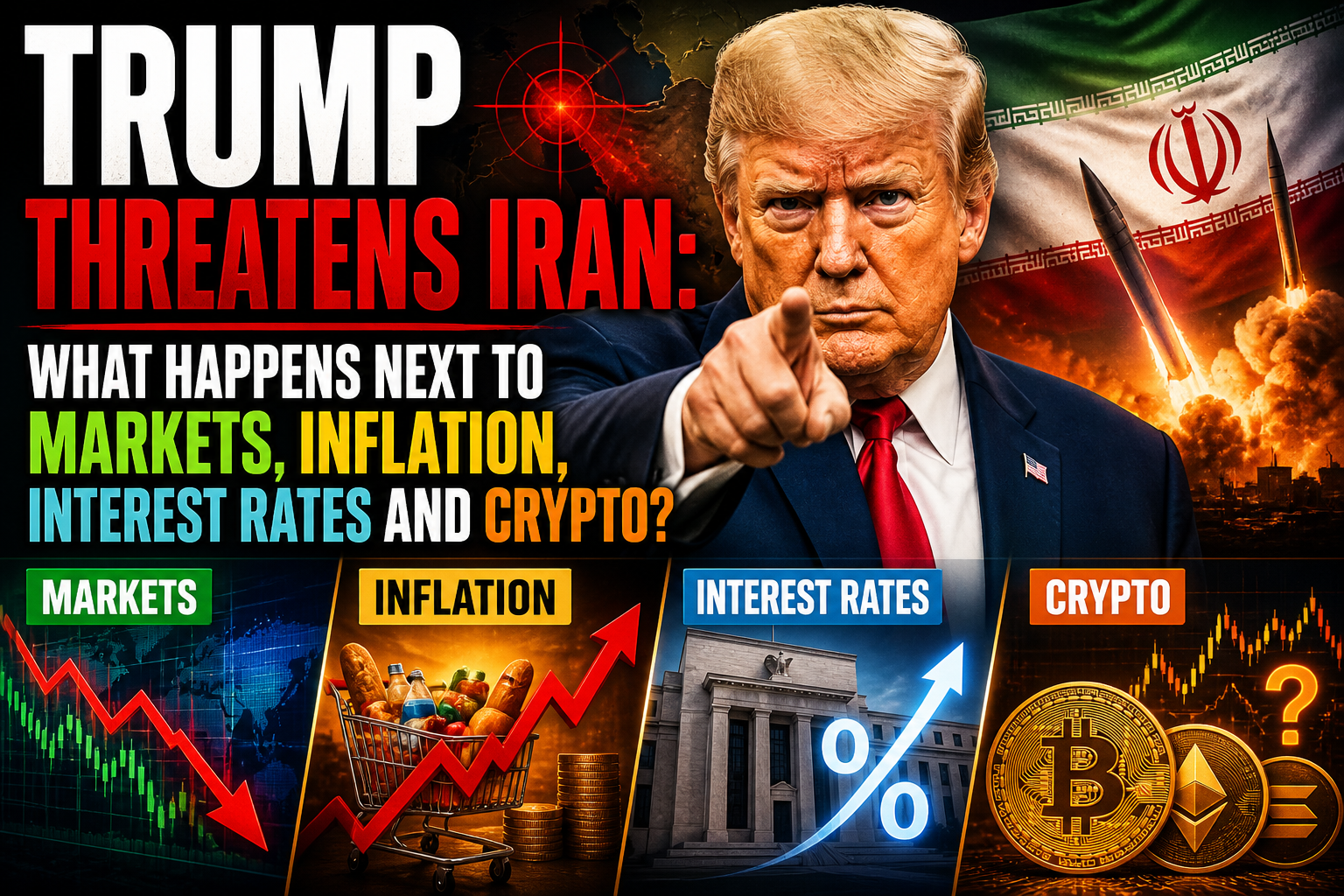
Breaking: Trump’s Threat Just Changed the Market Narrative Overnight
In moments like this, markets don’t just react they reprice reality.
Over the last 24 hours, the geopolitical tone has shifted from tension to something much more unstable. When Donald Trump warned that Iran could be “wiped off the face of the Earth,” it wasn’t just rhetoric designed for headlines. It was a signal one that forces investors to rethink probabilities.
From my perspective, this is exactly the kind of moment where markets lag behind risk. Not because investors are unaware, but because they are anchored to the previous narrative: that escalation would remain contained.
But that assumption is now fragile.
If you’ve spent enough time watching how markets behave during geopolitical transitions, you start to recognize a pattern. First, disbelief. Then, slow adjustment. And finally, a sudden repricing once the risk becomes undeniable.
What stands out to me right now is that we are still somewhere between the first and second phase. Markets are reacting but not decisively. And that’s where opportunity and danger coexist. Because when pricing is incomplete, moves tend to be more violent later.
Market Shock Incoming: What to Watch at the Open
When markets reopen, the real signal won’t come from headlines it will come from flows.
The first layer is always index futures. The S&P 500 doesn’t just reflect earnings expectations it reflects collective risk tolerance. A sharp gap down tells you fear is entering the system. But what matters more, in my experience, is what happens after the first hour of trading.
Does selling accelerate? Or do buyers step in aggressively?
That distinction separates panic from controlled repositioning.
Then there’s volatility specifically the VIX. In geopolitical shocks, volatility is not just a byproduct. It’s a transmission mechanism. Rising volatility forces funds to de-risk, which creates more selling, which pushes volatility even higher. It’s a feedback loop.
But the real heartbeat of this situation is oil.
The Strait of Hormuz is not just symbolic it’s structural. A disruption there is not a localized event. It’s a global macro shock. Roughly a significant portion of global oil flows through that corridor, and markets know it.
From what I’ve seen historically, oil doesn’t need an actual disruption it just needs a credible threat. Once that threshold is crossed, prices start incorporating a risk premium.
And that risk premium doesn’t stay isolated.
It spreads into:
- inflation expectations
- bond yields
- currency markets
And eventually, equities.
Bitcoin and gold add another dimension. Early in these events, capital doesn’t always behave rationally. Liquidity becomes king. Investors sell what they can, not necessarily what they want to.
That’s why you sometimes see everything drop at once even assets that are supposed to hedge risk.
But that phase doesn’t last forever.
My Personal Take: How I See Markets Opening Tomorrow
If I strip away the noise and focus on positioning, I see a market that is not fully prepared for escalation. And that shapes how I think about tomorrow.
Base Case: Controlled Panic
This is where I think we are heading initially. Markets open lower, but not in a disorderly way. Oil trends higher, volatility increases, and investors begin hedging more aggressively.
In my experience, this phase is deceptive. It feels manageable. It feels like markets are “handling it.”
But underneath, positioning is shifting. Funds reduce exposure. Risk managers tighten limits. Liquidity starts to thin out. It’s a transition phase not a resolution.
Worst Case: Full Escalation Pricing
If something escalates overnight a military response, disruption in shipping, or direct confrontation markets will not wait.
They will move fast. Equities could see sharp, broad-based selling. Oil could spike aggressively, not gradually. Volatility could jump to levels that force systematic funds to unwind positions. In this scenario, what matters most is not valuation it’s liquidity.
And liquidity disappears quickly in stressed environments.
Best Case: Relief Rally Nobody Expects
This is the scenario almost nobody positions for. If rhetoric cools or diplomatic signals emerge even weak ones markets can rebound sharply.
Why?
Because positioning becomes too defensive. I’ve seen this repeatedly: when fear builds quickly, even a small reduction in perceived risk triggers disproportionate upside.
That’s why I always think in probabilities, not predictions.
Inflation Is Back on the Table And Markets Are Underestimating It
This is, in my view, the most important second-order effect.
Energy is not just another sector it’s an input into everything.
When oil rises, it feeds into:
- transportation costs
- manufacturing inputs
- logistics chains
- consumer prices
But what makes inflation dangerous isn’t the first move it’s the persistence.
From what I’ve seen, markets consistently underestimate how quickly energy shocks can become embedded in the economy. Businesses adjust pricing strategies. Consumers change behavior. Wage dynamics start to shift.
And suddenly, what was expected to be a temporary spike becomes a structural issue.
If oil remains elevated, even for a few weeks, the inflation narrative could change materially. And markets are not positioned for that.
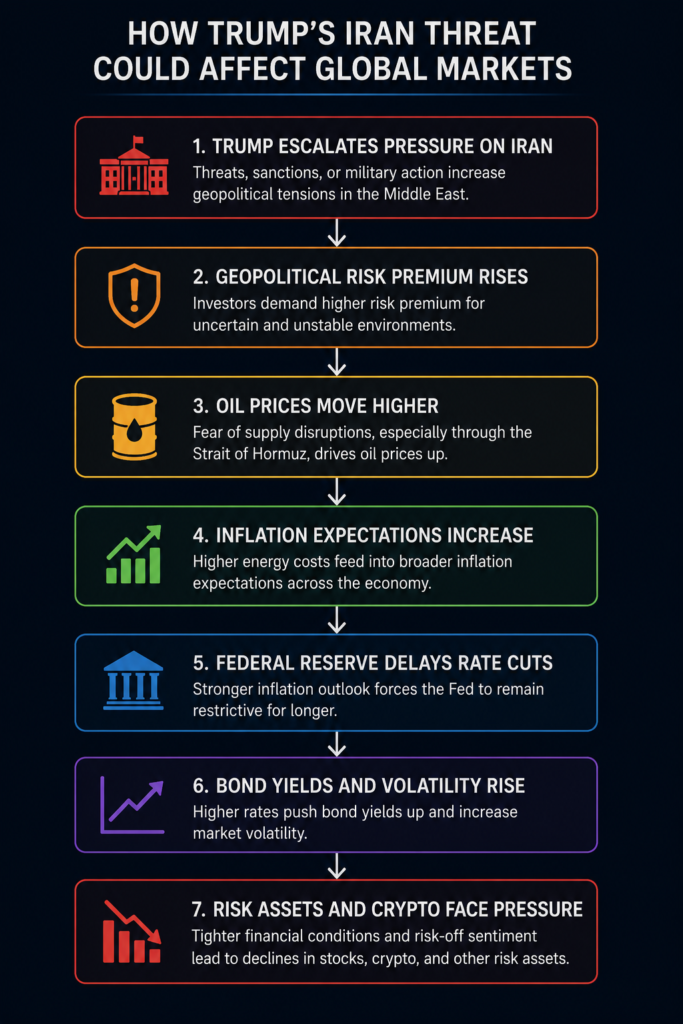
How Trump’s Iran Threat Could Affect Global Markets
The Fed Problem: Inflation vs Financial Stability
One of the biggest macroeconomic risks surrounding the Iran situation is not simply the geopolitical conflict itself, but how rising oil prices could complicate the Federal Reserve’s path over the coming months.
Energy prices remain one of the fastest transmission mechanisms into inflation expectations. When oil moves sharply higher, transportation costs, logistics expenses, manufacturing input prices and gasoline prices usually rise alongside it. That pressure can eventually spread into broader inflation readings across the economy.
This creates a difficult environment for the Federal Reserve.
If inflation expectations begin rising again because of higher energy prices, the Fed may become less willing to cut interest rates aggressively even if economic growth starts slowing down.
From a macro perspective, this is where the situation becomes especially fragile.
Markets had increasingly expected central banks to move toward a more dovish stance during 2026. However, a renewed oil shock could delay that transition and force policymakers to keep financial conditions tighter for longer than investors currently anticipate.
That scenario would likely create pressure across multiple areas of financial markets:
| Market Area | Potential Impact |
|---|---|
| Bonds | Higher yields and lower prices |
| Economic growth | Slower activity and weaker investment |
| Crypto markets | Reduced liquidity and higher volatility |
| Small-cap stocks | Greater pressure from expensive financing |
| Housing and credit | Higher borrowing costs |
| Risk assets overall | More defensive positioning |
The key problem is that central banks are effectively trapped between two competing objectives:
- controlling inflation
- preserving financial stability and growth
If rates remain elevated for too long, economic activity and liquidity conditions could deteriorate significantly. But if policymakers cut rates too early while inflation remains unstable, markets may lose confidence in the inflation-fighting credibility of central banks, potentially pushing long-term yields even higher.
From my perspective, this is why geopolitical oil shocks matter far beyond energy markets alone.
They directly affect:
- Inflation expectations.
- Monetary policy.
- Liquidity conditions.
- Investor sentiment.
- And ultimately the broader direction of financial markets.
Why Bitcoin Is Caught Between Liquidity and Fear
One of the biggest misconceptions surrounding Bitcoin is the idea that it always behaves like a traditional safe-haven asset during periods of geopolitical or financial stress. In reality, Bitcoin’s behavior is far more complex.
At times, BTC trades like a hedge against monetary instability, inflation and long-term currency debasement. But during acute periods of market stress especially when liquidity conditions tighten Bitcoin often behaves much more like a high-beta risk asset than a defensive one. That distinction is extremely important in the current macroeconomic environment.
From my perspective, Bitcoin today sits directly at the intersection of two powerful forces:
- Global liquidity.
- And investor fear.
And whichever force dominates usually determines BTC’s short-term direction.
Bitcoin Is Still Highly Dependent on Liquidity
Despite the narrative of Bitcoin as “digital gold,” the reality is that BTC remains deeply connected to global liquidity conditions. Over the last decade, Bitcoin’s largest bullish phases generally coincided with:
- Low interest rates.
- Quantitative easing.
- Abundant liquidity.
- Weaker dollar conditions.
- Aggressive risk-taking behavior across markets.
This is not a coincidence.
Bitcoin is still a relatively volatile and speculative asset compared to traditional safe havens such as gold or short-term government bonds. That means capital tends to flow aggressively into BTC during periods where investors feel comfortable taking risk and liquidity is abundant.
When central banks inject liquidity into the system, financial conditions loosen. Borrowing costs decline, speculative activity increases and investors become more willing to allocate capital toward higher-risk assets.
That environment historically benefits:
- Technology stocks.
- Growth assets.
- Venture capital.
- Altcoins.
- And Bitcoin itself.
In many ways, Bitcoin has increasingly become a liquidity-sensitive macro asset.
Why BTC Can Fall During Geopolitical Crises
One of the most misunderstood aspects of Bitcoin is that it does not always rise during periods of fear or geopolitical instability. In fact, during sudden market shocks, Bitcoin often falls alongside equities.
Why?
Because when markets enter a true “risk-off” environment, investors typically prioritize:
- Cash.
- Liquidity.
- Short-term safety.
- Lower volatility.
During those moments, market participants frequently reduce exposure to speculative assets across the board including crypto.
We saw similar dynamics during:
- The COVID liquidity crash in 2020.
- Aggressive Fed tightening cycles.
- Major banking stress periods.
- Geopolitical escalation events.
From my perspective, this happens because investors are not only reacting to fear itself. They are reacting to tightening liquidity conditions. And liquidity is one of the most important variables driving Bitcoin. If oil prices surge, inflation expectations rise and the Federal Reserve becomes less dovish, markets immediately begin anticipating tighter financial conditions for longer.
That creates pressure across:
- Equities.
- High-growth sectors.
- Speculative assets.
- Altcoins.
- And often Bitcoin itself.
This is why BTC can temporarily trade much more like a Nasdaq-style liquidity asset than a pure inflation hedge.
Bitcoin and the Federal Reserve Are More Connected Than Many Investors Realize
The relationship between Bitcoin and Federal Reserve policy has become increasingly important over recent years.
Markets closely monitor:
- Interest rates.
- Quantitative tightening.
- Balance sheet expansion.
- Liquidity injections.
- Treasury yields.
- Dollar strength.
Because all of those variables influence the availability and cost of capital globally.
When the Fed tightens policy aggressively:
- Liquidity contracts.
- Financing becomes more expensive.
- Risk appetite weakens.
- Leverage declines.
That environment tends to pressure Bitcoin. But the opposite is also true. If economic conditions deteriorate enough, central banks may eventually be forced to pivot back toward:
- Lower rates.
- Liquidity injections.
- Emergency support measures.
- Quantitative easing.
And historically, Bitcoin has reacted extremely aggressively whenever markets begin pricing future liquidity expansion.
The Long-Term Bullish Case Often Begins During Fear
Ironically, some of Bitcoin’s strongest long-term recoveries have started during periods of maximum fear and tightening conditions.
This is one reason why Bitcoin remains so psychologically difficult to trade.
Short term:
- Tighter liquidity hurts BTC.
- Fear pressures speculative assets.
- Volatility rises sharply.
But longer term:
- Monetary expansion.
- Debt monetization.
- Currency debasement.
- Liquidity injections.
Can become powerful bullish catalysts again.
From my perspective, this creates a highly asymmetric market structure. If central banks maintain restrictive policy longer than expected, Bitcoin could remain vulnerable to deeper corrections and liquidity-driven downside pressure. However, if financial conditions deteriorate enough to force future monetary easing, BTC could eventually recover extremely violently as liquidity returns to the system.
That is one reason why Bitcoin often experiences:
- Brutal corrections.
- Followed by explosive recoveries.
The same liquidity conditions that can destroy speculative positioning during tightening cycles can later fuel massive upside momentum once monetary policy reverses.
Bitcoin Is Increasingly Becoming a Macro Asset
Another important structural shift is that Bitcoin is no longer trading purely as an isolated crypto asset. Institutional adoption, ETFs, derivatives markets and macro fund participation have increasingly integrated BTC into the broader financial system.
As a result, Bitcoin now reacts much more directly to:
- Bond yields.
- Inflation expectations.
- Federal Reserve policy.
- Global liquidity.
- Geopolitical instability.
- Dollar strength.
From my perspective, understanding Bitcoin today requires understanding macroeconomics. Crypto no longer exists outside the financial system. It is becoming part of it. And that means BTC increasingly responds to the same liquidity cycles and policy expectations that drive broader global markets.
The Real Battle: Fear vs Future Liquidity
Ultimately, Bitcoin’s current market structure reflects a battle between two opposing forces.
On one side:
- Geopolitical fear.
- Inflation uncertainty.
- Tighter liquidity.
- Restrictive monetary policy.
On the other:
- Long-term monetary expansion.
- Future liquidity injections.
- Structural debt pressures.
- Declining confidence in fiat systems.
In the short term, fear can dominate. But over longer time horizons, liquidity has historically been the stronger force. And from my perspective, that tension is exactly what makes Bitcoin one of the most fascinating macro assets in the world today.
The Failed Three-Phase Plan: Why Diplomacy Just Broke Down
One of the most underappreciated aspects of this situation is the collapse of Iran’s proposed three-phase plan. While details are limited, the structure suggested a pathway toward de-escalation. The fact that it was rejected is critical.
Because diplomacy is not just about outcomes it’s about signaling. And right now, the signal is clear: Diplomatic channels are not functioning effectively.
From what I’ve seen in past conflicts, once diplomacy fails at this stage, escalation risk increases non-linearly. Not gradually but in jumps.
And markets tend to lag that realization.
Historical Patterns: What Iraq and Ukraine Teach Us About Tomorrow
Markets have memory.
During the Iraq War, the pattern was:
- Uncertainty → sell-off
- Clarity → rally
In Ukraine, the pattern was different:
- Shock → energy spike
- Inflation → prolonged macro impact
Today, we are somewhere in between.
There is uncertainty. But there is also a clear energy risk.
If I had to lean one way, I would say this situation has more in common with Ukraine particularly in how it could impact inflation dynamics. And that matters more for markets than short-term volatility.
Smart Money Playbook: How Capital Typically Repositions
Capital doesn’t panic it reallocates. In environments like this, money moves with purpose. Energy becomes attractive because of rising prices. Defense gains relevance due to increased demand expectations. Commodities benefit from inflation hedging.
At the same time, areas dependent on low rates and stable growth become vulnerable. Tech. High-growth equities. Speculative assets.
From my perspective, watching this rotation is key. Because it tells you how seriously markets are taking the situation.
Final Outlook: This Could Be the Start of a Bigger Shift
From my perspective, the biggest mistake investors can make is assuming geopolitical shocks remain isolated from the broader macroeconomic system. In today’s environment, oil, inflation, interest rates, bonds and crypto are increasingly connected.
What we’re seeing right now may not be a one-day event. It may be the beginning of a broader shift in how markets price geopolitical risk.
From everything I’m observing, the ingredients are there:
- Escalating rhetoric.
- Energy risk.
- Inflation pressure.
- Policy uncertainty.
The next 24–48 hours will matter. But the bigger story may unfold over weeks. And those are the environments where the biggest moves happen.
FAQs
Will markets crash if the US attacks Iran?
Not necessarily, but volatility and downside pressure would increase significantly.
Does war increase inflation?
Yes, especially through energy and supply chains.
What happens to interest rates?
Rate cuts may be delayed or repriced.
Is Bitcoin a safe haven?
Not immediately but potentially later.