
Global inflation is not just an economic statistic. It is one of the main forces shaping interest rates, currencies, commodities, stock valuations and even crypto cycles. When I look at markets, inflation is usually one of the first variables I check, because it changes the rules for almost every asset class.
In the United States, inflation has become especially important again. The Federal Reserve’s preferred inflation gauge, the PCE price index, rose 3.5% year over year in March 2026, while core PCE remained at 3.2%, according to Reuters. That matters because it keeps pressure on the Fed to stay cautious with interest rates instead of rushing into rate cuts.
At the global level, inflation is also proving harder to kill than many expected. The OECD reported that headline inflation across OECD countries was 3.4% in February 2026, broadly stable after months of decline. Meanwhile, the OECD’s March 2026 outlook said higher energy prices are likely to prolong global inflation, with G20 inflation projected at 4.0% in 2026 before easing in 2027.
What Is Global Inflation and Why Does It Matter?
Global inflation refers to the broad rise in prices across countries and regions. It does not mean every country has the same inflation rate. The U.S., the Euro Area, Japan, Turkey, Argentina and Brazil can all experience inflation differently depending on energy exposure, currency strength, wage growth, fiscal policy and central bank credibility.
The important thing is that inflation is connected globally. A rise in oil prices can affect transportation costs in the U.S., food prices in emerging markets, corporate margins in Europe and import prices in Asia. That is why I do not see inflation as one isolated number. I see it as a chain reaction.
For investors, inflation matters because it affects:
- Interest rates.
- Bond yields.
- Stock valuations.
- The U.S. dollar.
- Commodities.
- Consumer spending.
- Corporate profits.
- Crypto liquidity.
The key point is simple: markets do not only react to inflation. They react to what inflation forces central banks to do.
What Causes Global Inflation?
Global inflation is rarely caused by one single factor. In my view, the biggest mistake is blaming inflation only on oil, only on wages or only on central banks. The real picture is usually a combination of several forces.
Energy Prices and Commodity Shocks
Energy is one of the fastest ways inflation spreads through the economy. Oil, gasoline and natural gas affect transport, manufacturing, electricity, food production and consumer budgets.
The recent U.S. inflation acceleration was partly linked to higher gasoline prices, with Reuters reporting a sharp March 2026 increase in the PCE index driven by energy costs.
When energy rises, companies often face higher costs. Some absorb those costs, but many pass them on to consumers. That is how a commodity shock becomes consumer inflation.
Supply Chains and Deglobalization
Supply chain problems can also push prices higher. If shipping costs rise, if trade routes are disrupted or if companies move production closer to home, goods can become more expensive.
Deglobalization is especially important. For decades, globalization helped keep prices low by allowing companies to produce goods where costs were cheapest. If that process reverses, inflation may become more structural.
Wages and Services Inflation
Even when goods inflation slows, services inflation can stay sticky. Rent, healthcare, insurance, restaurants and labor-intensive services often depend heavily on wages.
This is why central banks care so much about core inflation. Core inflation excludes food and energy, but it can reveal whether price pressure is spreading deeper into the economy.
Fiscal Deficits and Government Spending
Government spending can support growth, but it can also add demand to an economy already facing supply constraints. Large fiscal deficits may also weaken confidence in a currency, especially in emerging markets.
In the U.S., fiscal policy matters because Treasury issuance, deficits and debt sustainability can influence bond yields. Higher yields then affect mortgages, corporate borrowing, equity valuations and risk appetite.
Currency Weakness
A weaker currency can make imports more expensive. This is especially painful for countries that import energy, food or technology.
The U.S. has an advantage because the dollar is the world’s reserve currency. But even in the U.S., dollar strength or weakness affects commodities, multinational profits and global liquidity.
Global Inflation by Country: Recent Inflation Rates Table
Inflation is not evenly distributed across the world. Some countries are close to central bank targets, while others still face serious price pressure.
The table below uses recent reported or estimated inflation figures from sources such as the IMF, OECD and Trading Economics. Values can change quickly, so this should be treated as a snapshot, not a permanent ranking. The IMF’s April 2026 database lists annual average consumer-price inflation estimates, while Trading Economics compiles recently reported national inflation data.
| Country / Region | Recent Inflation Rate | Reference Period / Type | Quick Reading |
|---|---|---|---|
| United States | 3.3% CPI / 3.5% PCE | Mar. 2026 | Inflation is still above the Fed’s 2% target |
| United Kingdom | 3.3% | Mar. 2026 | Sticky inflation remains a policy problem |
| Euro Area | Around 2.6% projected average | 2026 ECB baseline | Closer to target, but energy risk remains |
| Japan | Around 3% range | Recent trend | Inflation is meaningful after years of low prices |
| China | Low inflation / weak demand pressure | Recent trend | More disinflationary than inflationary |
| India | Moderate inflation | Recent trend | Food and energy remain important drivers |
| Brazil | Mid-single-digit area | Recent trend | Central bank policy remains relevant |
| Mexico | Moderate inflation | Recent trend | Rate policy and currency matter |
| Canada | Around 2–3% area | Recent trend | Closer to target than the U.S. |
| Australia | 4.6% | Mar. 2026 | Inflation pressure still elevated |
| Turkey | 30.87% | Mar. 2026 | Very high inflation remains a major issue |
| Argentina | Very high inflation | Recent trend | Currency and fiscal credibility are central |
This table is useful because it shows one of the most important truths about global inflation: the world does not experience inflation equally. The U.S. problem is not the same as Turkey’s problem, Argentina’s problem or China’s problem.
Why Inflation Has Become Structural Again
One of the biggest mistakes markets made over the last few years was assuming inflation would quickly return to pre-pandemic norms.
From my perspective, inflation is no longer driven solely by temporary supply shocks or short-term demand distortions. The global economy itself is becoming structurally more inflationary.
Several powerful forces are now working simultaneously:
- Geopolitical fragmentation.
- Reshoring of supply chains.
- Energy transition investment.
- Persistent labor shortages.
- Rising debt levels.
- And increasing commodity volatility.
All of these trends reduce efficiency and increase costs across the global economy.
For decades, globalization helped suppress inflation by lowering production costs and expanding global supply chains. But the world is now moving toward a more fragmented economic system where resilience and security are increasingly prioritized over pure efficiency.
That transition is expensive.
Governments and corporations are rebuilding supply chains, increasing strategic inventories and investing heavily in domestic manufacturing capacity. While these shifts may improve long-term resilience, they also create upward pressure on prices.
Energy is another major factor.
The transition toward cleaner energy systems requires massive infrastructure investment in:
- Electricity grids.
- Copper.
- Lithium.
- Uranium.
- Semiconductors.
- And industrial metals.
This creates an environment where commodity cycles may become structurally tighter. At the same time, aging populations and labor shortages in developed economies continue placing pressure on wages and services inflation.
From a macro perspective, this is why inflation may remain more persistent and volatile than many markets still expect. And if inflation proves harder to control, central banks may be forced to keep interest rates elevated for much longer than investors currently anticipate.
How Global Inflation Impacts Financial Markets
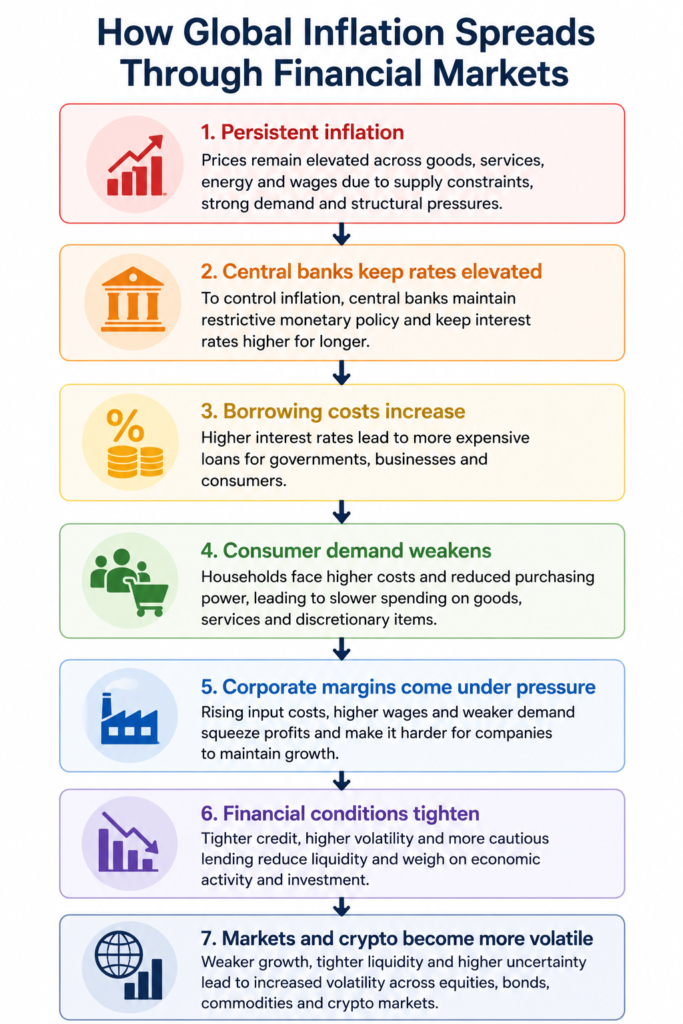
Inflation acts like a market filter. When inflation is low and stable, investors can focus more on growth, earnings and innovation. When inflation is high or unpredictable, the market starts obsessing over central banks, bond yields and real rates.
Stocks: Valuations, Earnings and Risk Appetite
Inflation can hurt stocks in several ways.
First, higher inflation can lead to higher interest rates. Higher rates reduce the present value of future earnings, which is especially painful for growth stocks.
Second, inflation can pressure margins. If companies face higher wages, energy costs or input prices, they either raise prices or accept lower profits.
Third, inflation can weaken consumers. If households spend more on food, fuel and rent, they may spend less on discretionary goods.
That said, not all stocks react the same way. Energy companies, commodity producers and firms with strong pricing power may perform better in inflationary environments.
Bonds: Yields, Duration and Real Rates
Bonds are directly affected by inflation. If inflation rises, investors usually demand higher yields to compensate for the loss of purchasing power.
Long-duration bonds are especially vulnerable because their cash flows are further in the future. When yields rise, bond prices fall.
The most important variable is often the real yield: the nominal yield minus expected inflation. Real yields matter because they influence the attractiveness of cash, bonds, gold and crypto.
Currencies: Why the Dollar Matters
The U.S. dollar plays a central role in global inflation. Many commodities are priced in dollars. When the dollar strengthens, commodities can become more expensive for non-U.S. buyers. When the dollar weakens, global liquidity often improves.
For crypto, emerging markets and commodities, the dollar is one of the most important macro variables. A strong dollar often tightens financial conditions globally.
Emerging Markets and Capital Flows
Emerging markets are often more sensitive to inflation because they may depend more on imported energy, imported food or foreign capital.
When U.S. rates rise, capital can flow out of emerging markets and into dollar assets. That can weaken local currencies and make inflation worse.
This is why U.S. inflation is not just a U.S. issue. The Fed’s response to U.S. inflation can affect the entire world.
How Inflation Affects Commodities
Commodities are often where inflation becomes visible first. Oil, gas, copper, gold and food prices can tell us a lot about the pressure building inside the global economy.
Oil and Natural Gas
Oil is one of the most important inflation drivers because it affects transportation, plastics, chemicals, airlines, logistics and consumer gasoline prices.
When oil rises sharply, headline inflation usually reacts quickly. That does not always mean core inflation will rise immediately, but if energy remains high long enough, second-round effects can appear.
Gold as an Inflation Hedge
Gold is traditionally seen as an inflation hedge, but its relationship with inflation is more complex than many people think.
Gold often performs well when investors lose confidence in fiat currencies, real yields fall or geopolitical risk rises. But if inflation causes central banks to raise rates aggressively and real yields rise, gold can face pressure.
So gold is not just an inflation trade. It is also a real-yield, dollar and confidence trade.
Copper and Industrial Metals
Copper is linked to global growth, construction, electrification and manufacturing. If inflation comes with strong demand, copper can benefit. But if inflation triggers a slowdown or recession, industrial metals can suffer.
That is why commodities do not all move together. Oil inflation, gold inflation and copper inflation can tell different stories.
Food Prices and Social Pressure
Food inflation is politically sensitive. Rising food prices hit lower-income households hardest and can create social pressure, especially in emerging markets.
Climate shocks, fertilizer costs, energy prices and currency weakness can all affect food inflation.
Inflation and Crypto Markets
Crypto deserves its own section because it is often misunderstood in inflation discussions.
A common argument says Bitcoin is a hedge against inflation because its supply is limited. There is some logic there, but in practice, Bitcoin does not always rise when inflation rises.
In my view, crypto reacts less to inflation itself and more to what inflation forces central banks to do.
Is Bitcoin Really an Inflation Hedge?
Bitcoin has a fixed supply schedule, which makes it attractive to people worried about currency debasement. Over the long term, that narrative matters.
But in the short and medium term, Bitcoin often behaves like a liquidity-sensitive risk asset. When inflation rises and central banks become hawkish, liquidity tightens. That can hurt Bitcoin, Ethereum and altcoins.
So the better question is not only:
“Is Bitcoin an inflation hedge?”
The better question is:
“What are inflation, real rates, dollar strength and global liquidity doing at the same time?”
Why Liquidity and Real Rates Matter More Than Headline CPI
If inflation rises but central banks stay loose, crypto may benefit from liquidity. If inflation rises and central banks raise rates, crypto may suffer.
That is why headline CPI or PCE alone is not enough. Crypto investors should also watch:
- Real yields.
- Fed policy.
- Dollar strength.
- Liquidity conditions.
- Risk appetite.
- ETF flows.
- Stablecoin supply.
Ethereum, Stablecoins and Risk Assets
Ethereum and other crypto assets are usually even more sensitive to risk appetite than Bitcoin. When liquidity improves, investors may move further out on the risk curve. When liquidity tightens, they usually become more defensive.
Stablecoins are also important because they act as a bridge between fiat money and crypto liquidity. If stablecoin supply expands, it can signal more capital available inside crypto markets.
Central Banks and Global Inflation
Central banks are the main actors in the inflation story. They do not control every cause of inflation, but they control the price of money.
The Federal Reserve, European Central Bank, Bank of England and other central banks are all trying to balance the same problem: reduce inflation without crushing growth.
The Federal Reserve’s Position
The Fed’s challenge is clear. Inflation is still above target, and the latest PCE data gives policymakers less room to cut rates aggressively. Reuters reported that the Fed may keep rates in the 3.50%–3.75% range despite inflation pressure.
For markets, this matters enormously. If the Fed sounds hawkish, bond yields can rise, the dollar can strengthen and risk assets can struggle. If the Fed signals future cuts, stocks and crypto may rally.
The European Central Bank’s Position
The ECB’s March 2026 bulletin projected headline inflation at 2.6% in 2026, 2.0% in 2027 and 2.1% in 2028 in its baseline.
That suggests Europe may be closer to its inflation target than the U.S., but the region remains vulnerable to energy shocks, weak growth and geopolitical risks.
Bank of England, Bank of Japan and Emerging Markets
The Bank of England still faces sticky inflation pressure, especially in wages and services. Japan is in a different situation because inflation has returned after decades of very low price growth.
Emerging market central banks often have to react faster and more aggressively because currency weakness can quickly feed into inflation.
Why Communication Moves Markets
Central banks do not only move markets through rate decisions. They move markets through language.
Sometimes the message matters almost as much as the decision itself. A central bank can hold rates steady but sound hawkish. Or it can cut rates while warning that inflation risks remain.
Markets listen to every word because policy expectations drive yields, currencies and risk appetite.
Global Inflation Outlook: What Could Happen Next?
There are three main scenarios.
Scenario 1: Inflation Falls Slowly
This is the soft-landing scenario. Inflation gradually moves lower, central banks cut rates carefully and growth remains positive.
For markets, this would probably be the most constructive outcome. Stocks could benefit, bonds could stabilize and crypto could see better liquidity conditions.
Scenario 2: Inflation Reaccelerates
This is the risk markets fear. Inflation rises again because of energy shocks, tariffs, wages, fiscal deficits or geopolitical tension.
In this scenario, central banks may delay rate cuts or even consider more tightening. That would be difficult for bonds, growth stocks and crypto.
Scenario 3: Stagflation Returns
Stagflation means weak growth and high inflation at the same time. This is the hardest environment for policymakers.
In stagflation, central banks cannot easily cut rates because inflation is too high, but they also cannot tighten too much because growth is weak.
Gold and some commodities may do better in this environment, while equities and long-duration bonds may struggle.
How Investors Can Think About Global Inflation
I treat inflation as a market regime, not just a number.
When inflation is low and stable, risk assets can trade mostly on growth and liquidity. When inflation is high or volatile, everything changes: discount rates, earnings expectations, bond yields, central bank language and investor psychology.
For investors, the key is not to predict every inflation print perfectly. The key is to understand what inflation changes.
Watch:
- U.S. PCE and CPI,
- core inflation,
- oil and gasoline prices,
- wage growth,
- Treasury yields,
- real yields,
- the U.S. dollar,
- gold,
- Bitcoin,
- Fed communication.
Global inflation is not just about the cost of living. It is about the cost of money.
Conclusion
Global inflation remains one of the most important forces in the world economy, and the U.S. is still at the center of the story. With U.S. PCE inflation at 3.5% year over year in March 2026 and core PCE at 3.2%, the Federal Reserve has a strong reason to stay cautious.
The market impact goes far beyond consumer prices. Inflation affects stocks, bonds, commodities, currencies and crypto. It changes how central banks communicate. It changes how investors value risk. It changes how capital moves around the world.
My main view is this: inflation is not just an economic indicator. It is a market regime. And when that regime changes, every investor needs to pay attention.
FAQs About Global Inflation
What causes global inflation?
Global inflation can be caused by energy prices, supply chain disruptions, wage growth, fiscal deficits, currency weakness, tariffs, geopolitical shocks and strong demand.
How does inflation affect markets?
Inflation affects markets by changing interest-rate expectations, bond yields, corporate margins, consumer spending and risk appetite.
Does inflation help or hurt commodities?
It depends on the commodity. Oil and food can drive inflation higher, gold may benefit from currency or confidence concerns, and copper depends heavily on global growth.
Is Bitcoin a good hedge against inflation?
Bitcoin can be seen as a long-term hedge against currency debasement because of its fixed supply, but in the short term it often behaves like a liquidity-sensitive risk asset.
How do central banks fight inflation?
Central banks usually fight inflation by raising interest rates, keeping policy restrictive, reducing liquidity and managing inflation expectations through communication.
Why does U.S. inflation matter globally?
U.S. inflation matters globally because it influences Federal Reserve policy, the U.S. dollar, Treasury yields, global liquidity and capital flows into emerging markets and risk assets.