
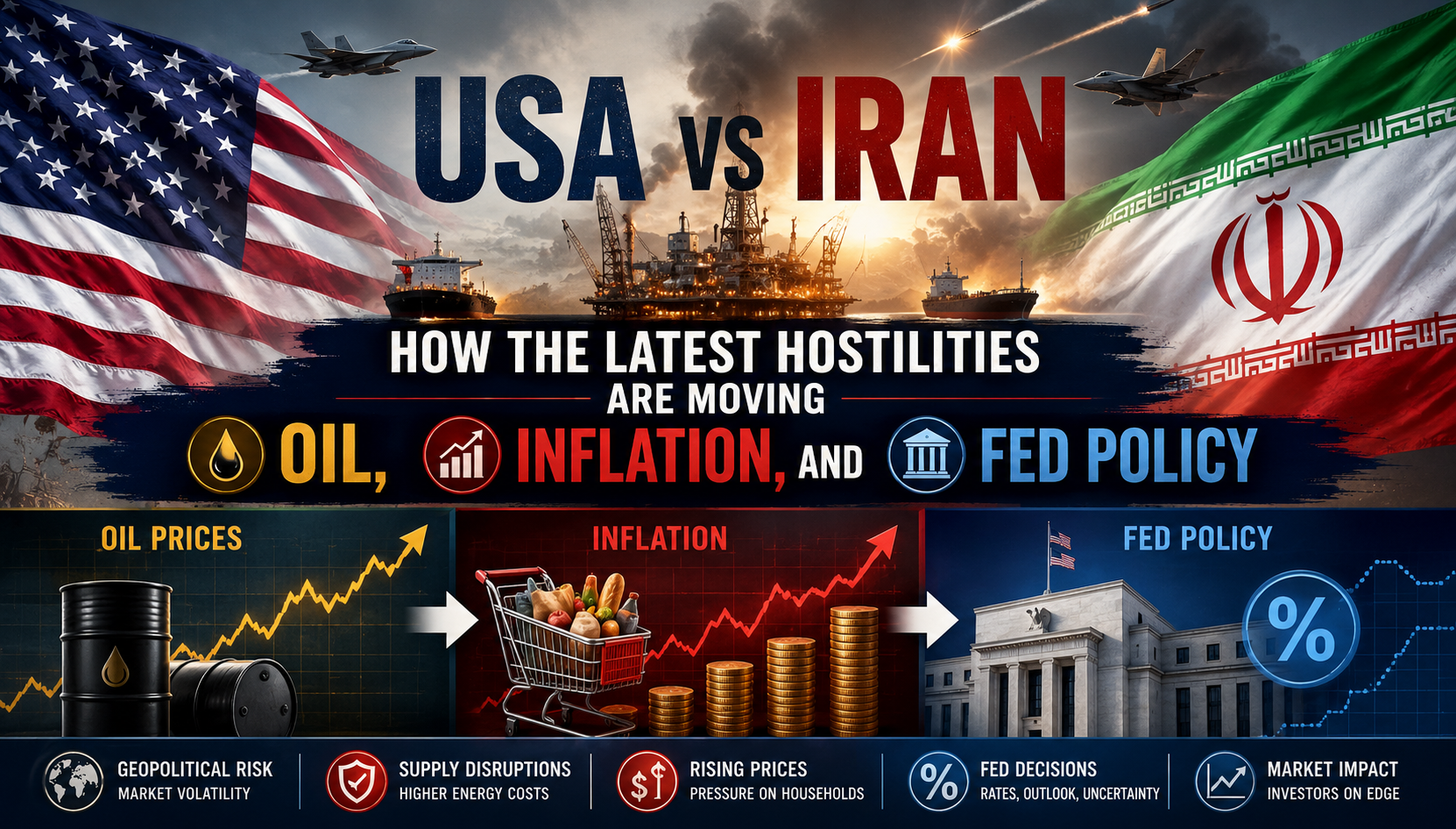
When I look at the latest USA vs Iran headlines, I’m not just watching the military or diplomatic side of the story. I’m watching the macro chain reaction: oil prices, inflation expectations, Federal Reserve policy, bond yields, the dollar, and eventually the U.S. consumer.
That is the real economic question right now. Not just whether Washington and Tehran can reach a deal, but whether the latest hostilities are turning into a longer-lasting oil shock.
The market has already started to price that risk. Brent crude recently settled above $104 a barrel, while U.S. West Texas Intermediate closed near $98 after President Donald Trump said the ceasefire with Iran was “on life support.” That move came after oil had previously fallen on hopes of a possible peace deal, showing how sensitive crude prices are to every diplomatic signal around the conflict.
In my view, this is where the story becomes much bigger than geopolitics. If oil stays high for a few sessions, markets can absorb it. If oil stays high for weeks or months, the Federal Reserve has a very different problem.
Why USA vs Iran Is Now a Macroeconomic Story
The USA vs Iran conflict matters economically because Iran sits close to one of the most important energy chokepoints in the world: the Strait of Hormuz. Any disruption there affects not only crude oil prices, but also shipping costs, insurance premiums, refined fuel markets, and inflation expectations.
That is why I would not treat this as a simple “risk-on, risk-off” market event. The key issue is persistence. A short spike in oil prices can look dramatic on a chart, but central banks usually try to look through temporary energy shocks. A longer oil shock is different. It can move into gasoline prices, transportation costs, business margins, consumer confidence, and eventually monetary policy.
The U.S. government is already responding through energy-market tools. The Trump administration announced a loan of 53.3 million barrels of crude from the Strategic Petroleum Reserve to energy companies as part of a broader attempt to stabilize markets affected by the Iran conflict and disruptions around Hormuz.
That tells me policymakers are not looking at this as just another foreign-policy headline. They are trying to prevent a geopolitical shock from becoming an inflation shock.
What Is Happening to Oil Prices?
Oil has become the cleanest market signal in the USA-Iran conflict.
After renewed tension around the peace proposal, Brent crude moved back above $100 per barrel, with Reuters reporting Brent at $104.21 and WTI at $98.07. A few days earlier, oil had dropped sharply on optimism that the U.S. and Iran were moving toward a peace deal, with Brent settling at $101.27 and WTI at $95.08.
That kind of price action tells me the oil market is no longer trading only supply and demand. It is trading diplomacy.
If negotiations improve, crude sells off. If Trump rejects Iran’s response or the Strait of Hormuz remains at risk, crude rallies again. This is classic geopolitical risk premium: traders are paying more for oil not only because of current supply losses, but because of what could happen next.
And that matters for the U.S. economy because oil is not just another commodity. It feeds directly into gasoline, diesel, jet fuel, freight, plastics, chemicals, agriculture, and consumer psychology.
How the USA-Iran Conflict Moves Through the U.S. Economy
Here is the macro transmission mechanism I’m watching:
| Macro channel | What to watch | Why it matters | Potential U.S. impact |
|---|---|---|---|
| Oil prices | Brent crude, WTI crude, geopolitical risk premium | Oil is usually the first asset to react to Middle East tension | Higher gasoline prices, higher business costs, renewed inflation pressure |
| Inflation | CPI, PCE, gasoline, transportation costs | Energy shocks can lift headline inflation quickly | The Fed may delay rate cuts if inflation looks persistent |
| Federal Reserve | FOMC statements, Fed speeches, dot plot | The Fed reacts to persistence, not just one-day oil moves | Monetary policy may stay tighter for longer |
| U.S. dollar | Dollar Index, safe-haven demand | The dollar often benefits during geopolitical stress | Stronger dollar, pressure on emerging markets |
| Bonds | 10-year Treasury yield, breakeven inflation | Bonds price growth, inflation, and risk | Higher volatility in yields and rate expectations |
| Stocks | Energy, airlines, transport, consumer discretionary | Sectors react differently to higher oil | Energy may outperform while transport and consumers weaken |
| Consumer | Gas prices, confidence, disposable income | Gasoline is one of the most visible inflation signals | Lower confidence and less discretionary spending |
| Supply chains | Shipping, insurance, Hormuz risk | The shock is not only oil production, but movement of oil | Higher logistics costs and margin pressure |
The way I see it, the Fed does not need to panic over one oil spike. But it cannot ignore a sustained one.
That distinction is crucial.
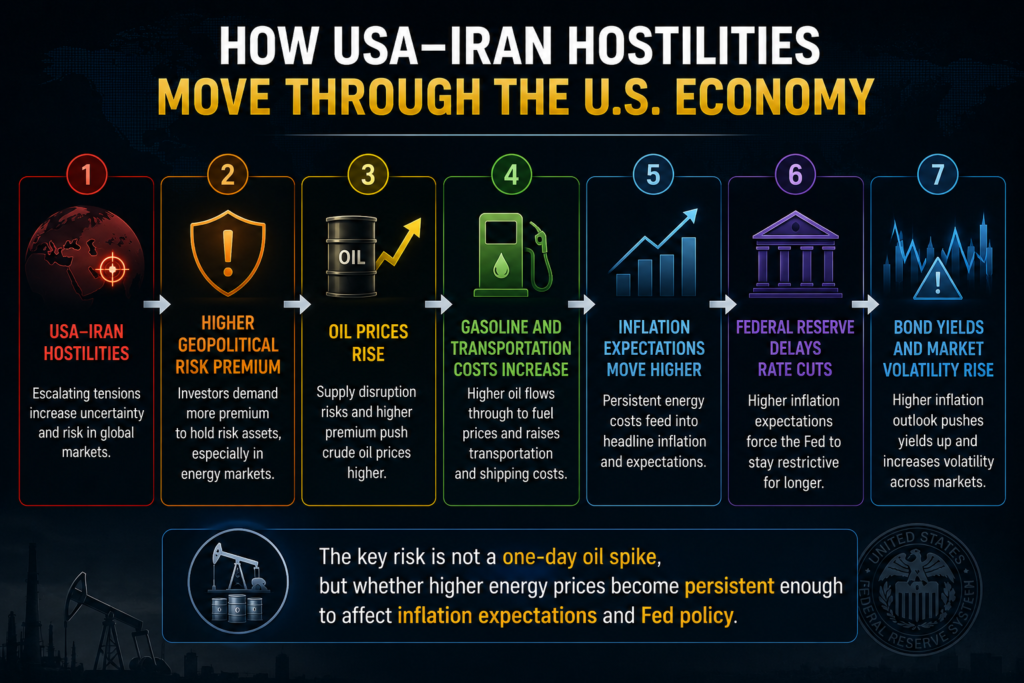
The key risk is not a one-day oil spike, but whether higher energy prices become persistent enough to affect inflation expectations and Fed policy.
When Will the Fed Feel the Impact?
The Fed will not change policy because oil jumps for one day. The real impact shows up through a sequence:
First, oil prices rise. Then gasoline prices follow. Then headline inflation data picks it up. Then consumers and businesses start adjusting expectations. Then the Fed responds through language, projections, or policy.
So the effect on monetary policy is not immediate. It usually appears over weeks and months, especially through CPI, PCE inflation, market-based inflation expectations, and Fed communication.
The Federal Reserve’s own financial stability work has already flagged the issue. Its May 2026 Financial Stability Report said market contacts most frequently cited geopolitical risks, an oil shock, AI risks, private credit, and persistent inflation as key risks to U.S. financial stability.
That is important because it shows the Fed is not blind to the oil channel. Even if policymakers do not instantly hike rates or cancel future cuts, they are watching whether the conflict creates a more persistent inflation problem.
In my opinion, the Fed’s first reaction would probably be verbal, not mechanical. Instead of saying “we are hiking because of Iran,” officials are more likely to say they need more confidence that inflation is moving sustainably lower.
Translation: rate cuts get harder when oil stays high.
Three Scenarios for Oil, Inflation, and Fed Policy
Scenario 1: Contained Conflict
This is the mildest scenario. The conflict remains tense, but diplomacy prevents a major escalation. Oil keeps a geopolitical premium, but prices do not spiral higher.
In this case, Brent and WTI may stay volatile, but the Fed can probably look through part of the shock. Gas prices may rise, but the effect on inflation could remain manageable if the conflict does not worsen.
This is my base case if negotiations keep moving, even slowly. The market can live with uncertainty. What it hates is disruption.
For the Fed, this scenario likely means caution. Rate cuts may not be completely off the table, but policymakers would want to see whether higher energy prices are temporary.
Scenario 2: Prolonged Oil Shock
This is the scenario I would watch most closely.
A prolonged oil shock does not need to look dramatic every single day. It becomes dangerous because it quietly moves through the entire economy. Higher crude becomes higher gasoline. Higher gasoline becomes weaker consumer confidence. Higher transport costs become margin pressure. Eventually, inflation expectations may become harder to control.
Reuters has reported that Fed-related analysis and market commentary are already focused on the inflation risk from the Iran war and oil disruption, including scenarios where headline inflation could rise meaningfully if global oil trade remains disrupted.
This is where the Fed becomes more constrained. If growth slows but inflation rises, policymakers face a stagflation-style dilemma: cutting rates could support growth, but it could also worsen inflation expectations.
That is the uncomfortable macro setup.
Scenario 3: Strait of Hormuz Escalation
For me, the real red line is Hormuz.
If the market starts pricing serious disruption in the Strait of Hormuz, the USA vs Iran story stops being mainly geopolitical and becomes an inflation story very quickly.
The reason is simple: Hormuz is a critical route for global energy flows. When that route is threatened, the market does not wait for official inflation data. It reprices risk immediately.
In this scenario, oil could maintain a much higher risk premium. Gasoline prices would likely become more politically sensitive in the U.S. The dollar could strengthen as a safe-haven asset. Stocks could struggle outside the energy sector. Bond yields could become more volatile as investors try to price both weaker growth and higher inflation.
This is the scenario where the Fed’s job becomes hardest.
What I’m Watching Next
I would not focus only on the next headline from Washington or Tehran. For a macro read, I would track a dashboard:
- Brent crude and WTI crude.
- U.S. gasoline prices.
- The 10-year Treasury yield.
- Market-based inflation expectations.
- Fed speeches.
- CPI and PCE inflation.
- Any change in the Strategic Petroleum Reserve strategy.
- Shipping and insurance costs around the Strait of Hormuz.
- The U.S. dollar.
- Energy, airline, transport, and consumer discretionary stocks.
The most important signal is not whether oil moves up or down in one session. It is whether the market starts treating $100 oil as temporary or normal.
That is the difference between a scare and a macro regime shift.
What This Means for Investors and Consumers
For investors, the USA vs Iran conflict creates sector rotation. Energy stocks can benefit from higher crude prices, while airlines, logistics, travel, and consumer discretionary companies may face pressure from higher fuel costs.
For consumers, the first visible impact is gasoline. Higher pump prices affect psychology quickly because people see them every week. Even if core inflation stays more stable, gasoline can change how households feel about the economy.
That is why oil shocks are politically powerful. They hit the consumer directly.
From a personal standpoint, I would not overreact to every headline. But I would take the oil signal seriously. If crude remains elevated and gasoline follows, the conversation around Fed policy could change fast.
Can the Fed Still Cut Rates?
Yes, but the bar gets higher.
If inflation data stays calm and oil prices retreat, the Fed can keep future rate cuts alive. But if oil stays high, gasoline rises, and inflation expectations move up, the Fed has less room to ease.
The market has already started to adjust to that possibility. Reuters reported that earlier optimism around a reopened Strait of Hormuz and falling oil prices had boosted bets that the Fed could resume rate cuts later, but policymakers remained cautious because of inflation risks.
That is exactly how I would frame it: the Fed is not reacting to Iran alone. It is reacting to whether Iran changes the inflation path.
Conclusion
The USA vs Iran conflict is no longer just a military or diplomatic story. It is a macroeconomic story moving through oil, inflation, the dollar, bonds, equities, consumer confidence, and Federal Reserve policy.
My main takeaway is simple: the Fed will not respond to headlines. It will respond to persistence.
If oil spikes and then falls, the macro damage may be limited. If oil stays elevated because the Strait of Hormuz remains under pressure, the U.S. economy could face a more difficult mix of higher inflation and slower growth.
That is why I’m watching oil first, inflation second, and Fed language third.
The conflict may begin with geopolitics, but the real U.S. impact will show up at the gas pump, in inflation data, and eventually in the Fed’s next policy decisions.
FAQs
Will USA vs Iran raise gas prices?
It can. If the conflict keeps oil prices elevated, gasoline prices in the U.S. are likely to face upward pressure. The effect depends on how long crude prices remain high and whether refining, shipping, or inventory conditions worsen.
Can the Iran conflict delay Fed rate cuts?
Yes. The Fed may delay rate cuts if higher oil prices feed into inflation data or inflation expectations. A short-term oil spike may not be enough, but a prolonged shock could make the Fed more cautious.
Why does the Strait of Hormuz matter for oil prices?
The Strait of Hormuz is one of the world’s most important energy transit routes. If markets fear disruption there, oil prices can rise quickly because traders price in potential supply shortages and higher shipping risks.
Is this conflict inflationary for the U.S.?
It can be inflationary, mainly through energy. Higher crude oil can raise gasoline, diesel, freight, and production costs. The key question is whether the shock remains temporary or becomes persistent.
What indicators should I watch next?
Watch Brent crude, WTI crude, U.S. gasoline prices, CPI, PCE inflation, the 10-year Treasury yield, Fed speeches, the dollar, and any news related to the Strait of Hormuz or the Strategic Petroleum Reserve.