

Gold returns to the center of global macroeconomic analysis as inflation, geopolitical fragmentation and financial uncertainty reshape investor behavior
Gold has once again become one of the most important assets in global financial markets after reaching new all-time highs during April 2026. But what makes this rally especially important is not simply the price level itself.
It is the macroeconomic environment in which these highs are taking place.
Unlike previous gold cycles that were largely driven by one dominant factor, the current rally appears to be supported by several overlapping structural forces at the same time: persistent inflation, geopolitical fragmentation, sovereign debt concerns, central bank accumulation and growing uncertainty around the long-term stability of the global monetary system.
From my perspective, this is one of the reasons why gold’s behavior in 2026 feels fundamentally different from many previous rallies. Markets are no longer viewing gold simply as a short-term defensive trade.
Increasingly, it is being treated as a strategic asset inside a world that is becoming more volatile, more fragmented and less predictable.
That raises a critical question for investors: after reaching record highs, is gold becoming overextended, or is the market entering a new structural phase where gold regains long-term monetary relevance?
Why Gold Is Rising Again
One of the most important drivers behind gold’s strength has been inflation.
Although headline inflation moderated in some economies during early 2026, core inflation remained stubbornly elevated in several major regions. Investors increasingly realized that inflation was not disappearing as quickly as central banks had hoped.
This matters because inflation gradually erodes purchasing power and weakens confidence in fiat currencies over time.
Historically, gold performs best when investors begin questioning the long-term stability of paper currencies or when real interest rates remain relatively low compared to inflation.
From my perspective, gold acts not only as a hedge against inflation but also as a psychological form of financial insurance during periods of uncertainty.
And importantly, today’s inflation environment is not purely cyclical.
Part of the inflation pressure appears increasingly structural, driven by:
- Geopolitical fragmentation.
- Supply-chain reorganization.
- Energy insecurity.
- Labor market pressures.
- Industrial reshoring.
- Rising infrastructure investment.
That creates a much stronger long-term foundation for gold demand than a temporary inflation spike alone.
Why Gold Is Rising Again
Gold tends to perform strongly when inflation pressures persist and confidence in traditional monetary systems weakens.
Geopolitical Fragmentation Is Strengthening Gold’s Role
Another major factor behind gold’s rally in April 2026 was the increasing geopolitical fragmentation visible across the global economy. Conflicts, trade tensions and shifting alliances were already creating instability across:
- Energy markets.
- Supply chains.
- Global trade.
- Financial flows.
This environment naturally increases demand for neutral assets. And gold’s neutrality remains one of its strongest advantages.
Unlike sovereign bonds or fiat currencies, gold is not directly tied to the financial condition or political decisions of any single country. That makes it especially attractive during periods where geopolitical trust begins deteriorating.
From my perspective, this is one of the biggest structural shifts happening in markets right now. Investors, sovereign wealth funds and central banks are increasingly searching for assets capable of preserving value independently from geopolitical fragmentation.
Gold fits that role exceptionally well.
Why Investors Turn to Gold During Uncertainty
| Macroeconomic Risk | Why Gold Benefits |
|---|---|
| Inflation | Protects purchasing power |
| Geopolitical tensions | Neutral global asset |
| Currency instability | Alternative store of value |
| Financial market volatility | Defensive positioning |
| Sovereign debt concerns | Independent from governments |
| Banking stress | No counterparty risk |
Gold increasingly benefits when investors seek stability outside traditional financial systems.
Slower Growth and Debt Concerns Also Matter
Another important theme supporting gold in April 2026 was growing concern around global growth momentum.
Several economies were already showing signs of slower activity due to:
- Restrictive monetary policy.
- Weaker consumer demand.
- Elevated borrowing costs.
- Tighter credit conditions.
At the same time, sovereign debt levels remained historically high.
This combination creates a fragile macroeconomic environment because central banks face growing difficulty balancing:
- Inflation control.
- Financial stability.
- Economic growth.
From my perspective, gold becomes especially attractive in environments where investors lose confidence in the long-term sustainability of fiscal and monetary policy simultaneously. That is increasingly what markets were beginning to fear during April 2026.
Gold and the Macro Stress Cycle
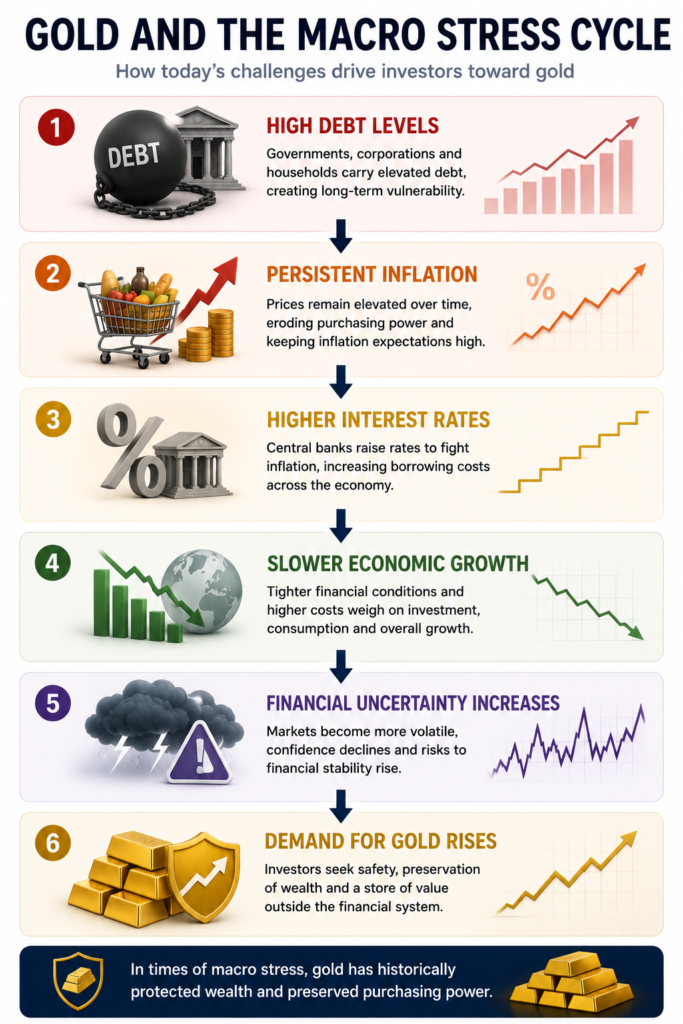
Gold often strengthens during periods of combined inflation, debt stress and economic uncertainty.
What Happens After Gold Reaches Record Highs?
One of the biggest questions after gold hits new highs is whether the market is approaching exhaustion or entering a new long-term cycle.
Historically, gold rarely moves in a straight line after reaching major peaks. Most large gold cycles tend to evolve through several phases: strong momentum, speculative enthusiasm, consolidation and eventual repositioning based on broader macroeconomic conditions.
Importantly, consolidation should not automatically be interpreted as weakness. Very often, periods of sideways trading help stabilize markets after strong rallies by reducing speculative excesses and allowing investors to reassess fundamentals.
From my perspective, the most likely scenario after April 2026 was not necessarily a dramatic collapse in gold prices, but rather a transition toward a more mature and structurally supported market environment. That distinction matters enormously. A consolidation phase inside a structurally bullish environment is very different from the end of a speculative bubble.
Typical Gold Market Cycle
| Phase | Characteristics |
|---|---|
| Bull rally | Strong macro-driven momentum |
| Peak formation | High volatility and media attention |
| Consolidation | Sideways movement and stabilization |
| Correction | Profit-taking and sentiment reset |
| New cycle | Market adapts to new fundamentals |
Gold markets historically move through several phases rather than following a straight upward trajectory.
Central Banks Are Quietly Supporting the Market
One of the most important structural drivers behind gold in recent years has been central bank demand. This trend became increasingly visible throughout 2025 and early 2026 as several emerging economies continued expanding their gold reserves. The motivation goes far beyond speculation.
Many central banks are attempting to:
- Diversify reserve assets.
- Reduce dependency on the U.S. dollar.
- Strengthen financial autonomy.
- Hedge geopolitical risk.
Unlike retail investors, central banks operate with very long investment horizons. They are less sensitive to short-term price fluctuations and tend to accumulate strategically over time.
From my perspective, this is one of the strongest arguments supporting gold’s long-term relevance. The current rally is not being driven exclusively by speculative trading. It is also being supported by structural institutional demand.
Gold vs Bitcoin: Competition or Coexistence?
Another interesting debate emerging during 2026 was the relationship between gold and digital assets like Bitcoin. Bitcoin is increasingly referred to as “digital gold” because of its scarcity and decentralized structure.
However, the comparison remains incomplete. Gold and Bitcoin behave very differently during periods of volatility.
Gold still benefits from:
- Centuries of monetary history.
- Lower volatility.
- Universal recognition.
- Physical tangibility.
- Broader institutional trust.
Bitcoin, meanwhile, offers:
- Higher growth potential.
- Digital portability.
- Scarcity-based narrative.
- Stronger speculative upside.
From my perspective, the relationship between both assets is more likely to evolve toward coexistence rather than direct replacement.
Younger investors may gravitate toward digital assets, while traditional institutions continue relying on gold as a defensive reserve asset.
Gold vs Bitcoin
| Feature | Gold | Bitcoin |
|---|---|---|
| Physical asset | Yes | No |
| Volatility | Lower | Higher |
| Historical track record | Thousands of years | Around 15 years |
| Central bank adoption | High | Limited |
| Scarcity | Natural | Algorithmic |
| Crisis perception | Safe haven | Risk-sensitive at times |
Gold and Bitcoin increasingly occupy different roles inside modern portfolios.
Why Gold Still Has Structural Advantages
Despite technological change and the rise of digital finance, gold continues maintaining several unique advantages that are difficult to replicate.
Gold’s supply grows slowly, which protects it from rapid monetary dilution.
Its physical nature also gives it independence from:
- Digital infrastructure.
- Cyber risks.
- Banking systems.
- Institutional solvency.
And perhaps most importantly, gold carries no counterparty risk. It does not depend on the financial health of governments, corporations or banking institutions.
In a world increasingly characterized by debt expansion, financial fragmentation and geopolitical uncertainty, that independence becomes especially valuable.
Why Gold Endures
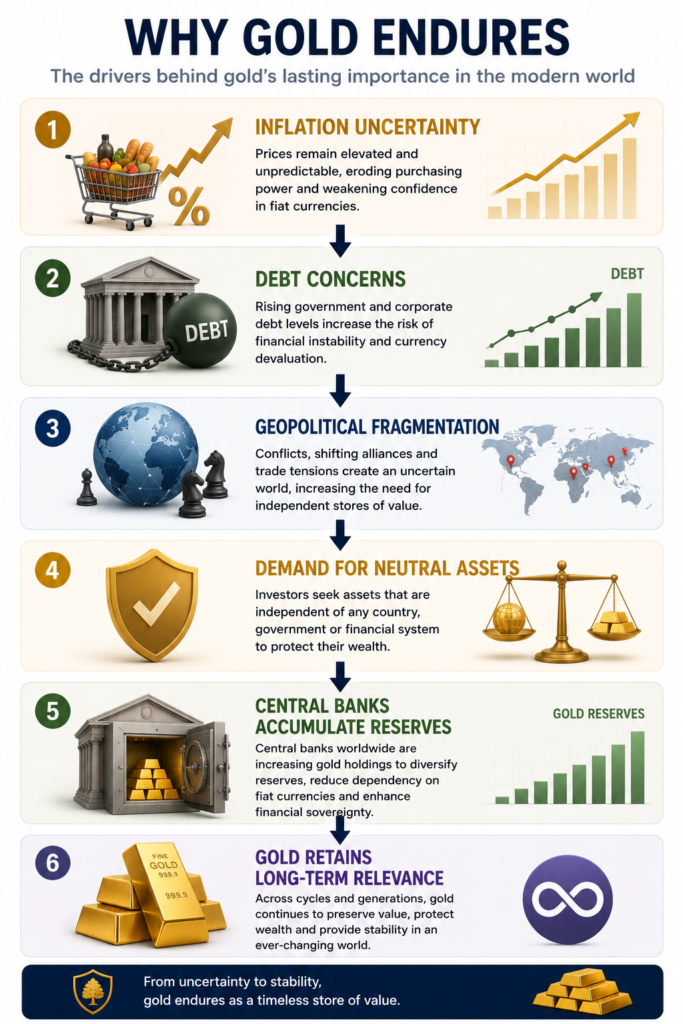
Gold’s role increasingly extends beyond short-term speculation into long-term strategic positioning.
Could Gold Enter a New Structural Era?
From my perspective, this is the most important question markets were beginning to ask in April 2026. Gold’s strength no longer appears tied to a single macroeconomic shock. Instead, it seems increasingly supported by multiple long-term forces simultaneously:
- Persistent inflation.
- Sovereign debt concerns.
- Geopolitical fragmentation.
- Central bank accumulation.
- Weakening confidence in fiat systems.
- Financial volatility.
That does not mean gold cannot experience corrections. Short-term pullbacks are normal after major rallies. But structurally, the environment supporting gold appears much broader than during previous cycles.
This is why many investors were beginning to treat gold not simply as a temporary defensive position, but as a strategic long-term asset allocation.
Conclusion: Gold Is Being Redefined, Not Replaced
Gold’s return to record highs in April 2026 may represent something larger than another cyclical rally.
It may reflect a broader transformation in how investors perceive monetary stability, geopolitical risk and financial resilience in the modern global economy. From my perspective, the most important aspect of gold today is not simply price momentum.
It is the changing role gold is beginning to play inside a world characterized by:
- Persistent macroeconomic uncertainty.
- Rising sovereign debt.
- Geopolitical fragmentation.
- Structurally higher inflation risk.
- Weakening confidence in traditional financial systems.
Gold is not being displaced by technological change. If anything, it is being redefined.
And in a world becoming increasingly complex and unstable, assets capable of preserving value independently from governments and financial institutions may become more important rather than less.
That is why gold’s current cycle feels increasingly structural instead of purely speculative.
FAQs
Why did gold reach record highs in April 2026?
Gold benefited from persistent inflation, geopolitical tensions, central bank demand and growing concerns about debt sustainability and financial stability.
Why is gold considered a safe-haven asset?
Because it is independent from governments and financial institutions, making it attractive during periods of uncertainty and market volatility.
How does inflation affect gold prices?
Higher inflation often increases demand for gold because investors seek protection against the loss of purchasing power.
Why are central banks buying more gold?
Many central banks are diversifying reserves, reducing dependency on the U.S. dollar and strengthening protection against geopolitical risks.
Could gold correct after reaching all-time highs?
Yes. Consolidation and corrections are normal after strong rallies, but they do not necessarily imply the end of a long-term bullish cycle.
How does gold compare to Bitcoin?
Gold is generally less volatile and more established as a reserve asset, while Bitcoin offers higher growth potential but greater price volatility.
Why do geopolitical tensions support gold?
Geopolitical instability increases demand for neutral assets capable of preserving value outside traditional political and financial systems.
Is gold entering a new structural era?
Many investors believe gold is becoming structurally more relevant due to inflation uncertainty, sovereign debt concerns and the fragmentation of the global economy.