

As quantum technology advances, investors are increasingly asking whether Bitcoin’s cryptographic foundations could eventually face a structural challenge
Bitcoin has spent more than a decade establishing itself as one of the most important technological and financial innovations of the modern era. At the same time, quantum computing has evolved from a theoretical scientific concept into one of the most ambitious technological races of the 21st century.
As both technologies continue developing, a major long-term question has started attracting increasing attention across financial markets, cybersecurity circles and the cryptocurrency ecosystem itself: Could quantum computing eventually break Bitcoin’s security?
From my perspective, what makes this discussion so important is not simply the technical risk itself. It is what the debate represents.
Bitcoin’s value ultimately depends on trust in cryptographic security. Quantum computing, meanwhile, is one of the few technologies theoretically capable of challenging parts of the cryptographic infrastructure that secures not only Bitcoin, but much of the global digital economy.
That means the implications extend far beyond cryptocurrency. Banks, governments, military systems, cloud infrastructure and financial networks all rely heavily on encryption standards that could eventually face pressure from future quantum capabilities.
This is why the conversation around Bitcoin and quantum computing has become increasingly serious during 2026.
Why Quantum Computing Matters
Traditional computers process information using bits that exist as either 0 or 1.
Quantum computers operate differently. They use qubits, which can exist in multiple states simultaneously through a phenomenon known as superposition. Combined with quantum entanglement, this allows quantum systems to process certain calculations exponentially faster than classical machines.
That computational advantage is what creates concern around modern cryptography.
Bitcoin currently relies on extremely robust security systems such as:
- SHA-256 hashing.
- Elliptic curve cryptography (ECC).
- Private/public key structures.
Under classical computing conditions, these systems remain extraordinarily secure because cracking them would require impractical amounts of computational power and time. Quantum computing changes the equation because certain quantum algorithms could theoretically solve mathematical problems much faster than traditional computers.
The most frequently discussed example is Shor’s algorithm. In theory, a sufficiently advanced quantum computer using Shor’s algorithm could derive private keys from public keys far more efficiently than classical machines.
If that ever became feasible at scale, it could create serious vulnerabilities for cryptocurrency wallets and blockchain security systems.
Why Quantum Computing Matters for Bitcoin
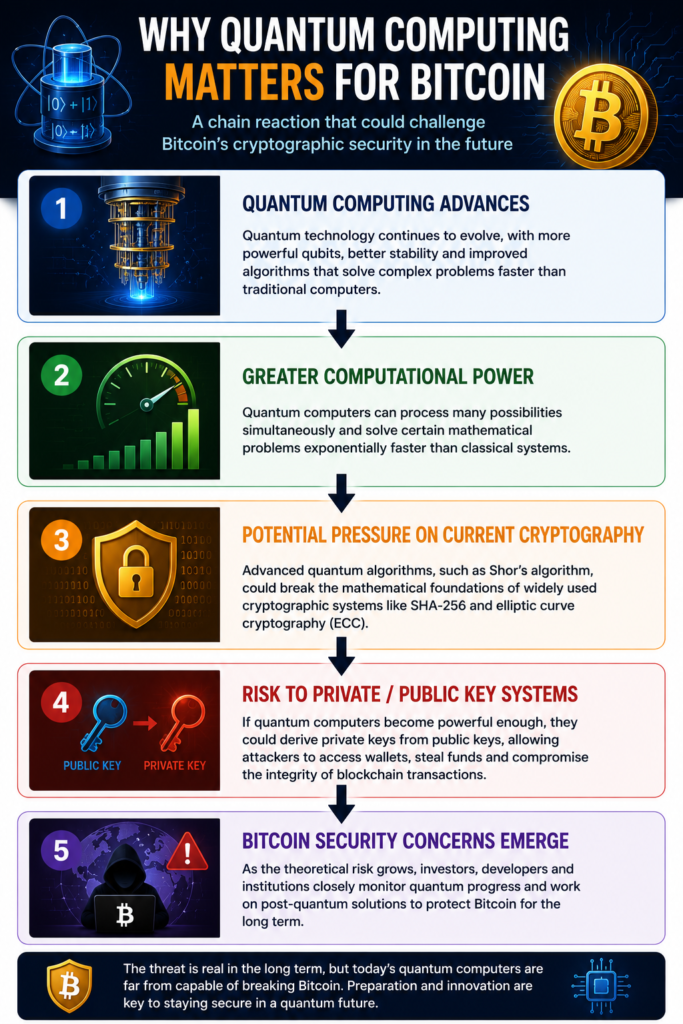
Quantum computing could eventually challenge parts of the cryptographic infrastructure securing digital assets.
The Threat Is Real But Still Distant
One of the biggest misconceptions surrounding this topic is the belief that quantum computers are already close to breaking Bitcoin. That is not the case.
Current quantum systems remain highly experimental and face enormous technical limitations.
Modern quantum machines still struggle with:
- Qubit instability.
- High error rates.
- Limited scalability.
- Fragile operating environments.
- Short coherence times.
From a practical perspective, existing quantum computers are nowhere near capable of breaking Bitcoin’s cryptographic architecture. The gap between current capabilities and the level required to threaten elliptic curve cryptography remains enormous.
At the time of publication in April 2026, most quantum systems operated with hundreds or a few thousand qubits at most, while estimates for breaking Bitcoin-level cryptography often involve millions of highly stable and error-corrected qubits.
That difference is extremely important. It suggests the industry likely still has many years potentially decades before quantum computing becomes a direct operational threat to Bitcoin security.
Current Quantum Capability vs Bitcoin Threat Threshold
| Current Quantum Systems | Estimated Requirement to Threaten Bitcoin |
|---|---|
| Hundreds to thousands of qubits | Millions of stable qubits |
| High error rates | Advanced error correction |
| Experimental infrastructure | Industrial-scale systems |
| Limited coherence stability | Long-duration stability |
| Research-stage hardware | Mature quantum architecture |
The technological gap between current quantum systems and Bitcoin-breaking capability remains extremely large.
Why the Bitcoin Ecosystem Is Already Preparing
Another important aspect often ignored in mainstream discussions is that the cryptocurrency ecosystem is already aware of the potential long-term threat.
Researchers and developers have been working for years on post-quantum cryptography:
security systems specifically designed to remain resistant even against advanced quantum attacks.
These approaches include:
- Lattice-based cryptography.
- Hash-based signatures.
- Quantum-resistant encryption methods.
From my perspective, this is one of Bitcoin’s greatest structural advantages. Bitcoin is not a static system. It is an adaptive network capable of evolving over time through upgrades, consensus changes and technological improvements.
The transition toward quantum-resistant security would likely be extremely complex and require broad coordination across:
- Developers.
- Miners.
- Wallet providers.
- Exchanges.
- Institutions.
- Users.
But importantly, the industry would almost certainly not wait until a quantum attack becomes imminent before responding.
Historically, technological ecosystems tend to adapt gradually once future vulnerabilities become sufficiently credible.
How Bitcoin Could Adapt to Quantum Risk
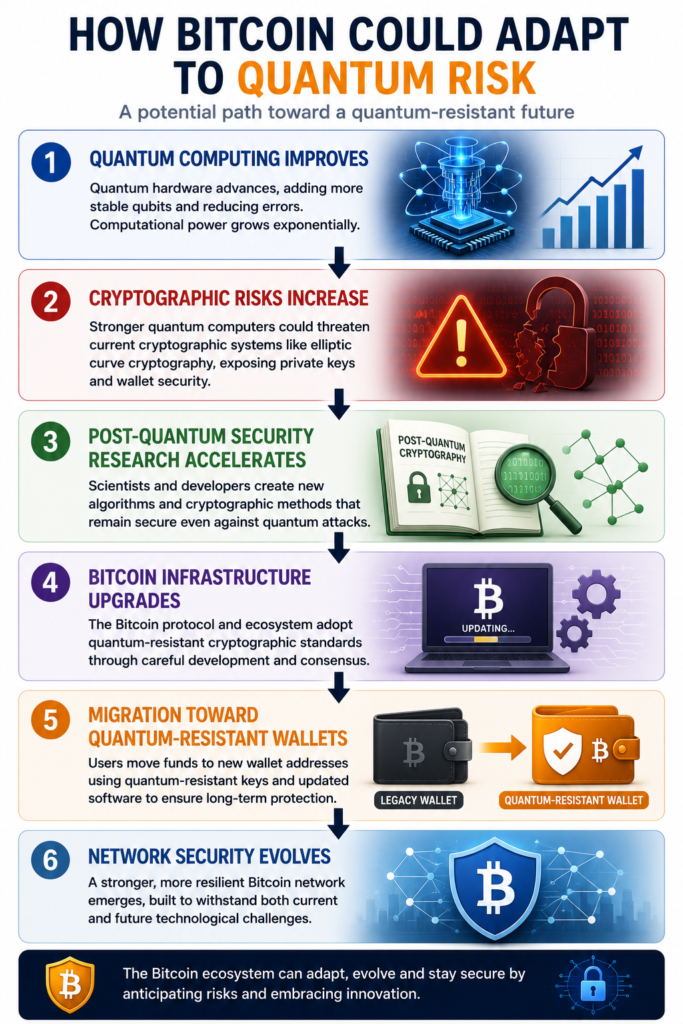
The Bitcoin ecosystem could gradually transition toward quantum-resistant cryptographic systems over time.
Could Quantum Computing Actually Strengthen Blockchain Technology?
Interestingly, quantum computing is not viewed only as a threat. Some researchers believe it could eventually improve parts of blockchain infrastructure and financial systems as well.
Quantum algorithms may eventually enhance:
- Optimization systems.
- Transaction processing.
- Network efficiency.
- Cryptographic innovation.
- Data security models.
This is why the relationship between Bitcoin and quantum computing should probably not be viewed as a simple technological confrontation. From my perspective, it is more likely part of a broader technological evolution where both systems continue adapting simultaneously.
The same technological advances that could eventually pressure older cryptographic standards may also help create stronger and more resilient security systems in the future.
Bitcoin, Trust and the Psychology of Security
One of the most important aspects of this debate is psychological rather than technical. Bitcoin’s long-term value depends heavily on confidence.
If investors ever begin believing Bitcoin’s security architecture could realistically become vulnerable, markets would likely react long before an actual quantum attack ever occurred. Financial systems are heavily driven by expectations. That means the perception of future risk matters almost as much as the technological reality itself.
This is why discussions around quantum computing increasingly attract attention from:
- Institutional investors.
- Cybersecurity firms.
- Governments.
- Central banks.
- Blockchain developers.
Even if the operational threat remains distant, markets constantly attempt to price future structural risks ahead of time.
Bitcoin vs Quantum Risk
| Factor | Current Situation |
|---|---|
| Immediate threat level | Low |
| Long-term theoretical risk | Significant |
| Current quantum capability | Insufficient |
| Industry preparation | Already underway |
| Post-quantum research | Accelerating |
| Probability of near-term collapse | Extremely low |
Quantum computing remains a long-term strategic issue rather than an immediate operational threat.
Why This Matters Beyond Bitcoin
Perhaps the most important point is that quantum computing is not just a Bitcoin problem.
Modern cryptography secures:
- Banking systems.
- Military communications.
- Government databases.
- Cloud infrastructure.
- Payment systems.
- Internet security.
If quantum computing eventually reaches the capability required to break current encryption standards, the challenge would affect much of the digital economy simultaneously.
That means governments and major institutions are already investing heavily in:
- Quantum research.
- Quantum-resistant encryption.
- Cybersecurity modernization.
- Next-generation cryptographic standards.
From my perspective, Bitcoin is simply one visible part of a much larger technological transition.
The Broader Quantum Security Transition
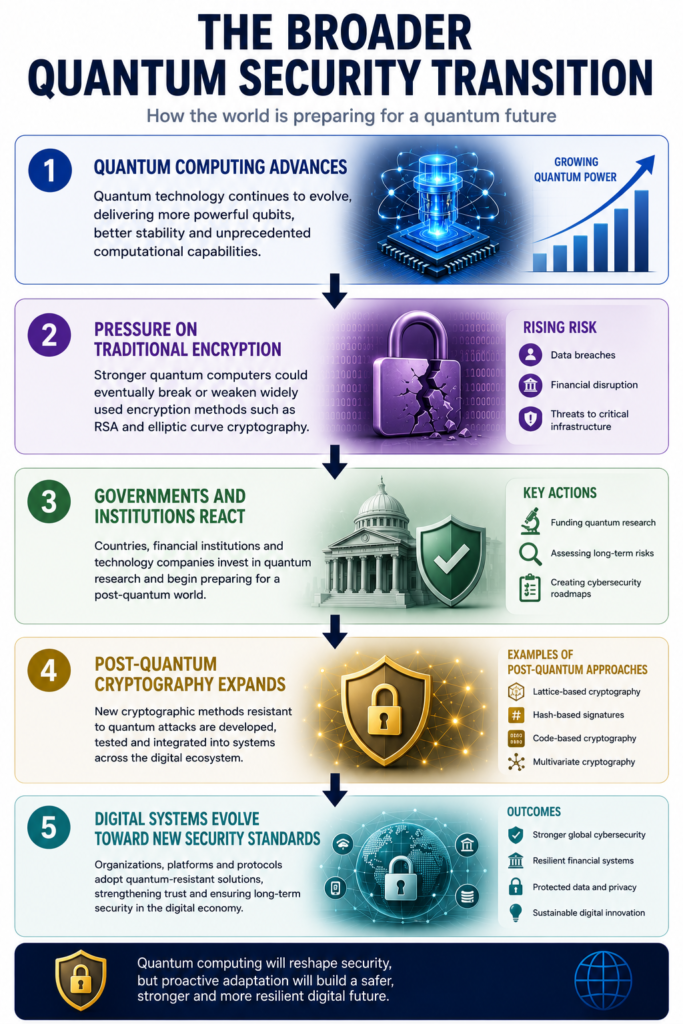
The transition toward quantum-resistant security systems may eventually reshape the entire digital economy.
Could Bitcoin Survive a Quantum Era?
From my perspective, the answer is probably yes but only through adaptation. Bitcoin’s long-term survival has never depended on remaining technologically static.
Its strength comes from:
- Decentralization.
- Open-source development.
- Global participation.
- Adaptive infrastructure.
- Network effects.
The cryptocurrency ecosystem has already shown its ability to evolve through:
- Protocol upgrades.
- Scaling improvements.
- Security enhancements.
- Infrastructure expansion.
Quantum computing may eventually become another chapter in that evolutionary process rather than the end of Bitcoin itself. That does not mean the risks should be ignored.
But it does suggest the future is likely more nuanced than the simplistic narrative that “quantum computers will destroy Bitcoin.”
Conclusion: A Long-Term Evolution, Not an Immediate Crisis
Quantum computing represents one of the most important technological developments of the century. Its long-term implications for cryptography, cybersecurity and financial systems could eventually be enormous. But as of April 2026, the threat to Bitcoin remained theoretical rather than immediate.
From my perspective, the most important takeaway is that the conversation itself reflects how mature the cryptocurrency ecosystem has become. Bitcoin is no longer viewed as an experimental niche technology.
It is now important enough that future-generation computing systems are being analyzed in relation to its long-term security. The challenge moving forward will not simply be resisting technological change.
It will be adapting fast enough to evolve alongside it. And historically, technological systems that survive are rarely the ones that never face threats.
They are the ones capable of evolving before those threats fully materialize.
FAQs
Can quantum computers break Bitcoin today?
No. Current quantum computers are far from powerful enough to break Bitcoin’s cryptographic security.
Why is quantum computing considered a threat to Bitcoin?
Because advanced quantum algorithms could theoretically derive private keys from public keys much faster than classical computers.
What is Shor’s algorithm?
Shor’s algorithm is a quantum computing method capable of solving certain mathematical problems exponentially faster than traditional computers.
How far are quantum computers from threatening Bitcoin?
Most experts believe the technology required would likely take many years or decades to develop.
Is Bitcoin preparing for quantum threats?
Yes. Researchers are already developing post-quantum cryptography and quantum-resistant security systems.
Could Bitcoin upgrade its security in the future?
Yes. Bitcoin’s open-source infrastructure allows developers to implement protocol upgrades if necessary.
Is quantum computing only a problem for Bitcoin?
No. Quantum computing could eventually affect banking systems, government infrastructure and much of global cybersecurity.
Could quantum computing also improve blockchain technology?
Potentially yes. Quantum systems may eventually enhance optimization, cryptographic innovation and computational efficiency.