
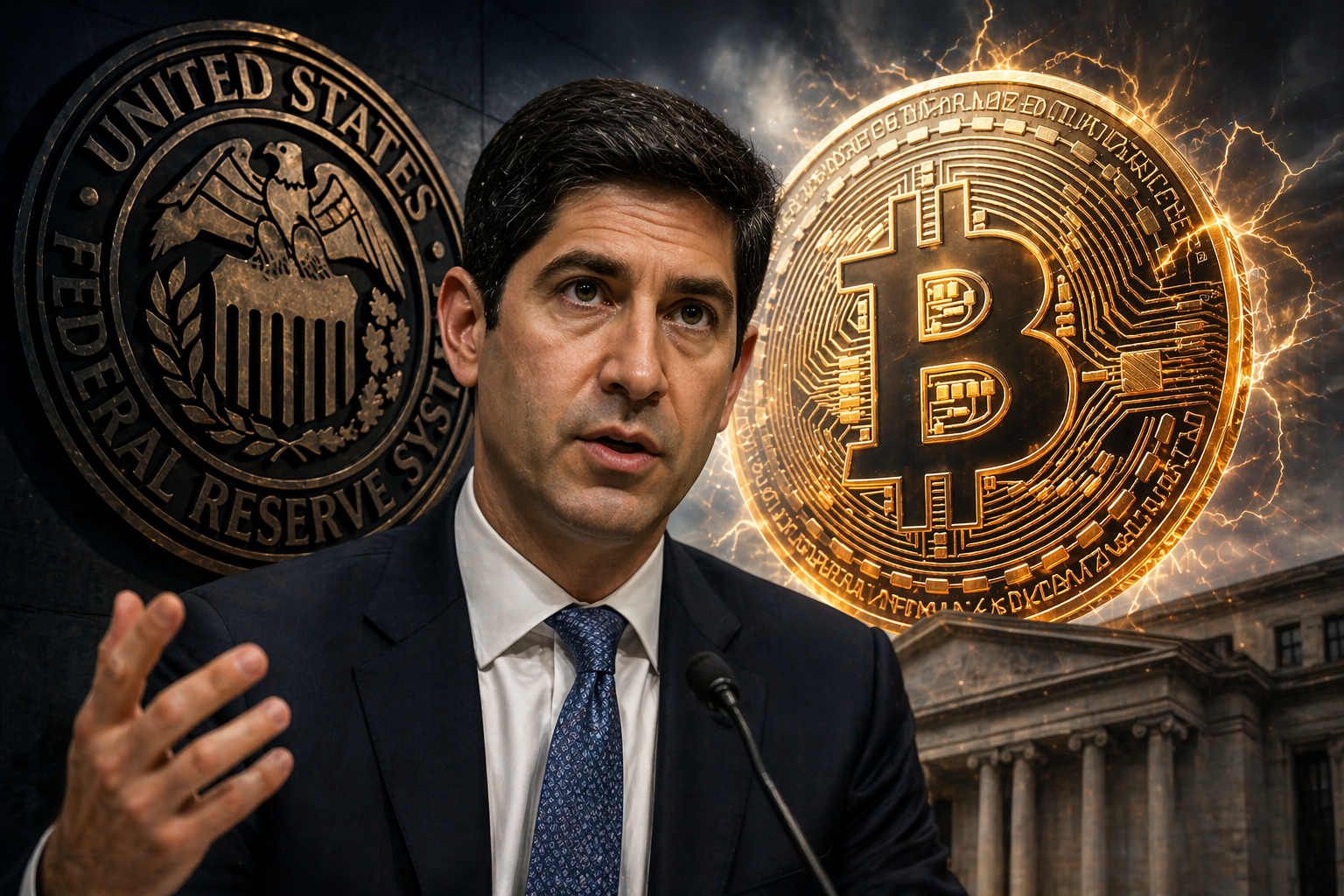
A crypto-literate Federal Reserve chair could change how markets think about Bitcoin, digital assets, liquidity and monetary policy
The Federal Reserve may be entering one of the most important transitions in modern financial history.
Kevin Warsh’s rise to the center of U.S. monetary policy has triggered a major debate across Wall Street, crypto markets and global macro circles. The reason is simple: Warsh is not being viewed only as another central banker. Markets are increasingly treating him as a potential bridge between the traditional financial system and the digital-asset economy.
That matters because the Federal Reserve is not just any institution.
It controls the most important monetary policy framework in the world. It influences the U.S. dollar, global liquidity, bond yields, risk appetite, banking regulation and the cost of capital across the entire financial system.
So when a Fed leader with disclosed exposure to crypto-related investments enters the spotlight, markets naturally begin asking a much bigger question:
Could digital assets become more integrated into the official financial system?
Warsh reportedly disclosed investments tied to multiple crypto projects during his confirmation process, which helped fuel the perception that the next phase of monetary leadership could be more familiar with digital assets than previous Fed regimes.
From my perspective, this does not mean the Federal Reserve suddenly becomes “pro-crypto” overnight. That would be too simplistic. But it does mean something important has changed.
Crypto is no longer being treated only as an outside threat to the financial system. It is increasingly being discussed as part of the system itself.
Why This Matters for Crypto
The biggest shift is psychological. For years, crypto markets operated under a cloud of uncertainty. Investors constantly had to worry about whether regulators, banks and central banks would treat digital assets as innovation or as systemic risk. That uncertainty limited institutional participation.
Large investors do not like legal ambiguity. Banks do not like unclear compliance frameworks. Pension funds and asset managers do not allocate aggressively into markets where regulatory treatment remains uncertain.
This is why Warsh’s position matters. A Fed leadership team that understands crypto, tokenization and digital finance could make institutional investors more comfortable with the idea that digital assets are becoming a permanent part of the financial landscape.
That does not remove risk. But it changes the tone.
Instead of asking whether crypto will be pushed out of the system, markets may begin asking how crypto will be regulated inside the system. That is a major difference.
How a Crypto-Literate Fed Could Change Market Perception
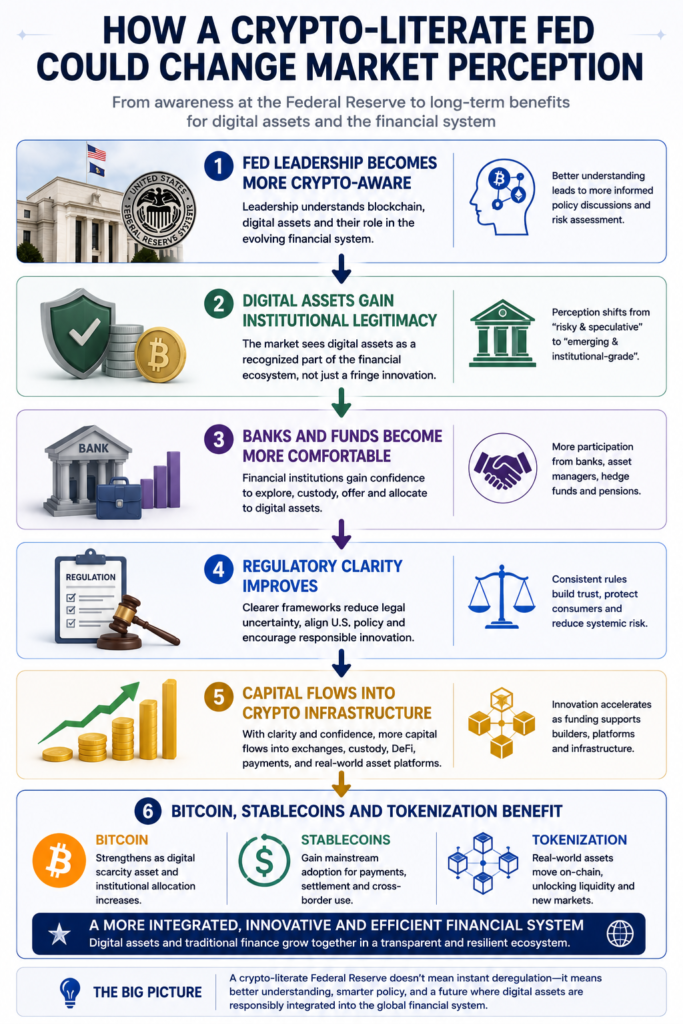
A crypto-literate Fed does not mean instant deregulation, but it could reduce institutional uncertainty around digital assets.
The Real Issue: Liquidity Still Rules Crypto
Even if the market views Warsh as more crypto-literate, crypto prices will still depend heavily on liquidity. This is extremely important. Bitcoin, Ethereum and altcoins do not rise only because regulation improves. They rise most aggressively when liquidity conditions improve.
That means crypto markets will still care about:
- Interest rates.
- Bond yields.
- The Fed balance sheet.
- Dollar liquidity.
- Risk appetite.
- Inflation expectations.
Warsh has historically been associated with a more traditional and disciplined view of central banking, including criticism of excessive Fed intervention. Reuters recently reported that Warsh’s approach could involve reducing the Fed’s balance sheet and scaling back market interventions, although U.S. debt dynamics could complicate that strategy.
That creates an interesting tension. On one hand, crypto investors may like the idea of a Fed chair who understands digital assets.
On the other hand, if Warsh pushes for tighter liquidity, a smaller Fed balance sheet or a more restrictive monetary regime, crypto could still face pressure.
From my perspective, this is the key nuance. A crypto-literate Fed is not automatically bullish if liquidity becomes tighter. Crypto needs both legitimacy and liquidity.
Why Crypto Still Depends on Liquidity
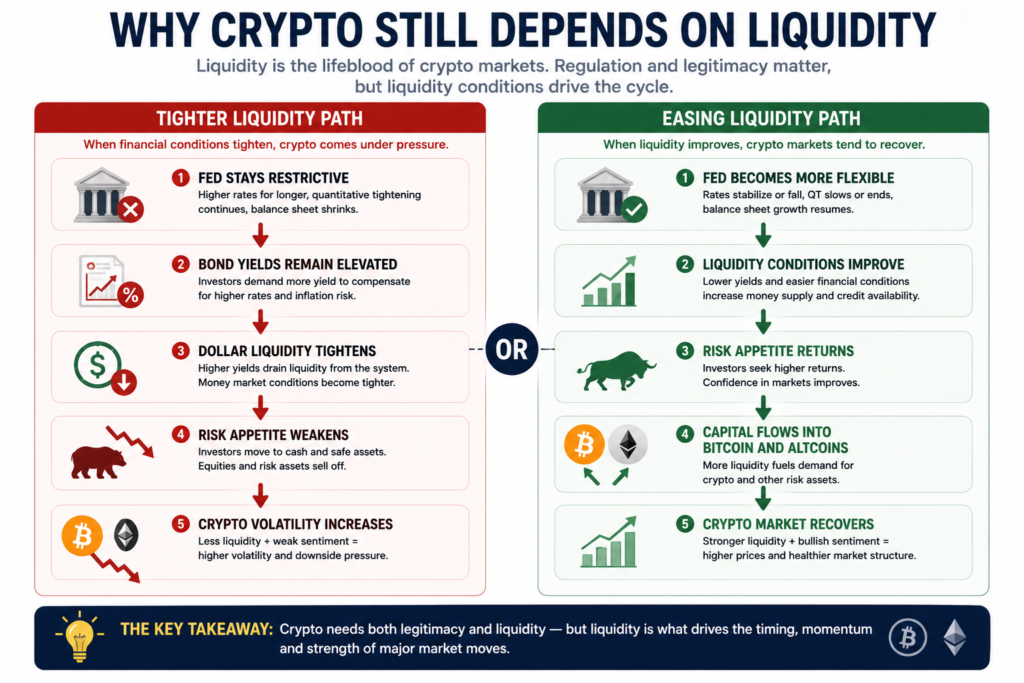
Regulatory legitimacy can help crypto long term, but liquidity still drives most major market cycles.
Why Stablecoins and Tokenization Could Be the Biggest Winners
The most important long-term impact may not be Bitcoin price action. It may be stablecoins and tokenization.
Stablecoins increasingly sit at the intersection of:
- Payments.
- Banking.
- Dollar liquidity.
- Crypto markets.
- Cross-border finance.
- Treasury demand.
If U.S. policymakers become more comfortable with digital assets, stablecoins could become one of the most important tools in the future dollar system. This is why the regulatory debate matters so much.
A clearer framework for digital assets could allow banks, fintech companies and payment firms to integrate stablecoins more aggressively into mainstream financial infrastructure.
PwC has also highlighted that U.S. digital asset regulation and tokenization oversight remain active areas of regulatory development, including coordination between agencies and congressional work on digital asset market structure.
From my perspective, this is where the real macro story is. Crypto is not just about speculative tokens anymore. It is about the future plumbing of financial markets.
Tokenized Treasuries, stablecoins, on-chain settlement and digital collateral systems could eventually become part of the next generation of market infrastructure.
What a Crypto-Literate Fed Could Mean
| Area | Potential Impact |
|---|---|
| Bitcoin | More institutional legitimacy, but still liquidity-sensitive |
| Ethereum | Benefits if tokenization and DeFi infrastructure expand |
| Stablecoins | Could gain stronger regulatory acceptance |
| Banks | May explore digital asset custody and settlement more seriously |
| Tokenization | Could accelerate real-world asset adoption |
| Altcoins | May benefit from better regulatory clarity, but remain high risk |
| Dollar system | Stablecoins could extend dollar usage globally |
Why the Fed Cannot Ignore Crypto Anymore
The Federal Reserve does not need to become a crypto promoter for digital assets to matter.
Crypto already affects:
- Retail investors.
- Institutional portfolios.
- Payment innovation.
- Stablecoin markets.
- Offshore dollar liquidity.
- Bank supervision.
- Financial stability debates.
That means the Fed must understand crypto even if it remains cautious. The central bank’s role is not to decide which tokens should rise or fall.
Its role is to monitor how new financial technologies affect:
- Systemic risk.
- Banking stability.
- Payment systems.
- Consumer protection.
- Capital markets.
- Monetary transmission.
From that perspective, having Fed leadership that understands digital assets could be important. Not because it guarantees easier regulation. But because better understanding can lead to better policy.
Suggested Chart Section
“Crypto Legitimacy vs Liquidity Conditions”
Suggested visual:
- X-axis: regulatory clarity
- Y-axis: liquidity conditions
- four quadrants:
- high clarity / high liquidity = strongest crypto environment
- high clarity / low liquidity = institutional adoption but weaker prices
- low clarity / high liquidity = speculative rally
- low clarity / low liquidity = weakest environment
The strongest crypto cycles usually require both improving legitimacy and supportive liquidity conditions.
Why This Could Reshape the Global Financial System
The broader implication goes far beyond crypto prices. If digital assets become more integrated into the financial system, the architecture of global finance could gradually change. Settlement could become faster. Collateral could become tokenized. Dollar stablecoins could move across borders more efficiently. Treasury markets could become increasingly connected to on-chain infrastructure. Banks could compete with crypto-native firms in custody, payments and tokenized assets.
That does not mean the traditional system disappears. More likely, the traditional system absorbs parts of crypto infrastructure.
From my perspective, this is the most realistic outcome. Crypto does not replace Wall Street overnight. Wall Street gradually integrates the parts of crypto that improve efficiency, liquidity and settlement. That is why the Fed’s posture matters so much.
Why Markets Should Still Be Careful
It would be a mistake to assume this is automatically bullish for every crypto asset. Regulatory legitimacy usually benefits stronger, more transparent and more institutionally useful parts of the market. It may not benefit speculative tokens with weak fundamentals.
In fact, clearer regulation could create a larger divide between:
- Bitcoin.
- Ethereum.
- Stablecoins.
- Tokenized real-world assets.
- Regulated exchanges.
- Speculative altcoins.
- Opaque DeFi protocols.
The market may become more selective. That is not necessarily bad. It could mark the maturation of the crypto industry. But investors should understand that institutional adoption does not mean every asset wins equally.
Conclusion
Kevin Warsh’s rise at the Federal Reserve represents more than a personnel change. It symbolizes a possible shift in how the world’s most powerful central bank understands digital assets.
From my perspective, the key takeaway is not that the Fed is suddenly becoming a crypto institution. It is that crypto is becoming too important for the Fed to ignore.
That alone is significant.
The future of digital assets will likely depend on two forces moving together:
- Regulatory legitimacy.
- And global liquidity conditions.
If both improve, crypto could enter a much more mature institutional phase. But if legitimacy improves while liquidity tightens, the market may still struggle in the short term. That is why this story matters so much. It is not just about Bitcoin. It is about whether digital assets are moving from the outside of the financial system toward the center of it. And if that transition continues, it could reshape the future of money, banking, payments and global markets.
FAQs
Why does Kevin Warsh matter for crypto?
Because markets see him as a Fed leader who is more familiar with digital assets than previous central bank officials.
Does this mean the Fed is becoming pro-crypto?
Not necessarily. It means crypto may become more integrated into the regulatory and financial policy conversation.
Why is liquidity still important for Bitcoin?
Bitcoin and crypto markets remain highly sensitive to interest rates, bond yields, dollar liquidity and risk appetite.
Could stablecoins benefit from this shift?
Yes. Stablecoins could benefit if U.S. policymakers create clearer rules for digital payments and tokenized finance.
Could a crypto-literate Fed help institutional adoption?
Potentially. Better understanding of digital assets could reduce uncertainty for banks, funds and financial institutions.
Is this bullish for all altcoins?
No. Regulatory clarity may benefit stronger projects but increase scrutiny on weaker speculative tokens.
Why does tokenization matter?
Tokenization could allow traditional assets like Treasuries, funds and collateral to move more efficiently through digital financial infrastructure.
What is the biggest risk for crypto?
The biggest risk remains tighter liquidity. Even with better regulation, crypto can struggle if interest rates stay high and financial conditions tighten.