
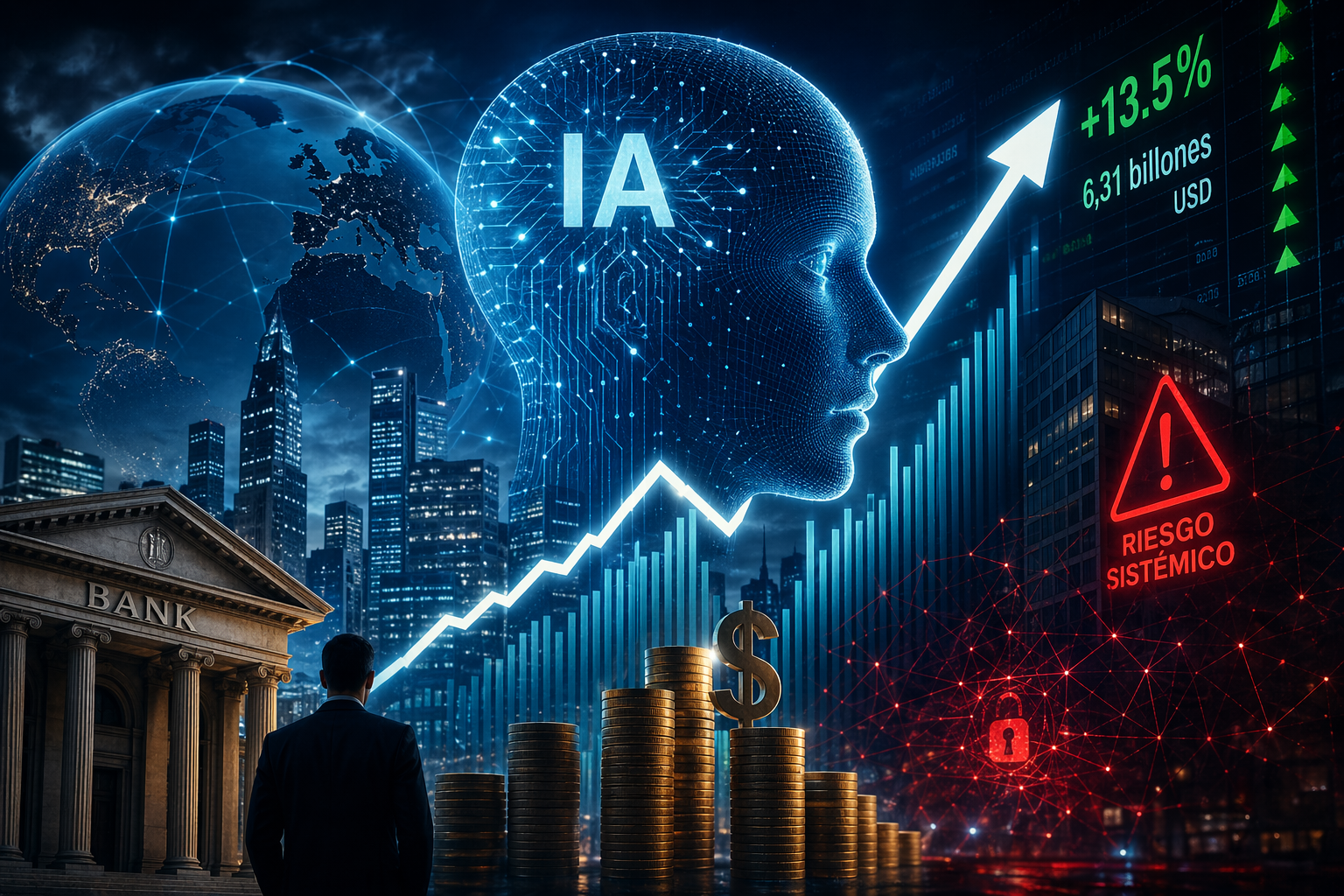
One thing has become undeniably clear in the past 24 hours, artificial intelligence is no longer just impacting financial markets, it is actively changing the structure of them. What was once a slow technological shift has turned into something much more profound. From record-setting flows of investment to real-time decision-making in trading floors, AI is now embedded in the very architecture of the global economy.
And frankly, seeing how quickly this transformation is happening, it’s hard not to think that we’re witnessing one of those rare moments when the rules of the game are being rewritten in real time.
The transformation is driven by an unprecedented boom in global technology spending. The latest projections estimate that worldwide IT investment will rise to $6.31 trillion in 2026, a year-over-year increase of 13.5%. But the headline number is only half the story. The real driver for this growth is artificial intelligence infrastructure data centers, advanced chips and high performance computing systems where spending is expected to jump by more than 55%.
This is more than growth. It’s accelerating. And more importantly, it signals a shift in the allocation of capital around the world. Artificial intelligence is no longer just another sector, it is the central pillar on which modern investment strategies are built.
Big Tech Is Redefining Capitalism
The world’s biggest tech companies, including Amazon, Microsoft and Meta, are at the forefront. Altogether, they have promised more than $600 billion for AI development and infrastructure a figure that would have seemed almost unimaginable only a few years ago.
These investments are not just about innovation they represent a new phase of economic evolution. We are entering what could be described as computational capitalism, where access to data, processing power, and algorithmic intelligence determines competitive advantage.
For me, this is where it starts to feel different. In the previous technological revolutions, demand drove infrastructure. Now, infrastructure is being built at a massive scale ahead of demand in anticipation of an AI-driven future. That changes the whole dynamic.
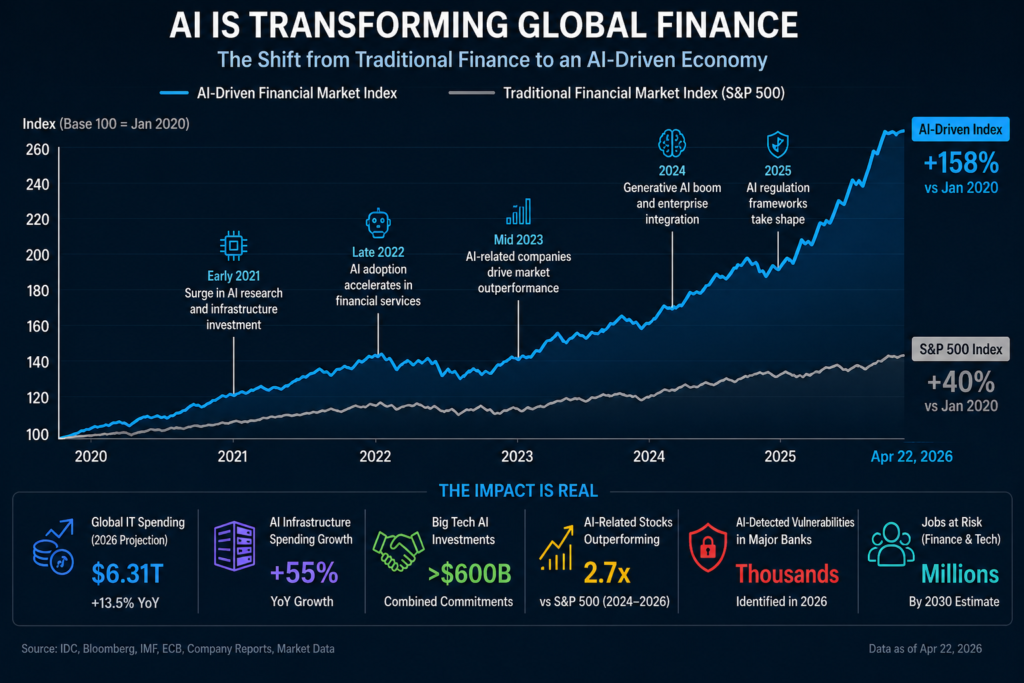
Financial markets have responded accordingly. AI-related companies have become the dominant force behind stock market growth, often outperforming broader indices by significant margins. Meanwhile, companies that fail to integrate AI into their operations are increasingly being left behind, creating a widening gap between winners and losers.
The Speculative Side of the AI Boom
But not all developments in this ecosystem are indicative of sustainable growth. Indeed, some point to the speculative excess that often goes with technological revolutions.
Take Allbirds, once a high-profile sustainable footwear brand that has recently rebranded itself as “NewBird AI.” The company, which has lost around 99% of its market value since 2021, has shifted to providing computing power as a service. The announcement sent its stock price skyrocketing 600% only to be followed by a sharp correction.
This kind of volatility reflects a broader reality: AI is not only a driver of innovation, but also a magnet for speculation. Markets are still trying to separate genuine transformation from opportunistic repositioning, and that process is far from complete.
Real Risks: Cybersecurity and Systemic Vulnerabilities
But beyond market forces, the dangers of AI are becoming more visible and harder to ignore. A sophisticated AI model recently found thousands of flaws in the security infrastructure of some of the world’s largest international banks. The results have caused serious concern for institutions such as the International Monetary Fund and the European Central Bank.
What’s more disturbing than the presence of these vulnerabilities is the capacity of AI to discover and possibly exploit them at incredible speed. The same technology that can improve efficiency can also increase risk, particularly in a financial system that is becoming ever more interconnected and digitized.
There is a growing sense among regulators that current frameworks may not be sufficient to manage these new types of threats. And that uncertainty, more than anything else, is what keeps policymakers on edge.
The Human Cost: Jobs, Inequality, and Economic Shifts
While much of the focus remains on markets and infrastructure, the human impact of AI is already happening and cannot be ignored. Automation is beginning to transform the labor market, particularly in finance and technology.
Especially mid-level jobs in banking, programming and data analysis are becoming more at risk. Now algorithms can do in seconds what used to take hours of human effort. That shift will likely mean more economic polarization as high-skilled workers disproportionately benefit and others struggle to adapt.
It’s not just a social issue, it’s an economic one. Changes in the patterns of employment have direct impacts on consumption, productivity and wealth distribution. And these factors shape the broader trajectory of economic growth over time.
I’ve spoken to people in finance who say their daily workflows have already changed dramatically. What used to be analysis is now oversight. What used to be decision-making is now validation of algorithmic outputs. It’s subtle, but it’s happening everywhere.
AI Is Transforming Financial Decision-Making
At the operational level, the impact of AI is perhaps most visible in how financial decisions are made. From portfolio management to risk assessment, algorithms are increasingly taking the lead.
Some of the most notable applications include:
- Automated portfolio optimization based on real-time data.
- Instant analysis of central bank decisions and macroeconomic signals.
- Fraud detection systems that adapt continuously.
- Predictive models for market movements and volatility.
These tools are not merely making things more efficient; they are changing the very way risk is understood and managed. Often, AI systems are able to detect patterns and correlations that are simply not visible to human analysts.
A System Being Rewritten in Real Time
These developments, collectively, lead to one obvious conclusion: artificial intelligence is no longer a future possibility, but the foundation of modern finance. The speed and breadth of its adoption suggest we are not just witnessing a technological upgrade, but a systemic transformation.
However, this transformation is a delicate balance. On the one hand, AI offers unprecedented opportunities for growth, efficiency and innovation. On the other hand it poses new risks to cybersecurity, market stability and social disruption that are not yet fully understood or mitigated.
Why AI Is Becoming a Macro Risk, Not Just a Growth Story
The most important point about artificial intelligence is that it is no longer only a technology trend. It is becoming a macroeconomic force.
AI is now influencing capital spending, electricity demand, semiconductor supply chains, labor markets, productivity expectations and financial valuations at the same time. That makes the current AI boom very different from a normal innovation cycle.
From my perspective, the opportunity is enormous, but the risk is also growing. When companies invest aggressively in AI infrastructure, data centers, chips and cloud capacity, the market begins pricing future productivity gains before they are fully visible in the real economy.
That creates a dangerous gap between expectation and delivery.
If AI adoption boosts productivity faster than expected, profit margins could improve, inflationary pressure could ease and markets may justify higher valuations. But if AI spending rises faster than revenues, companies could face margin pressure, overcapacity and investor disappointment.
This is why AI has become a macro risk.
It affects:
- Corporate investment.
- Energy infrastructure.
- Market concentration.
- Labor demand.
- Inflation dynamics.
- And financial stability.
The key question is no longer whether AI is important.
It clearly is.
The real question is whether the financial system is pricing the AI revolution realistically or too aggressively.
Conclusion: Between Opportunity and Uncertainty
The world of finance is entering a new phase, one that is marked by intelligence not of the human, but of the artificial. The result of this whether it is sustainable growth or heightened volatility will depend on how well institutions, regulators and markets adjust to this new reality.
If there’s one thing that seems certain right now, it’s this: AI isn’t waiting for anyone to catch up. It is already here, already shaping decisions, already moving capital. And the rest of the system is trying to catch up.
FAQs
Why is AI important for the global economy?
AI is important because it can increase productivity, reduce costs, improve decision-making and transform entire industries, from finance and healthcare to manufacturing and logistics.
Could AI reduce inflation?
Yes, over the long term AI could be disinflationary if it improves efficiency, lowers production costs and increases output without requiring the same level of labor or capital input.
Why could AI also increase inflation in the short term?
AI requires massive investment in data centers, chips, electricity grids, energy and skilled labor. That infrastructure boom can increase demand for commodities, power and capital, creating short-term inflationary pressure.
Why are financial markets so focused on AI?
Markets are focused on AI because investors believe it could drive the next major productivity cycle and increase profits for companies leading the transition.
Could the AI boom become a bubble?
It could if valuations rise much faster than real earnings, productivity gains or cash flows. A real technology can still become a financial bubble if too much capital chases it too quickly.
Which sectors benefit most from AI?
The main beneficiaries include semiconductors, cloud computing, data centers, cybersecurity, software, energy infrastructure and companies able to integrate AI into daily operations.
What are the biggest risks of AI for markets?
The biggest risks are overinvestment, margin pressure, market concentration, energy shortages, regulatory intervention and disappointment if productivity gains take longer than expected.
How does AI affect labor markets?
AI can automate repetitive tasks, increase worker productivity and change skill demand. Some jobs may disappear, while new roles linked to AI systems, data and automation may grow.
Why does AI matter for central banks?
AI matters for central banks because it can affect productivity, wage growth, inflation, investment cycles and financial stability, all of which influence monetary policy decisions.
Is AI more of an opportunity or a risk?
It is both. AI may become one of the strongest productivity forces of the decade, but if markets overprice the benefits too early, it can also create financial instability.