
In a fast-moving development on the international stage that has attracted worldwide interest, Iran has vehemently denied reports that it had dispatched a delegation to Islamabad for indirect talks with the United States. The denial, delivered through the state broadcaster Islamic Republic of Iran Broadcasting, comes at a particularly sensitive time for international relations, where even the smallest signal of dialogue between these two long-standing rivals can have far-reaching implications.
The official statement released on April 21, 2026, said Iranian authorities categorically denied any Iranian diplomatic mission, formal or informal, had traveled to Islamabad. The message was clear: there were no negotiations underway, no back-channel activity being ignited, no meetings being held between Iranian and U.S. representatives in Pakistan.
What strikes me is not the denial, but the speed and clarity of the denial. In diplomacy silence is often as meaningful as speech but when a government responds this quickly and this firmly it usually means one of two things: either the reports were entirely inaccurate or the narrative needed to be controlled immediately.
How the Reports Emerged and Why They Matter
Early reports in several international media outlets suggested that backchannel communications between Washington and Tehran may have quietly resumed in Pakistan. The choice of Islamabad was not a coincidence. In the past, Pakistan has played the role of a discreet mediator in sensitive geopolitical situations, offering a neutral ground for preliminary or indirect talks.
These reports took off quickly, not only in political circles but also in financial markets, where any suggestion of thawing tensions between Iran and the United States can affect oil prices, regional stability expectations and investor sentiment.
Even the possibility that the two sides might be thinking about dialogue, at least indirectly, was enough to spark cautious optimism in some diplomatic circles. After years of tensions, sanctions and sporadic confrontation, even the prospect of resuming communication is seen as a major step.
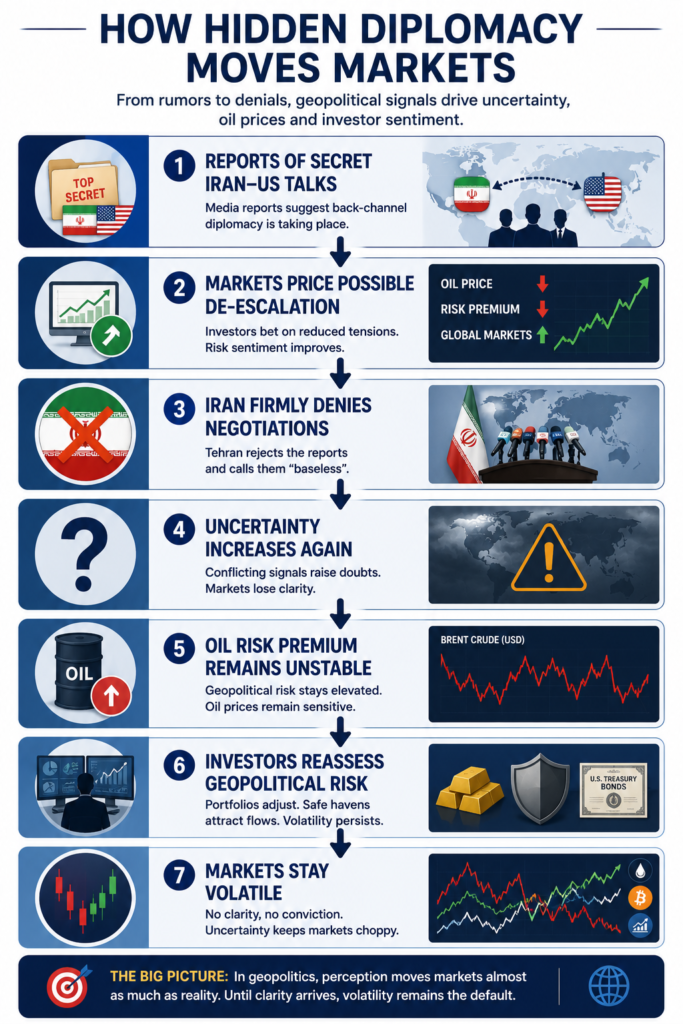
How Hidden Diplomacy Moves Markets
Why Diplomatic Ambiguity Matters for Markets
Financial markets do not only react to confirmed events. They react to probabilities.
That is why rumors of hidden negotiations between Iran and the United States can matter even when neither side officially confirms them. If investors believe the probability of dialogue is increasing, oil risk premiums may fall, safe-haven demand may ease and risk appetite can improve.
But the opposite is also true. When Iran strongly denies any contact with Washington, markets are forced to reassess the situation. The denial does not automatically prove that no communication exists, but it does reduce confidence that a diplomatic breakthrough is imminent.
From my perspective, this is the key market point. The issue is not only whether talks are happening. The issue is whether investors believe escalation risk is rising or falling.
In a situation involving Iran, the Strait of Hormuz and U.S. foreign policy, that perception can quickly affect:
- Brent crude prices.
- Inflation expectations.
- Bond yields.
- Safe-haven flows.
- Equity volatility.
- And crypto risk appetite.
This is why diplomatic ambiguity itself becomes a market force.
When the signal is unclear, markets do not fully relax. They keep a risk premium embedded in prices until the probability of de-escalation becomes more credible.
| Diplomatic Signal | Possible Market Interpretation |
|---|---|
| Reports of indirect talks | Lower escalation risk |
| Iran denies negotiations | Uncertainty remains high |
| U.S. stays silent | Strategic ambiguity |
| Pakistan mentioned as mediator | Possible back-channel diplomacy |
| No formal confirmation | Oil risk premium remains unstable |
| Clear diplomatic progress | Risk assets could recover |
Tehran’s Strategic Denial: Reality or Tactic?
Iran’s flat denial of the reports adds a layer of ambiguity that is typical of modern diplomacy. The statement looks straightforward on the surface: no delegation has been sent, no talks are taking place. The broader context, however, makes the situation more complex.
It is common knowledge to diplomatic observers that in early stages negotiations, especially between adversarial states, are often conducted in secrecy. And governments often deny their existence until it is clear they’ve made progress, so as not to face political backlash at home and to retain strategic flexibility.
This raises an important question: is Iran’s denial a reflection of reality, or part of a deliberate communication strategy?
There are several possible interpretations:
- The reports were inaccurate, and no talks have taken place
- Preliminary contacts may exist but are being intentionally concealed
- Iran is signaling unwillingness to negotiate under current conditions
- The denial is aimed at managing domestic or regional political narratives
From where I see it, all of these scenarios remain plausible. And that’s precisely what makes the situation so difficult to interpret.
The U.S. Silence Adds to the Uncertainty
Adding to the ambiguity is the lack of an official response from Washington. The United States has neither confirmed nor denied reports that talks may be held in Islamabad.
This silence is telling. Sometimes, diplomatically, not responding is just as strategic a move as making a statement. It leaves room for manoeuvre, avoids escalation and keeps options open without locking into a particular narrative.
And at the same time, it fuels speculation. Analysts and market participants are left to read the tea leaves to see if there are any quiet communication channels still operating under the surface.
A Fragile Geopolitical Context
The timing of these developments is especially significant. The global geopolitical landscape is still very fragile and there are several conflicts and areas of tension that are occurring simultaneously. Iran is involved directly or indirectly in a number of these dynamics , and its relationship with the United States is a key piece of the larger regional stability puzzle .
Any indication of dialogue even indirect could influence:
- Ceasefire negotiations in ongoing conflicts
- Sanctions policies and economic expectations
- Energy markets, particularly oil supply perceptions
- Diplomatic alignments in the Middle East and beyond
Conversely, a firm denial reinforces the perception that tensions remain unresolved and that a breakthrough is not imminent.
Pakistan’s Role as a Potential Mediator
The mention of Islamabad in these reports is no accident. Pakistan’s geostrategic importance and its links with a range of global and regional actors make it an attractive site for discreet diplomatic activity.
Historically, neutral locations such as Pakistan have been used by competing countries for non-direct communication, giving them an opportunity to begin a dialogue away from the main stage. But without confirmation from either side, the role of Pakistan in this case is still open to speculation.
Markets and Diplomacy: A Sensitive Relationship
Although this development is primarily political, its impact extends into financial markets. Investors closely monitor geopolitical signals, particularly those involving major energy producers like Iran.
Even unconfirmed reports of potential negotiations can:
- Lower perceived geopolitical risk
- Influence oil price expectations
- Affect currency and equity market volatility
On the other hand, strong denials such as the one issued by Iran can quickly reverse that sentiment, reinforcing uncertainty and risk premiums.
The Complexity of Modern Diplomacy
Ultimately, what this episode shows is that the face of diplomacy is changing in the modern age. Information, misinformation and strategic communication often co-mingle, making it ever more difficult to distinguish between signal and noise.
Governments are not only negotiating with other governments; they are also managing public perception, media narratives, and market reactions simultaneously. In this context, such statements as Iran’s denial serve several purposes: clarifying position, controlling narrative, and shaping expectations.
I find that aspect of geopolitics fascinating myself. It’s not just what goes on behind closed doors but also how those events are presented or concealed from the public.
What Comes Next?
As of April 21, 2026, the situation remains fluid and open to interpretation. There is no concrete evidence confirming the existence of talks in Islamabad, but the absence of confirmation does not necessarily mean the absence of communication.
Key questions moving forward include:
- Will the United States eventually respond to the reports?
- Will new information emerge supporting or contradicting Iran’s denial?
- Are indirect communication channels already active elsewhere?
- Could this episode evolve into a more formal diplomatic process?
For now, uncertainty remains the defining characteristic of the situation.
Conclusion: Between Denial and Possibility
Iran’s categorical denial of reports on diplomatic talks in Islamabad adds another layer to an already tense geopolitical canvas. Whether this is a true absence of negotiations, or a calculated effort to control the narrative, remains to be seen.
What is certain, however, is that the mere idea of a dialogue between Iran and the United States is of great importance. It affects not only political expectations, but economic and financial dynamics globally.
Events will continue to unfold, and the world will be watching closely, knowing that in today’s geopolitical environment, the line between reality and strategy is often thinner than it appears.
FAQs
Why did Iran deny reports of talks with Washington?
Iran may have denied the reports because they were inaccurate, politically sensitive or because Tehran wanted to control the diplomatic narrative.
Why would secret talks affect financial markets?
Even rumors of dialogue can reduce perceived geopolitical risk, especially when Iran and the United States are involved.
How could this affect oil prices?
If markets believe tensions are easing, oil prices may fall. If negotiations are denied or uncertainty rises, oil risk premiums may remain elevated.
Why does Pakistan matter in this story?
Pakistan can be viewed as a possible neutral location for indirect diplomacy, although no official talks were confirmed in the article’s April 21 context.
Why does U.S. silence matter?
Silence can preserve diplomatic flexibility, but it also increases uncertainty because markets cannot confirm whether talks are real or not.
Could this affect the Federal Reserve?
Indirectly, yes. If geopolitical tensions keep oil prices high, inflation expectations may remain elevated, reducing the Fed’s flexibility.
Why does this matter for crypto?
Crypto is sensitive to global liquidity and risk appetite. Geopolitical uncertainty can pressure Bitcoin and altcoins if investors move into safer assets.