
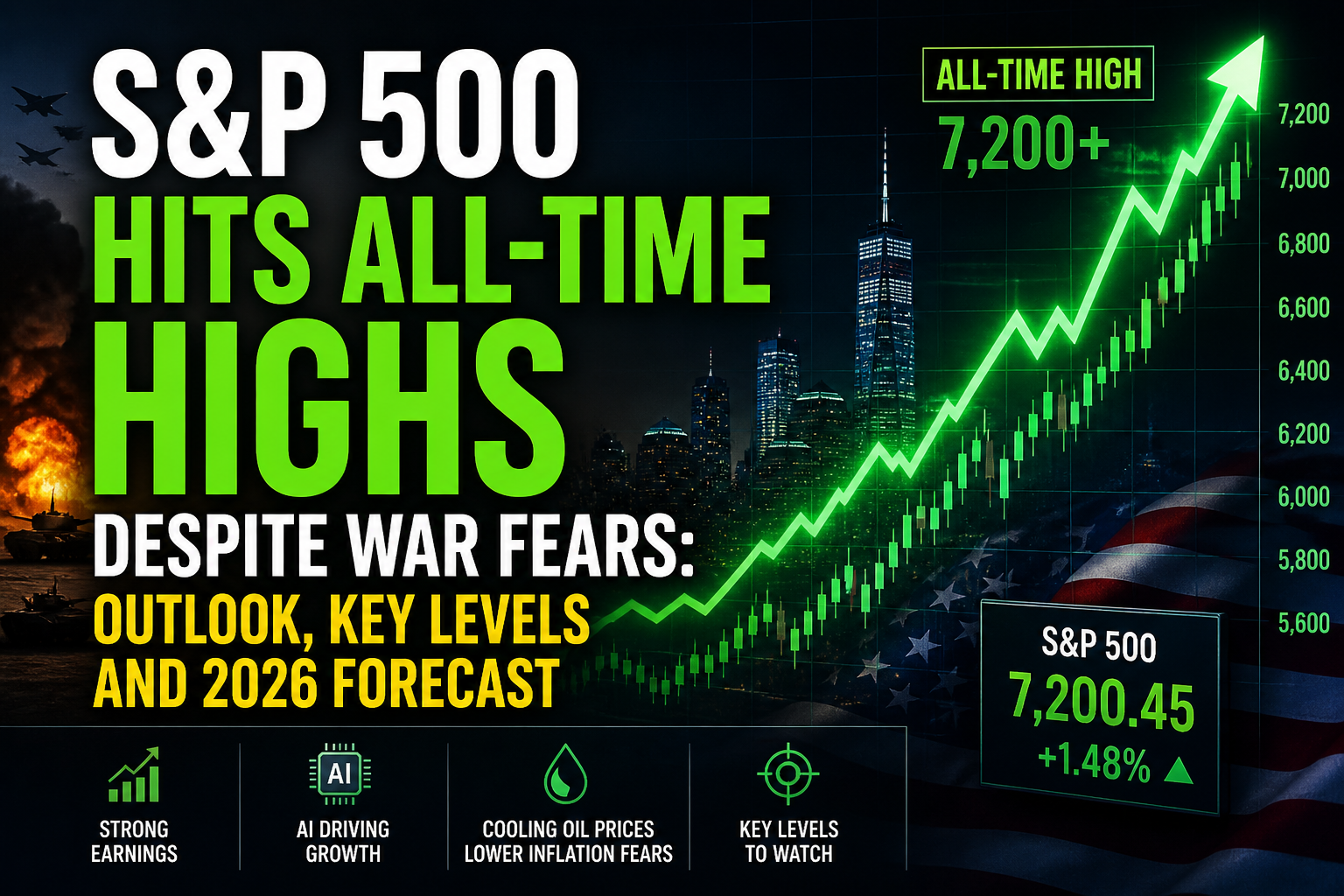
Why is the S&P 500 hitting all-time highs despite war fears?
The recent surge in the S&P 500 to fresh all-time highs has left many investors uneasy, especially given the persistent backdrop of geopolitical tension in the Middle East and renewed concerns surrounding Iran. At first glance, the rally appears disconnected from reality. Headlines continue to highlight instability, potential supply shocks in energy markets, and the broader risks that typically accompany military conflict. Yet despite all of this, equities continue to grind higher.
This apparent contradiction is not unusual. Financial markets rarely move in direct response to fear itself; instead, they respond to the difference between what investors expect to happen and what actually unfolds. In recent months, a significant degree of geopolitical risk had already been priced into asset prices. Investors had positioned defensively, anticipating escalation, sustained oil price spikes, and the potential for renewed inflationary pressure. However, as events have developed, the worst-case scenarios that many had feared have not materialized.
The real reason markets are ignoring Iran war fears
If you’ve been following the headlines closely, the current rally in the S&P 500 probably feels uncomfortable, even contradictory. On one side, there is a steady stream of news about geopolitical tension, rising risks in the Middle East, and concerns around Iran that could, at least in theory, destabilize global markets. On the other side, equities continue to push higher, breaking records and showing little sign of stress.
This disconnect, however, is not new. Markets are not designed to react emotionally to fear or uncertainty. Instead, they move based on expectations and, more importantly, on how reality compares to those expectations. In recent months, investors had already priced in a significant amount of geopolitical risk, anticipating escalation, prolonged instability, and a potential surge in oil prices. What has actually unfolded so far has been less severe than feared, and that gap between expectation and reality is precisely what is driving the market higher.
1. The worst-case scenario isn’t happening
One of the most important forces behind the current rally is the simple fact that the most negative outcomes have not materialized. Investors had positioned themselves for a scenario in which tensions would escalate rapidly, disrupting energy markets and feeding into a broader inflation shock. That positioning reflected a defensive mindset, with capital moving toward safer assets and away from equities.
However, while tensions remain elevated, the conflict has so far stayed relatively contained. Oil markets, which initially reacted with sharp price increases, have since shown signs of stabilization. This matters because energy prices are a key input into inflation expectations. As oil prices ease or fail to spike further, fears of a renewed inflation surge begin to fade.
With inflation concerns moderating, the pressure on central banks to maintain aggressive monetary tightening also diminishes. This creates a more supportive environment for equities, particularly for growth-oriented sectors that are sensitive to interest rates. In effect, the removal of extreme downside scenarios leads to a gradual unwinding of risk premiums that had previously weighed on the market.
What drives prices higher in this context is not necessarily good news, but rather the absence of bad news. Markets are recalibrating, recognizing that reality, at least for now, is less negative than anticipated.
2. Earnings are dominating everything
While geopolitical developments capture headlines, the true engine of the rally lies in corporate performance. Across multiple sectors, companies have continued to deliver strong earnings, often surpassing analyst expectations. This resilience has reinforced investor confidence and provided a fundamental justification for higher valuations.
A particularly powerful driver has been the ongoing surge in investment tied to artificial intelligence. Large-cap technology firms and semiconductor companies have seen significant capital inflows as businesses and governments alike accelerate spending in this area. The perception that AI represents a long-term structural growth opportunity has amplified enthusiasm in the market and helped sustain momentum.
When earnings growth remains strong, macroeconomic fears tend to lose their immediate impact. Investors may still be aware of geopolitical risks, but as long as companies continue to generate profits and expand, those risks are often treated as secondary considerations. This dynamic has played out repeatedly in past cycles, where strong fundamentals were sufficient to offset external uncertainty.
In the current environment, the consistency of earnings growth is acting as a stabilizing force, anchoring the market even as headlines suggest instability elsewhere.
3. Positioning is being unwound
Another key factor behind the rally is more subtle but equally important: the unwinding of defensive positioning. Earlier in the year, many investors prepared for a downturn by reducing exposure to equities, increasing cash holdings, or establishing short positions. These strategies were based on expectations of escalating conflict, economic slowdown, or both.
When those expectations failed to materialize, the market began to move higher, forcing a reassessment. Investors who had bet against the market were compelled to cover their positions, while those who had remained on the sidelines faced pressure to re-enter in order to avoid missing gains. This shift created additional buying demand, which in turn pushed prices even higher.
The result is a self-reinforcing cycle. Rising prices trigger further buying, whether through short covering, systematic trading strategies, or discretionary portfolio adjustments. Momentum builds, and what began as a cautious rebound evolves into a stronger and more sustained rally.
From this perspective, the current market strength is not solely the result of positive developments, but also of previously bearish positioning being reversed.
Latest S&P 500 update
As of May 2026, the S&P 500 has reached new all-time highs, trading above the 7,200 level. This milestone reflects a combination of strong corporate earnings, continued enthusiasm around artificial intelligence, and easing concerns about inflation driven by stabilizing oil prices.
What stands out in the current phase of the rally is that it is no longer narrowly concentrated. Earlier advances were heavily driven by a small group of mega-cap technology stocks, but the recent move shows signs of broader participation across sectors. This improvement in market breadth suggests that the rally may be becoming more sustainable, rather than relying on a limited number of leaders.
Such transitions are often important in determining whether a bull market can extend further. A broader base of participation tends to provide greater stability and resilience against sector-specific shocks.
Key technical levels to watch
Even for investors focused primarily on macroeconomic trends, technical levels play an important role in shaping market behavior, especially when indices reach new highs. In these conditions, traditional resistance levels no longer exist, and the market enters what is often referred to as a price discovery phase.
The zone between 7,300 and 7,400 represents the next area of potential friction, not because of historical resistance, but because psychological thresholds tend to influence trading decisions. At the same time, several support levels remain relevant in the event of a pullback.
The 7,000 level serves as an important psychological benchmark, while 6,800 marks a previous area of consolidation that could act as support. Further below, the 6,500 level represents a more significant structural base that would likely come into focus in a deeper correction scenario.
Historically, when markets break into new highs, upward movements can accelerate quickly due to the absence of overhead supply. At the same time, pullbacks are often limited in duration, as investors look to buy dips in a rising trend.
What happens next? My outlook for 2026
Looking ahead, the market environment is unlikely to be defined by a simple bullish or bearish narrative. Instead, it reflects a complex balance between supportive fundamentals and persistent risks.
In a constructive scenario, continued earnings growth, sustained investment in artificial intelligence, and stable inflation could allow the rally to extend further. If these conditions hold, it would not be surprising to see the market reach significantly higher levels by the end of the year, as momentum and investor confidence reinforce each other.
At the same time, downside risks cannot be ignored. A meaningful escalation in tensions involving Iran could disrupt energy markets and reignite inflation pressures. This, in turn, could force central banks to maintain restrictive policies for longer than expected, weighing on valuations. Additionally, any signs of weakening earnings would undermine one of the key pillars supporting the current rally.
In more adverse scenarios, market declines tend to be rapid rather than gradual, driven by shifts in liquidity, rising volatility, and increasing correlations across assets. This asymmetry between slow advances and fast declines is a recurring feature of financial markets.
What history tells us about markets and wars
There is a common perception that war inevitably leads to falling markets, but historical evidence suggests a more nuanced reality. In many cases, markets decline in anticipation of conflict, only to recover once uncertainty begins to resolve.
During the Gulf War, equities sold off ahead of the military campaign but rallied strongly once it became clear how events were unfolding. Following the September 11 attacks, markets experienced an initial shock but recovered within months as the economic impact became better understood. Similarly, in the lead-up to the Iraq War, stocks bottomed before the conflict officially began.
The consistent pattern across these episodes is that markets tend to find their lows during periods of maximum uncertainty, not when conditions are already improving. Once the range of possible outcomes narrows and worst-case scenarios are priced out, investors begin to reallocate capital toward risk assets.
This pattern appears to be playing out again. The current rally reflects not a disregard for geopolitical risk, but an adjustment to a reality that is, at least for now, less severe than what had been expected.
Historical data: how the S&P 500 reacted to past conflicts
The numbers make the pattern clearer.
| Event | Initial S&P 500 reaction | Recovery / next move |
|---|---|---|
| Gulf War 1990–1991 | Around -16% to -18% | Rebounded roughly +26% to +29% after uncertainty peaked |
| 9/11 attacks 2001 | S&P 500 fell about -11.6% in the first trading week | Recovered in the following months |
| Iraq War 2003 | Market weakness before invasion | S&P 500 gained around +20% in the year after the invasion |
| Major geopolitical shocks since WWII | Average decline around -5% to -6% | Average recovery in roughly 28 days in most cases |
The key lesson is not that war is bullish. It is not.
The real lesson is that markets usually sell off when uncertainty rises, and then recover when investors can finally price the risk. That’s why the S&P 500 can reach new all-time highs even when the headlines still look scary.
In my view, this is exactly what many investors underestimate: the market does not need perfect news to rally. It only needs reality to be less bad than expected.
Sources: Reuters reported the S&P 500 closing at a record 7,259.22 on May 5, 2026, while historical conflict data shows Gulf War drawdowns around 16%, the 9/11 weekly S&P 500 drop at 11.6%, and average geopolitical-shock declines around 5%–6%.
My positioning mindset right now
I’m not approaching this market with extreme conviction.
Instead, I’m focusing on staying flexible.
What I’m doing:
- Buying pullbacks instead of chasing highs
- Watching earnings more than headlines
- Tracking liquidity closely
Because in environments like this, the biggest mistake is being rigid.
The S&P 500 reaching new all-time highs in the middle of geopolitical tension is not a paradox it’s a reflection of how markets actually function.
Markets don’t rise or fall simply because of fear. They move based on how reality compares to what investors had already anticipated. When expectations are overly pessimistic and outcomes turn out to be less severe, prices adjust upward, sometimes aggressively.
Right now, that adjustment is clearly underway. The perceived risks, while still present, are not materializing at the scale many had feared. At the same time, expectations are steadily improving, supported by resilient earnings and stabilizing macro conditions.
But there is an important nuance that should not be overlooked.
Periods like this when the narrative feels clear, when the trend appears strong, and when consensus begins to align can also carry hidden risk. Markets tend to become most fragile not when uncertainty is high, but when confidence becomes too comfortable.
Because even in the strongest bull markets, the moments that seem the most obvious are often the ones that require the most caution.
FAQs
Why is the S&P 500 rising despite war fears?
Because markets had already priced in the risk. When reality is less severe, prices move higher.
Is it safe to invest at all-time highs?
Historically yes, if earnings support the move but short-term volatility increases.
What could stop this rally?
Escalating conflict, rising inflation, or weakening corporate earnings.