

Bitcoin is back above the $80,000 area, and the market is already getting loud again.
Every time BTC bounces hard, the same question comes back: is Bitcoin still in a bear market, or is the bull market finally back? Some traders are already talking about a new supercycle. Others think this is just another bear-market rally before the next leg down.
Personally, I’m still in the second camp.
I still think BTC is in a bear market, or at least close enough to one that I would not treat this rally as a confirmed bullish reversal yet. Yes, the price action looks better than it did at the lows. Yes, Bitcoin has recovered strongly. And yes, breaking back above $80K is psychologically important.
But none of that automatically means the bear market is over.
At the time of writing, Bitcoin is trading around $81,449, with an intraday high near $81,656 and an intraday low around $79,727. That is a solid short-term bounce, but for me, the real question is not whether BTC can touch $80K. The real question is whether it can hold above major resistance, reclaim key moving averages, and prove that this is not just another relief rally.
And right now, I’m not convinced.
Bitcoin Is Back Above $80K, But That Doesn’t Mean the Bear Market Is Over
A move above $80,000 looks impressive on the surface. Big round numbers always matter in crypto because they attract attention. Retail traders notice them. Algorithms react to them. Headlines are built around them.
But a price moving above a round number is not the same thing as a confirmed trend reversal.
That is where I think many people get trapped. Bitcoin can rally 15%, 20%, or even 30% inside a broader bearish structure and still fail later. Bear-market rallies are often violent because they are powered by short liquidations, fear of missing out, and traders rushing back in too early.
That is exactly why I’m cautious here.
In my view, this current BTC move still looks more like a bear-market rally than the start of a clean new bull market. I’m not saying bulls have no case. They do. But I think the market has not earned the right to be called fully bullish again yet.
The Difference Between a Real Reversal and a Bear-Market Rally
A real Bitcoin reversal usually has several things behind it.
It reclaims major moving averages. It builds higher lows. It turns old resistance into support. It attracts strong spot demand, not just leveraged futures trading. It also tends to come with improving macro conditions, better liquidity, and a stronger appetite for risk.
A bear-market rally is different.
A bear-market rally moves fast, feels bullish, and convinces people that the worst is over before the chart has actually confirmed it. It usually happens after sentiment gets too bearish, shorts pile in, and the market squeezes higher.
That does not make the rally fake, but it does make it fragile.
For me, Bitcoin has to do more than trade above $80K for a few candles. I want to see BTC reclaim the key resistance zone, hold it as support, and show that real buyers are stepping in. Until then, I still think there is a serious risk of another major drop.
Why the $80K–$82K Zone Is So Important
The $80,000–$82,000 area matters because it is not just a psychological level. It is also a technical battleground.
This is the kind of zone where bulls and bears usually fight hard. If BTC can break above it cleanly and hold, the bullish case gets stronger. But if Bitcoin gets rejected here, it could confirm that the recent move was only a temporary bounce.
That is why I do not want to chase this rally blindly.
The way I see it, the market is asking a very simple question right now: can Bitcoin turn resistance into support, or will sellers take control again?
Until that question is answered, I remain cautious.
My Technical Analysis: BTC Still Looks Vulnerable
From a technical analysis perspective, Bitcoin is sitting at a very important decision point.
The chart has improved, but it is not fully bullish yet. BTC has bounced from lower levels, but it is now pushing into a zone where rejection would make a lot of sense. This is where technical traders usually look for confirmation instead of emotion.
And honestly, I still think BTC looks vulnerable.
The 200-Day Moving Average Is the Line Bulls Need to Reclaim
One of the most important levels I’m watching is the 200-day moving average or 200-day EMA, depending on the chart setup.
This level matters because it often separates bullish market structure from bearish market structure. When Bitcoin is clearly above the 200-day moving average and holding it as support, the market usually looks much healthier. When BTC is below it or getting rejected around it, the trend is more fragile.
Right now, this is one of the main reasons I am not ready to say the bear market is over.
I do not care much about one breakout candle. I care about structure. Can BTC close above the 200-day moving average? Can it retest it? Can it hold? Can buyers defend the level when price comes back down?
Until the answer is yes, I still think the downside risk is too big to ignore.
The Bear Flag Risk Is Still on the Table
The bearish pattern I’m watching most closely is the potential bear flag.
A bear flag usually forms when price drops sharply, then moves sideways or slightly upward in a corrective channel, before eventually breaking lower again. The rally feels bullish while it is happening, but in many cases, it is just a pause before the next move down.
That is what worries me about BTC here.
If Bitcoin fails around the $80K–$82K region and starts losing momentum, the next major area I would watch is around $70K–$72K. That would be the first zone where buyers might try to step in again.
But if that level fails, things could get much uglier.
In a more aggressive bearish scenario, I would not be shocked to see Bitcoin revisit the $50K area. That may sound dramatic, especially while BTC is trading above $80K, but crypto moves fast. When support breaks, leverage unwinds, sentiment flips, and downside targets that looked impossible suddenly become realistic.
For me, the danger is not just that Bitcoin drops a little. The danger is that traders underestimate how deep the next leg lower could be.
Why I’m Not Buying the Supercycle Argument Yet
The supercycle argument is attractive. I understand why people like it.
Bitcoin has institutional demand now. Spot ETFs changed the market structure. Corporate buyers are still part of the story. Supply is limited. Long-term adoption is real. All of that matters.
But I still think it is too early to use the word “supercycle.”
Supercycle narratives usually become popular when people are desperate for confirmation that the bull market is back. They sound exciting, they generate clicks, and they make everyone feel like the next huge move is just around the corner.
Maybe that ends up being true. Maybe Bitcoin breaks higher, holds the mid-$80Ks, and starts moving toward $90K or $100K.
But that is not confirmed yet.
Personally, I would rather be late to a confirmed bullish breakout than early to a fake one.
BTC Price Chart: The Battle Between Bulls and Bears
Here is a simple scenario chart showing the key zones I’m watching:
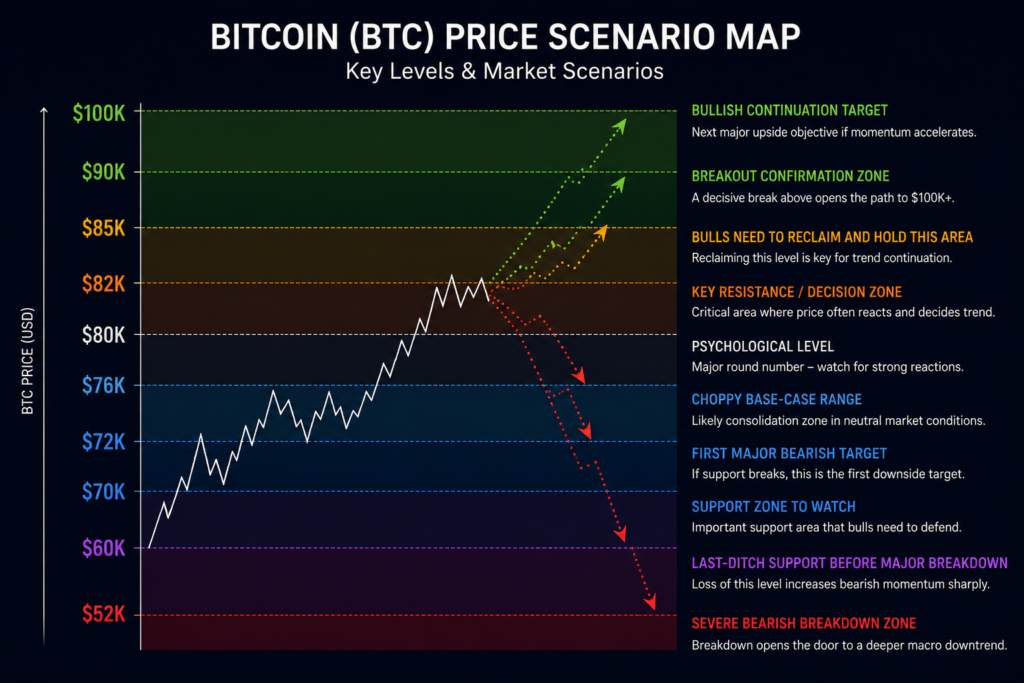
This is not a prediction that every level must be hit. It is a roadmap.
For me, the most important part is the $80K–$85K region. If Bitcoin breaks and holds above that area, the bearish thesis gets weaker. But if BTC fails there and starts closing back below $80K, I think the probability of a bigger drop rises quickly.
The Macroeconomic Picture Still Looks Risky for Bitcoin
Technical analysis is only one part of the story.
Bitcoin also depends heavily on macro conditions. People like to say BTC is independent from traditional finance, but in real market conditions, Bitcoin often trades like a high-beta risk asset. When liquidity is strong and investors want risk, BTC can fly. When liquidity tightens and fear comes back, BTC can fall hard.
That is another reason I’m still cautious.
Interest Rates and Liquidity Still Matter
Bitcoin tends to perform better when liquidity is expanding. Lower rate expectations, easier financial conditions, and stronger risk appetite usually help crypto.
But if the Federal Reserve stays hawkish, if inflation remains sticky, or if markets start pricing in tighter conditions again, Bitcoin could struggle.
This is where I think many crypto traders get too optimistic. They focus only on the BTC chart and ignore the macro backdrop. But if liquidity dries up, even strong assets can sell off.
In my opinion, Bitcoin needs more than a technical bounce. It needs a supportive macro environment. Without that, this rally could fade.
A Strong Dollar Could Pressure BTC
Another macro factor I would watch is the US dollar.
When the dollar strengthens, risk assets often come under pressure. A stronger dollar can make global liquidity feel tighter, especially for assets that rely on speculative demand. Bitcoin can sometimes move independently, but over time, it is still affected by liquidity cycles.
If the dollar starts moving higher again while Bitcoin is sitting near resistance, that would make me even more cautious.
It does not guarantee a crash, but it adds pressure.
ETF Flows Help, But They Don’t Eliminate Downside Risk
One of the strongest bullish arguments is ETF demand.
Spot Bitcoin ETFs have made BTC more accessible to institutions, advisors, and traditional investors. That is a real structural change. I do not dismiss it.
But ETF flows do not make Bitcoin immune to bear markets.
Institutions can buy, but they can also sell. Funds can allocate, but they can also rebalance. If macro conditions turn ugly, ETF demand can slow down. And if price starts falling, inflows can weaken just when bulls need them most.
That is why I do not think ETF demand alone is enough to declare the bear market over.
It helps the bullish case, but it does not remove the technical and macro risks.
Market Psychology: This Is Where Traders Get Trapped
One of the biggest reasons I still think BTC could drop is market psychology.
After a strong bounce, people want to believe the pain is over. Nobody likes sitting in uncertainty. Traders want a clean story: the bottom is in, the bull market is back, and the next target is $100K.
But markets are rarely that easy.
Bear markets are designed to make people doubt themselves. They punish late sellers, then punish early buyers. They create rallies that look convincing, only to roll over again when everyone starts feeling safe.
That is why I’m trying to stay realistic.
I may be wrong, but I would rather be cautious here than pretend Bitcoin has already confirmed a new bull market. The chart is better, but it is not clean enough for me yet.
The FOMO Trap Above $80K
The move above $80K can easily create FOMO.
Traders who were scared at $70K suddenly feel comfortable buying at $81K. That is normal human behavior, but it is also dangerous. The higher price goes into resistance, the more emotional traders become.
This is exactly where I think people need to slow down.
If Bitcoin breaks above $85K and holds, that is a different conversation. But buying aggressively into resistance before confirmation is risky. It may work, but the risk-to-reward is not as attractive as it looks.
For me, the smarter approach is to wait for confirmation or wait for a better opportunity.
What Would Make Me Change My Mind?
Even though I am bearish, I am not married to the bearish thesis. Markets change. Good analysis should have invalidation points. If Bitcoin proves strength, I will respect it.
There are a few things that would make me reconsider my view.
A Clean Break Above the Mid-$80Ks
The first thing I would need to see is a clean break above the mid-$80,000s.
Not just a wick. Not just a short squeeze. Not just one daily candle that gets everyone excited.
I want to see Bitcoin break above that area, hold it, and turn it into support. If BTC can do that, the bearish argument becomes weaker. It would suggest that buyers are strong enough to absorb selling pressure at a key level.
That would not automatically mean Bitcoin goes straight to new highs, but it would make the chart look much healthier.
Strong Spot Demand
The second thing I want to see is strong spot demand.
A rally driven mostly by leverage is not enough for me. Leveraged rallies can disappear quickly. If traders are using futures to chase price higher, the move can unwind violently when momentum slows.
Spot demand is different. It shows that real buyers are accumulating BTC, not just speculating with leverage.
If Bitcoin is going to prove that the bear market is over, I want to see stronger evidence of real demand underneath the move.
Better Macro Conditions
The third thing I would need is a more supportive macro backdrop.
If liquidity improves, risk appetite rises, inflation cools, and rate expectations become more favorable, Bitcoin has a much better chance of sustaining a move higher.
But if macro conditions stay uncertain or turn risk-off again, BTC could struggle near resistance.
That is why I’m not only watching the chart. I’m watching the broader environment too.
My BTC Price Scenarios: What Could Happen Next?
Here is how I currently see the market.
| Scenario | Trigger | Possible BTC Path | My View |
|---|---|---|---|
| Bullish breakout | BTC breaks and holds above $85K | Move toward $90K–$100K | Possible, but not confirmed |
| Base case | BTC chops around resistance | Range between $76K–$85K | Very realistic short-term |
| Bearish rejection | BTC fails at $80K–$82K | Drop toward $70K–$72K | My main risk scenario |
| Severe breakdown | $70K support fails | Move toward $48K–$52K | Not guaranteed, but possible |
Bullish Scenario
The bullish scenario is straightforward.
Bitcoin breaks above $82K, pushes through the mid-$80Ks, holds that level, and starts building a stronger trend. If that happens, BTC could move toward $90K and eventually test $100K.
If the chart gives that confirmation, I would have to respect it.
But we are not there yet.
Base Case
My base case is sideways volatility.
Bitcoin may chop between roughly $76K and $85K while the market decides what comes next. This would make sense because BTC is sitting near a major decision zone.
In this scenario, both bulls and bears get frustrated. Bulls do not get a clean breakout. Bears do not get an immediate collapse.
The market simply ranges until one side loses control.
Bearish Scenario
The bearish scenario is the one I take most seriously.
BTC fails to hold the $80K–$82K area, gets rejected near key moving averages, and starts moving back toward $70K–$72K.
If that happens, sentiment could flip quickly. Traders who bought the breakout may exit. Leveraged longs could get liquidated. The market could start treating the recent rally as a failed move.
That is when the downside risk becomes much more serious.
Severe Bearish Scenario
The severe bearish scenario happens if $70K fails.
In that case, Bitcoin could enter a much deeper correction. A move toward the $50K area would not be impossible, especially if macro conditions worsen at the same time.
I am not saying this must happen. But I do think it should be part of the risk map.
Crypto markets often move further than people expect in both directions. Ignoring downside just because price is currently bouncing is not a strategy.
Historical Bitcoin bear-market drawdowns across major cycles.
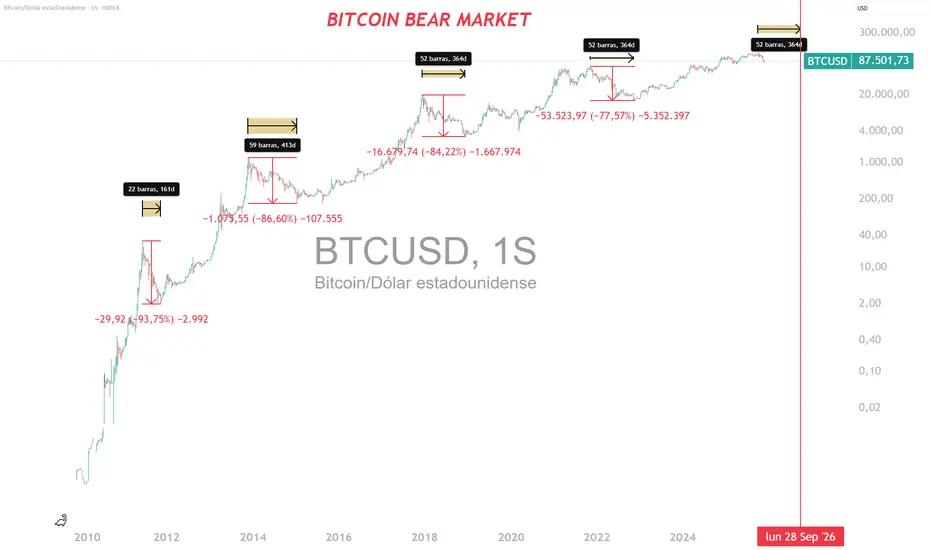
BTC has repeatedly experienced corrections above 75% even during long-term structural bull markets.
Final Thoughts: I Still Think BTC Is in a Bear Market
So, is BTC still in a bear market?
From my perspective, the biggest mistake investors can make is assuming Bitcoin is incapable of another deep macro correction.
The rally above $80K is important, but it is not enough. BTC is still facing a major resistance zone. The 200-day moving average remains a key test. The macro picture is still uncertain. ETF demand helps, but it does not remove downside risk. And market psychology is getting too comfortable too quickly.
Personally, I still think major drops are possible.
That does not mean I hate Bitcoin. It does not mean I think BTC has no future. Actually, I think Bitcoin remains one of the most important assets in the world. But being bullish long term does not mean being blind short term.
Right now, I would rather be cautious than chase a rally into resistance.
If Bitcoin reclaims the mid-$80Ks, holds that zone, and shows strong demand, I will reconsider. But until that happens, I still see this as a dangerous market where the bear case is very much alive.
Bitcoin may prove me wrong.
But for now, I still think the bear has not left the room.
FAQs
Is BTC still in a bear market?
In my view, yes. Bitcoin has bounced strongly, but it has not fully confirmed a new bull market. BTC still needs to reclaim key resistance levels, hold above major moving averages, and show stronger demand.
Is Bitcoin’s move above $80K bullish?
It is bullish in the short term, but not enough to confirm a full trend reversal. The $80K–$82K area is a major decision zone, and BTC needs to hold above it to strengthen the bullish case.
Can Bitcoin drop back to $70K?
Yes. If BTC fails near resistance and loses momentum, a move toward $70K–$72K is a realistic bearish scenario.
Could BTC fall below $50K?
It is not guaranteed, but it is possible in a severe breakdown scenario. If Bitcoin loses major support and macro conditions turn negative, a deeper correction toward the $48K–$52K area could happen.
What would prove the Bitcoin bear market is over?
A clean break above the mid-$80Ks, strong spot demand, better macro conditions, and sustained closes above major moving averages would all help confirm that the bear market is ending.
Should I buy BTC now?
This is not financial advice. Personally, I would be careful about chasing Bitcoin directly into resistance. Waiting for confirmation may be less exciting, but it can reduce the risk of buying into a failed breakout.