
When I look at XRP, I do not just see another crypto ticker moving up and down on a chart. I see one of the longest-running bets in crypto: the idea that blockchain can actually improve global payments, cross-border settlement and financial infrastructure.
That is why Brad Garlinghouse’s recent comments about the CLARITY Act, XRP and stablecoin regulation matter. The Ripple CEO is not only speaking to XRP holders. He is also speaking to lawmakers, banks, exchanges, institutions and anyone trying to understand whether the United States is finally ready to give crypto a real rulebook.
The core message is simple: clarity is better than chaos. And honestly, that is exactly how I see it too. Crypto in the U.S. has spent too many years stuck in a gray area, where companies often had to guess what regulators wanted after the fact. For a market that wants serious institutional adoption, that is not sustainable.
The CLARITY Act could become one of the most important crypto bills in the U.S. because it tries to define how digital assets should be regulated, which agencies should oversee them, and how projects can operate without constantly fearing surprise enforcement actions. Recent reporting around the bill has focused on the Senate Banking Committee, a possible markup timeline, and debates over stablecoin restrictions and market structure rules.
For XRP, the story is even more interesting. Ripple already fought one of the biggest legal battles in crypto history against the SEC. That case left XRP with a more defined regulatory story than many other tokens, even though the outcome was not a total clean sweep for Ripple. Reuters reported that Ripple’s case ended with a $125 million fine, while the court maintained a distinction between institutional XRP sales and XRP sales on public exchanges.
So when Garlinghouse talks about the CLARITY Act and says XRP has clarity, I do not read that as a simple victory lap. I read it as a bigger statement: XRP may have survived its regulatory fire, but the rest of the crypto industry still needs rules that are clear before companies build, banks adopt and investors trust the market.
Brad Garlinghouse’s Message: Clarity Is Better Than Chaos
Brad Garlinghouse has been one of the loudest voices in crypto regulation for years, and it makes sense. Ripple was not watching the SEC debate from the sidelines. Ripple was in the middle of the fight.
That context matters. When Garlinghouse talks about regulatory clarity, it is not theory. Ripple lived through years of uncertainty, legal costs, headlines, market pressure and investor anxiety. For XRP holders, the SEC case was not some abstract legal debate. It shaped the way exchanges treated XRP, how institutions viewed Ripple, and how the broader market talked about the asset.
What stood out to me from Garlinghouse’s comments is that he sounds less focused on hype and more focused on rules, banks and real adoption. That is a very different tone from the usual crypto conversation, where people often jump straight to price predictions.
The message is basically this: crypto cannot become mainstream financial infrastructure if every major company has to operate in legal fog.
Why His Comments Matter Right Now
Garlinghouse’s timing matters because the CLARITY Act is tied to a bigger political window. Reports around the bill suggest lawmakers are trying to move crypto market structure legislation forward before the legislative calendar becomes harder to manage during election season. CoinDesk reported that the bill was waiting on Senate Banking Committee action, while other coverage highlighted a bipartisan compromise related to stablecoin yield restrictions.
That is why the “next two weeks” framing became important in crypto news. The idea is not that XRP depends on one exact date. The bigger issue is momentum. If Congress delays again, the industry may stay stuck with patchwork enforcement, unclear agency boundaries and inconsistent treatment of digital assets.
In my view, that uncertainty is one of the biggest reasons U.S. crypto innovation has felt so messy. It is hard to build long-term products when nobody can tell you clearly which regulator is in charge or what classification your token will receive.
Why XRP Is at the Center of the Conversation
XRP is at the center of this conversation because it is one of the few major crypto assets with a long, public regulatory history.
The SEC sued Ripple in 2020, alleging that XRP sales were unregistered securities offerings. Years later, the case produced a mixed but extremely important outcome: sales of XRP on public exchanges were treated differently from certain institutional sales made by Ripple. Reuters reported that the SEC ultimately ended the lawsuit, leaving the $125 million fine and injunction in place.
That is why the phrase “XRP has clarity” became powerful inside the XRP community. It does not mean XRP is magically risk-free. It means XRP has already gone through a legal process that many other tokens have not.
And that is a big deal.
What Is the CLARITY Act?
The CLARITY Act is a proposed U.S. crypto market structure bill. In simple terms, it is designed to answer one of the biggest questions in crypto:
Who regulates what?
Right now, crypto companies often have to deal with overlapping signals from different agencies. The SEC may view some assets through securities law. The CFTC may view some assets more like commodities. Banks, exchanges, brokers, stablecoin issuers and blockchain companies all need to know which rules apply to them.
That is what the CLARITY Act is trying to address.
The Simple Explanation
The CLARITY Act is basically an attempt to create clearer rules for digital assets in the United States.
It aims to define when a digital asset should be treated like a security, when it may be treated more like a commodity, and what kind of disclosures, registration rules or compliance obligations crypto companies must follow.
For a normal investor or reader, the easiest way to understand it is this:
The CLARITY Act is supposed to reduce the guessing game.
Instead of crypto companies waiting to be sued before they understand the rules, the bill is meant to give the market a more predictable framework.
For me, this is why the bill matters. I do not think the crypto market needs zero regulation. I think it needs regulation that people can actually understand and follow.
Securities, Commodities and the Regulatory Gray Area
The biggest fight in U.S. crypto regulation has been whether tokens are securities, commodities or something else.
That classification matters because securities are heavily regulated. If a token is treated as a security, companies may need to register offerings, follow disclosure rules, and comply with securities law. If an asset is treated more like a commodity, the regulatory path can be very different.
This is exactly why XRP became such a major case. Ripple’s fight with the SEC forced the court to look at different types of XRP sales and whether they should be treated the same way. The final result was not as simple as “Ripple won everything” or “the SEC won everything.” It was more nuanced: institutional sales and public exchange sales were treated differently.
That nuance is important for the CLARITY Act. The bill is trying to make these distinctions clearer before companies end up in court.
Why U.S. Crypto Companies Need Clear Rules
Clear rules matter because serious companies cannot scale on uncertainty.
Banks need legal clarity. Payment companies need legal clarity. Exchanges need legal clarity. Stablecoin issuers need legal clarity. Institutional investors need legal clarity.
Without it, the U.S. risks pushing innovation offshore or creating a market where only the biggest companies can afford the legal risk.
That is one reason I think Garlinghouse keeps pushing this issue. Ripple is not just trying to win a debate on Twitter. Ripple wants to sell blockchain infrastructure to financial institutions. And financial institutions do not like gray areas.
How Regulatory Clarity Could Shape XRP and Crypto
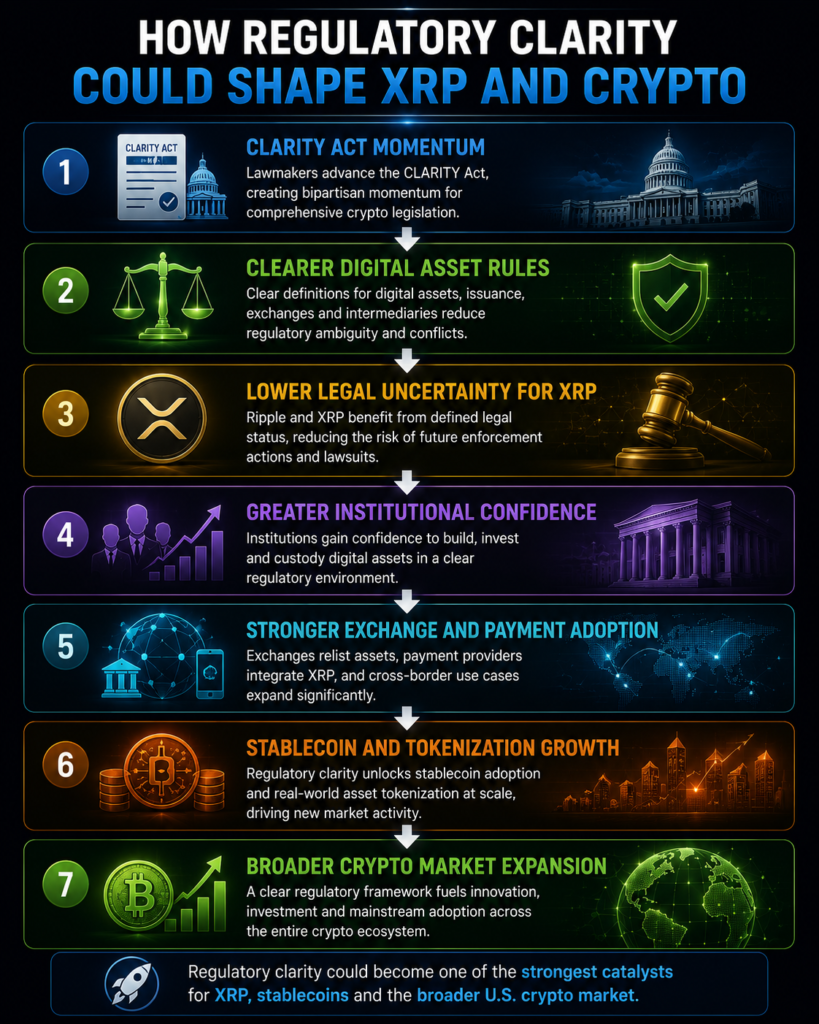
Regulatory clarity could become one of the strongest catalysts for XRP, stablecoins and the broader U.S. crypto market.
Why the CLARITY Act Matters for Ripple and XRP
The CLARITY Act matters for Ripple and XRP because Ripple’s business model sits directly at the intersection of crypto, payments, liquidity, stablecoins and institutional finance.
Ripple is not a meme coin project. It is a company trying to build payment infrastructure. XRP is part of that story because it can act as a bridge asset for liquidity and settlement, especially in cross-border payment flows.
But for that vision to scale in the United States, the regulatory environment has to be clear enough for banks and institutions to participate.
XRP Already Has a Different Regulatory Story
I would not say XRP is risk-free, but I do think it is one of the few major crypto assets with a real regulatory story behind it.
That matters because most tokens have not been tested in court the way XRP has. The Ripple case gave the market more information about how at least one federal court viewed different XRP transactions.
Again, this does not mean every possible XRP-related activity is automatically safe. It means XRP has more legal history than many other crypto assets.
That is why Garlinghouse can argue that XRP is not waiting for Washington in the same way some other tokens might be. XRP already went through a high-profile legal battle. The broader industry, however, still needs a clear national framework.
The Ripple vs SEC Case Changed the Conversation
The Ripple case changed crypto regulation because it challenged the idea that every token transaction should automatically be treated the same way.
The court’s distinction between institutional sales and public exchange sales became one of the most important legal developments in crypto. Reuters reported that the court found XRP sales on public exchanges did not meet the legal definition of securities, while institutional sales were treated differently.
That distinction matters for XRP holders, exchanges and crypto companies trying to understand how token sales may be evaluated.
In my opinion, this is why the XRP community is so focused on the word “clarity.” They are not just talking about marketing. They are talking about a legal outcome that changed how XRP is perceived.
Why Legal Clarity Can Attract Institutions
Institutions do not move like retail traders. They do not just see a green candle and jump in.
Banks, asset managers, payment processors and enterprise clients need compliance departments to sign off. They need legal opinions. They need risk models. They need to know what happens if regulators change direction.
That is where legal clarity becomes powerful.
If the CLARITY Act creates a more predictable environment, it could make it easier for companies like Ripple to pitch blockchain-based payment solutions to banks and financial institutions.
That does not guarantee XRP adoption. But it removes one major excuse institutions have had for staying away.
What Ripple Actually Does And Why XRP Matters
A lot of people still confuse Ripple and XRP.
Ripple is the company. XRP is the digital asset. XRP Ledger is the blockchain network. They are connected, but they are not the same thing.
That distinction is important because when people say “Ripple is doing this” or “XRP is doing that,” they often mix up the company, the token and the network.
Ripple Is Not Just Another Crypto Company
Ripple is best understood as a blockchain payments and digital asset infrastructure company.
Its long-term pitch is that global payments are slow, expensive and fragmented. Traditional cross-border payment systems often involve multiple intermediaries, delays, foreign exchange friction and trapped capital.
Ripple’s goal has been to use blockchain infrastructure to make value move faster.
That is why Ripple cares so much about banks. If crypto is going to affect global finance at scale, the company believes financial institutions have to be involved. That lines up with the video angle you shared: stablecoin regulation, tokenization and bank adoption are not side topics. They are central to Ripple’s future.
XRP as a Bridge Asset for Liquidity and Settlement
XRP’s core value proposition is not that it is a stable dollar. It is that it can act as a bridge asset.
In simple terms, XRP can be used to move value between currencies or networks without needing every financial institution to hold every possible currency pair in advance.
That is the big idea: liquidity on demand.
When I look at XRP, this is the part that interests me most. The price conversation is loud, but the real question is whether XRP can be used in enough real payment flows to justify long-term relevance.
The XRP Ledger and Real-World Payments
The XRP Ledger, often called XRPL, is the blockchain where XRP operates. It is designed for fast settlement and low transaction costs.
That makes it relevant for payments, tokenized assets and stablecoins. Ripple’s own RLUSD stablecoin is issued natively on both the XRP Ledger and Ethereum, according to Ripple’s official materials. Ripple says RLUSD is backed by segregated reserves of cash and cash equivalents and redeemable 1:1 for U.S. dollars.
That is important because it shows Ripple is not choosing between XRP and stablecoins. It is building around both.
Ripple CEO on Stablecoins, Tokenization and Bank Adoption
The video you shared points toward something bigger than the CLARITY Act alone.
Garlinghouse’s broader message around stablecoin regulation, tokenization and bank adoption suggests that Ripple is thinking about the next version of financial infrastructure. That means tokenized dollars, tokenized assets, faster settlement and regulated blockchain rails that institutions can actually use.
This is where I think many XRP conversations become too narrow. People ask, “Will stablecoins hurt XRP?” But the better question is:
Can stablecoins, XRP and tokenization all exist inside the same payment ecosystem?
I think the answer is yes.
Why Banks Are Still the Big Prize
Banks are still the big prize because they control enormous payment flows.
Retail crypto adoption matters, but institutional payment adoption is a different level. If banks, fintechs and payment companies start using blockchain rails for settlement, stablecoins and liquidity, that could create real demand for infrastructure.
Ripple has always positioned itself closer to that institutional world than many crypto projects.
That is why regulation matters so much. Banks are not going to deeply integrate with digital assets if the rules are unclear. They need compliance-ready products, reliable reserves, legal certainty and regulatory comfort.
Where Stablecoins Fit Into Ripple’s Strategy
Stablecoins are tokenized versions of fiat money, usually designed to maintain a stable value. In Ripple’s case, RLUSD is designed to maintain a value of one U.S. dollar and is backed by cash and cash equivalents, according to Ripple.
That makes stablecoins useful for payments, treasury movement, trading pairs and settlement.
The way I see it, stablecoins are not automatically competition for XRP. In Ripple’s world, they may become another rail on the same financial network.
A dollar-backed stablecoin can represent stable value. XRP can provide liquidity and bridge settlement. The XRP Ledger can provide infrastructure. Ripple can package these tools for institutions.
That is a much more interesting story than simply saying “stablecoins will kill XRP” or “XRP will replace stablecoins.”
XRP vs Stablecoins: Competition or Complement?
| Feature | XRP | Stablecoins like RLUSD |
|---|---|---|
| Main role | Bridge asset and liquidity tool | Stable digital dollar |
| Price behavior | Volatile | Designed to stay near $1 |
| Best use case | Cross-border liquidity and settlement | Payments, dollar transfers, trading and treasury |
| Regulatory concern | Token classification and sales history | Reserve backing, redemption, issuer rules |
| Ripple strategy | Part of liquidity infrastructure | Part of regulated payment infrastructure |
My take is simple: XRP and stablecoins do not have to fight for the same job.
A stablecoin is useful because it is stable. XRP is useful because it can move liquidity across markets. If Ripple can combine both inside regulated payment products, the ecosystem becomes stronger, not weaker.
The Future of XRP: What Could Happen Next?
The future of XRP depends on more than price charts.
It depends on regulation, liquidity, institutional adoption, real payment usage, stablecoin growth, exchange support, tokenization and Ripple’s ability to execute.
That is why I do not like lazy predictions like “XRP is going to the moon” or “XRP is dead.” Both are too simple.
The better way to think about XRP is through scenarios.
Bullish Scenario: Regulation, Banks and Liquidity Line Up
The bullish case for XRP is that U.S. crypto regulation becomes clearer, Ripple keeps expanding institutional relationships, stablecoins grow on the XRP Ledger, and XRP continues to be used as a liquidity tool.
In this scenario, the CLARITY Act helps by reducing uncertainty. Banks become more comfortable with digital assets. Ripple can pitch regulated payment products more easily. RLUSD adds more utility to the ecosystem. XRP benefits from being part of that infrastructure.
This is the version XRP holders want to see.
But even in the bullish case, utility has to show up. Narratives can move price in the short term, but long-term value needs usage.
Neutral Scenario: XRP Survives, But Adoption Takes Time
The neutral scenario is probably the most realistic middle ground.
XRP keeps its place as a major crypto asset. Ripple continues building. Regulation improves slowly. Stablecoins grow. But institutional adoption takes longer than expected.
That would not be shocking. Banks move slowly. Regulators move slowly. Payment infrastructure changes slowly.
In this scenario, XRP remains relevant, but the big transformation takes years instead of months.
I think this is the scenario investors should take seriously. Even good technology and better regulation do not automatically create instant adoption.
Bearish Scenario: Regulation Improves, But Usage Disappoints
The bearish scenario is that crypto gets more legal clarity, but XRP does not capture enough real-world usage.
This could happen if banks prefer stablecoins without needing XRP, if other payment networks win more adoption, if regulatory rules become too restrictive, or if Ripple’s products do not scale as expected.
That is the risk XRP holders should not ignore.
I still think XRP has one of the most interesting regulatory stories in crypto, but legal clarity alone does not guarantee demand. The market will eventually ask a simple question:
Who is actually using it, and for what?
My Take: XRP’s Future Is About Utility, Not Just Hype
My view is simple: XRP’s future depends less on memes and more on whether Ripple can keep turning regulation, bank relationships and liquidity into actual usage.
Garlinghouse’s comments about the CLARITY Act are important because they point to the next phase of crypto. The industry is moving from rebellion to integration. That does not mean crypto loses its edge. It means serious adoption requires serious rules.
For XRP, that could be a good thing.
XRP has already been through years of legal pressure. Ripple has already fought the SEC. The market already understands that XRP is not just a random new token appearing out of nowhere.
But the next chapter has to be about execution.
Why I Think Garlinghouse Is Focused on the Bigger Picture
I do not think Garlinghouse is only trying to defend XRP’s past. I think he is trying to position Ripple for the future of regulated digital finance.
That future includes:
- Stablecoins.
- Tokenized assets.
- Bank adoption.
- Cross-border payments.
- Crypto market structure.
- Clearer rules for digital assets.
- Better settlement infrastructure.
That is why the CLARITY Act matters. It could give companies like Ripple a clearer path to build in the U.S. instead of constantly navigating uncertainty.
What I Would Watch Before Getting Too Excited
Before getting too bullish, I would watch a few things carefully.
First, I would watch whether the CLARITY Act actually advances in the Senate. Momentum matters, but bills can still stall.
Second, I would watch how stablecoin rules develop. Stablecoins are becoming a major part of the crypto economy, and restrictions around yield, reserves and issuer obligations could shape the market. Recent reporting says the CLARITY Act compromise included restrictions on stablecoin issuers offering yield or interest on reserves.
Third, I would watch RLUSD adoption. Ripple’s stablecoin could become an important part of its institutional strategy if it gains real usage.
Fourth, I would watch whether XRP sees measurable payment and liquidity demand, not just speculative trading.
That is the difference between hype and utility.
Conclusion: The CLARITY Act Could Be Bigger Than One Token
The CLARITY Act is not just about XRP. It is about whether the United States can finally create a serious rulebook for digital assets.
But XRP is one of the most interesting assets in this debate because Ripple already went through the kind of regulatory battle that many crypto companies fear. That gives XRP a different story.
Brad Garlinghouse’s message is not just “XRP is fine.” The bigger message is that crypto needs rules clear enough for builders, banks, investors and institutions to move forward.
For me, that is the real takeaway.
XRP’s future will not be decided by one headline, one interview or one bill alone. It will be decided by whether Ripple can connect regulatory clarity, stablecoins, bank adoption, tokenization and real-world liquidity into something people actually use.
And if that happens, XRP could remain one of the most important assets in the conversation about the future of global payments.
FAQs About Ripple, XRP and the CLARITY Act
What is the CLARITY Act?
The CLARITY Act is a proposed U.S. crypto market structure bill designed to create clearer rules for digital assets. It aims to define how crypto assets should be regulated, which agencies should oversee them, and how companies can comply with the law.
Why is the CLARITY Act important for XRP?
It matters because XRP has been at the center of U.S. crypto regulation for years. Even though XRP has more legal clarity than many tokens after the Ripple case, a broader law could create a clearer environment for Ripple, exchanges, institutions and the crypto market as a whole.
Did Brad Garlinghouse say XRP already has clarity?
Yes, Garlinghouse has argued that XRP has a level of clarity because of the Ripple legal case. The important nuance is that XRP’s situation is clearer than many other tokens, but the broader U.S. crypto market still lacks a complete regulatory framework.
Is XRP a security?
The safest answer is nuanced. The Ripple case distinguished between different types of XRP sales. Public exchange sales were treated differently from certain institutional sales by Ripple, which were found to fall under securities law. Reuters reported that the case ended with a $125 million fine and an injunction related to institutional sales.
Are stablecoins bad for XRP?
Not necessarily. Stablecoins and XRP can serve different purposes. A stablecoin like RLUSD is designed to represent a stable U.S. dollar value, while XRP can function as a bridge asset for liquidity and settlement. In Ripple’s strategy, they may complement each other.
What is RLUSD?
RLUSD is Ripple’s U.S. dollar stablecoin. Ripple says it is issued on the XRP Ledger and Ethereum, backed by segregated reserves of cash and cash equivalents, and redeemable 1:1 for U.S. dollars.
What is the future of XRP?
The future of XRP depends on regulatory clarity, institutional adoption, Ripple’s execution, stablecoin growth, XRP Ledger usage and real demand for liquidity in cross-border payments. XRP has a strong narrative, but long-term success depends on utility, not just hype.