
Silver has been one of the most fascinating and frustrating markets to follow in 2026.
After a powerful run that pushed prices dramatically higher, silver has started to correct. And whenever silver corrects, the same question comes back: what happened to silver?
The simple answer is that silver is being pulled in two directions at once.
On one side, higher interest rates, a stronger US dollar, real yields, profit-taking, and shifting Federal Reserve expectations can pressure precious metals. On the other side, silver still has a long-term demand story that is hard to ignore: solar panels, electronics, electrification, advanced manufacturing, data centers, and the broader AI infrastructure boom.
That is why I do not see silver’s 2026 correction as a simple “bull market is over” story. To me, silver is one of those assets that can look weak in the short term while its structural case remains very much alive.
As of April 29, 2026, Trading Economics showed silver trading around $71.31 per troy ounce, down on the day but still sharply higher year over year. The same data showed silver up more than 118% compared with the previous year, while noting that silver had reached an all-time high earlier in January 2026. Prices move quickly, so those figures should be treated as a market snapshot, not a fixed reference point.
So the real question is not only whether silver is correcting.
The better question is: what kind of correction is this a temporary reset, a warning sign, or the beginning of a wider repricing?
Silver’s 2026 Pullback: What Is Actually Happening?
Silver’s correction in 2026 is not happening in a vacuum. It is the result of several forces hitting the market at the same time.
First, silver had already moved aggressively higher. After a large rally, corrections are normal. Traders take profits. Short-term buyers get nervous. Leveraged positions unwind. Momentum cools. A market that moves too far too quickly often needs to reset before it can build another leg higher.
Second, silver is sensitive to interest rates. Like gold, silver does not pay interest. When Treasury yields rise or when markets believe the Federal Reserve will keep rates higher for longer, non-yielding assets can become less attractive. In that environment, investors may prefer cash, bonds, or other income-producing assets.
Third, the US dollar matters. Silver is priced globally in dollars. When the dollar strengthens, silver often becomes more expensive for buyers using other currencies, which can weigh on demand.
Fourth, geopolitical risk has added another layer of volatility. Recent market coverage has highlighted the tension between safe-haven demand and rate fears across precious metals, with silver and gold reacting to Federal Reserve signals and broader uncertainty.
From my perspective, one of the biggest mistakes investors make with silver is expecting it to move in a straight line. Silver rarely does that. It can rally violently, then correct just as aggressively, even when the long-term thesis has not changed.
That is what makes silver so difficult and so interesting.
Why silver is correcting after strong moves
The correction is partly technical and partly macroeconomic.
When silver rises sharply, it attracts momentum traders. These buyers can push the price higher very quickly, but they can also leave the market just as quickly. If a key level breaks, selling can accelerate. That does not always mean long-term investors have abandoned silver. Sometimes it simply means the fast money is moving out.
There is also a valuation issue. If silver moves too far ahead of fundamentals, the market may need to cool off. Industrial users may delay purchases. Investors may hesitate. Traders may wait for better entry points.
A correction after a major rally can actually be healthy if it removes excess speculation. The danger comes when the pullback is driven not just by profit-taking, but by a deterioration in the underlying demand story.
Right now, I would frame silver’s correction as a mix of both: short-term market pressure, but not yet a full breakdown in the long-term case.
The role of interest rates, real yields, and the US dollar
Silver tends to dislike rising real yields.
Real yields are interest rates adjusted for inflation. When real yields rise, investors can earn more from relatively safer assets. That makes metals less attractive, especially for large institutions comparing silver against bonds, cash, and other assets.
The Federal Reserve is central to this story. If the market expects rate cuts, silver can benefit. If the market expects rates to stay higher, silver can struggle. That is why every Fed speech, inflation report, employment number, and Treasury yield move can matter.
The dollar adds another layer. A stronger dollar often creates pressure on commodities. A weaker dollar can support them.
This is why silver sometimes sells off even when the industrial story looks positive. The macro backdrop can overpower the fundamentals in the short run.
Why short-term weakness does not always break the bigger trend
Silver can correct sharply without destroying the larger trend.
That is especially true when the correction comes after a very strong rally. In those cases, the market may simply be digesting gains.
The bigger issue is whether silver’s fundamental drivers remain intact. Are industrial users still buying? Is supply tight? Are investors still interested in precious metals? Is the energy transition still supporting long-term demand? Are AI and data center buildouts still increasing pressure on electricity infrastructure?
If the answer to most of those questions remains yes, then a correction may be painful but not necessarily fatal.
Why Silver Is So Volatile Compared With Other Assets
Silver is volatile because it has two identities.
It is a precious metal, like gold. But it is also an industrial metal, more like copper in some respects. That combination makes silver unusually sensitive to both fear and growth.
When investors worry about inflation, currency debasement, geopolitical risk, or financial instability, silver can attract safe-haven demand. But when investors worry about recession, weaker manufacturing, or falling industrial demand, silver can come under pressure.
That dual personality is the core reason silver often moves more aggressively than gold.
Gold is mostly a monetary and investment asset. Silver is partly monetary, partly industrial, partly speculative, and partly technological. That makes it more complicated.
In my view, silver’s volatility is not a bug it is part of the asset’s personality.
Silver’s dual identity: precious metal and industrial metal
Silver is used in jewelry, coins, bars, and investment products. But it is also used in electronics, solar panels, electrical contacts, medical applications, batteries, and industrial systems.
That means silver reacts to different kinds of news.
If inflation fears rise, silver may benefit.
If the dollar falls, silver may benefit.
If solar demand rises, silver may benefit.
If manufacturing slows, silver may suffer.
If rates rise, silver may suffer.
If investors panic, silver may either rise as a safe haven or fall as traders liquidate positions.
That is why silver is hard to simplify.
It is not just “poor man’s gold.” That phrase misses the point. Silver is a hybrid asset, and hybrid assets are naturally more volatile.
Why silver often moves harder than gold
Silver usually has a smaller market than gold. That matters.
A smaller market can move faster when money flows in or out. When bullish sentiment builds, silver can outperform gold dramatically. But when sentiment reverses, silver can fall harder too.
The gold-to-silver relationship is important here. In strong precious metals bull markets, silver often lags at first and then catches up aggressively. In periods of stress or liquidity pressure, silver can underperform because investors prefer gold’s deeper, more liquid market.
This is why silver can feel emotionally exhausting. It can look like the best asset in the world during a breakout and then suddenly behave like a highly speculative commodity during a selloff.
What volatility means for investors and market sentiment
For investors, silver volatility creates both opportunity and risk. The opportunity is obvious: when silver runs, it can move very quickly. The risk is just as obvious: drawdowns can be brutal. That is why silver is rarely an asset people should analyze with a one-day mindset. A single correction does not tell the whole story. You need to look at the macro setup, the technical structure, the industrial demand picture, and investor positioning.
Personally, I think silver is best understood as an asset that rewards patience but punishes overconfidence.
The Big Drivers of Silver Prices for the Rest of 2026
The rest of 2026 will likely be shaped by five major forces:
- Federal Reserve policy
- The US dollar
- Inflation and recession risk
- Industrial demand
- Investor positioning and volatility
No single factor controls silver all the time. The dominant driver can change quickly.
Federal Reserve policy and macro uncertainty
The Fed remains one of the biggest variables for silver.
If inflation stays sticky and the Fed keeps policy tight, silver may struggle to build a sustained rally. Higher rates and higher real yields usually create headwinds.
But if the economy weakens and rate cuts become more likely, silver could benefit. Lower rates reduce the opportunity cost of holding metals. They can also weaken the dollar, which may support commodity prices.
This is why silver traders watch the Fed so closely. The metal is not only reacting to current rates. It is reacting to what the market thinks the Fed will do next.
Inflation, recession fears, and safe-haven demand
Silver can benefit from inflation fears, but the relationship is not always clean.
If inflation rises because of strong demand, silver may benefit from both monetary and industrial forces. But if inflation rises while growth weakens, the picture becomes more complicated. Industrial demand may come under pressure, even as safe-haven demand rises.
That is the challenge in 2026. The market is not dealing with a simple inflation story. It is dealing with inflation, geopolitics, energy prices, rate uncertainty, and growth concerns all at once.
This combination can make silver choppy.
Industrial demand, supply pressure, and market positioning
The industrial side of silver remains one of the most important parts of the story.
The Silver Institute said in February 2026 that the silver market was expected to remain in deficit for a sixth consecutive year, with supportive supply-demand fundamentals still in place. It also pointed to factors such as tight physical supply, geopolitical volatility, US policy uncertainty, and concerns around the Federal Reserve as part of the backdrop.
A market deficit does not guarantee higher prices every month. But it does matter. If supply remains constrained and demand stays firm, the long-term balance can remain supportive even during corrections.
That is one reason I would not dismiss silver simply because it pulls back. A correction can change sentiment. It does not automatically change the supply-demand structure.
Silver’s Industrial Story Is Getting More Important
Silver’s industrial demand story is no longer a side note. It is central.
Silver is one of the most conductive metals in the world. That makes it valuable in electrical and electronic applications. It is used where efficiency, reliability, and conductivity matter.
This is especially important in a world moving toward electrification, renewable energy, automation, and advanced technology.
Silver in solar panels, electronics, and electrification
Solar remains one of the biggest industrial demand stories for silver.
Silver is used in photovoltaic cells because of its conductivity. Even though manufacturers are constantly trying to reduce the amount of silver used per solar cell, the overall scale of solar deployment remains a major factor for demand.
The Silver Institute has noted that silver demand is expected to expand across key technology sectors, while also acknowledging that technological improvements can reduce silver intensity in some photovoltaic cells. That tension is important: solar can be supportive for silver, but efficiency gains may reduce the amount of silver needed per unit.
This is exactly why the silver story needs nuance.
It is not enough to say, “solar is growing, so silver must go up.” The better argument is that solar, electronics, and electrification create a structural demand base, but prices still depend on supply, substitution, thrift technologies, investment flows, and macro conditions.
Why industrial demand gives silver a different profile than gold
Gold’s main demand pillars are investment, jewelry, central banks, and some technology use. Silver has a much larger industrial personality. That means silver can participate in precious metals rallies, but it can also respond to manufacturing cycles.
If the economy is strong, industrial silver demand can help. If the economy slows, that same industrial exposure can become a risk. This makes silver more cyclical than gold. It also makes it potentially more leveraged to long-term technology trends.
Where technology demand could support prices
The strongest long-term argument for silver is not just that people want to own it as a store of value. It is that modern economies keep finding ways to use it.
Silver plays a role in:
- solar panels
- electrical systems
- electronics
- sensors
- switches
- medical applications
- industrial equipment
- electric vehicles
- advanced manufacturing
That gives silver a broader demand base than many investors realize. And that brings us to one of the most interesting parts of the 2026 story: artificial intelligence.
What AI Has to Do With Silver
The connection between AI and silver is real, but it should not be exaggerated.
AI does not mean every data center is suddenly filled with silver bars. That would be a lazy argument. The smarter connection is indirect.
AI requires massive digital infrastructure. That infrastructure requires chips, servers, networking equipment, cooling systems, power systems, grid upgrades, backup energy, and huge amounts of electricity. Silver can benefit from parts of that ecosystem because it is used in electronics, electrical components, and energy infrastructure.
So when I think about AI and silver, I do not see a simple one-line story. I see a broader infrastructure story.
AI, data centers, and the growing need for power infrastructure
AI is increasing demand for computing power. Computing power increases demand for data centers. Data centers increase demand for electricity. Electricity demand increases the need for grid investment, power equipment, renewable energy, and efficiency.
That chain matters.
The International Energy Agency estimated that data centers consumed around 415 terawatt-hours of electricity in 2024, about 1.5% of global electricity consumption, and that data center electricity use had grown at about 12% per year over the previous five years.
The IEA also reported that data center electricity demand grew by 17% in 2025, while AI-focused data centers grew even faster.
That does not mean silver prices will rise just because AI grows. But it does mean AI is part of a much larger electrification and infrastructure trend and silver sits inside that ecosystem.
Chips, connectivity, and advanced industrial systems
AI infrastructure depends on semiconductors, servers, cooling, high-performance networking, and power management. These systems require advanced electronic components and reliable electrical conductivity.
Silver’s role in technology is not always visible to consumers, but it is there. It is embedded in the machinery of modern life.
The bigger the digital economy becomes, the more important electrical efficiency and reliability become. That is where silver’s physical properties matter.
Again, this is not a short-term trading signal. It is a long-term demand lens.
Why the AI link is indirect but still worth watching
The AI-silver connection should be framed carefully. A weak version of the argument would be: “AI uses silver, so silver must go higher.”
A stronger version is: “AI accelerates electricity demand, data center construction, grid upgrades, chip production, and advanced infrastructure and those trends can support demand for metals used in electrical and technological systems, including silver.”
That is the argument I think makes sense.
It is not hype. It is infrastructure.
Silver Price Chart: What the Market Is Telling Us
Silver Price Chart 2026
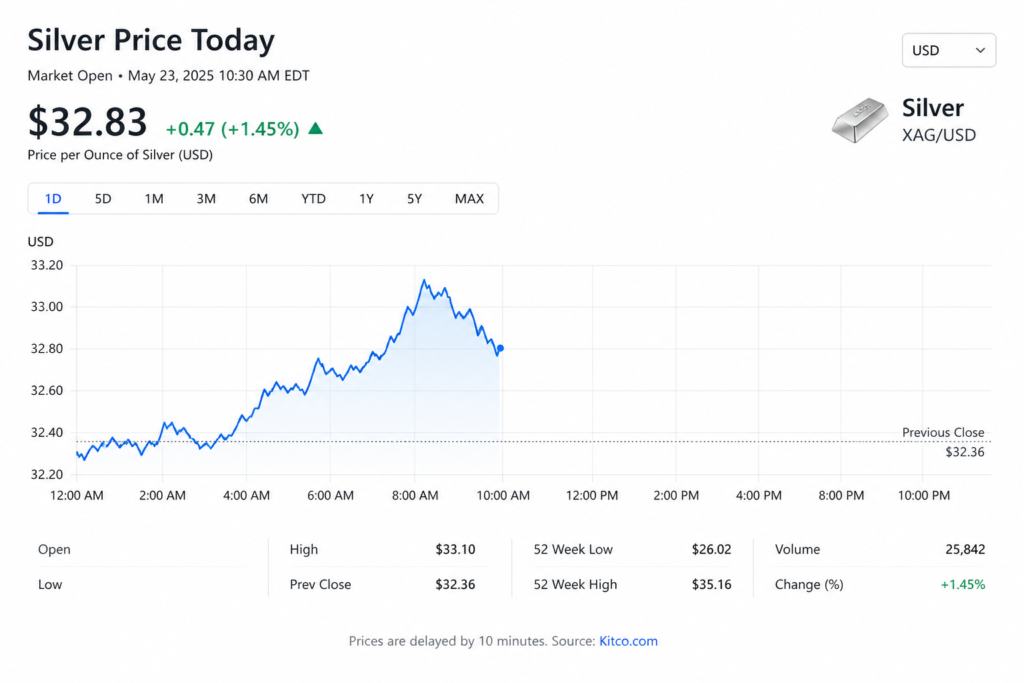
A silver price chart is important because this market is emotional. Words can explain the story, but the chart shows the violence of the move.
As of April 29, 2026, Trading Economics data showed silver trading near $71.31 per troy ounce, down on the day but still up sharply compared with the previous year. The same source showed silver had reached an all-time high of $121.64 in January 2026.
That context matters. A fall from extreme highs can feel bearish, but if the price is still massively higher year over year, the market may be correcting from excess rather than collapsing into weakness.
Key price zones and recent behavior
For the chart section, I would focus on three zones:
- Recent highs: where momentum peaked and sellers appeared
- Current consolidation area: where buyers and sellers are fighting
- Major support zones: where the market previously found demand
The exact technical levels should be updated before publishing, but the logic is simple: silver needs to stabilize before a durable recovery can form.
A strong recovery would likely require:
- Lower real yields.
- A weaker US dollar.
- Renewed precious metals inflows.
- Stronger industrial demand signals.
- Improving technical momentum.
Further weakness could come from:
- Higher Treasury yields.
- A stronger dollar.
- Reduced rate-cut expectations.
- Weaker manufacturing data.
- Investor liquidation after a crowded rally.
How to read the current correction in context
The current correction should be read as a stress test.
If silver holds above important support levels and begins forming higher lows, the bull case remains alive. If it breaks major support with heavy volume and the macro backdrop worsens, the market may need more time to reset.
For me, the most important thing is not whether silver has a bad week. It is whether the long-term demand story remains intact while the macro pressure fades.
What would confirm recovery or further weakness
A recovery would look more convincing if silver starts rising even when the market is not relying solely on fear or geopolitics. That would suggest broader demand and investment interest.
Further weakness would look more serious if silver falls despite supportive industrial headlines, a softer dollar, or improving rate expectations. That would suggest the market is dealing with deeper positioning or demand concerns.
Silver Outlook for the Rest of 2026: Bullish, Base, and Bearish Scenarios
No one can predict silver perfectly. Anyone who claims otherwise is selling certainty that does not exist. A better approach is to think in scenarios.
Bullish scenario
The bullish case for silver in the rest of 2026 would likely require a combination of softer Fed policy, a weaker US dollar, persistent inflation concerns, and continued strength in industrial demand.
In this scenario, investors return to precious metals, real yields fall, and silver benefits from both monetary and industrial demand.
AI infrastructure, data centers, solar, electrification, and grid investment would not need to create a sudden demand shock. They would simply need to reinforce the idea that silver has a strong structural use case beyond jewelry and investment.
In a bullish scenario, silver could regain momentum and challenge higher levels again, especially if the market believes the correction has cleared speculative excess.
Base-case scenario
The base case is probably continued volatility.
Silver may trade in wide ranges as investors debate the Fed, inflation, recession risk, and industrial demand. This would not be surprising. Silver often needs time to consolidate after extreme moves. In this scenario, prices may remain choppy, with rallies sold and dips bought.
The long-term story would remain constructive, but short-term macro pressure would prevent a clean breakout. This is the scenario that feels most realistic to me unless the Fed or the dollar delivers a major surprise.
Bearish scenario
The bearish case would involve higher real yields, a stronger dollar, weaker industrial demand, and a broader risk-off move that forces investors to sell commodities. If manufacturing slows meaningfully, solar demand disappoints, or investors rotate away from metals, silver could remain under pressure.
A bearish scenario would become more convincing if silver breaks major support levels and fails to recover even when macro conditions improve. The biggest risk is that silver’s 2026 rally pulled too much demand forward and left the market vulnerable to a deeper reset.
Final Thoughts: Is Silver Still a Story Worth Watching in 2026?
Yes silver is absolutely still a story worth watching in 2026.
But it is not a simple story.
Silver is correcting because rates, the dollar, profit-taking, and market positioning matter. It is volatile because it is both a precious metal and an industrial metal. It can fall sharply even when the long-term demand case remains intact.
That is exactly why I find silver so interesting.
The market is not just asking whether silver is “cheap” or “expensive.” It is asking whether the world still needs more of it. And when you look at solar, electrification, electronics, AI infrastructure, data centers, and grid investment, the answer is not easy to dismiss.
Still, silver is not a guaranteed winner. It is a high-volatility asset that can punish anyone who treats it like a straight-line bet.
My view is simple: silver’s correction deserves respect, but it does not erase the bigger picture. The rest of 2026 will likely be noisy, emotional, and macro-driven but the industrial and technological demand story remains one of the strongest reasons to keep watching this metal closely.
FAQs
Why is silver correcting in 2026?
Silver is correcting because of profit-taking after a strong rally, pressure from interest rates, changes in Federal Reserve expectations, a stronger US dollar, and short-term market positioning. Corrections are common in silver because the metal is highly volatile and often attracts speculative flows.
Why is silver more volatile than gold?
Silver is more volatile than gold because it has a smaller market and a dual identity. It behaves partly like a precious metal and partly like an industrial metal. That means it reacts to inflation, interest rates, the dollar, manufacturing demand, solar demand, and investor sentiment all at once.
Can AI really support silver demand?
AI can support silver demand indirectly. AI growth increases the need for data centers, electricity, chips, networking equipment, cooling systems, and grid infrastructure. Silver is used in electrical and technological applications, so it can benefit from the broader infrastructure buildout, even if the relationship is not direct or immediate.
Could silver still rally later in 2026?
Yes, silver could still rally later in 2026 if real yields fall, the US dollar weakens, the Fed becomes more dovish, industrial demand remains firm, and investors return to precious metals. However, silver could also remain volatile or fall further if macro conditions turn against it.
Is silver more attractive than gold right now?
Silver may offer more upside than gold in certain bullish scenarios because it is more volatile and more tied to industrial demand. But that also means it carries more risk. Gold is usually the cleaner safe-haven asset, while silver is more cyclical and more sensitive to technology and manufacturing trends.
What is the biggest risk for silver in 2026?
The biggest risk is that macro pressure overwhelms the industrial demand story. If real yields rise, the dollar strengthens, and industrial demand weakens, silver could remain under pressure even if the long-term technology narrative stays intact.
What is the strongest bullish argument for silver?
The strongest bullish argument is the combination of monetary demand and industrial demand. Silver can benefit from inflation fears, weaker real yields, precious metals inflows, solar demand, electrification, electronics, AI infrastructure, and tight supply conditions.