
Why AI may become one of the most powerful economic forces of the next decade
Artificial intelligence is no longer just a technology story. It is becoming a macroeconomic force capable of reshaping productivity, inflation dynamics, labor markets, capital allocation and even the way central banks analyze economic growth.
For years, the global economy relied on three major engines of expansion: globalization, demographic growth and cheap capital.
Now, all three are slowing down. Global trade fragmentation is increasing. Public debt levels remain historically elevated. Interest rates are structurally higher than they were during the post-2008 era. Aging populations are reducing labor force growth across developed economies.
In this environment, artificial intelligence is emerging as one of the few structural forces capable of increasing productivity fast enough to offset some of these pressures. That is why markets, governments and central banks are paying close attention.
The AI story is no longer only about chatbots or software automation.
It is increasingly about the future productive capacity of the global economy itself.
Why Productivity Matters More Than Ever
Productivity is one of the most important variables in macroeconomics. In simple terms, productivity measures how efficiently an economy transforms labor, capital and technology into output.
Historically, countries become wealthier not simply because they work more hours, but because they become more productive. That distinction matters enormously today.
Most developed economies are facing:
- Slower population growth.
- Rising debt burdens.
- Higher financing costs.
- Weaker demographic trends.
- Declining productivity growth compared to previous decades.
Without productivity gains, long-term growth becomes harder to sustain.
This is where AI becomes critical.
Unlike many previous technological waves, artificial intelligence is not confined to a single industry. Its impact spreads across almost every sector simultaneously.
Manufacturing uses AI for predictive maintenance and automation. Financial institutions use machine learning for risk analysis and capital allocation. Healthcare systems use AI for diagnostics and operational optimization. Logistics companies use AI to improve routing and inventory management. Energy companies use AI to optimize electricity demand and grid efficiency.
This creates system-wide efficiency gains.
And that is what makes this technological cycle different.
How AI Transmits Into the Real Economy
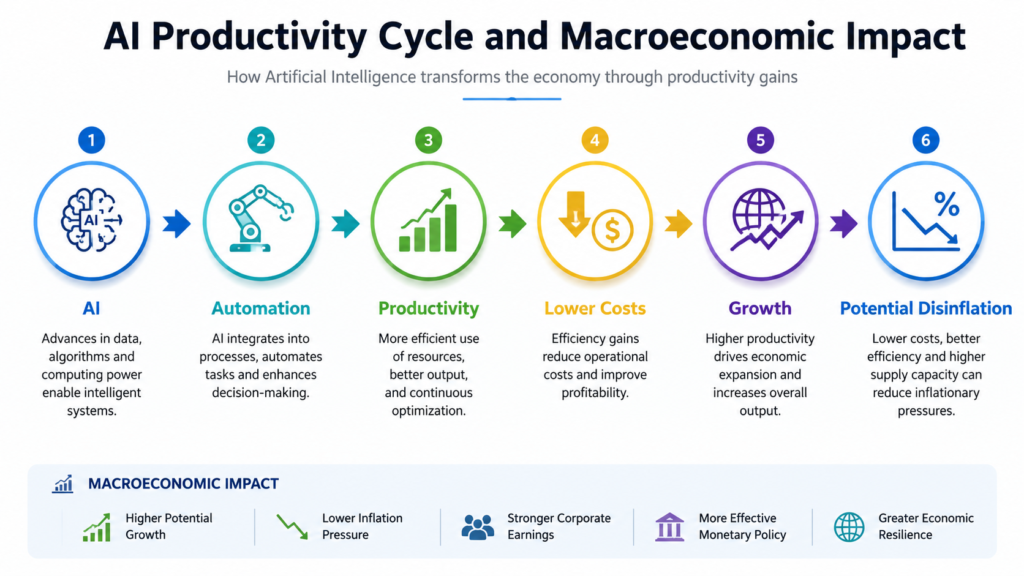
AI is increasingly moving from software applications into core economic infrastructure.
AI Is Changing the Nature of Economic Growth
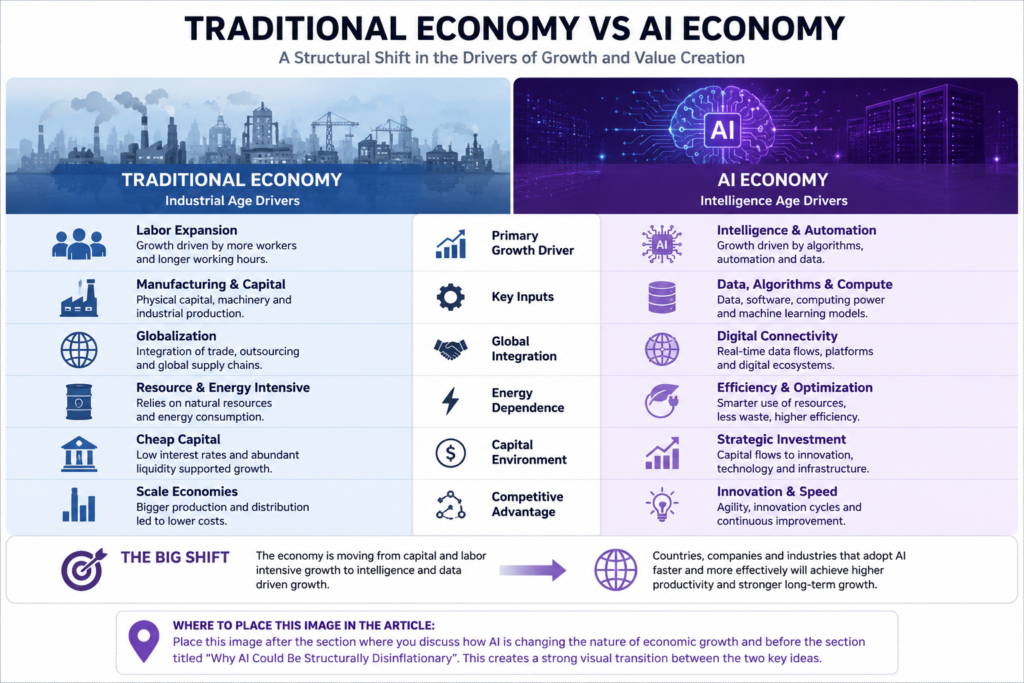
The traditional economy was driven mainly by:
- Labor.
- Physical capital.
- Energy.
- Industrial production.
The emerging AI economy is increasingly driven by:
- Data.
- Algorithms.
- Computing power.
- Automation.
- Digital infrastructure.
This is a structural shift. The global economy is gradually moving from labor-intensive growth toward intelligence-intensive growth.
That may sound abstract, but markets are already reacting to it.
Companies capable of integrating AI effectively are improving:
- operational efficiency
- customer targeting
- cost management
- supply-chain optimization
- productivity per employee
This is one reason why the largest technology companies continue to dominate equity markets. The S&P 500’s performance in recent years has become increasingly concentrated around firms viewed as leaders in artificial intelligence infrastructure and adoption. Markets are starting to price AI not simply as a technological innovation, but as a future productivity engine.
Traditional Economy vs AI-Driven Economy
| Traditional Growth Drivers | AI-Driven Growth Drivers |
|---|---|
| Labor expansion | Automation |
| Globalization | Digital infrastructure |
| Cheap capital | Computational efficiency |
| Industrial production | Data and algorithms |
| Manufacturing scale | AI-enhanced productivity |
| Resource intensity | Optimization and intelligence |
The global economy is gradually shifting toward a productivity model driven by computation and automation.
Why AI Could Be Structurally Disinflationary
One of the most important macroeconomic questions is whether AI could reduce inflationary pressures over time. The answer is potentially yes but the process will not be immediate or uniform.
Artificial intelligence can reduce costs in several ways:
- Automation of repetitive tasks.
- Improved logistics efficiency.
- Optimization of energy usage.
- Faster software development.
- Reduced operational waste.
- Better allocation of resources.
If an economy becomes more efficient, it can produce more output without generating the same inflationary pressure. This is critical for central banks.
Historically, economic expansions often created inflation because stronger demand pushed labor markets and production capacity beyond their limits. But if productivity rises significantly, economies may be able to grow faster without overheating.
That could partially change one of the oldest tradeoffs in macroeconomics:
the tradeoff between growth and inflation.
The Potential AI Productivity Cycle
Suggested chart
| Stage | Economic Impact |
|---|---|
| AI adoption begins | Higher corporate investment |
| Automation expands | Lower operational costs |
| Productivity improves | Faster output growth |
| Supply efficiency rises | Lower inflationary pressure |
| Economic expansion extends | Stronger earnings and investment |
Productivity-driven growth could alter traditional economic cycles.
But AI Could Also Create Inflationary Pressures
This is where the story becomes more complex. AI may reduce costs in software and services, but it also requires massive physical infrastructure.
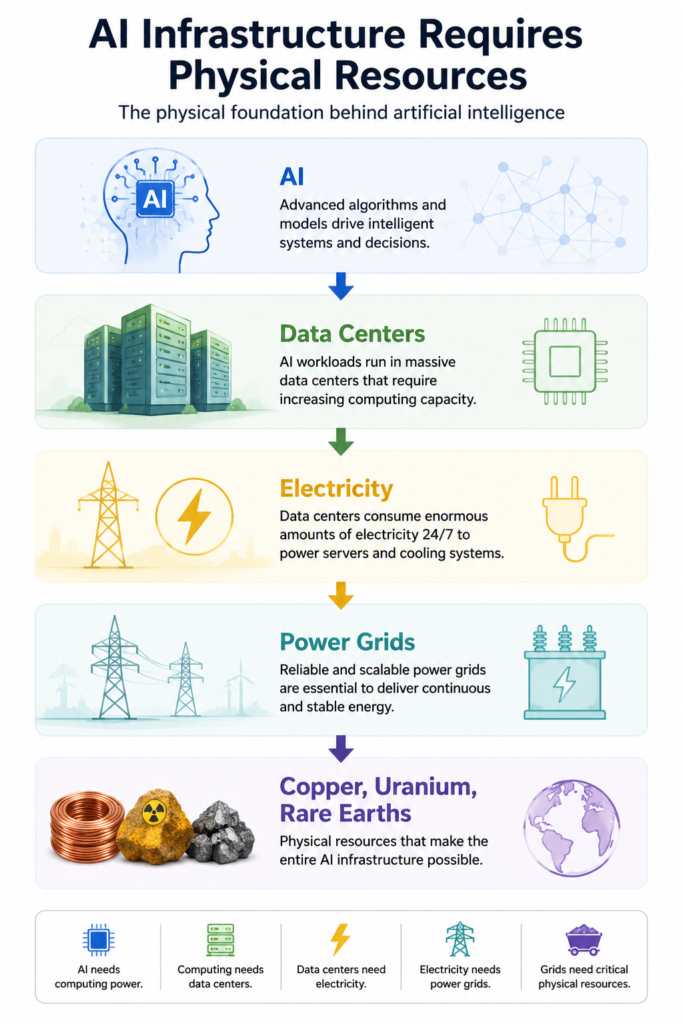
Data centers consume enormous amounts of electricity. Advanced chips require highly specialized manufacturing. AI infrastructure needs copper, rare earths, semiconductors, cooling systems and power grids.
This creates a second macroeconomic effect: AI may also increase demand for energy, industrial metals and strategic commodities.
In other words: AI may reduce labor costs. But it may increase infrastructure costs. That creates a tension markets are still trying to price correctly.
The International Energy Agency recently warned that electricity demand from AI-related data centers is rising much faster than expected, while grid investment and power generation capacity are struggling to keep pace.
This is one reason why:
- Copper demand is rising.
- Uranium interest is increasing.
- Grid investment is accelerating.
- Strategic commodities are gaining importance.
The AI boom is not only digital. It is also physical.
AI and Financial Markets
Financial markets are increasingly differentiating between:
- Economies that lead AI adoption.
- Economies that lag behind.
This divergence may become one of the defining themes of the next decade.
Countries capable of:
- Attracting talent.
- Securing computing infrastructure.
- Building energy capacity.
- Leading semiconductor production.
- Integrating AI into industry.
Could achieve structurally stronger productivity growth. That is why the AI race between the United States and China matters so much. This is no longer simply technological competition.
It is economic competition. Industrial competition. Geopolitical competition.
AI leadership increasingly translates into:
- Higher productivity.
- Stronger capital inflows.
- Greater innovation capacity.
- Stronger corporate earnings.
- Higher strategic influence.
Potential Winners From the AI Productivity Cycle
| Sector | Why It Benefits |
|---|---|
| Semiconductors | AI computing demand |
| Data centers | Infrastructure expansion |
| Power utilities | Electricity demand growth |
| Cloud computing | AI deployment |
| Cybersecurity | AI-related digital risk |
| Industrial automation | Efficiency gains |
| Grid infrastructure | Electrification and AI energy needs |
| Software platforms | Workflow optimization |
Labor Markets: The Biggest Uncertainty
One of the most debated aspects of AI is its effect on employment. Historically, technological revolutions destroyed some jobs while creating others. AI may follow the same pattern, but potentially at a much faster speed. Routine cognitive tasks are increasingly vulnerable to automation:
- Administrative work.
- Customer service.
- Data processing.
- Basic coding.
- Repetitive analytical tasks.
At the same time, demand could rise for:
- AI engineers.
- Infrastructure specialists.
- Energy technicians.
- Cybersecurity experts.
- Advanced manufacturing workers.
This transition may create temporary imbalances. Some sectors may experience strong productivity gains while parts of the labor market struggle to adapt.
This is important because labor market disruptions can influence:
- Wage growth.
- Consumer spending.
- Inequality.
- Political stability.
- Monetary policy decisions.
The productivity benefits of AI may therefore coexist with social and economic tensions during the transition period.
Why Central Banks Are Watching AI Closely
Artificial intelligence is introducing a new variable into macroeconomic analysis.
Traditional monetary policy models rely heavily on:
- Unemployment.
- Wage growth.
- Consumption.
- Credit conditions.
- Inflation expectations.
But AI may change the relationship between these variables.
If productivity rises rapidly:
- Inflation may fall faster.
- Output capacity may increase.
- Labor shortages may ease.
- Economic growth could remain stronger for longer.
This means central banks may eventually need to rethink parts of their analytical framework.
The Federal Reserve and the European Central Bank are increasingly aware that technological productivity could become a major macroeconomic factor over the next decade.
Monetary policy may no longer depend only on labor-market tightness or interest-rate sensitivity.
It may increasingly depend on:
- Technology diffusion.
- Productivity acceleration.
- Infrastructure capacity.
- AI-related investment cycles.
AI’s Potential Impact on the Macro Economy
| Area | Potential Effect |
|---|---|
| Productivity | Higher |
| Long-term growth | Higher |
| Inflation | Potentially lower over time |
| Labor displacement | Higher during transition |
| Energy demand | Higher |
| Commodity demand | Higher |
| Corporate margins | Improved in AI leaders |
| Market concentration | Increased |
AI may simultaneously improve productivity while increasing pressure on energy systems and strategic resources.
The Geopolitical Dimension of AI
AI is not just an economic story. It is increasingly tied to geopolitical power.
Control over:
- Semiconductors.
- Advanced chips.
- Computing infrastructure.
- Cloud systems.
- Electricity generation.
- Rare earth supply chains.
Is becoming strategically important.
This is why the United States and China are investing aggressively in:
- AI infrastructure.
- Semiconductor manufacturing.
- Domestic supply chains.
- Strategic mineral access.
- Energy capacity.
The Key Risk Markets May Be Underestimating
Markets are increasingly optimistic about AI. But there are still major risks.
The AI boom does not eliminate:
- High public debt.
- Geopolitical tensions.
- Trade fragmentation.
- Energy bottlenecks.
- Financial instability.
In fact, AI infrastructure expansion may intensify some of these pressures by increasing:
- Electricity demand.
- Capital spending.
- Strategic resource competition.
There is also the possibility that markets are overpricing short-term productivity gains before they fully materialize. Technological revolutions usually take longer to diffuse across the real economy than investors initially expect. The internet transformed the world, but the productivity effects took years to appear meaningfully in macroeconomic data.
AI may follow a similar path.
Practical Reading for Investors
The AI story is no longer limited to technology stocks.
Investors increasingly need to analyze:
- Electricity demand.
- Semiconductor supply chains.
- Strategic commodities.
- Infrastructure spending.
- Labor-market transitions.
- Productivity trends.
- Monetary policy implications.
The companies and countries that integrate AI most efficiently may achieve structurally stronger growth over the next decade. But volatility will remain high.
Markets tend to overestimate short-term disruption while underestimating long-term structural change.
That may also happen with AI.
Conclusion: AI Is Becoming a Macroeconomic Force
Artificial intelligence is no longer a peripheral technological trend.
It is gradually becoming one of the most important forces shaping:
- Productivity.
- Inflation.
- Labor markets.
- Monetary policy.
- Industrial competitiveness.
- Capital allocation.
- Geopolitical power.
The world economy is entering a transition where intelligence, automation and computational infrastructure become central drivers of growth.
From my perspective, the real significance of AI is not that it creates new software tools. It is that it may fundamentally alter how economies generate output and manage resources.
That could help offset some of the structural pressures weighing on the global economy today:
- Aging populations.
- High debt levels.
- Slower globalization.
- Tighter financial conditions.
But the transition will not be frictionless. AI may reduce costs in some sectors while increasing infrastructure and energy pressures in others. It may improve productivity while simultaneously disrupting labor markets. And it may increase geopolitical competition over technology, energy and strategic resources.
What seems increasingly clear is this:
Artificial intelligence is no longer just a technology theme. It is becoming a macroeconomic theme. And possibly one of the defining economic transformations of the next decade.
FAQs
Why is artificial intelligence important for the economy?
AI is important because it can improve productivity, reduce operational inefficiencies, optimize resource allocation and potentially increase long-term economic growth.
Could AI reduce inflation?
Potentially yes. AI can lower costs through automation, logistics optimization and higher efficiency. However, the process may take years and could vary across sectors.
Why are markets so focused on AI?
Markets view AI as a future productivity engine capable of improving corporate earnings, competitiveness and long-term economic growth.
How does AI affect energy demand?
AI requires large-scale data centers and advanced computing infrastructure, which significantly increases electricity consumption and grid demand.
Could AI replace jobs?
AI may automate certain repetitive cognitive tasks, but it could also create demand for new specialized roles in infrastructure, engineering, cybersecurity and advanced manufacturing.
Why are central banks paying attention to AI?
Because productivity gains from AI could alter inflation dynamics, labor markets and long-term economic growth, affecting monetary policy decisions.
Which sectors benefit the most from AI adoption?
Semiconductors, cloud computing, data centers, power infrastructure, industrial automation, cybersecurity and AI software platforms are among the sectors most exposed to AI growth.
Is AI becoming a geopolitical issue?
Yes. Control over semiconductors, computing infrastructure, strategic minerals and advanced AI systems is increasingly linked to economic and geopolitical power.