
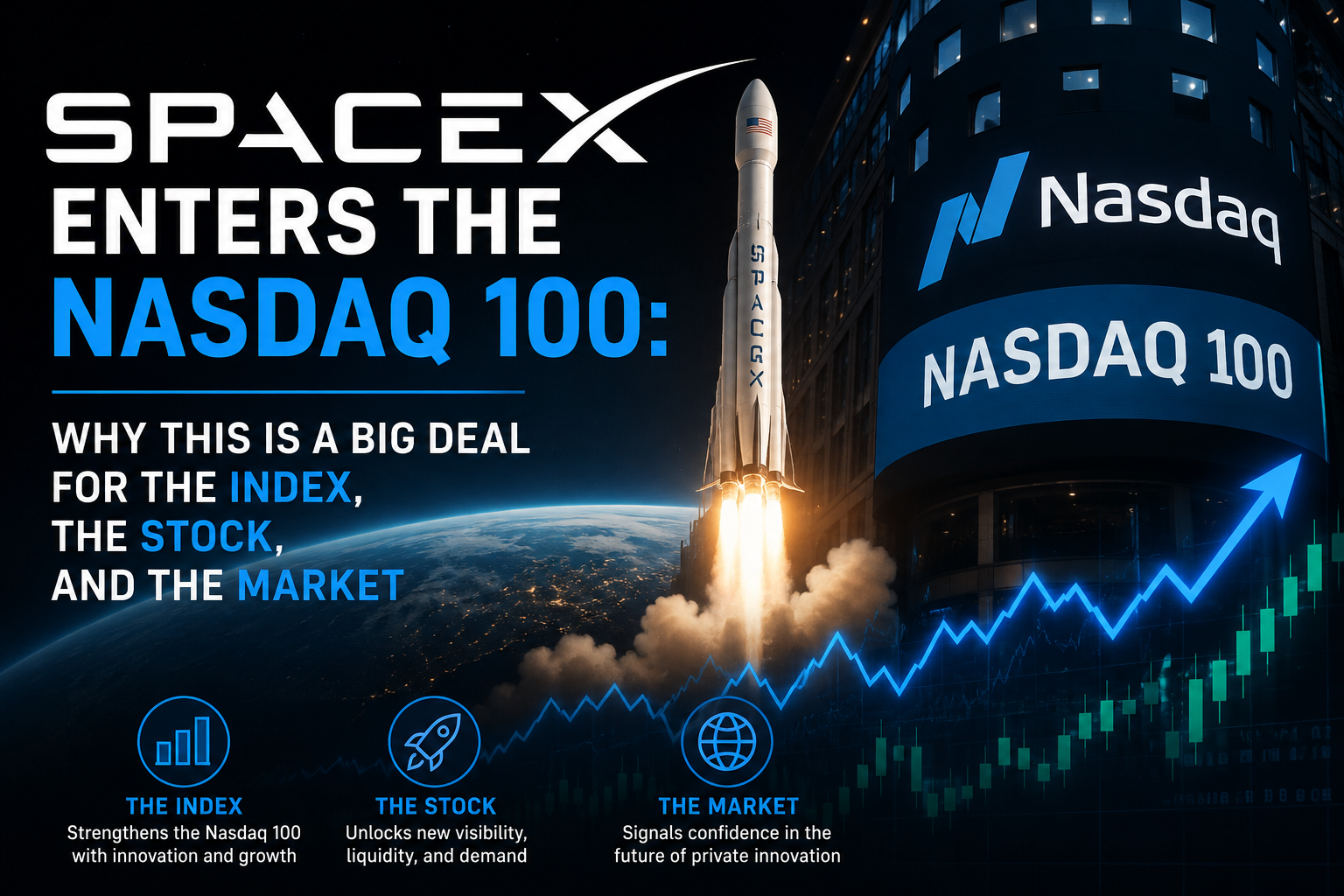
SpaceX entering the Nasdaq 100 is not just another index-change headline. The way I see it, this is one of those moments where a company stops being only a story about innovation, rockets, satellites, Elon Musk, and future potential, and becomes part of the daily machinery of the U.S. stock market.
That is the real shift here.
SpaceX is no longer just a high-profile post-IPO stock that traders are watching for volatility. It is now a stock that index funds, ETFs, portfolio managers, benchmark-aware institutions, and retail investors indirectly have to deal with. Once a company enters the Nasdaq 100, it becomes part of one of the most followed growth and technology benchmarks in the world.
According to Reuters, SpaceX joined the Nasdaq 100 on July 7, 2026, less than a month after its June 12 IPO, making it one of the fastest additions ever to the index. That speed was possible because Nasdaq revised its rules for newly listed companies entering major benchmarks.
That alone makes the story important. But the bigger story is what happens next: passive buying, index weighting, volatility, analyst coverage, valuation pressure, and the question every investor eventually asks — where can the stock go from here?
SpaceX’s Nasdaq 100 Inclusion Is More Than Just a Headline
What matters to me here is not simply that SpaceX got into the Nasdaq 100. The important part is how fast it happened and why the market cares so much.
Normally, index inclusion is a technical event. A company qualifies, index providers announce the change, funds rebalance, and the market moves on. But SpaceX is not a normal company, and this is not a normal inclusion.
SpaceX came public in what has been described as the largest IPO in U.S. market history. Cinco Días reported that the offering was valued at US$75 billion and that the stock was trading above its IPO price of US$135 shortly after listing.
That creates a rare setup: a newly public company with an enormous market capitalization, a powerful retail following, institutional demand, a low public float, and immediate index demand.
For investors, that mix can be explosive. It can support the stock in the short term, but it can also exaggerate volatility. When too much demand chases too few freely traded shares, price moves can become sharper than fundamentals alone would justify.
Why the Timing Matters
The timing is crucial because SpaceX entered the Nasdaq 100 shortly after its IPO, before the market had much time to fully digest its public valuation, earnings profile, governance structure, and long-term financial model.
Reuters noted that SpaceX made its Nasdaq debut on June 12 and joined the Nasdaq 100 on July 7. That is a very compressed timeline for a company of this size to go from IPO excitement to benchmark ownership.
In my view, that compresses several market phases into one short window:
First, the IPO hype phase.
Second, the analyst-coverage phase.
Third, the index-inclusion phase.
Fourth, the passive-buying phase.
Usually, these stages have more breathing room. With SpaceX, they are overlapping. That makes the stock harder to analyze because the price is being influenced by fundamentals, narratives, technical flows, and forced institutional buying all at once.
Why This Is One of the Fastest Index Inclusions Ever
Nasdaq’s rule change is central to the story. Reuters reported that SpaceX’s rapid entry was enabled by revised rules for newly listed companies seeking inclusion in major benchmarks.
Morningstar explained that Nasdaq changed its rules to allow SpaceX to enter the Nasdaq 100 after 15 trading days, while FTSE Russell also created a fast-entry rule for large IPOs. Morningstar also highlighted that S&P Dow Jones kept its 12-month waiting period and profitability filter for the S&P 500.
That contrast matters. Nasdaq is moving faster. S&P is being more conservative.
From a market-structure perspective, Nasdaq is basically saying: if a company is big enough and important enough, the index should reflect that sooner. S&P is saying: size alone is not enough; we still want seasoning, eligibility, and a longer public track record.
That difference creates an interesting split. SpaceX gets immediate exposure through Nasdaq-linked products, but not yet through the S&P 500, which remains the larger and more widely tracked U.S. equity benchmark.
What SpaceX Joining the Nasdaq 100 Actually Means
When people hear “SpaceX enters the Nasdaq 100,” it can sound symbolic. In reality, it has very practical consequences.
The Nasdaq 100 is tracked by major ETFs and funds, including Invesco QQQ. When a new stock enters the index, funds that replicate the benchmark need to buy the stock in order to match the index composition.
That is why this matters. It creates automatic demand.
Reuters reported that J.P. Morgan estimated SpaceX’s Nasdaq 100 inclusion could draw around US$4.3 billion in passive inflows. Reuters also reported that more than US$587 billion is benchmarked to funds tracking the Nasdaq 100.
Cinco Días put the expected forced-buying range between roughly US$4 billion and US$6 billion, with at least €4.5 billion in purchases from indexed products.
Bloomberg Línea cited Bloomberg Intelligence analyst Rob Du Boff estimating that inclusion in Nasdaq 100 and FTSE Russell indexes would drive at least US$5.4 billion in purchases from index-tracking funds.
The exact number varies depending on the source and methodology, but the direction is clear: billions of dollars in mechanical demand are now attached to SpaceX stock.
The Power of Passive Buying
Passive buying is not based on whether a fund manager loves SpaceX, believes in Mars colonization, or thinks Starship will change global logistics. It is based on index rules.
That is what makes it powerful.
If a fund tracks the Nasdaq 100, and SpaceX becomes part of the Nasdaq 100, the fund has to own SpaceX in proportion to its benchmark weight. The portfolio manager does not need to be bullish. The mandate does the buying.
I would not treat this as a simple “index-inclusion pop,” though. The market often anticipates these flows before the actual inclusion date. Traders buy ahead of the event, expecting passive funds to come in later. Then, once the event happens, some of that early speculative money may sell.
That may help explain why the stock can fall even on good index-inclusion news. Reuters reported that SpaceX shares fell 5.4% on the day of the Nasdaq 100 entry amid broader weakness in high-momentum tech stocks and concerns about the AI boom.
In other words, index inclusion is supportive, but it is not magic.
Why QQQ and Other ETFs Matter
The most important ETF in this story is Invesco QQQ, one of the most widely followed Nasdaq 100 products. Cinco Días specifically pointed to Invesco QQQ Trust as a major product affected by SpaceX’s entry.
For retail investors, this changes something important: many people may now own SpaceX indirectly without buying SPCX shares directly. If they own QQQ or another Nasdaq 100-linked product, SpaceX becomes part of their exposure.
That has two effects.
First, it broadens SpaceX’s investor base.
Second, it ties SpaceX more directly to the performance and identity of U.S. mega-cap growth stocks.
That matters because SpaceX is not just an aerospace company in this context. Inside the Nasdaq 100, it will be grouped psychologically with Nvidia, Apple, Microsoft, Tesla, Amazon, Meta, and other large growth names. Whether that comparison is fair or not, it is how many investors will frame it.
The Free-Float Problem
The biggest technical issue is SpaceX’s low free float.
Cinco Días reported that about 95% of SpaceX shares remain in the hands of initial holders, especially Elon Musk, leaving around US$100 billion of stock freely trading out of a total valuation above US$2 trillion.
Morningstar also noted that SpaceX’s public float at IPO was around 4.25% of total shares, and that Musk owned around 49% of the company’s equity according to the June 3 prospectus.
This matters because a low float can amplify price moves. If passive funds need to buy billions of dollars of stock, but only a small percentage of shares is freely available, the demand can put upward pressure on the price.
But the same structure can work in reverse later. When lock-up periods expire and insiders or early investors are allowed to sell, the available supply can increase. That can pressure the stock if demand does not keep up.
This is one of the most important risks in the SpaceX story.
Why This Matters for the Nasdaq 100
SpaceX joining the Nasdaq 100 changes the index itself.
The Nasdaq 100 has always been technology-heavy, growth-oriented, and more concentrated than many broader market benchmarks. Adding SpaceX makes it even more tied to futuristic, capital-intensive, high-expectation businesses.
In my opinion, this makes the Nasdaq 100 more exciting, but also more complicated.
SpaceX brings exposure to rockets, satellite broadband, defense-adjacent infrastructure, AI ambitions, and Elon Musk’s ecosystem. That is a very different business mix from a software company or a semiconductor firm.
A Bigger Bet on Space, AI, and Elon Musk
Reuters described SpaceX as a rocket and satellite company with AI ambitions, and noted that brokerages are valuing it across space, connectivity, and AI. Goldman analysts, according to Reuters, said the company is well positioned across markets that could become multi-trillion-dollar opportunities over a five-year-plus horizon.
That is the bull narrative in one sentence: SpaceX is not just a launch company. It is a platform company.
The market is trying to price several businesses at once:
Starlink as a global satellite broadband network.
Starship as a reusable launch system that could transform space economics.
Government and defense contracts as a stable strategic revenue base.
AI infrastructure as a potential new growth pillar.
That combination is exactly why the stock attracts excitement. It is also why valuation becomes so difficult.
More Concentration, More Volatility
Adding SpaceX could increase the Nasdaq 100’s exposure to high-beta, story-driven growth. Reuters reported that SpaceX had a 1.34% weight in the Nasdaq 100 according to LSEG data.
Cinco Días reported a lower estimated range of 0.5% to 0.8%, based on free-float constraints and Nasdaq 100 rules.
The difference likely reflects different timing, data inputs, or weighting methodology. But even at a modest weight, SpaceX matters because of its profile. This is not a sleepy defensive stock. It is a newly public, highly watched, low-float, mega-cap growth name.
That can add volatility to ETFs that track the index, especially if SpaceX’s price swings remain large.
Why the S&P 500 Is Taking a Slower Approach
One of the most important parts of this story is what did not happen: SpaceX did not get fast-tracked into the S&P 500.
Reuters reported that S&P Global declined to create a similar fast-track process and that SpaceX is expected to wait at least a year before joining the S&P 500.
Morningstar also highlighted that S&P maintained its profit filter and 12-month waiting period.
That matters because S&P 500 inclusion would likely be an even bigger demand event. The S&P 500 is tracked by far more assets than the Nasdaq 100. If SpaceX eventually qualifies, the passive-flow story could repeat on a larger scale.
So for me, the Nasdaq 100 inclusion is not the final catalyst. It may be the first major index catalyst.
What It Could Mean for SpaceX Stock
The stock impact is where the story becomes more nuanced.
On one hand, passive inflows support demand. On the other hand, the market knew this inclusion was coming, and the stock had already moved sharply after the IPO.
Reuters reported that SpaceX shares had gained about 1% since their debut as of July 7, after a volatile post-IPO ride.
The Wall Street Journal reported that SpaceX shares fell more than 5% on July 7, trading just under US$152, close to the US$150 level where the stock opened on June 12. WSJ also reported that the stock remained more than 10% above its US$135 IPO price but more than 25% below its post-IPO peak above US$200.
That gives us the basic technical map:
US$135: IPO price.
Around US$150: first-day opening area.
Above US$200: post-IPO peak zone.
Around US$152: recent trading area reported by WSJ on July 7.
Those levels matter because investors tend to anchor around IPO price, first trade, and early highs.
The Bull Case
The bull case is straightforward: SpaceX is a rare asset.
It has a dominant launch business, Starlink scale, strategic relevance to the U.S. government, potential AI infrastructure ambitions, and a brand that retail investors understand immediately.
Reuters reported that Raymond James set a Wall Street-high price target of US$800, arguing that SpaceX could become one of the century’s defining infrastructure platforms.
That is an aggressive target, but it shows how some analysts are thinking. They are not valuing SpaceX as a normal aerospace company. They are trying to value it as a foundational infrastructure company across space, communications, and AI.
If that view proves right, today’s valuation could eventually look less extreme.
The bull case depends on several assumptions:
Starship must work at scale.
Launch costs must fall dramatically.
Starlink must keep expanding globally.
AI infrastructure must become a real business, not just a narrative.
SpaceX must convert revenue growth into durable profitability.
If those pieces come together, the stock could move much higher over the long term.
The Bear Case
The bear case is also clear: expectations may be too high.
Reuters reported that CFRA was the only brokerage with a sell rating and a Street-low price target of US$115.
That downside case matters because SpaceX’s valuation already reflects a lot of future success. If the company misses execution targets, delays Starship milestones, burns more cash than expected, or faces regulatory/political pressure, the stock could re-rate lower.
Bloomberg Línea also quoted New Constructs CEO David Trainer warning that SpaceX’s market valuation may not be connected to its fundamentals.
That is the key bear argument: the company may be extraordinary, but the stock may already be pricing in too much.
I think investors need to separate those two ideas. A great company can still be an expensive stock.
The Base Case I Would Watch
My base case is that SpaceX remains volatile after entering the Nasdaq 100.
I would not be surprised to see support around IPO-related levels, especially near US$135 to US$150, because those areas represent important psychological anchors. But I would also not be surprised to see the stock struggle if it cannot reclaim the post-IPO momentum zone above US$200.
In the short term, the stock may trade less on fundamentals and more on flows, sentiment, analyst commentary, and broader tech-market risk appetite.
In the medium term, the market will likely focus on:
The first public earnings reports.
Starlink revenue growth.
Starship launch cadence.
Margins and cash burn.
Any additional debt or capital raises.
Lock-up expiration dates.
Progress toward S&P 500 eligibility.
That is where the real test begins.
The Role of Wall Street Analysts
One reason this Nasdaq 100 inclusion matters is that it coincides with major Wall Street firms initiating coverage.
Reuters reported that more than a dozen brokerages, including Morgan Stanley, Goldman Sachs, and J.P. Morgan, started coverage of SpaceX with top ratings.
This is important because it gives institutional investors a framework. Before that, SpaceX was largely a private-market legend. Now analysts are publishing price targets, forecasts, risk assessments, and valuation models.
That changes the conversation.
Why Buy Ratings Matter
Buy ratings can attract more institutional interest, especially when they come from major banks. They also help create a valuation narrative around the stock.
Reuters reported that analysts see Starship as a key growth driver and that Wall Street forecasts thousands of Starship launches annually by 2031, with projections ranging from more than 1,500 to around 5,000 launches depending on the bank.
That is a huge assumption. If Starship achieves that level of scale, SpaceX could become one of the most important infrastructure companies in the world.
But if Starship remains slower, more expensive, or more technically difficult than expected, those models may need to come down.
Why Investors Should Still Be Careful
Bloomberg Línea made an important point: sell-side analysts are often optimistic. It noted that among the 3,000 largest U.S. companies, buy recommendations represent 63% of all analyst ratings, while sell ratings represent only 4.2%.
That does not mean analysts are wrong. But it does mean investors should not blindly treat a wave of buy ratings as proof that a stock is cheap.
In my view, analyst coverage is useful, but it is not a substitute for risk management.
Key Risks After the Nasdaq 100 Inclusion
SpaceX entering the Nasdaq 100 creates support, but it does not remove risk. In some ways, it increases the stakes.
Valuation Risk
SpaceX’s valuation is enormous. Reuters reported that SpaceX had a market capitalization of about US$2 trillion, making it the sixth-largest U.S. company.
At that size, the company is no longer being valued like a speculative startup. It is being valued like one of the most important businesses in the world.
That means the market will demand results.
Revenue growth alone may not be enough forever. Investors will want to see margins, cash flow, execution, and evidence that SpaceX can justify a valuation normally reserved for the largest technology platforms.
Lock-Up Expiration Risk
This is one of the biggest post-IPO risks.
Cinco Días reported that bearish investors may get more room when post-IPO lock-up periods expire and early shareholders with large unrealized gains are able to sell.
That matters because today’s low float is part of what supports the stock. If more shares become available later, the supply-demand balance can change.
A stock can be supported by scarcity at first and pressured by supply later.
That is why I would watch lock-up expiration dates closely.
Execution Risk Around Starship, Starlink, and AI
The SpaceX thesis depends on execution across multiple fronts.
Starlink has to keep growing.
Starship has to scale.
AI ambitions have to become economically meaningful.
Government contracts need to remain durable.
Regulation and geopolitical issues need to stay manageable.
Reuters reported that investors are betting SpaceX can evolve into a hyperscale AI infrastructure provider, while also seeing room for Starlink to expand in satellite communications.
That is a big vision. But big visions come with big execution risk.
Where SpaceX Stock Could Go Next
I would look at SpaceX stock in three scenarios.
Short-Term Scenario
In the short term, the stock may remain choppy.
Index inclusion can support demand, but much of that demand may already be anticipated. If broader tech stocks sell off, SpaceX can fall too, even with passive buying in the background.
The key levels I would watch are:
US$135, the IPO price.
US$150, the first-day opening area.
US$200+, the early post-IPO peak zone.
If the stock holds above US$135 to US$150, bulls can argue that the IPO base is intact. If it breaks below US$135, the story changes psychologically.
Medium-Term Scenario
Over the medium term, I think the next move depends less on index inclusion and more on fundamentals.
The market will want proof.
That proof could come from:
Stronger-than-expected Starlink growth.
Clearer Starship economics.
Evidence that AI infrastructure is real.
Better margin visibility.
Institutional ownership growth.
More index inclusion, especially future S&P 500 eligibility.
If these catalysts arrive, the stock could attempt to retest its post-IPO highs.
If they disappoint, the stock could drift toward the lower end of analyst expectations.
Long-Term Scenario
Long term, SpaceX is a debate about whether the company becomes a defining infrastructure platform or remains an extraordinary company with a valuation that ran too far ahead of fundamentals.
That is the entire investment question.
The most bullish analysts see enormous upside, with Raymond James reportedly setting a US$800 target. The most cautious view cited by Reuters is CFRA’s US$115 target.
That range is massive, and it tells us something important: nobody really knows how to value SpaceX with precision yet.
The stock is pricing a future that is still being built.
Final Take: SpaceX Is Now a Market Structure Story
SpaceX entering the Nasdaq 100 is important because it changes the company’s role in the market.
It is no longer just a post-IPO growth stock.
It is now part of the Nasdaq 100.
It is now part of major ETFs.
It is now part of passive portfolios.
It is now part of the benchmark conversation.
For the index, SpaceX adds more exposure to space, satellite communications, AI infrastructure, and Elon Musk’s empire. That makes the Nasdaq 100 more futuristic, but also potentially more volatile.
For the stock, the inclusion creates real demand, but it does not eliminate valuation risk. Passive flows can support the price, especially with a low float, but they cannot permanently replace earnings, cash flow, execution, and investor trust.
The way I see it, this is not just a bullish story or a bearish story. It is a market-structure story.
SpaceX has entered the Nasdaq 100 faster than almost anyone expected. Now the company has to prove that it belongs there.
FAQs
Is SpaceX in the Nasdaq 100?
Yes. SpaceX joined the Nasdaq 100 on July 7, 2026, less than a month after its June 12 IPO.
Why does SpaceX joining the Nasdaq 100 matter?
It matters because Nasdaq 100-tracking ETFs and funds need to buy SpaceX shares to match the index. That creates passive demand and gives more investors indirect exposure to the stock.
How much money could flow into SpaceX because of the Nasdaq 100?
J.P. Morgan estimated that SpaceX’s Nasdaq 100 inclusion could attract around US$4.3 billion in passive inflows, while other estimates cited by Bloomberg Línea and Cinco Días point to roughly US$5.4 billion or €4.5 billion-plus when broader index effects are included.
Will SpaceX stock go up after joining the Nasdaq 100?
Not necessarily. Index inclusion creates demand, but the stock can still fall if the news was already priced in, if broader tech sentiment weakens, or if investors worry about valuation. Reuters reported that SpaceX shares fell 5.4% on the day of its Nasdaq 100 entry.
Can SpaceX join the S&P 500?
Not immediately. S&P Global did not create a fast-track process similar to Nasdaq’s, and SpaceX is expected to wait at least 12 months before being eligible for S&P 500 inclusion.
What are the biggest risks for SpaceX stock?
The biggest risks are valuation, post-IPO lock-up expirations, Starship execution, Starlink growth, AI-related expectations, and the possibility that passive buying has already been priced into the stock.