
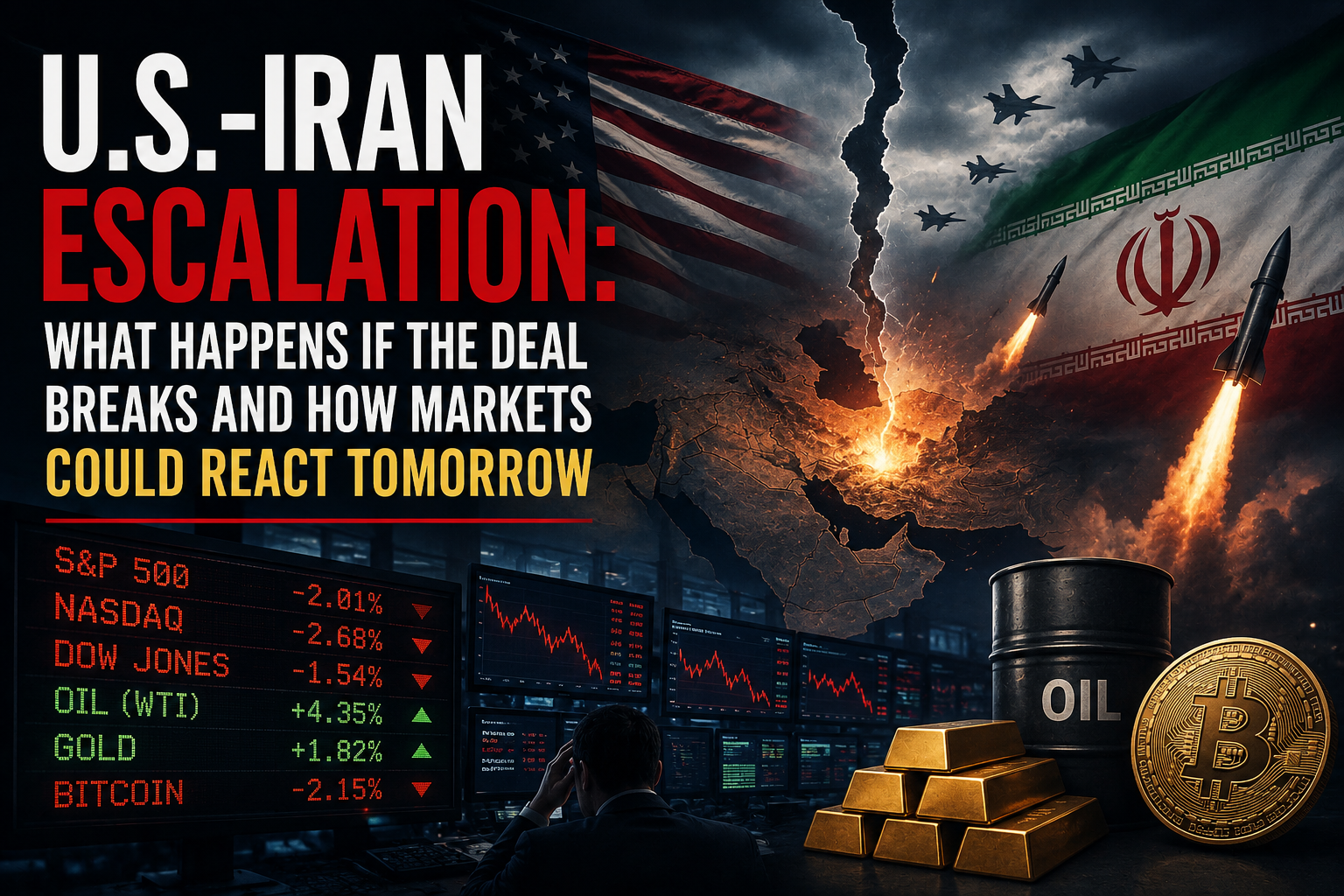
The U.S.-Iran escalation is no longer just a geopolitical headline. It has become a market event. And what makes this moment especially dangerous is not simply that Washington and Tehran are trading accusations again. It is that the fragile agreement designed to cool the conflict is now being tested in the exact place where the global economy is most vulnerable: the Strait of Hormuz.
As of Sunday, June 28, 2026, the situation has deteriorated sharply. Reports describe renewed U.S. strikes against Iranian positions, Iranian-linked attacks or retaliatory actions around the Gulf, a tanker incident in Hormuz, and accusations from both sides that the other party violated the ceasefire framework. Vozpópuli frames the crisis as a renewed threat to the fragile Ormuz truce, while SANA says the escalation is putting the ceasefire agreement through its most delicate test since it entered into force.
What worries me most is not only the military exchange itself. Markets can sometimes absorb limited strikes if investors believe the escalation is contained. What they struggle to absorb is ambiguity: Who controls Hormuz? Is the agreement still alive? Can tankers move safely? Are sanctions relief and Iranian oil flows still credible? Will the Fed have to rethink inflation again?
That is why tomorrow, Monday, June 29, could matter. Not because anyone can predict one clean outcome, but because markets will probably have to reprice a risk that had just started to fade.
The Deal Is Not Dead Yet But It Is No Longer Fully Trusted
The core issue is credibility. A peace agreement, ceasefire or memorandum of understanding only has market value if investors believe it reduces future volatility. The recent deal had done exactly that. Oil prices fell, risk assets improved, and the market began to price in the possibility that the Strait of Hormuz would normalize. CoinDesk reported that the U.S.-Iran breakthrough triggered a risk-on reaction, with crude falling and Bitcoin benefiting as geopolitical risk eased.
That relief trade now looks vulnerable.
The problem is that the agreement appears to have left key questions unresolved: navigation rules in Hormuz, Iran’s nuclear program, sanctions, verification mechanisms, U.S. military posture and regional spillover involving Israel, Hezbollah, Bahrain and Kuwait. SANA explicitly notes that complex issues such as Iran’s nuclear program, the future of Hormuz and U.S. sanctions remain postponed for future negotiation rounds.
This matters because markets do not wait for diplomats to declare a deal broken. Markets move when the probability of failure rises. If traders believe there is a higher chance that the deal collapses, they will start rebuilding a geopolitical risk premium into oil, gold, the dollar, Treasury yields and crypto volatility.
In my view, the deal has moved from “fragile but tradable” to “fragile and no longer cleanly priced.” That is a very different setup.
Why the Strait of Hormuz Is the Market’s Pressure Point
The Strait of Hormuz is the reason this conflict matters to every asset class. It is not just a military chokepoint. It is an inflation chokepoint.
The U.S. Energy Information Administration estimated that oil flows through Hormuz averaged about 20 million barrels per day in 2024, equivalent to roughly 20% of global petroleum liquids consumption. The International Energy Agency also notes that about 80% of oil and oil products transiting Hormuz in 2025 were destined for Asia, while more than 110 bcm of LNG passed through the strait, with limited alternative routes for those volumes.
That means any disruption is not local. It hits shipping insurance, tanker availability, crude benchmarks, LNG pricing, Asian import costs, inflation expectations and central-bank reaction functions.
This is why I am watching oil first. Not because oil is the only asset that matters, but because oil is the transmission belt. It carries the geopolitical shock into inflation, the Fed, real yields, the dollar, equities, emerging markets and Bitcoin.
Vozpópuli reports that the truce began unraveling after an attack on a merchant vessel in Hormuz, followed by U.S. strikes on Iranian military facilities and further Iranian responses. It also points to the lack of a precise and verifiable framework around navigation, military presence and Iran’s nuclear file. That lack of precision is exactly what markets dislike.
Tomorrow’s Market Setup: The Risk Premium Comes Back Before Certainty Does
Tomorrow’s market reaction will likely depend on whether investors see this as:
- A contained violation inside a still-functioning agreement.
- A serious but negotiable crisis.
- The beginning of a full breakdown.
The first scenario is mildly risk-off. The second is volatile and two-way. The third is the one that could create a sharp repricing.
Oil had recently fallen back toward pre-war levels as fears around Hormuz eased. Reuters reported on June 24 that Brent settled at $73.74 and WTI at $70.34 as smoother flows through Hormuz reduced supply-disruption fears. But MarketWatch reported that after the U.S. confirmed a retaliatory strike, WTI rose in after-hours trading from $69.23 to $70.24 and Brent from $71.99 to $72.98.
That tells me the market is not ignoring the risk. It is simply waiting to see whether the next headline confirms escalation or containment.
For Monday, I would expect the first reaction to appear in oil, gold, FX and crypto before cash equities fully digest it. If Asian markets open under stress, the dollar and crude could become the early tells. If oil gaps higher and Bitcoin sells off, that would suggest investors are treating the event as a macro shock, not just a regional story.
Oil: The First Asset to Watch
Oil is the cleanest market expression of this crisis. If the agreement holds, crude can continue losing its war premium. If the agreement breaks, crude probably reclaims that premium fast.
The recent decline in Brent and WTI showed how powerful the de-escalation trade had become. Brent fell near the low $70s after hopes improved around Hormuz traffic and Iranian supply. Trading Economics listed Brent at $71.99 on June 26, down sharply over the previous month.
But that decline creates its own risk: if traders had removed too much geopolitical premium too quickly, any new military incident can force a sudden rebuild. In plain English, oil can fall slowly on peace and jump quickly on fear.
A serious rupture of the agreement could push traders to price in:
- higher war-risk insurance,
- slower tanker movement,
- possible shipping restrictions,
- higher LNG risk premiums,
- renewed sanctions uncertainty,
- and the possibility of direct U.S.-Iran retaliation cycles.
I do not think the base case has to be an immediate return to extreme oil prices. But I do think the market may need to reprice the probability of a larger disruption. Allianz previously warned that a prolonged conflict with major Hormuz disruption could push oil toward $100 per barrel, although adaptation could eventually bring prices lower again.
For tomorrow, the key is not whether oil goes to $100. The key is whether Brent starts moving as if the peace discount was premature.
Commodities: Gold, LNG, Industrial Metals and the Inflation Chain
Commodities will not all move the same way.
Gold should benefit if investors seek geopolitical hedges. But gold’s reaction is complicated by yields. If the escalation drives oil higher and pushes the Fed more hawkish, real yields may rise, which can cap gold. That is why gold can sometimes rally on fear and then fade if the bond market decides the bigger story is inflation.
Energy is the more direct channel. LNG deserves special attention because Hormuz is also critical for liquefied natural gas flows. The IEA says significant LNG volumes transit Hormuz and highlights the lack of alternative routes for some of those flows.
Industrial metals may react in two stages. First, risk-off pressure can hit copper and cyclical commodities. Later, if energy costs rise, production costs across metals, transport and manufacturing can move higher. That is the uncomfortable part of an energy shock: it can be bearish for growth and bullish for input costs at the same time.
That combination is exactly what investors hate. It smells like stagflation.
The Fed: Why This Escalation Complicates Everything
The Federal Reserve is already in a difficult spot. On June 17, the FOMC kept the federal funds target range at 3.50% to 3.75%. A Reuters poll conducted June 23–25 found most economists expected the Fed to hold rates steady for the rest of 2026, even though inflation remained above target and the labor market was strong.
That was before the latest escalation placed the agreement under fresh pressure.
The Fed’s problem is simple: an oil shock is not a normal demand boom, but it can still feed inflation. If gasoline, diesel, jet fuel, shipping costs and LNG rise, the Fed may not be able to ignore it. The central bank can look through a temporary energy spike, but it cannot easily look through second-round effects if businesses pass higher costs into prices and consumers expect inflation to stay high.
Axios reported that May data showed personal income, disposable income and consumer spending rising, while PCE inflation remained elevated at 4.1% year over year and core inflation at 3.4%. That means the Fed is not dealing with a weak economy that obviously needs cuts. It is dealing with a strong economy, sticky inflation and a geopolitical oil shock.
That is a nasty mix.
If the U.S.-Iran agreement breaks, I do not see how the market can confidently price near-term cuts. The more realistic immediate reaction is this: rate-cut hopes fade, rate-hike tail risk rises, and the front end of the Treasury curve stays nervous.
This is why the Fed is central to the story. The escalation is not just about oil. It is about whether oil forces the Fed to stay tighter for longer.
U.S. Stocks: Risk-Off First, Sector Rotation Second
For equities, the first reaction to a breakdown would likely be risk-off. The market does not like geopolitical uncertainty, higher oil, higher yields or a stronger dollar. A U.S.-Iran escalation can potentially deliver all four.
The most vulnerable areas would likely be:
- high-growth technology,
- unprofitable risk assets,
- rate-sensitive stocks,
- airlines,
- transports,
- consumer discretionary,
- and emerging-market exposed equities.
The relative winners could be:
- energy producers,
- defense names,
- some commodity-linked companies,
- select infrastructure/security plays,
- and possibly large-cap quality stocks if investors seek balance-sheet safety.
But I would be careful with the simple “buy energy, sell everything else” interpretation. If oil rises because of supply fear, energy stocks can benefit. If oil rises enough to damage growth expectations, the whole market can start trading defensively, including parts of energy.
My base expectation for tomorrow would be choppy trading rather than a clean one-directional move. If the headlines calm down before the U.S. open, dip-buyers may appear. If there are new attacks, threats or tanker incidents, the market could shift into a more aggressive risk-off mode.
The Dollar: Safe Haven or Inflation Currency?
The dollar’s reaction is one of the most interesting parts of this story.
In a clean de-escalation, the dollar can weaken because safe-haven demand fades and inflation fears cool. FXStreet reported that the U.S. Dollar Index declined after the U.S.-Iran deal eased safe-haven demand and reduced inflation concerns.
But renewed escalation can flip that logic. A stronger dollar would make sense if investors seek liquidity, reduce exposure to emerging markets, buy Treasuries or price a more hawkish Fed. At the same time, if the conflict becomes politically messy for Washington or damages confidence in U.S. diplomacy, the dollar’s safe-haven bid could be less straightforward.
For tomorrow, I would watch whether the dollar rises alongside oil. If both rise together, that is usually a bad signal for risk assets. It means the market is pricing both an energy shock and a liquidity squeeze.
If oil rises but the dollar does not, then the market may be treating the shock as more regional and less systemic. That would be less dangerous for equities and crypto.
Bitcoin: This Is Not a Simple Safe-Haven Story
Bitcoin is the asset people will argue about the most.
Some will say Bitcoin should rally because it is “digital gold.” Others will say it should fall because geopolitical shocks trigger deleveraging. I lean toward the second interpretation in the short term.
Bitcoin can benefit from de-escalation because lower oil, lower inflation pressure and easier Fed expectations improve liquidity conditions. That was visible after the U.S.-Iran breakthrough, when crypto rallied as the risk-on trade returned. Current BTC pricing from the market data tool shows Bitcoin around $59,531, with a small negative move versus the previous close.
But if the deal breaks and oil spikes, Bitcoin may face three headwinds at once:
- stronger dollar,
- higher real yields or tighter Fed expectations,
- risk-off deleveraging across speculative assets.
That does not mean Bitcoin must crash. It means the “Bitcoin as safe haven” narrative may not dominate the first 24–48 hours. In my view, BTC is still highly sensitive to liquidity. If traders believe the Fed has less room to cut, Bitcoin usually has a harder time sustaining upside.
The level I would watch is not just price. I would watch volatility, funding rates, ETF flows if available, and whether BTC behaves more like gold or more like Nasdaq. In a true macro stress event, Bitcoin often tells you how much leverage is still hiding in the system.
Treasuries: The Hardest Market to Read
Treasuries are tricky because escalation creates two opposing forces.
On one side, geopolitical fear can create demand for safe assets, pulling yields lower. On the other side, an oil shock can raise inflation expectations, pushing yields higher. Which force wins depends on whether investors fear recession more than inflation.
Recently, the market has already been wrestling with a “rate shock” dynamic. MarketWatch cited Apollo’s Torsten Slok arguing that even with oil lower, the conflict’s rate shock was not over, with the U.S. two-year yield still elevated around 4.15%.
If tomorrow brings a sharper escalation, I would watch the two-year yield first. If two-year yields rise, the market is saying: “This makes the Fed more hawkish.” If ten-year yields fall while two-year yields rise, that is a more ominous signal: tighter policy plus weaker growth expectations.
That would be the classic uncomfortable macro mix.
Three Scenarios for Monday, June 29
Scenario 1: Controlled Escalation
In this scenario, both sides keep talking, mediators remain active, and shipping through Hormuz continues with caution. Oil may rise modestly, gold may catch a bid, the dollar may firm, but equities could stabilize after an initial scare.
This would be the “headline shock, not regime shift” scenario.
Scenario 2: Agreement Under Severe Stress
This is the middle scenario and, in my view, the most realistic near-term market setup. The agreement does not formally collapse, but nobody fully trusts it. Tanker traffic slows, insurance costs rise, political rhetoric hardens and traders rebuild part of the risk premium.
Oil moves higher. Gold firms. The dollar strengthens. Bitcoin becomes volatile. Stocks open weaker, then trade based on headline flow.
This is where I think markets may spend the next session unless there is a clear diplomatic intervention.
Scenario 3: Deal Breaks
If Iran suspends diplomacy, the U.S. expands strikes, Hormuz traffic deteriorates materially, or regional actors are pulled further in, markets could move into a sharper risk-off phase.
In that case, I would expect:
- Brent and WTI to gap higher,
- gold to rally,
- the dollar to strengthen,
- Treasury curves to react violently,
- equities to sell off,
- Bitcoin to trade more like a high-beta liquidity asset than a safe haven,
- and Fed-cut expectations to be pushed further out.
This is not my prediction. It is the scenario markets must now price more seriously than they did a week ago.
What I Am Watching First
I am not watching speeches first. I am watching market plumbing.
The first thing I want to see is oil. If Brent opens firm but controlled, the market is nervous but not panicking. If Brent gaps aggressively and keeps climbing, the market is pricing real disruption risk.
Second, I am watching the dollar. A stronger dollar plus higher oil is a toxic combination for global risk appetite.
Third, I am watching Bitcoin. If BTC holds up despite oil strength and dollar strength, that would be surprisingly constructive. If it rolls over fast, it means liquidity fear is back.
Fourth, I am watching the two-year Treasury yield. That tells us whether investors think the Fed just lost flexibility.
And finally, I am watching headlines around Hormuz shipping volumes, insurance, military escorts and any statement from mediators. The market does not need perfect peace. It needs evidence that the corridor will not become untradeable.
The Bigger Market Message
The bigger message is that this escalation arrives at a fragile moment. Investors had just started to price relief. Oil had fallen. The dollar had softened. Risk assets had room to breathe. The U.S.-Iran agreement gave markets a reason to remove part of the geopolitical premium.
Now that premium may be coming back.
The danger is not only a sudden spike in oil. The danger is a feedback loop:
Higher oil feeds inflation expectations.
Higher inflation expectations make the Fed less flexible.
A less flexible Fed supports the dollar and pressures liquidity.
Tighter liquidity hits equities and Bitcoin.
Risk-off behavior strengthens safe-haven flows.
And every new headline from Hormuz becomes a market catalyst.
That is why I do not see this as “just another Middle East headline.” I see it as a macro trigger sitting on top of an already sensitive inflation and rates environment.
Conclusion
The U.S.-Iran escalation has reached the point where markets can no longer treat the agreement as a clean de-escalation story. The deal may survive, but its credibility has been damaged. And for markets, damaged credibility is enough to move prices.
Tomorrow, I expect investors to focus first on oil, then the dollar, then rates, then Bitcoin and equities. If the Strait of Hormuz remains navigable and both sides leave room for diplomacy, the market reaction may be contained. But if the agreement visibly breaks, the repricing could be fast and broad.
My personal view is simple: this is a moment to respect risk, not chase certainty. The market does not need confirmation of a full war to become volatile. It only needs the probability of a broken agreement to rise.
And that probability just rose.
FAQs
How could the U.S.-Iran escalation affect markets tomorrow?
The first reaction would likely appear in oil, gold, the dollar, Treasuries and Bitcoin. Equities may open weaker if investors price higher geopolitical risk, higher energy costs and a less flexible Fed.
Why is the Strait of Hormuz so important?
Because roughly one-fifth of global petroleum liquids consumption has historically moved through Hormuz, making it one of the world’s most important energy chokepoints.
Could oil spike if the agreement breaks?
Yes. A formal or practical breakdown could rebuild the geopolitical risk premium in crude, especially if tanker traffic slows or shipping insurance costs rise.
What does this mean for the Fed?
It complicates the Fed’s inflation outlook. Higher oil can feed headline inflation and potentially delay cuts or increase the probability of a more hawkish stance.
Is Bitcoin a safe haven in this situation?
Not necessarily in the short term. Bitcoin may behave more like a liquidity-sensitive risk asset if the dollar strengthens, yields rise and traders reduce leverage.
What should investors watch first?
Oil prices, dollar strength, two-year Treasury yields, Bitcoin volatility and concrete shipping data from Hormuz.