

Emerging markets are back on investors’ radar. After several years in which many global portfolios were heavily dominated by the U.S., mega-cap technology stocks, and developed-market equities, 2026 is showing a meaningful shift: emerging-market assets are regaining momentum.
In my view, this move is not random. Emerging markets combine three powerful ingredients when handled correctly: economic growth, attractive valuations, and global diversification. The recent performance of the MSCI Emerging Markets universe reinforces that idea. BlackRock reported that the iShares MSCI Emerging Markets ETF had a 15.90% year-to-date NAV total return as of April 24, 2026.
That said, strong recent performance does not mean investors should rush in blindly. For me, the key is not to treat emerging markets as a quick trade, but as an opportunity that requires selectivity, patience, and disciplined risk management.
What Are Emerging Markets?
Emerging markets are economies that have not yet reached the same level of development, institutional stability, or financial-market depth as countries such as the United States, Germany, or Japan, but that often offer higher long-term growth potential than many developed economies.
This group includes countries such as India, Brazil, Mexico, China, Indonesia, South Africa, Colombia, Chile, Taiwan, and others. But one thing needs to be clear: emerging markets are not all the same.
One of the most common mistakes I see investors make is talking about “emerging markets” as if it were one single block. They’re not. Demographics and digitalization may play in India’s favor. Brazil could be more sensitive to commodity, interest rates and currency moves. Mexico has the opportunity of nearshoring. China is a force in its own right because of its industrial muscle, its technology ecosystem, and its regulatory environment.
That is why, when I analyze emerging markets, I never stop at the label. I want to know which country, which sector, which currency, which valuation, and which political risks are behind the investment.
Why Emerging Markets Could Benefit in 2026
Why the Dollar Matters So Much for Emerging Markets
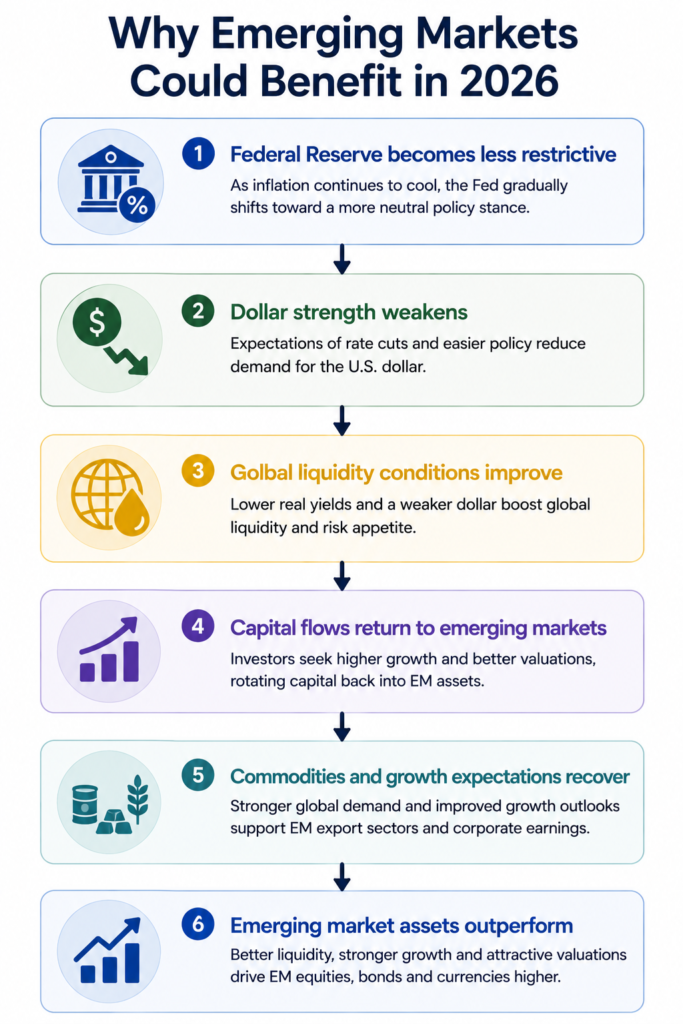
One of the most important variables for emerging markets is not necessarily domestic growth itself. It is the U.S. dollar. From a macro perspective, many emerging economies remain heavily influenced by global dollar liquidity because:
- Debt is often denominated in dollars.
- Commodities are priced in dollars.
- And international capital flows are highly sensitive to Federal Reserve policy.
When the dollar strengthens aggressively, financial conditions tend to tighten across emerging markets. Borrowing costs rise, local currencies weaken and investors often reduce exposure to riskier international assets. This can place enormous pressure on:
- Emerging market equities.
- Sovereign debt.
- Banking systems.
- And economic growth.
But the opposite is also true. If the Federal Reserve eventually becomes less restrictive and dollar strength begins to weaken, global liquidity conditions may improve significantly.
That environment historically tends to support:
- Commodity-exporting economies.
- Emerging market equities.
- International capital inflows.
- And higher risk appetite globally.
From my perspective, this is one of the key reasons many investors are starting to look again at emerging markets heading into 2026. The story is not just about local growth. It is about the global liquidity cycle.
Why Emerging Markets Are Gaining Attention Again
The strong year-to-date performance of the MSCI Emerging Markets universe is an important signal. It does not guarantee that the trend will continue, but it does show that global capital is once again looking beyond developed markets.
Several factors help explain this renewed interest:
- More attractive valuations than many developed markets.
- Higher economic growth potential.
- Favorable demographics in several countries.
- Expansion of domestic consumption.
- Exposure to technology, artificial intelligence, semiconductors, and energy transition themes.
- Potential support from a more favorable interest-rate environment.
- Diversification away from portfolios that are too concentrated in the U.S.
Another important point is that emerging markets are no longer just a story about commodities or low-cost manufacturing. The MSCI Emerging Markets Index includes major companies such as Taiwan Semiconductor Manufacturing, Samsung Electronics, Tencent, SK Hynix, Alibaba, HDFC Bank, and Reliance Industries among its top holdings.
That matters because today’s emerging-market exposure also means exposure to chips, digital commerce, financial services, manufacturing, cloud infrastructure, and the global AI supply chain.
Emerging Markets in 2026: Are They a Good Opportunity?
My view for 2026 is constructive: yes, emerging markets can be a good opportunity, but not for every investor and not in any form.
The main argument is that many emerging economies are entering this cycle with better growth prospects, reasonable valuations, and exposure to major global themes such as digitalization, industrial relocation, artificial intelligence, strategic commodities, and the growth of the middle class.
Recent performance also supports the case. MarketWatch reported that emerging-market stocks had outperformed U.S. equities in 2026, with the iShares Core MSCI Emerging Markets ETF up 13.7% through April 21, compared with a 3.2% gain for the S&P 500 over the same period.
But this is where investors need to stay disciplined. Emerging markets have done well this year so far, but that doesn’t mean they can’t correct. Emerging markets are typically more volatile than developed markets. Therefore, I would not consider them to be a short-term trend. I’d treat them as a strategic asset in a diversified portfolio.
Main Opportunities in Emerging Markets
Emerging-Market Equities
Emerging-market stocks could have some appeal in 2026 as a way to gain exposure to companies with structural growth prospects. Some important sectors are technology, consumer goods, banking, infrastructure, energy, commodities, health care and industrial production.
What I find particularly interesting is that many investors still think about emerging markets as underdeveloped economies driven primarily by raw materials. That view is dated. Semiconductors, e-commerce, digital payments, electric vehicles, artificial intelligence and global manufacturing now make up a large part of the emerging-market universe.
Emerging-Market Debt
Emerging-market debt can also make sense for investors looking for potential income through bonds. This can include sovereign debt, corporate debt, local-currency bonds, or hard-currency bonds.
However, risk analysis is essential here. Buying debt from a country with improving fiscal stability is very different from buying debt from a country facing high inflation, persistent deficits, weak institutions, or pressure on its currency.
Emerging-Market Currencies
Emerging-market currencies present opportunities but they are also a huge risk. Personally, I always look at the currency first when looking to evaluate an emerging-market investment. The local stock market may do very well, but if the local currency falls sharply against the U.S. dollar, the bottom line can look very different to a U.S.-based investor.
Latin America and Asia
Latin America may benefit from commodities, lower interest rates, and renewed investor appetite for risk. Asia, meanwhile, continues to concentrate a large part of the world’s technology, manufacturing, and semiconductor growth.
For 2026, I do not think the right question is simply “emerging markets: yes or no?” The better question is:
Which emerging regions offer the best combination of growth, stability, valuation, and catalysts?
Risks of Investing in Emerging Markets
Emerging markets can be a good opportunity, but they are not risk-free. The main risks include:
- Political risk: elections, policy changes, capital controls, institutional instability, or government intervention.
- Currency risk: sharp currency depreciation can reduce returns for U.S. investors.
- Liquidity risk: some markets are less liquid and harder to trade.
- Regulatory risk: especially in countries where the state plays a large role in strategic sectors.
- Commodity risk: several economies are tied to oil, copper, soybeans, gas, or critical minerals.
- Volatility: capital flows can move in and out quickly.
My approach is optimistic, but not blind. I like emerging markets for 2026, but I would not buy any asset simply because it has the “emerging market” label. Selection matters as much as the broader investment thesis.
How to Invest in Emerging Markets in 2026
For most investors, the most practical way to access emerging markets is through diversified ETFs or mutual funds. This reduces the risk of depending too much on one country, one company, or one currency.
A portfolio may include exposure to:
- Broad emerging-market ETFs.
- Actively managed emerging-market funds.
- Emerging-market bond funds.
- Regional ETFs focused on Asia, Latin America, India, China, or other areas.
- Mixed strategies combining equities and fixed income.
I like to think of emerging markets as a strategic allocation, not a short-term bet. The investor who buys just because the index has gone up a lot this year may get in late and sell badly at the first correction.
The better question is:
What percentage of my portfolio should be allocated to emerging markets based on my risk profile, time horizon, and tolerance for volatility?
Common Mistakes When Investing in Emerging Markets
Thinking All Emerging Countries Are the Same
This is the number one mistake. China, India, Brazil, Mexico, South Africa, and Taiwan do not have the same economic drivers or the same risks.
Buying Only Because of Recent Performance
The MSCI Emerging Markets universe has performed very well so far this year, but that should not be an excuse to buy without analysis. Momentum is positive, but it does not replace strategy.
Ignoring the U.S. Dollar
Emerging markets are often affected by the strength or weakness of the U.S. dollar. A strong dollar can pressure emerging-market currencies, make external debt more expensive, and reduce investor appetite.
Overconcentrating in One Country
Putting too much money into a single emerging country can work if the thesis is right, but it can also be very risky. Diversification is essential.
Confusing Opportunity With Safety
A low valuation does not automatically mean a bargain. Sometimes a market is cheap because the risks are high, earnings are uncertain, or investors are demanding a large risk premium.
My View: Emerging Markets as an Opportunity With Discipline
My conclusion is clear: emerging markets can be a good option for 2026. The strong year-to-date performance of the MSCI Emerging Markets universe confirms that interest is returning and that the asset class has momentum.
But that does not mean investors should chase the rally without a plan.
For me, the best approach is balanced:
- recognize the growth potential;
- accept that volatility will be part of the journey;
- diversify across countries and sectors;
- control currency risk;
- avoid excessive concentration;
- maintain a medium- to long-term view.
Emerging markets are not for investors who want absolute stability. But for investors who understand the cycle, accept the risks, and diversify properly, they can offer growth, diversification, and attractive opportunities in 2026.
Conclusion
Emerging markets are once again at the center of the investment conversation. ETFs and indexes linked to the MSCI Emerging Markets universe have helped boost their strong performance so far in 2026, indicating growing investor confidence in this asset class.
My view is positive: I believe emerging markets can be a good opportunity for 2026. But the key is not to buy them just because they have gone up. The key is to understand what is driving the move: countries, sectors, currencies, interest rates, valuations, earnings, and risk appetite.
The opportunity is real. But in emerging markets, the difference between a smart investment and a bad decision usually comes down to discipline.
FAQs About Emerging Markets
What are emerging markets?
Emerging markets are economies with higher growth potential than developed markets, but also higher political, financial, regulatory, currency, and liquidity risks.
Are emerging markets a good investment for 2026?
They can be, especially when accessed through diversified vehicles and with a long-term view. The strong performance of the MSCI Emerging Markets universe so far this year supports the case, but it does not eliminate the risks.
Which countries are considered emerging markets?
Common examples include China, India, Brazil, Mexico, Indonesia, South Africa, Colombia, Chile, Taiwan, and other economies across Asia, Latin America, Africa, the Middle East, and Eastern Europe.
What is the biggest risk of investing in emerging markets?
Volatility is one of the biggest risks. Currency risk, political risk, liquidity risk, and regulatory uncertainty are also important.
Is it better to invest through ETFs or individual stocks?
For most investors, ETFs or diversified mutual funds are usually more practical because they reduce dependence on a single company, country, or currency.