
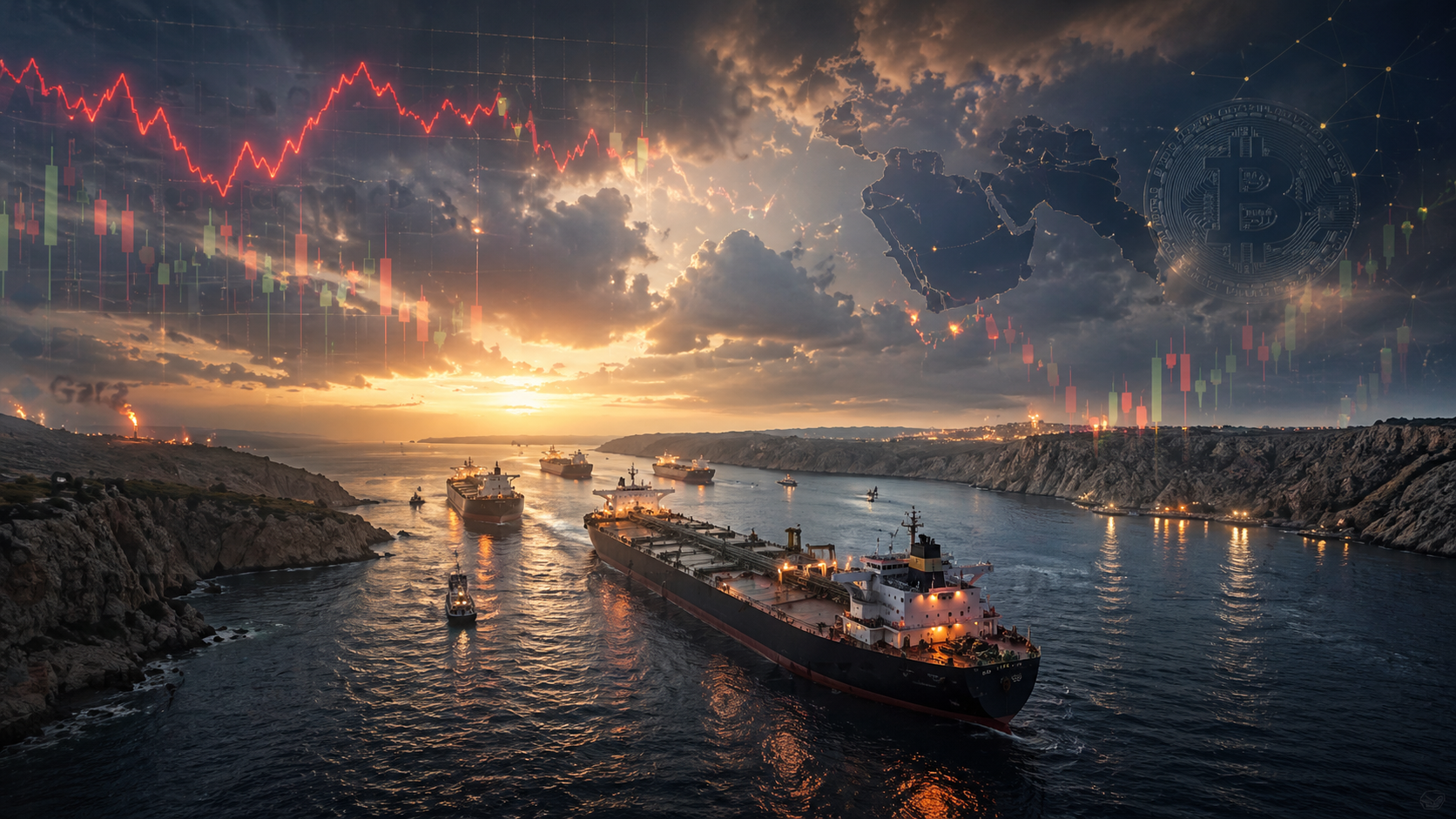
A Geopolitical Headline That Could Reshape Oil, Inflation and Global Markets
The headline initially sounded bullish.
Iran reportedly offered to reopen the Strait of Hormuz, one of the most strategically important energy corridors in the world, while signaling willingness to discuss regional security arrangements and broader diplomatic conditions.
At first glance, markets should have exploded higher.
A reopening of Hormuz would theoretically reduce pressure on global oil supply, ease fears of another inflation wave, calm shipping disruptions and improve overall investor sentiment.
But that is not what happened.
Instead, markets reacted cautiously. Oil remained elevated. Stocks failed to fully commit to a sustained relief rally. Crypto volatility continued. Gold fluctuated violently.
And bond markets kept pricing uncertainty around inflation and central-bank policy.
From my perspective, this tells us something extremely important:
Investors do not see this as a peace agreement. They see it as a temporary geopolitical negotiation where the risk of failure remains very high. And honestly, they are probably right.
Because beneath the diplomatic headlines lies a much bigger macroeconomic story one involving oil, inflation, interest rates, global shipping routes, central banks and investor psychology.
The Strait of Hormuz is not simply a regional issue anymore.
It has become one of the most important macroeconomic variables in the world.
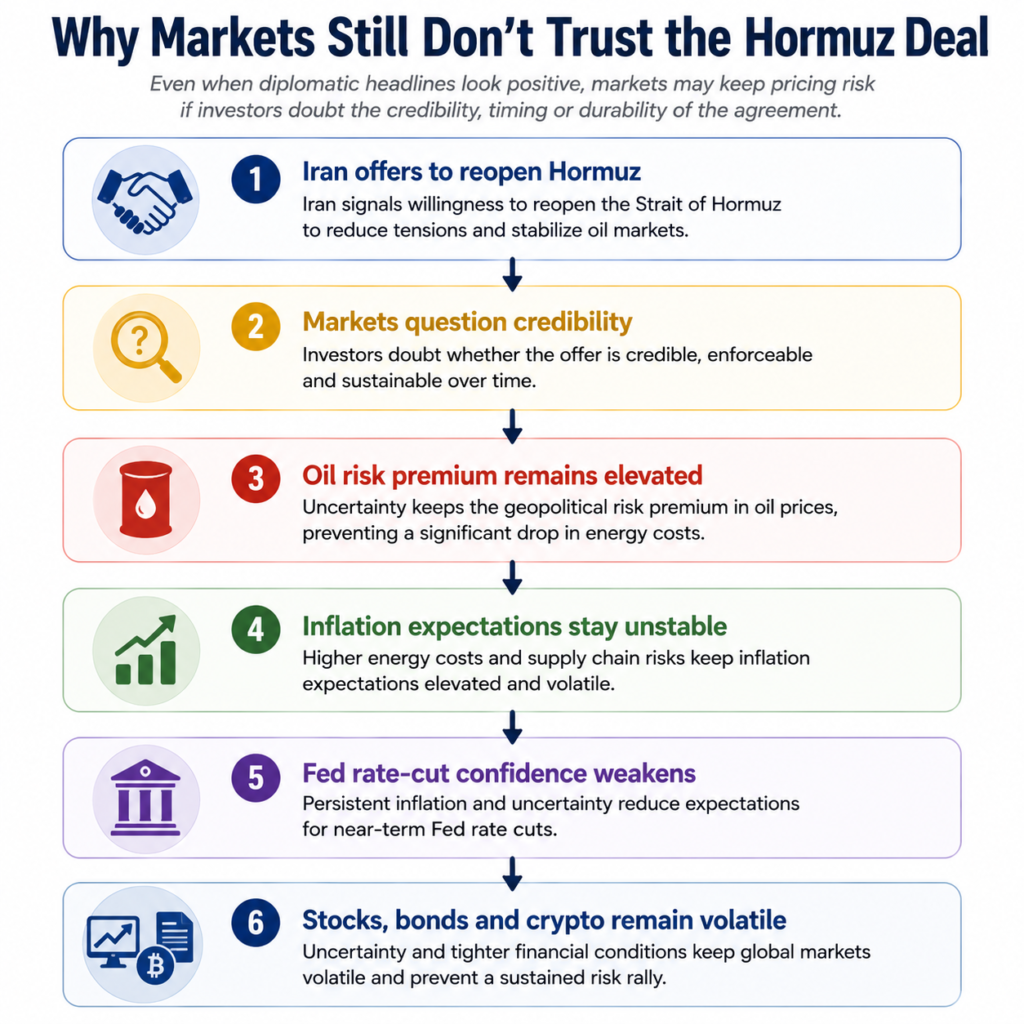
Why Markets Still Don’t Trust the Hormuz Deal
Why the Strait of Hormuz Matters More Than Almost Any Other Geopolitical Location
Most people hear the words “Strait of Hormuz” and think of another geopolitical flashpoint in the Middle East. But financially, it is much bigger than that.
The Strait of Hormuz is one of the most critical maritime chokepoints on Earth.
A massive percentage of global oil exports passes through it every single day, alongside major liquefied natural gas shipments heading toward Europe and Asia.
That means any disruption in Hormuz immediately affects:
- Oil prices.
- Natural gas markets.
- Shipping insurance costs.
- Inflation expectations.
- Global supply chains.
- Central-bank expectations.
- Equity-market sentiment.
- Crypto liquidity conditions.
- Consumer spending expectations.
Very few geopolitical locations can move so many asset classes simultaneously. And that is exactly why markets remain nervous. When Hormuz becomes unstable, investors begin pricing worst-case scenarios extremely quickly.
The reason is simple. Modern financial markets are deeply interconnected. A disruption in energy flows does not stay confined to oil traders. It eventually spreads into transportation costs, manufacturing expenses, food prices, corporate margins, bond yields and consumer confidence. That is why markets are not simply watching diplomatic headlines.
They are trying to calculate whether the global economy is about to face another inflationary shock.
Why Markets Are Still Skeptical About Iran’s Proposal
The biggest issue is not whether Iran wants negotiations. The biggest issue is how the negotiations are structured. Reports suggest Iran wants a phased diplomatic process:
- End the war.
- Lift the blockade.
- Establish security guarantees.
- Discuss nuclear issues later.
The United States, however, appears to prefer the opposite structure.
Washington wants strategic guarantees first. Only then would sanctions pressure or military pressure potentially ease.
This difference matters enormously. Because it creates a sequencing problem. Iran wants immediate de-escalation. The U.S. wants leverage before concessions.
And historically, negotiations built around leverage tend to produce volatility rather than stability. That is why financial markets are reacting with hesitation instead of optimism. Investors understand that even if diplomatic talks continue, the probability of failure remains significant.
And as long as that probability exists, oil markets will likely continue embedding a geopolitical premium into prices.
Oil Has Become the Core Macro Driver Again
One of the clearest lessons from this entire crisis is that oil is once again becoming the center of the macroeconomic conversation. For years, markets focused primarily on interest rates, artificial intelligence, liquidity and technology stocks. But geopolitical crises involving energy supply can rapidly change the market narrative. And that is exactly what we are beginning to see.
Even rumors of shipping disruptions through Hormuz have already caused massive swings in crude oil prices. Because markets are not reacting to today’s physical supply alone. They are reacting to the possibility of future shortages. That distinction is critical. Oil markets are forward-looking. Traders price expected risk, not only current reality.
So even if actual supply remains partially functional, fear alone can keep prices elevated.
And once oil prices rise aggressively, the effects spread everywhere.
Why Higher Oil Prices Matter So Much for Inflation
This is where the situation becomes dangerous for central banks. Higher oil prices directly influence inflation in several ways.
Transportation Costs
Nearly every part of the global economy depends on transportation.
If fuel costs rise:
- Airlines become more expensive.
- Shipping costs increase.
- Trucking expenses rise.
- Consumer prices eventually move higher.
Manufacturing Costs
Energy is deeply embedded in industrial production. Factories, chemicals, plastics, logistics and heavy industry all become more expensive when energy prices rise.
Consumer Psychology
This is one of the most underestimated effects. When consumers see gasoline prices rising sharply, inflation expectations psychologically increase. And inflation expectations themselves can become inflationary.
People begin demanding higher wages. Companies become more willing to raise prices.
Consumers spend differently. That creates second-round inflation effects. And this is exactly what central banks fear the most.
Why the Federal Reserve Is Watching Hormuz Extremely Closely
The Federal Reserve may not officially comment on every geopolitical headline. But make no mistake: energy prices matter enormously for monetary policy.
One of the biggest reasons markets rallied earlier this year was the belief that inflation was gradually cooling and rate cuts would eventually arrive. But if oil prices remain elevated because of geopolitical tensions, that process becomes much more complicated.
Higher oil prices could:
- Delay rate cuts.
- Push inflation forecasts higher.
- Keep bond yields elevated.
- Tighten financial conditions.
- Slow economic growth.
This creates a very uncomfortable environment for policymakers.
Because the Fed could face a situation where:
- Growth weakens.
- Inflation rises again.
- Financial conditions tighten.
- Markets become more volatile.
That combination resembles elements of stagflation. And stagflation is historically one of the most difficult macroeconomic environments for both investors and central banks.
Why Stocks Have Not Fully Panicked Yet
One of the most fascinating aspects of this crisis is how resilient equities have remained.
At first glance, this seems irrational. Geopolitical tensions are rising. Oil prices remain unstable. Inflation risks are increasing. And yet the S&P 500 has not completely collapsed.
Why?
Because markets are still balancing two competing narratives.
Narrative 1: Diplomacy Eventually Wins
This is the optimistic scenario.
Investors betting on this outcome believe:
- Hormuz eventually reopens fully.
- Oil prices stabilize.
- Inflation pressures fade again.
- The Fed eventually cuts rates.
- Liquidity conditions improve.
- AI and technology growth continue supporting equities.
Under this scenario, current volatility becomes temporary noise.
Narrative 2: Inflation Returns Aggressively
This is the bearish scenario.
Investors betting on this outcome believe:
- Oil remains structurally elevated.
- Inflation expectations rise again.
- Central banks remain restrictive.
- Economic growth slows.
- Corporate margins weaken.
- Valuations compress.
And honestly, this is why market reactions feel so unstable right now. Because investors are constantly shifting between these two macro narratives.
Which Sectors Could Benefit And Which Could Suffer
Potential Winners If Tensions Ease
Airlines
Airlines are highly sensitive to fuel prices.
A credible reopening of Hormuz could sharply reduce jet-fuel concerns.
Consumer Discretionary Stocks
Lower inflation expectations would improve household spending power.
Technology Stocks
Growth stocks tend to perform better when inflation and bond yields decline.
Emerging Markets
Emerging economies often struggle when oil and the dollar rise together.
A calmer energy environment could improve capital flows.
Potential Winners If Tensions Escalate
Energy Companies
Oil producers would likely benefit from higher crude prices.
Defense Stocks
Military and defense-related sectors often outperform during prolonged geopolitical instability.
Commodity Exporters
Countries heavily exposed to commodities could initially benefit from price spikes.
Potential Losers If Oil Keeps Rising
Retailers
Consumers tend to reduce discretionary spending when fuel and food costs rise.
Industrials
Manufacturing margins can compress under higher energy costs.
Small Caps
Smaller companies are generally more vulnerable to tighter financial conditions.
Highly Leveraged Firms
Higher yields and elevated rates create refinancing pressure.
Gold’s Strange Behavior Is Sending an Important Signal
Normally, geopolitical crises push gold sharply higher. But this time, gold’s behavior has been more complicated.
Why?
Because investors are facing two opposing forces simultaneously.
Bullish for Gold
- Geopolitical instability.
- Safe-haven demand.
- Fear-driven positioning.
- Global uncertainty.
Bearish for Gold
- Higher bond yields.
- Stronger dollar.
- Elevated real interest rates.
- Sticky inflation expectations.
That creates a market where gold can rally aggressively one day and sell off the next. And honestly, that instability reflects the broader macro environment perfectly. Markets are deeply uncertain about what comes next.
The Bond Market May Be the Most Important Signal of All
While most investors focus on oil or stocks, bond markets may actually be telling the real story. If Treasury yields continue moving higher despite geopolitical tensions, it means investors are becoming increasingly worried about inflation persistence. And that matters enormously. Because modern markets are heavily dependent on liquidity.
If yields rise too aggressively:
- Borrowing becomes more expensive.
- Valuations compress.
- Credit conditions tighten.
- Corporate financing weakens.
- Economic activity slows.
In other words, the bond market could ultimately determine whether this geopolitical crisis becomes a temporary shock or a broader macroeconomic problem.
Historical Comparisons: Markets Have Seen This Before
One of the biggest mistakes investors make during geopolitical crises is assuming every event is completely unique.
In reality, markets often follow recognizable historical patterns.
1970s Oil Shocks
The oil crises of the 1970s created a combination of:
- Inflation spikes.
- Economic stagnation.
- Weak consumer confidence.
- Aggressive monetary tightening.
That period became one of the clearest examples of stagflation in modern economic history.
Gulf War Period
Oil prices initially surged during uncertainty but later stabilized once markets believed supply disruptions would remain contained.
Russia-Ukraine Conflict
Energy markets reacted violently because Europe depended heavily on Russian energy flows. What made that conflict important was not only military escalation. It was the inflationary transmission into the global economy. And that is exactly why Hormuz matters today.
This is not simply about geopolitics. It is about how geopolitics flows into inflation, monetary policy and financial conditions.
The Four Main Scenarios Markets Are Pricing Right Now
Scenario 1: Full Diplomatic Breakthrough
This is the bullish scenario.
- Hormuz fully reopens.
- Oil falls sharply.
- Inflation fears ease.
- Stocks rally.
- Crypto rebounds.
- Bond yields stabilize.
Probability: Possible, but currently not the market’s base case.
Scenario 2: Partial De-Escalation
This is likely the current market expectation.
- Negotiations continue.
- Shipping partially normalizes.
- Oil remains volatile but controlled.
- Markets stay nervous but functional.
This would create a highly headline-driven environment.
Scenario 3: Diplomatic Failure
This is the bearish macro scenario.
- Oil spikes higher.
- Inflation expectations rise again.
- Rate cuts get delayed.
- Equities weaken.
- Crypto struggles.
- Volatility surges.
This scenario would likely create major pressure across global risk assets.
Scenario 4: Major Regional Escalation
This is the tail-risk scenario.
A broader conflict could trigger:
- Extreme oil-price spikes.
- Severe market volatility.
- Global growth fears.
- Aggressive safe-haven flows.
- Emergency central-bank responses.
This is not currently the market’s primary expectation but investors are clearly pricing some probability of it.
Final Thoughts
Iran’s proposal to reopen the Strait of Hormuz may sound like a diplomatic breakthrough. But markets are behaving exactly as they should: carefully.
Because this is not a completed peace agreement. It is a fragile negotiation taking place under enormous geopolitical pressure.
And as long as uncertainty remains around:
- Oil flows.
- Shipping security.
- Inflation.
- Interest rates.
- Central-bank policy.
- Regional military escalation.
Markets will continue reacting violently to every new headline.
From my perspective, the most important thing investors should understand is this: The Strait of Hormuz is no longer only a geopolitical story. It is now a macroeconomic story. A monetary-policy story. A liquidity story. An inflation story. And potentially one of the defining market risks of 2026.
FAQs
Why is the Strait of Hormuz so important for global markets?
Because a massive portion of global oil and liquefied natural gas exports passes through it. Any disruption can rapidly affect energy prices, inflation expectations and global financial markets.
Why didn’t markets rally strongly after Iran’s proposal?
Because investors do not yet trust that a real diplomatic agreement will happen. Markets still see a significant risk that negotiations fail or tensions escalate again.
How does Hormuz affect inflation?
If oil prices rise because of supply disruptions, transportation and manufacturing costs increase globally. That can eventually push consumer prices higher.
Could this delay Federal Reserve rate cuts?
Yes. Higher energy prices could keep inflation elevated, making the Fed more cautious about easing monetary policy.
Which sectors benefit from higher oil prices?
Energy producers and some commodity-linked companies generally benefit from rising oil prices.
Which sectors suffer the most?
Airlines, transport companies, retailers and consumer discretionary firms are usually among the most vulnerable because their costs rise when energy becomes more expensive.
Could this become another stagflation scenario?
If inflation rises while economic growth weakens, markets could begin pricing stagflation risks more aggressively.
Is this crisis more important for commodities or equities?
Right now, commodities especially oil are driving the macro narrative. But eventually, higher energy prices can heavily affect equities, bonds and crypto as well.
What is the most likely short-term outcome?
At the moment, markets appear to expect a partial de-escalation rather than a full diplomatic breakthrough or immediate major escalation. But volatility is likely to remain extremely high.