
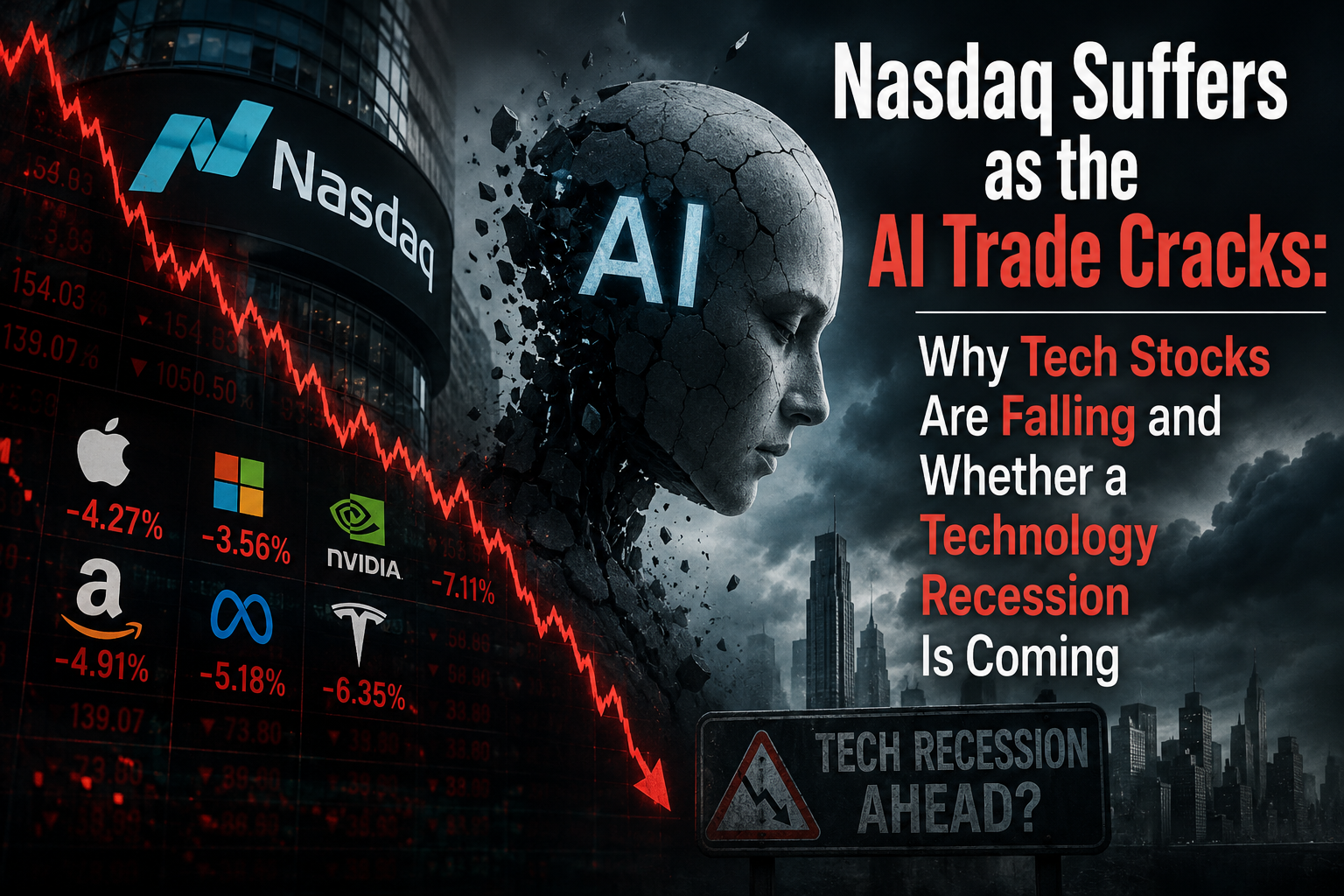
The Nasdaq suffers when Wall Street stops believing in tomorrow’s profits and starts asking for today’s cash flow. That is exactly what happened this week.
For months, investors treated artificial intelligence like a financial cheat code. If a company mentioned AI infrastructure, data centers, chips, cloud capacity, memory demand, or model training, the market gave it a higher multiple. The story was simple: AI would change everything, and the companies building the infrastructure would become even more powerful.
But this week, that story hit a wall.
The Nasdaq Composite posted a weekly loss of roughly 4% to 4.6%, depending on the market snapshot used, while the S&P 500 fell around 2% and the Dow actually held up better, gaining about 0.6% to 1% as investors rotated into more defensive parts of the market. That split matters. This was not a broad panic where everything crashed together. It was more specific, and in some ways more revealing: investors sold the very technology stocks that had been carrying the market.
In my view, that makes this Nasdaq selloff more important than a normal bad week. It is not just a chart move. It is a referendum on the AI boom.
Why Did the Nasdaq Fall This Week?
The short answer: the market started questioning whether AI valuations have run too far ahead of real earnings.
The longer answer is more uncomfortable. Several pressure points hit at once: elevated AI-related valuations, weakness in semiconductor stocks, rising memory and component costs, doubts about future AI monetization, Fed-rate concerns, and a visible rotation away from megacap technology into healthcare, industrials, utilities, and other defensive sectors.
That combination is toxic for the Nasdaq because the index is heavily exposed to high-growth technology names. When investors feel confident, that concentration works beautifully. When they start asking harder questions, it becomes a problem.
The key question this week was not “Is AI real?” AI is real. The question was: How much should investors pay today for profits that may arrive years from now?
That is where the pressure started.
Seeking Alpha reported that the Nasdaq dropped more than 4% for the week as Big Tech dragged the market lower, with concerns focused on elevated AI-related valuations and reports that OpenAI could delay its IPO until 2027. Negocios TV described the Tuesday session as a brutal opening for the Nasdaq, with the index down 3.17% at the open and pressure hitting names such as ARM, Nvidia, and SanDisk. HDFC Sky framed the week as the Nasdaq’s worst weekly loss in over a year, driven by a sharp rotation away from technology shares.
Put simply: investors did not suddenly stop caring about AI. They started caring about price.
The AI Boom Is Meeting Its First Serious Profitability Test
For the past year, the AI trade has been fueled by a powerful belief: spending more today means dominating tomorrow.
That belief helped support huge gains in chipmakers, cloud companies, memory suppliers, hyperscalers, and AI-linked hardware names. But every investment boom eventually faces the same question: Where is the return on invested capital?
Training models is expensive. Running models is expensive. Building data centers is expensive. Buying GPUs, memory, networking equipment, power capacity, cooling systems, and specialized infrastructure is expensive. At first, the market celebrated that spending because it meant demand. Now, investors are asking whether the spending will generate enough profit to justify the valuations.
That is the turning point.
MarketWatch reported that tech stocks had one of their worst weeks in 2026, with the Nasdaq down 4.6% and the “Magnificent Seven” losing nearly $2.8 trillion in market value during June, largely because of doubts about aggressive AI investment. That is not a small repricing. That is the market saying: “Show me.”
This is why I do not see the week’s Nasdaq selloff as random noise. I see it as the market moving from the AI imagination phase to the AI accounting phase.
In the imagination phase, investors reward vision. In the accounting phase, they demand margins, cash flow, pricing power, and proof that customers will pay enough to make the spending worthwhile.
That transition can be painful.
Semiconductor Stocks Were at the Center of the Selloff
The Nasdaq suffers most when semiconductor stocks break down because chips have become the backbone of the AI trade.
This week, chip and AI hardware stocks were hit hard. Reuters reported that the Philadelphia Semiconductor Index lost 5.3% on Friday and was set for a 7.7% weekly decline, its largest weekly drop since March 2025. The Washington Post also noted that the global selloff was driven by chipmakers and other AI beneficiaries, with the Nasdaq closing down more than 2% on Tuesday while names like Sandisk, Micron, Intel, and Nvidia came under pressure.
This matters because semiconductors are no longer just another sector. They are the market’s AI thermometer.
When Nvidia, Micron, Broadcom, AMD, ARM, SanDisk, Western Digital, Seagate, and other hardware-linked stocks rise, the market reads it as confirmation that the AI buildout is healthy. When they fall together, investors start to wonder whether the trade has become overcrowded.
Micron is a perfect example of the complexity. HDFC Sky reported that Micron delivered very strong fiscal third-quarter results, with revenue and earnings far above estimates, yet the broader chip sector still struggled as investors questioned valuations and the sustainability of AI infrastructure spending.
That is the most important detail of the week: even good news did not fully rescue the sector.
When a stock or sector sells off despite strong fundamentals, it usually means expectations were already too high.
Memory Costs Are Becoming a New Inflation Problem
One of the most interesting parts of this Nasdaq selloff is that it was not just about earnings multiples. It was also about costs.
AI requires huge amounts of memory. High-bandwidth memory, DRAM, NAND, storage, and advanced components are becoming essential inputs for the AI economy. When demand for those components surges, prices rise. That creates a strange problem: the AI boom can become inflationary for the very companies trying to profit from it.
Apple became a major symbol of that pressure this week. HDFC Sky reported that Apple dropped more than 6% after raising prices on iPad and MacBook products, blaming rising component and memory costs. The Los Angeles Times similarly reported that Micron was a heavy weight on the market and that Apple’s price increases raised concerns that higher memory costs could hurt demand.
This is where the AI story gets more complicated. If AI infrastructure demand pushes component prices higher, companies either absorb the costs and hurt margins, or pass those costs to consumers and risk weaker demand.
Neither option is great for stock valuations.
From a personal market-reading standpoint, this is the kind of detail I pay close attention to. A hype cycle can survive volatility. It can survive profit-taking. But it has a harder time surviving margin pressure. When costs rise faster than monetization, Wall Street gets nervous fast.
The OpenAI IPO Delay Story Hit Sentiment Hard
Another psychological blow came from reports that OpenAI could delay its IPO until 2027. Seeking Alpha cited concerns about elevated AI-related valuations and OpenAI possibly pausing its IPO as part of the pressure on tech stocks. HDFC Sky reported that the possible delay weighed on chip sentiment because investors worried about the sustainability of infrastructure spending if capital-market funding becomes less certain.
Why does an IPO delay matter so much?
Because OpenAI is not just another company in the AI narrative. It is one of the emotional centers of the entire boom. If the most famous AI company decides the market is too volatile, too skeptical, or not ready to support the valuation it wants, investors naturally ask what that means for the rest of the AI ecosystem.
A delayed IPO does not mean AI is failing. But it can mean the valuation environment is changing.
And when valuation psychology changes, the Nasdaq feels it first.
This Was Also a Rotation, Not Just a Crash
One reason I would be careful about calling this a full market crash is that money did not simply disappear. It rotated.
Business Insider described a “mega rotation” out of megacap tech and into cyclical and value sectors, noting resilience in areas like healthcare, small companies, and industrials. Investors Business Daily also reported that biotech, medical stocks, and small caps outperformed while the Nasdaq and S&P 500 dipped below their 50-day moving averages.
That is a very different setup from a classic recessionary panic.
In a true broad recession scare, investors usually dump economically sensitive assets across the board. This week, the story was more targeted. Technology weakened, but other sectors attracted capital. HDFC Sky noted that healthcare, utilities, consumer staples, and real estate helped buffer the broader market, while the Dow held up better because of its more defensive composition.
That tells me the market is not necessarily saying, “The U.S. economy is collapsing.”
It may be saying, “Tech got too expensive, and we need to rebalance.”
That distinction matters.
Is a Technology Recession Coming?
A technology recession is possible, but I would define it carefully.
I do not mean a 2008-style collapse of the whole economy. I mean a sector-specific downturn where technology companies face slower growth, lower valuations, tighter capital availability, spending cuts, weaker hiring, margin compression, and more investor skepticism.
By that definition, parts of tech may already be entering a mini-recession.
The signs are visible:
- AI and semiconductor valuations are being questioned.
- Software companies face disruption from AI rather than guaranteed upside.
- Hardware companies face rising component costs.
- Big Tech capex is under scrutiny.
- IPO appetite looks more fragile.
- Investors are rotating into defensive sectors.
- The Nasdaq is underperforming the Dow.
The Guardian reported that some economists compare the AI spending boom to the dot-com bubble, while also noting that today’s largest tech firms are structurally stronger because they generate massive profits. That is exactly the tension. This is not 2000 in a simple copy-paste way. Microsoft, Apple, Nvidia, Amazon, Alphabet, Meta, and other giants are real businesses with real earnings. But even great businesses can become bad stocks if expectations get too extreme.
So, is a tech recession coming?
My answer: a broad technology recession is not guaranteed, but an AI valuation recession is already underway.
That means the market may continue separating companies with real cash flows from companies whose valuations depend mostly on future AI promises.
Why Rising Rates Are Still a Problem for the Nasdaq
Technology stocks are especially sensitive to interest rates because much of their value comes from expected future earnings. When rates rise or stay higher for longer, those future earnings are discounted more heavily.
HDFC Sky reported that the 10-year Treasury yield climbed to 4.42% and that Fed hawkishness remained a headwind for tech stocks. It also cited core PCE inflation hitting 3.4% in May and Minneapolis Fed President Neel Kashkari shifting from expecting one rate cut to expecting one rate hike this year.
That backdrop is not friendly to long-duration growth stocks.
The Nasdaq wants lower rates. AI infrastructure wants cheap capital. High-growth companies want investors to value future profits generously. But if inflation remains sticky and the Fed stays hawkish, the market has less patience for distant promises.
This is why the selloff feels bigger than one bad week. It sits at the intersection of valuation, inflation, rates, and AI capital spending.
The Market Is Asking Whether AI Spending Has Gone Too Far
The biggest risk for the Nasdaq is not that AI disappears. The risk is that AI becomes real but less profitable than expected.
That sounds contradictory, but it happens often. Railroads changed the world, but many railroad stocks failed. The internet changed the world, but many dot-com stocks collapsed. Smartphones changed the world, but not every mobile company became a winner.
AI can be transformative and still produce terrible investment outcomes for overpriced stocks.
That is the uncomfortable truth behind this week’s Nasdaq drop.
Investors are starting to ask:
- Will AI revenue grow fast enough to justify massive capex?
- Will companies be able to monetize AI tools at high margins?
- Will chip demand remain strong without creating cost inflation?
- Will software companies benefit from AI or be disrupted by it?
- Will consumers accept higher device prices?
- Will cloud providers earn attractive returns on data-center spending?
- Will the Fed make capital more expensive just as AI spending peaks?
Those are serious questions. They do not get answered in a single trading week.
The Nasdaq Technical Picture Looks Weaker
Technical levels also matter because they shape short-term market psychology.
HDFC Sky reported that the Nasdaq fell below its 50-day moving average and identified 25,000 as a support area and 26,000 as a resistance area. Investors Business Daily also noted that the Nasdaq and S&P 500 dipped below their 50-day moving averages, a sign of pressure on the prevailing trend.
To me, the 50-day moving average break is not automatically catastrophic. Markets break technical levels all the time. But when a technical break happens alongside a fundamental narrative shift, it becomes more meaningful.
That is what happened here.
The Nasdaq did not fall because of one random headline. It fell because investors were already nervous about valuations, rates, AI spending, and the sustainability of the tech rally. The technical weakness confirmed what sentiment was already showing.
Is This the End of the AI Bull Market?
Not necessarily.
In fact, I would separate the AI story into three layers:
First, AI adoption is still real. Companies will continue integrating AI into workflows, products, customer service, coding, advertising, analytics, cybersecurity, healthcare, finance, and logistics.
Second, AI infrastructure demand is still real. Chips, memory, networking, cloud capacity, and data centers remain central to the next phase of computing.
Third, AI stock valuations may have been too aggressive.
The third layer is where the pain is.
The Guardian argued that the AI bubble may have further to run even though crash risks are building, citing concerns about inflated valuations and concentration in a small group of major tech firms. That is a fair way to frame it. Bubbles do not usually move in straight lines. They can correct, rebound, squeeze short sellers, make new highs, and then correct again.
So I would not declare the AI boom dead. I would say the market is becoming more selective.
The easy money phase may be over.
What Would Make the Nasdaq Keep Falling?
The Nasdaq could stay under pressure if several things happen at once.
If inflation remains sticky, the Fed may keep rates higher or even lean more hawkish. That would pressure growth-stock valuations. If AI companies continue spending heavily without clear monetization, investors may punish capex-heavy business models. If memory and component costs keep rising, margins could compress across hardware and consumer-tech companies. If OpenAI or other major AI names delay public-market plans, sentiment could weaken further. And if the Magnificent Seven continue losing leadership, the Nasdaq could struggle even if other sectors perform well.
The most dangerous scenario is not one dramatic shock. It is a slow confidence leak.
That is when investors stop buying every dip. They wait. They demand better prices. They rotate elsewhere. They start asking whether the growth story has already been priced in.
That kind of market can grind lower for longer than people expect.
What Could Stabilize the Nasdaq?
The Nasdaq can recover if companies prove that AI spending is translating into revenue, margins, and cash flow.
The market needs evidence. Not slogans. Not demos. Not keynote speeches. Evidence.
Strong earnings from cloud providers, chipmakers, and software firms could help. Clear AI monetization metrics could help. Lower inflation data could help. A more dovish Fed could help. Stabilization in memory prices could help. A successful AI-linked IPO could help restore risk appetite.
The most bullish outcome would be a rotation within technology rather than a rotation out of technology. In other words, investors stop buying everything AI-related and start rewarding the companies with the clearest earnings power.
That would be healthier.
The Nasdaq does not need hype to recover. It needs credibility.
My Take: This Is a Warning Shot, Not the Final Crash
The Nasdaq suffers this week because the market finally started questioning the price of the AI dream.
But I would not call this the end of the technology era. That would be too dramatic. What I see is more like a stress test.
The AI winners will probably still matter. The best chipmakers, cloud platforms, software companies, and infrastructure providers are not going away. But the market is no longer willing to pay any price for any company with an AI story.
That is healthy in the long run, even if it hurts in the short run.
The real danger is for companies whose valuation depends on a perfect future: endless AI demand, unlimited pricing power, cheap capital, no margin pressure, no competition, and patient investors. That is a lot to ask.
This week, the market became less patient.
Conclusion
The Nasdaq selloff this week was not just about one bad trading session. It was about a deeper reassessment of the AI trade.
Tech stocks fell because investors are questioning elevated AI valuations, semiconductor momentum, memory-cost inflation, OpenAI IPO timing, Fed policy, and the ability of Big Tech to turn massive AI spending into durable profits. At the same time, money rotated into defensive and non-tech sectors, which suggests this is not yet a full market panic.
Is a global technology recession coming? Possibly in parts of the sector. But the more precise answer is that an AI valuation recession may already be happening. The companies with real earnings, strong balance sheets, and clear monetization can survive it. The companies built mostly on future promises may have a much harder time.
For now, the Nasdaq is sending a clear message: AI may still be the future, but Wall Street is done giving the future a blank check.
FAQs
Why is the Nasdaq suffering this week?
The Nasdaq is suffering because investors are selling AI-linked and megacap technology stocks amid concerns about high valuations, semiconductor weakness, rising memory costs, possible delays in AI IPO activity, and tighter Fed policy expectations.
Is the Nasdaq crash caused by AI stocks?
AI stocks are a major cause of the selloff, especially semiconductor, memory, cloud, and megacap technology names. However, the move is also connected to rates, inflation, sector rotation, and concerns about whether AI spending will generate enough profit.
Is this the beginning of a tech recession?
It may be the beginning of a valuation recession in technology, especially in AI-related names. A full technology recession would require broader signs such as falling revenues, layoffs, capex cuts, weaker demand, and tighter financing conditions.
Could the Nasdaq recover?
Yes. The Nasdaq could recover if AI companies show stronger monetization, inflation cools, the Fed becomes less hawkish, semiconductor earnings remain strong, and investors regain confidence in tech-sector margins.
Is this like the dot-com bubble?
There are similarities in valuation excitement and concentration risk, but there are also major differences. Today’s largest tech companies generally have stronger profits and balance sheets than many dot-com-era firms. The risk is not that AI is fake; the risk is that investors paid too much too early.