
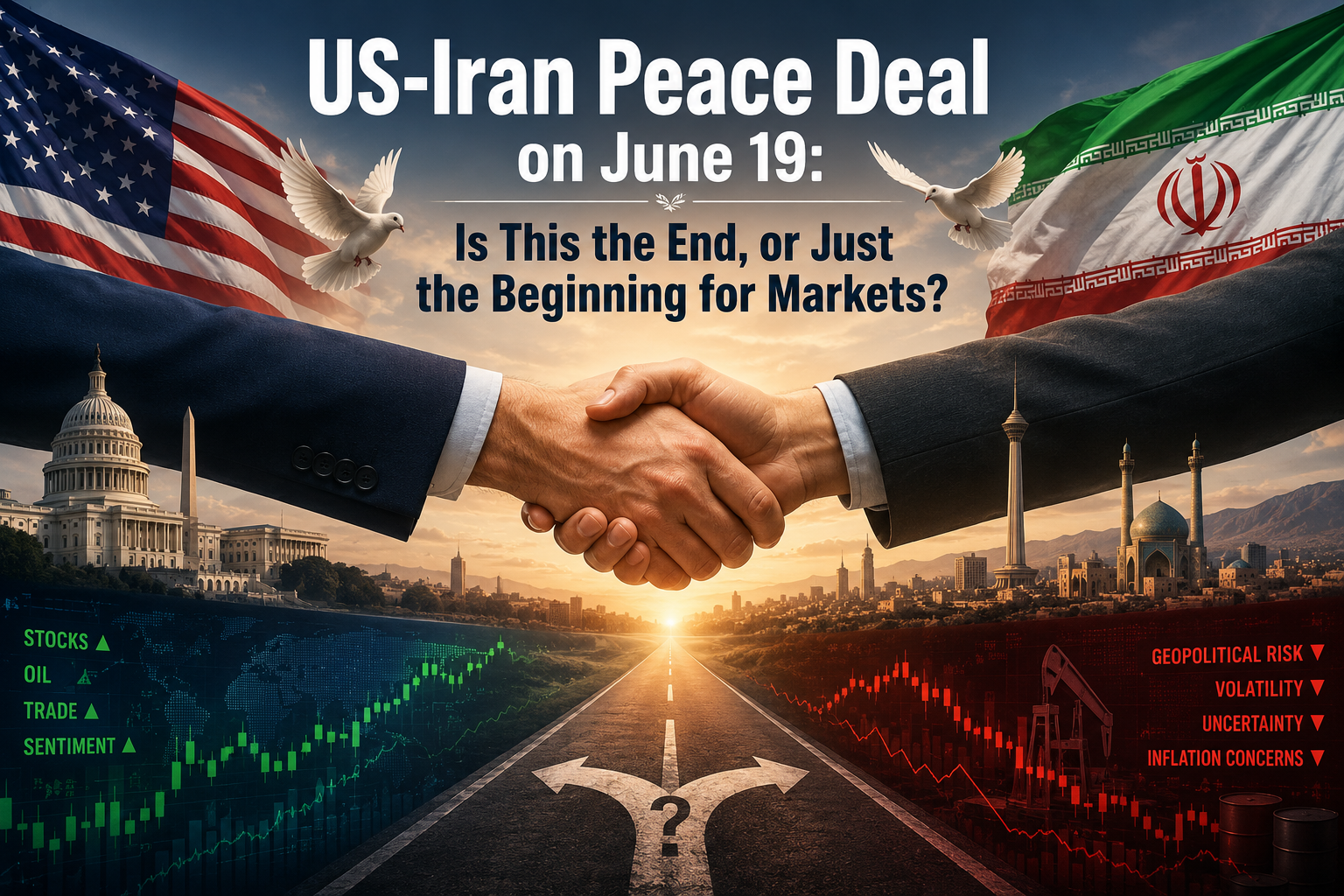
The scheduled US-Iran peace signing on June 19 may become one of the most important macro events of 2026. Not because one signature magically solves decades of geopolitical mistrust. It won’t. But because markets do not wait for perfect peace. Markets price probabilities, and right now the probability map has changed.
The United States and Iran have reportedly reached a framework to end the war, halt the US blockade of Iran, and reopen the Strait of Hormuz, with the formal signing expected in Switzerland on June 19. Reuters has described the agreement as preliminary, with the nuclear issue still left for further negotiations. That detail matters enormously. This is not necessarily the end of the US-Iran conflict as a geopolitical theme. But it could be the end of the most acute market shock phase.
For me, the key question is not simply, “Will they sign?” The real question is: if they sign, what gets repriced next?
Oil has already started falling. Stocks have rallied. Bitcoin has jumped. Bond yields have moved. Traders have reduced some of their bets on a more aggressive Federal Reserve. But I think the market is still in the first chapter of this story.
June 19 could mark the shift from a war-risk market to an implementation-risk market. That is a big difference. In a war-risk market, investors buy energy, hedge inflation, worry about supply shocks and punish long-duration assets. In an implementation-risk market, investors begin to ask whether shipping normalizes, whether inflation comes down, whether the Fed can pause, whether bonds can stabilize, and whether risk assets can extend the rally.
That is why I see this peace deal as more than a diplomatic headline. It is a potential macro reset.
Why June 19 Matters More Than a Normal Diplomatic Headline
A normal diplomatic headline moves markets for a few hours. This one moved oil, equities, bonds, Bitcoin and inflation expectations because it touches the most important artery in global energy: the Strait of Hormuz.
The Strait of Hormuz is not just another shipping lane. It is one of the world’s most sensitive energy chokepoints. When markets believe Hormuz is at risk, crude oil prices rise, shipping insurance costs rise, LNG flows become uncertain, inflation expectations increase and central banks become more uncomfortable.
That is why the peace signing scheduled for June 19 matters. According to 20minutos, the agreement is expected to be formally signed in Switzerland and includes the reopening of the Strait of Hormuz, though Washington intends to maintain its military deployment in the region until it sees Iranian compliance.
That last part is crucial. The US is not treating this as “peace and done.” It is treating it as “peace, but verify.” And markets should probably do the same.
I do not see June 19 as a clean finish line. I see it as a checkpoint. The market will initially celebrate the removal of the worst-case scenario: prolonged conflict, closed shipping lanes, higher oil, higher inflation and a more hawkish Fed. But after the first relief rally, investors will start looking for proof.
Proof means tankers moving normally. Proof means lower insurance premiums. Proof means Brent and WTI staying lower without sudden spikes. Proof means Iran, the US and regional actors not violating the agreement. Proof means Israel’s posture does not reignite escalation elsewhere.
This is why I would not confuse the first market reaction with the full market impact. The first reaction is relief. The full impact depends on implementation.
Is the US-Iran Peace Deal Really the End of the War?
The honest answer is: it may be the end of the direct war phase, but not the end of the strategic conflict.
This distinction matters for investors. A direct war ending is bullish for oil consumers, stocks, risk assets and potentially bonds. But a strategic conflict continuing means risk premiums may not fully disappear.
Reuters has reported that the agreement is designed to end the war, reopen Hormuz and halt the US blockade, but that Iran’s nuclear program remains subject to further negotiations. That means the hardest political issue has not disappeared. It has been moved into the next negotiating room.
From a market perspective, that creates a two-layer outcome:
First, the market prices immediate de-escalation. That is why oil fell and stocks rallied.
Second, the market keeps a residual risk premium because the deal can still fail, stall or be challenged by actors who do not fully support it.
The ABC, 20minutos and Perfil angles all point toward the same news hook: the June 19 peace signing. But the stronger article, in my view, must go beyond the signature. A signature does not guarantee a durable settlement. It only gives the market permission to remove the panic premium.
The Difference Between a Ceasefire, a Memorandum, and Real Peace
One reason I am cautious is that markets sometimes trade political language too aggressively.
A ceasefire is not peace. A memorandum of understanding is not a final treaty. A reopening of Hormuz is not the same as months of safe and normalized shipping. And a headline saying “deal signed” is not the same as an agreement that survives domestic politics in Washington, Tehran and the wider region.
The Reuters framing is important because it calls the agreement preliminary and notes that the nuclear issue still requires further talks. That means the deal may stop the bleeding, but it does not automatically heal the wound.
In my own reading, markets are right to rally on the reduction of tail risk. But they would be wrong to assume the entire Middle East risk premium should instantly go to zero.
The best way to think about June 19 is this:
Before the deal: markets priced escalation risk.
After the deal: markets price execution risk.
That is still bullish compared with where we were, but it is not risk-free.
Why the Strait of Hormuz Is the Market’s Real Obsession
The market does not care about diplomatic ceremonies for emotional reasons. It cares because oil, LNG and shipping routes are the plumbing of the global economy.
The UAE has already called for full implementation of the agreement and emphasized freedom of navigation through Hormuz. That tells me regional players understand the same thing markets understand: the peace deal only matters economically if ships can move.
Reuters has also reported that shippers remain cautious even after the US-Iran deal, which makes sense. Companies do not simply send vessels back through a conflict zone because a politician says the situation is fixed. They wait for security conditions, insurance costs, naval guidance and actual traffic patterns to improve.
That is why the impact on inflation may be slower than the impact on oil futures. Futures can fall in minutes. Supply chains take weeks or months to normalize.
The Immediate Market Reaction: Oil Down, Stocks Up, Bitcoin Risk-On
The first reaction was classic relief trade.
Oil fell. Stocks rallied. Bitcoin moved higher. Bond prices improved. The dollar softened in some market commentary. Investors began pricing lower geopolitical inflation risk.
Reuters reported that major stock indexes and bond prices rallied while oil futures settled at a three-month low after Trump said a preliminary agreement had already been signed by the US and Iran.
That is exactly what I would expect from this kind of headline. When the biggest inflationary shock begins to fade, the market immediately buys duration, buys equities, buys risk assets and sells oil.
But here is the important point: the first move is usually emotional; the second move is analytical.
The emotional move says: “War risk is down. Buy risk.”
The analytical move asks: “How much inflation comes out of the system? How does the Fed react? How durable is the deal? How far can oil fall without supply bottlenecks?”
That second move is what will define the rest of 2026.
Oil and Gas: The First Assets to Reprice
Oil is the cleanest and fastest expression of this deal. When Hormuz risk rises, oil jumps. When Hormuz risk falls, oil drops.
20minutos reported that WTI fell 4.87% to $80.75 after the announcement, as traders priced the prospect of ending hostilities and reopening the Strait of Hormuz. Bloomberg Línea also reported Brent falling more than 3% toward $84 while WTI approached $81.
That is a major relief, but I would not assume oil goes straight back to pre-war levels. There are several reasons.
First, physical flows may take time to normalize.
Second, shipping companies may stay cautious.
Third, insurance and security costs may remain elevated.
Fourth, inventories and refinery dynamics matter.
Fifth, any violation of the deal can instantly put a risk premium back into crude.
Investopedia has reported that even if the peace agreement holds, the inflation relief from lower energy prices could take months to filter through to everyday prices. That is exactly how I would frame oil too: futures move first, the real economy follows later.
For the rest of 2026, I would watch whether WTI can stay below the low-$80s and whether Brent can remain comfortably below the levels reached during peak conflict. If oil keeps falling, the market will start pricing a softer inflation path. If oil rebounds sharply, the Fed problem comes back.
Stocks: Relief Rally or New Bullish Leg?
Stocks love three things: lower inflation, lower rates and lower uncertainty. The US-Iran peace deal potentially delivers all three, at least partially.
Reuters reported that the Dow and STOXX 600 hit record-high closes as investors expected the deal to ease global inflation pressure and reduce the need for higher interest rates. SPY was also trading higher on June 16, reflecting the broader risk-on move in US equities.
But I would separate the stock market into three groups.
The first group is direct winners: airlines, transportation, consumer discretionary, industrials and energy-intensive businesses. Lower oil is effectively a margin relief story.
The second group is duration-sensitive winners: tech, growth stocks, speculative equities and crypto-related names. These assets benefit if Treasury yields stop rising.
The third group is mixed: energy producers. Peace is good for macro stability, but lower crude prices can pressure oil and gas equities if the price drop is large enough.
This is why the stock market reaction can be bullish overall while still creating sector rotation. The S&P 500 may like the deal, but oil producers may not like a sustained crude selloff.
Bitcoin: Why BTC Jumped After the Deal
Bitcoin’s reaction is one of the most interesting parts of this story.
The Wall Street Journal reported that Bitcoin rose to nearly $67,000 after the US-Iran interim peace deal, its highest level in nearly two weeks, as risk appetite improved. Current market data also shows Bitcoin trading around $66,801 on June 16.
To me, this confirms something important: in this environment, Bitcoin is trading less like pure “digital gold” and more like a high-beta liquidity asset.
When oil shocks push inflation higher, the Fed becomes more hawkish. When the Fed becomes more hawkish, liquidity expectations worsen. That is bad for BTC.
When oil falls, inflation pressure eases. When inflation pressure eases, the Fed has less reason to hike. When the Fed has less reason to hike, liquidity expectations improve. That is good for BTC.
So Bitcoin is not rallying simply because “peace is good.” Bitcoin is rallying because peace may reduce the probability of tighter monetary policy.
That distinction matters. If the deal holds and the Fed becomes less hawkish, BTC could have a strong second half of 2026. But if oil spikes again or inflation stays sticky, Bitcoin could lose that macro tailwind quickly.
The Fed: Why This Deal Could Change the Rate Path for 2026
The Federal Reserve may be the most important second-order effect of the US-Iran peace deal.
The war mattered to the Fed because energy prices feed inflation. If oil rises sharply, gasoline rises, transportation costs rise, production costs rise and inflation expectations can become unstable. In that environment, even if growth slows, the Fed has a problem.
Now the peace deal changes the equation.
Business Insider reported that the truce reduced one of the biggest threats to stocks: rate hikes. It noted that oil falling from wartime peaks toward the low-$80s eased inflation pressure and lowered the perceived probability of a Fed rate hike in 2026.
The Guardian reported that the Fed is expected to keep rates on hold, with the benchmark range at 3.5% to 3.75%, as easing energy pressure gives policymakers room to wait. MarketWatch also noted that most investors do not expect a June hike, even though inflation remains elevated and the 2-year Treasury yield is still above the Fed’s upper policy range.
That is the setup: less pressure to hike, but not enough evidence to declare victory.
Lower Oil Means Lower Inflation Pressure
If oil continues falling, the Fed gets breathing room.
Lower crude can reduce gasoline prices. Lower diesel can reduce transportation costs. Lower LNG and energy costs can help manufacturers. Lower energy volatility can reduce inflation expectations.
This does not mean inflation instantly returns to target. It means the probability of another inflation acceleration goes down.
In my view, this is the most bullish part of the peace deal for markets. Not the headline itself. Not even the oil drop. The real bullish factor is that the Fed may no longer feel forced into a defensive posture.
If the Fed can pause instead of hike, risk assets can breathe.
Why the Fed May Still Stay Cautious
The Fed cannot base policy on one diplomatic event. It needs data.
Even if oil falls, officials will still look at core inflation, wages, services prices, rent, consumer expectations and financial conditions. If stocks rally too aggressively and financial conditions loosen too much, the Fed may worry that inflation pressure returns through another channel.
This is why I would not expect the Fed to suddenly turn dovish overnight. The more realistic outcome is a less hawkish Fed, not an aggressively dovish Fed.
That difference matters for bonds, stocks and crypto.
A less hawkish Fed means fewer rate-hike fears.
A dovish Fed means rate-cut hopes.
We are probably closer to the first than the second.
The Bond Market Is the Real Judge
I am watching bonds more than headlines.
If the peace deal is real, the bond market should begin to price lower inflation risk. That could support Treasury prices, especially if growth slows and the Fed stays on hold. But the long end of the bond market also has to deal with deficits, Treasury supply and credibility.
MarketWatch highlighted that the 2-year yield remained around 4.06%, still above the Fed’s upper policy range, even as oil prices fell. That tells me the bond market is relieved, but not fully convinced.
TLT, a proxy for long-duration US Treasury bonds, was nearly flat on June 16, showing that the long-bond market is not delivering a simple “peace rally” without reservations.
If yields fall steadily over the next few weeks, that would confirm the market believes the inflation shock is fading. If yields stay high, it means the bond market thinks the Fed still has a problem.
Treasury Bonds: What I’m Watching After the Peace Deal
Bonds are where the peace deal becomes macro reality.
Stocks can rally on emotion. Bitcoin can spike on liquidity hopes. Oil can fall on headlines. But Treasury bonds require a deeper conviction that inflation, growth and policy are moving in a specific direction.
For the rest of 2026, I would watch three things.
First, the 2-year yield. This is the Fed expectations instrument. If the 2-year yield falls, markets are saying the Fed is less likely to hike.
Second, the 10-year yield. This reflects inflation expectations, growth expectations and fiscal risk.
Third, the yield curve. If short yields fall faster than long yields, markets may be pricing a friendlier Fed. If long yields stay high, markets may still be worried about deficits or long-term inflation credibility.
The peace deal is bond-friendly only if it lowers inflation expectations more than it improves growth expectations. If the deal creates a growth boom and risk-on surge, long yields may not fall much. But if it removes the oil shock while growth remains moderate, bonds could benefit.
That is why I think Treasuries may become the cleanest test of whether this deal is truly disinflationary.
Commodities Outlook: Oil, Gold, Copper, Natural Gas and Agriculture
The commodity market reaction will not be uniform. “Peace” does not mean all commodities fall. It means the risk premium changes.
Some commodities fall because war risk fades.
Some rise because growth expectations improve.
Some stay elevated because supply chains take time to heal.
Crude Oil: Relief, but Not a Full Reset
Crude oil should remain the most direct beneficiary of de-escalation — meaning prices fall as risk fades.
However, I would be careful with overly bearish oil calls. If the world has been operating under disrupted flows, depleted flexibility and cautious shipping conditions, then reopening Hormuz does not instantly create perfect supply.
Reuters has reported that shipping remains cautious despite the agreement. The US blockade of Iranian ports also remained in effect as of June 15 until the agreement is completed, according to Reuters.
So my base case is: oil can move lower, but not in a straight line. The first drop is easy. The second drop requires proof.
Gold: Why It Can Rise Even When Peace Arrives
Gold is tricky here.
In a simple textbook model, peace reduces safe-haven demand, so gold should fall. But the current setup is more complicated. Gold can rise if Treasury yields fall, if the dollar weakens, or if investors still distrust the durability of the agreement.
Gold-related market data showed GLD trading higher on June 16. Anadolu also reported that gold rose above $4,300 as oil fell and inflation fears eased.
That may look counterintuitive, but it makes sense. If peace reduces the need for Fed hikes, real yields may fall. Lower real yields can support gold even if geopolitical fear declines.
So for gold, I would watch real rates more than headlines.
If the deal holds and yields fall, gold can stay supported.
If the deal holds and risk appetite explodes while yields remain high, gold may struggle.
If the deal fails, gold likely gets a safe-haven bid again.
Copper and Industrial Metals: A Growth Repricing
Copper and industrial metals may benefit if the deal improves global growth expectations.
Lower energy prices reduce production costs. More stable shipping supports manufacturing. Lower inflation pressure can reduce central bank tightening risk. All of that is positive for industrial demand.
But this is not automatic. If the global economy is already slowing, lower oil may help margins without creating a major demand boom. Copper needs real activity, not just relief.
For me, copper is a second-stage trade. First oil falls. Then bonds confirm. Then industrial metals react if the market believes global growth can stabilize.
Agriculture and Fertilizers: The Slow-Moving Impact
Agriculture may see slower effects.
Energy prices affect fertilizer, transport, machinery costs and global food inflation. If oil and gas fall, agricultural input costs may ease over time. But farmers, distributors and food supply chains do not reprice as fast as futures markets.
Axios reported that supply chain effects from the US-Iran peace deal may be slow-going, especially in areas tied to energy, fertilizers and industrial goods.
That is why consumers may not feel immediate relief at the grocery store. Markets move first. Supply chains adjust later. Consumers usually feel it last.
Bitcoin and Crypto: Bullish, But Not for the Reason Most People Think
I think Bitcoin is one of the cleanest sentiment indicators after the US-Iran deal.
BTC rising toward $67,000 tells me investors are moving back into risk. But I would not frame this as Bitcoin responding to peace in a moral or political sense. It is responding to liquidity expectations.
Here is the chain:
US-Iran deal holds.
Hormuz reopens.
Oil falls.
Inflation pressure eases.
Fed hike probability falls.
Treasury yields stabilize.
Liquidity expectations improve.
Bitcoin rallies.
That is the story.
If any part of that chain breaks, BTC can reverse.
The most bullish BTC scenario for the rest of 2026 would be: oil keeps falling, the Fed stays on hold, yields drift lower, the dollar weakens and stocks continue higher. In that environment, Bitcoin could behave like a leveraged macro asset.
The bearish scenario would be: the deal breaks, oil spikes, inflation reaccelerates, the Fed talks tough and yields rise. In that environment, BTC could get hit hard.
So I am bullish on BTC if the deal holds but I am not blindly bullish. I want confirmation from oil, yields and the Fed.
What Could Happen During the Rest of 2026 If the Deal Holds
The rest of 2026 depends on whether this agreement becomes a durable regime shift or just a temporary pause.
I see three main scenarios.
Scenario 1: Clean Implementation and Market Relief
This is the bullish scenario.
The June 19 signing happens. Hormuz reopens fully. Shipping normalizes. The US begins reducing military pressure gradually. Iran complies enough to keep the deal alive. Israel remains unhappy but does not trigger a wider escalation. Oil continues falling or stabilizes at lower levels.
In this scenario:
- Oil stays under pressure.
- Inflation expectations fall.
- The Fed stays on hold.
- Rate-hike odds decline further.
- Stocks extend gains.
- Bitcoin benefits from liquidity optimism.
- Gold may stay supported if real yields fall.
- Consumer confidence improves into year-end.
This would be the best environment for a broad risk rally.
The market would begin to price 2026 not as a stagflation year, but as a year of disinflationary relief. That would be powerful.
Scenario 2: Fragile Peace and Choppy Markets
This is my base case.
The deal is signed, but implementation is messy. Hormuz reopens, but shipping is cautious. Oil falls, then stabilizes. The Fed stays patient but refuses to declare victory. Bonds rally slightly, but long yields remain sticky because of deficits and inflation credibility concerns.
In this scenario:
- Stocks can grind higher but with volatility.
- BTC rallies, then consolidates.
- Oil trades with headline risk.
- Gold remains supported.
- Bonds improve, but not dramatically.
- The Fed remains data-dependent.
This is the most realistic outcome in my view. Peace deals rarely move in a straight line. Markets may want a clean story, but geopolitics usually gives us a messy one.
Scenario 3: Deal Breaks Down and Inflation Returns
This is the bearish scenario.
The agreement is signed but quickly challenged. Iran, the US, Israel or regional proxies create a new escalation point. Hormuz becomes risky again. Oil jumps. Inflation expectations rise. The Fed becomes more hawkish. Bonds sell off. Stocks reverse. Bitcoin loses the liquidity bid.
In this scenario:
- Oil could spike quickly.
- The Fed may revive hike language.
- Treasury yields rise.
- Growth stocks suffer.
- BTC falls with risk assets.
- Gold gets a safe-haven bid.
- Consumer inflation fears return.
This is why I would not treat the June 19 deal as a risk-free green light. It is bullish, yes. But it is not invincible.
My Base Case for the Rest of the Year
My base case is that the June 19 US-Iran peace deal becomes a meaningful de-escalation event, but not a complete geopolitical reset.
I think markets are right to celebrate. Oil falling, stocks rallying and Bitcoin moving higher all make sense. The deal reduces the probability of a worst-case inflation shock and gives the Fed more room to pause.
But I also think the market will eventually become more selective.
In the first phase, everything risk-on can rally.
In the second phase, investors will ask what actually changed.
In the third phase, the winners will be assets supported by real data: lower oil, lower inflation, stable yields and better earnings.
For the rest of 2026, I would watch five indicators:
- Brent and WTI staying below crisis levels.
- The 2-year Treasury yield moving lower.
- Fed language becoming less hawkish.
- Bitcoin holding the post-deal breakout zone.
- Shipping traffic through Hormuz normalizing without incidents.
If those five things happen, the peace deal can become a real macro tailwind.
If they do not, the market may have front-run too much optimism.
Final Thoughts
The US-Iran peace deal scheduled for June 19 could be one of the biggest market turning points of 2026, but I would not call it “the end.”
I would call it the beginning of a new phase.
The war-risk premium is coming out of markets. That is why oil is falling, stocks are rallying, bonds are firmer and Bitcoin is acting better. But now comes the harder part: implementation.
For me, the smartest way to look at this is simple:
The headline is bullish. The details decide whether it lasts.
If the agreement holds, the second half of 2026 could look much better for risk assets than investors expected just weeks ago. Lower oil would reduce inflation pressure. A less aggressive Fed would support bonds and stocks. Bitcoin could benefit from better liquidity expectations. Commodities would rotate from war premium to growth fundamentals.
But if the deal fails, the same assets that rallied on peace can reverse violently.
So yes, June 19 matters. It may not be the end of the story, but it could be the day markets stop pricing panic and start pricing possibility.
FAQs
Will the US and Iran sign the peace deal on June 19?
The formal signing is expected on June 19 in Switzerland, according to multiple reports, but the agreement is still best understood as preliminary until implementation details are confirmed.
Is this the end of the US-Iran war?
It may end the direct war phase if implemented successfully, but it does not eliminate deeper strategic tensions, especially around Iran’s nuclear program, which Reuters says remains subject to further negotiations.
Why did oil fall after the peace deal news?
Oil fell because the agreement could reopen the Strait of Hormuz and reduce supply disruption risk. WTI dropped to around $80.75 after the announcement, according to 20minutos.
How could the peace deal affect the Fed?
If lower oil reduces inflation pressure, the Fed may have less reason to hike rates. Markets have already reduced some rate-hike expectations after the de-escalation.
Is the peace deal bullish for Bitcoin?
It can be bullish if it lowers inflation fears, reduces Fed tightening risk and improves liquidity expectations. Bitcoin moved near $67,000 after the interim deal, according to the Wall Street Journal.
What happens to gold if peace holds?
Gold can still rise if Treasury yields and the dollar fall. Peace reduces safe-haven demand, but lower real yields can support gold.
What is the biggest risk now?
The biggest risk is implementation failure: a violation of the deal, renewed attacks, slow reopening of Hormuz or unresolved nuclear negotiations.