
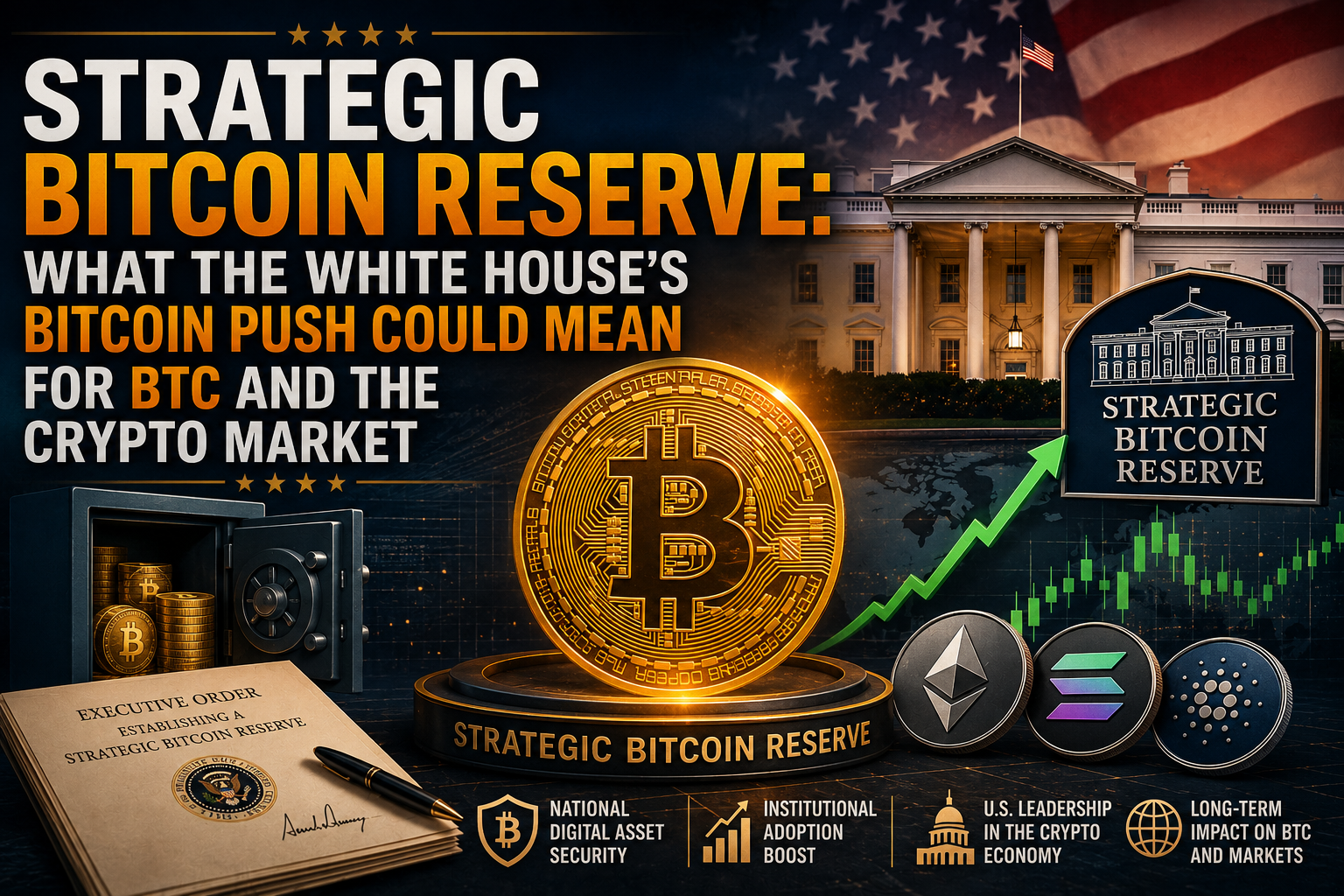
The idea of a Strategic Bitcoin Reserve sounded almost absurd a few years ago. Bitcoin was still treated by many politicians as a speculative internet asset, a tool for outsiders, or something regulators needed to contain. Now the White House has formally put Bitcoin into a different category: not just another crypto asset, but a potential sovereign reserve asset.
That is the part I cannot ignore.
What caught my attention was not only that the White House established a Strategic Bitcoin Reserve, but the language around it. The March 2025 executive order created both a Strategic Bitcoin Reserve and a separate U.S. Digital Asset Stockpile, with Bitcoin treated differently from other digital assets held by the federal government. The reserve is designed to be capitalized mainly with BTC already owned by the government through criminal or civil forfeiture, while other digital assets are placed into a separate stockpile.
To me, that distinction matters more than the headline.
This is not simply “the U.S. government likes crypto now.” It is closer to: the U.S. government is beginning to treat Bitcoin as a strategic monetary asset while treating the rest of crypto as a managed digital asset inventory.
That has consequences for Bitcoin, for altcoins, for exchanges, for custody firms, for stablecoins, for global regulation, and for anyone wondering whether they should buy BTC just because Washington is suddenly saying the word “Bitcoin” out loud.
Let’s go deep.
What Is the U.S. Strategic Bitcoin Reserve?
The U.S. Strategic Bitcoin Reserve is a federal reserve of Bitcoin established by executive order. Its purpose is to hold Bitcoin owned by the U.S. government in a more deliberate, strategic way instead of selling seized BTC case by case.
The key point is this: the reserve is not initially built around the government rushing into the open market and buying billions of dollars of Bitcoin tomorrow morning. It is built around the government keeping Bitcoin it already controls, mainly from forfeiture proceedings.
That may sound less exciting than a giant market buy order, but in some ways it is more important. For years, government-seized Bitcoin was often treated like an asset to liquidate. If the new policy is to hold instead of sell, that changes the market psychology.
It tells the market: Bitcoin is no longer just something the government confiscates and auctions off. It is something the government may want to keep.
The difference between a Bitcoin reserve and a digital asset stockpile
One of the most important details is the separation between the Strategic Bitcoin Reserve and the U.S. Digital Asset Stockpile.
The White House did not simply create one big “crypto reserve.” It created one bucket for Bitcoin and another bucket for other digital assets. That is a major signal.
Bitcoin is being framed as a strategic reserve asset. Other digital assets are being framed more like assets the government needs to manage responsibly after seizure. The official fact sheet says the Bitcoin reserve is intended to hold government-owned BTC, while the Digital Asset Stockpile applies to other digital assets obtained through forfeiture proceedings.
That difference could become one of the biggest narrative drivers in crypto.
For years, crypto investors have argued about whether Bitcoin is just one crypto among many or whether it belongs in a separate category. The White House’s structure leans toward the second view. Bitcoin gets the reserve. Everything else gets the stockpile.
That does not mean altcoins are dead. It does mean Bitcoin may be increasingly viewed by governments, institutions, and large allocators as the benchmark asset of the digital asset world.
Why the White House is treating Bitcoin differently
Bitcoin has several qualities that make it easier for policymakers to frame as a reserve asset:
- fixed supply of 21 million BTC;
- deep liquidity compared with most crypto assets;
- no central issuer;
- global recognition;
- long operational history;
- strong institutional adoption through ETFs, custodians, and public companies.
Senior administration officials described the reserve as a kind of “digital Fort Knox” and framed Bitcoin as “digital gold,” highlighting its scarcity and special status compared with other crypto assets.
I do not think that phrase was accidental.
When governments talk about strategic reserves, they usually talk about assets that matter beyond short-term price action: gold, oil, foreign currencies, critical materials. Putting Bitcoin into that conversation does not magically remove volatility, but it does change the mental category.
Bitcoin stops being only a trade.
It starts becoming a geopolitical asset.
What Did the White House Actually Say About the Bitcoin Reserve?
The White House executive order established the Strategic Bitcoin Reserve and directed the Treasury to manage custodial accounts for the government’s digital asset holdings. It also required agencies to review their authority to transfer relevant assets and asked Treasury to evaluate legal and investment considerations for managing the reserve and stockpile going forward.
That sounds bureaucratic, but it is exactly how serious policy usually begins.
The government does not normally say, “We are buying now, good luck everybody.” It builds legal authority, custody structures, reporting systems, interagency processes, and political cover. That is why I do not read this as a simple “the U.S. is buying Bitcoin tomorrow” headline.
I read it as institutional plumbing.
And in finance, plumbing matters.
The key point: seized Bitcoin would not be sold
The most immediately bullish part of the reserve is not necessarily new buying. It is the possibility that the U.S. government stops being a recurring forced seller.
If the government already controls a large amount of BTC and decides to hold it long term, that reduces a known source of potential sell pressure. It also sends a signal to other governments: maybe seized Bitcoin should not automatically be converted into dollars.
That is a big deal.
In the past, a government auction of Bitcoin could be seen as a one-time disposal event. Under a strategic reserve framework, those coins may become part of a national balance sheet.
From a market perspective, that changes the narrative from:
“The government will sell confiscated Bitcoin.”
to:
“The government may preserve confiscated Bitcoin as a strategic asset.”
That is a completely different story.
Why “budget-neutral acquisition” matters
Another major phrase is budget-neutral acquisition.
The White House order allows the Treasury and Commerce secretaries to develop strategies for acquiring additional Bitcoin, as long as those strategies are budget-neutral and do not impose incremental costs on taxpayers.
This is where people need to slow down.
Budget-neutral does not mean “the government is definitely buying tomorrow.” It means any additional acquisition strategy would need to avoid looking like a new taxpayer-funded spending program.
That could involve several theoretical paths:
- retaining forfeited BTC instead of selling it;
- using proceeds from other asset sales;
- revaluing or restructuring government-held assets;
- creating mechanisms approved by Congress;
- using creative Treasury accounting within legal boundaries.
Some of those ideas are politically realistic. Some are controversial. Some may never happen. The important part is that the administration left the door open without committing to an immediate market purchase.
That is why I think the market should pay attention, but not hallucinate certainty.
Why the lack of a purchase date is not accidental
A lot of investors want one answer: When will the U.S. buy Bitcoin?
I get it. That is the market-moving question.
But the lack of a clear purchase date is probably intentional. If Treasury announced a specific date, amount, and mechanism, the market would likely front-run it. Bitcoin’s price could move sharply before the government even acted.
Treasury Secretary Scott Bessent has signaled caution around the reserve, with recent reporting saying the Treasury is proceeding at “deliberate speed” rather than making a dramatic immediate announcement.
That phrase tells me a lot.
“Deliberate speed” is not “nothing is happening.” It is also not “we are smashing the buy button.” It means the government wants to move, but in a controlled, legally defensible, market-aware way.
That is exactly what I would expect if the U.S. were trying to build a Bitcoin policy without creating chaos in the market.
Is the U.S. Government Buying Bitcoin?
Right now, the cleanest answer is this:
The U.S. has created a Strategic Bitcoin Reserve, but the clearest foundation of that reserve is Bitcoin already obtained through forfeiture. Additional acquisition may be possible, but the government has not provided a simple public schedule for open-market purchases.
This distinction is everything.
Too many headlines blur three separate ideas:
- The U.S. already holds Bitcoin.
- The U.S. may stop selling seized Bitcoin.
- The U.S. may buy additional Bitcoin in the future.
Those are not the same thing.
Holding confiscated BTC is not the same as buying new BTC
If the government retains BTC it already owns, that is bullish in a structural way because it reduces potential future selling. But it is not the same as new demand entering the market.
If the government buys BTC in the open market, that is direct new demand. That could have a much more immediate price effect, especially if the amounts are large.
This is where investors need to be careful. A Strategic Bitcoin Reserve can be long-term bullish even if it does not create an instant green candle.
In my view, the worst mistake would be buying only because Washington said “Bitcoin” and assuming that means a massive buy order is already scheduled.
Before I think about price targets, I want to understand:
- where the coins are coming from;
- whether purchases are actually happening;
- whether Congress passes supporting legislation;
- how custody is handled;
- whether audits are public;
- whether wallet movements confirm the policy.
That is the difference between investing on information and gambling on vibes.
When could the U.S. buy more Bitcoin?
There are a few possible routes.
The first route is simple retention: the government keeps adding forfeited BTC to the reserve when cases are finalized. Bessent has previously described seized Bitcoin as the foundation of the reserve, and reporting has emphasized that forfeited assets remain central to the policy.
The second route is budget-neutral acquisition. This is more complex. The White House has allowed officials to explore ways to acquire additional Bitcoin without new taxpayer costs.
The third route is legislation. The American Reserve Modernization Act of 2026, introduced by Congressman Nick Begich with Congressman Jared Golden as co-lead, aims to establish a Strategic Bitcoin Reserve in law and modernize federal management of digital reserve assets.
If Congress creates a clearer legal framework, the odds of more structured accumulation could rise.
But as of now, I would not tell anyone that there is a guaranteed public purchase date. The more honest answer is: watch the legal framework, not just the headlines.
What needs to happen before any major purchase?
Before the U.S. government buys additional Bitcoin in size, several things likely need to be resolved.
First, there must be legal authority. Agencies need to know exactly what they are allowed to do.
Second, there must be custody infrastructure. A sovereign Bitcoin reserve cannot be managed casually. Wallet security, multisig controls, internal access, insurance, auditability, and operational risk all matter.
Third, there must be political justification. Bitcoin is volatile. If the government buys BTC and the price drops 30%, opponents will call it reckless. If the government buys BTC and the price doubles, critics may still ask who benefited from the announcement.
Fourth, there must be market strategy. Buying Bitcoin without moving the market is not easy at sovereign scale.
That is why the phrase “deliberate speed” makes sense. This is not just about buying an asset. It is about building a new category of state reserve management.
What Would a Strategic Bitcoin Reserve Mean for Bitcoin?
For Bitcoin, the Strategic Bitcoin Reserve could be one of the most important legitimacy events in its history.
Not because it guarantees a price target. It does not.
Not because governments suddenly understand Bitcoin perfectly. They do not.
But because it pushes Bitcoin into the same conversation as gold, sovereign reserves, strategic commodities, and national balance sheets.
That is a major psychological shift.
Bitcoin’s shift from speculative asset to sovereign reserve asset
Bitcoin has always had two identities.
To traders, it is a volatile risk asset.
To long-term believers, it is a scarce, decentralized monetary network.
A U.S. Strategic Bitcoin Reserve strengthens the second identity. It suggests that Bitcoin is no longer only something retail investors, hedge funds, ETFs, and tech companies hold. It may be something nations hold strategically.
That does not make Bitcoin risk-free. Gold is a reserve asset and still moves. Oil is strategic and still volatile. Currencies are sovereign instruments and still fluctuate.
But reserve status changes perception.
If the U.S. treats Bitcoin as worth holding, other countries may have to answer an uncomfortable question:
If Bitcoin is scarce and the U.S. is keeping it, should we have some too?
That is where game theory enters.
The potential supply shock narrative
Bitcoin’s supply is fixed. Only 21 million BTC can ever exist.
If governments begin accumulating and holding rather than selling, the liquid supply available to the market could shrink over time. Add ETFs, long-term holders, corporate treasuries, lost coins, and self-custody, and the supply story becomes even tighter.
This is the bullish argument:
- governments hold;
- institutions accumulate;
- ETFs absorb supply;
- retail returns during bull cycles;
- miners produce less new BTC after each halving;
- long-term holders sell less;
- price has to adjust upward to meet demand.
That argument is powerful.
But it is not automatic.
Bitcoin’s price still depends on liquidity, rates, risk appetite, leverage, regulation, and macro conditions. A reserve narrative can support long-term demand, but it cannot eliminate volatility.
I’m bullish on what this means symbolically, but I’m not blind to the fact that Bitcoin can still drop hard even with a great long-term story.
Why price may not react immediately
Markets often price narratives before policies fully happen.
If traders expect the U.S. to buy Bitcoin and then the government says, “We are moving carefully,” price may fall in the short term. That does not mean the policy is meaningless. It means the market got ahead of itself.
There is a difference between a price catalyst and a structural catalyst.
A price catalyst moves the chart quickly.
A structural catalyst changes the long-term foundation.
The Strategic Bitcoin Reserve is more structural than instant. It may influence how institutions, countries, and investors think about Bitcoin over years, not just days.
That is why I would not judge the policy only by the next 24-hour candle.
What Would It Mean for the Entire Crypto Ecosystem?
The Strategic Bitcoin Reserve is mainly about Bitcoin, but the effects could spread across the entire crypto ecosystem.
Some effects would be bullish. Some would be uncomfortable.
Bitcoin could become the benchmark asset of crypto
If Bitcoin gets treated as the sovereign-grade crypto asset, it may strengthen Bitcoin dominance.
That does not mean altcoins disappear. It means the market may increasingly separate crypto into categories:
- Bitcoin as reserve-grade digital money;
- stablecoins as payment and dollar infrastructure;
- Ethereum and smart contract platforms as application layers;
- tokenized assets as financial rails;
- speculative altcoins as high-risk venture-style bets.
That categorization could mature the industry.
It could also make the market harsher. If governments and institutions prefer Bitcoin, many altcoins may struggle to justify why they deserve a similar monetary premium.
Altcoins may benefit but not equally
A Strategic Bitcoin Reserve could lift the entire crypto market by improving legitimacy. If Washington treats Bitcoin seriously, large investors may become more comfortable exploring the broader digital asset space.
But the benefit will not be equal.
The strongest beneficiaries may be projects and companies tied to real infrastructure:
- custody;
- compliance;
- stablecoins;
- tokenization;
- exchanges;
- Bitcoin mining;
- institutional trading;
- blockchain analytics;
- proof-of-reserves tools.
Highly speculative tokens may get short-term attention, but long-term capital will likely ask harder questions.
That is healthy.
Crypto does not need every token to win. It needs the serious parts of the ecosystem to become more trusted, transparent, and useful.
Stablecoins, exchanges, custodians and ETFs could be infrastructure winners
If sovereign Bitcoin holdings grow, custody becomes a national-security-level issue.
That could benefit institutional custodians, ETF issuers, regulated exchanges, cybersecurity firms, wallet infrastructure, and audit technology. It could also push the U.S. toward clearer crypto market structure laws.
This is one reason I think the reserve story is bigger than BTC price.
A national Bitcoin reserve forces policymakers to answer practical questions:
- Who holds the keys?
- How are reserves audited?
- Can the public verify balances?
- What happens if coins move?
- Who has signing authority?
- What is the legal process for selling?
- Are other digital assets treated differently?
- How does this interact with stablecoin regulation?
Those questions pull crypto deeper into the financial system.
That can be bullish for adoption, but it also means more regulation.
Is It Good for Countries to Control Large Bitcoin Reserves?
This is the question people do not ask enough.
Is it good if countries control large Bitcoin reserves?
My honest answer: it is good for legitimacy, but it creates real risks.
Bitcoin was not created so governments could become whales. It was created as an open monetary network outside centralized control. So when governments start accumulating BTC, we should not turn off our brains and clap automatically.
The bullish case: legitimacy, scarcity and geopolitical game theory
The bullish case is obvious.
If countries hold Bitcoin, Bitcoin becomes harder to dismiss. It becomes part of sovereign strategy. It may become a hedge, a reserve asset, a geopolitical signal, or a neutral settlement asset in a fragmented world.
A U.S. reserve could also trigger competition.
If one major country holds Bitcoin and another does not, the second country may worry about being late. That is how reserve asset game theory works. Nobody wants to be the last buyer of a scarce asset if others are accumulating.
This could create a long-term adoption loop:
- The U.S. holds Bitcoin.
- Other countries study Bitcoin reserves.
- Institutions treat BTC as more legitimate.
- Liquidity deepens.
- Custody improves.
- More countries and institutions enter.
- Bitcoin’s reserve narrative strengthens.
That is the dream scenario for Bitcoin bulls.
The bearish case: concentration, political risk and market pressure
Now the uncomfortable part.
If countries control large BTC reserves, they can influence markets.
They may not control Bitcoin’s protocol, but they can affect liquidity, regulation, sentiment, and sell pressure. A government whale does not need to change the code to move the market. It only needs to signal buying, selling, regulation, taxation, custody rules, or sanctions policy.
There is also political risk.
One administration may support holding Bitcoin. Another may want to sell it. One Congress may see BTC as strategic. Another may frame it as reckless speculation. If Bitcoin becomes a political asset, the market may have to price election risk more directly.
That is not nothing.
There is also the philosophical issue. Bitcoin’s strongest value proposition is decentralization. If a small number of states, ETFs, custodians, and corporations hold too much liquid supply, Bitcoin still works technically, but the ownership structure becomes more concentrated.
That does not break Bitcoin.
But it changes the social layer.
Why self-custody still matters
This is why self-custody still matters.
If the future of Bitcoin is only ETFs, government reserves, centralized custodians, and sovereign wallets, then Bitcoin becomes more institutional but less spiritually Bitcoin.
The network remains decentralized as long as users can hold their own keys, run nodes, transact independently, and verify supply. That is the point.
So yes, I see the Strategic Bitcoin Reserve as bullish. But I also think it should remind people why Bitcoin was created in the first place.
Governments holding Bitcoin is validation.
Individuals holding their own Bitcoin is sovereignty.
Both can exist, but they are not the same thing.
What Should Investors Keep in Mind Right Now?
The Strategic Bitcoin Reserve is important, but it is not a free-money signal.
I would not buy Bitcoin simply because of one political headline. I would also not ignore the headline just because the government has not announced a massive purchase schedule.
The right approach is somewhere in the middle.
Do not confuse policy momentum with guaranteed price action
Policy momentum can support a long-term thesis, but it does not guarantee short-term gains.
Bitcoin can fall on good news. It can rise on vague rumors. It can overreact, underreact, and then reprice months later.
That is why I separate my thinking into three layers:
- Narrative: Is Bitcoin becoming more legitimate?
- Flow: Is new demand actually entering the market?
- Structure: Are laws, custody, audits, and institutions improving?
The Strategic Bitcoin Reserve is strongest on narrative and structure. The flow question is still open.
Until there is clear evidence of actual government buying, I would be careful about assuming immediate supply shock.
Watch custody, audits, legislation and actual wallet movements
Here is what I would watch before getting too excited:
| Signal | Why it matters |
|---|---|
| Treasury custody framework | Shows how serious and operational the reserve is |
| Public audits | Builds trust and verifies holdings |
| Congressional legislation | Makes the reserve harder to reverse politically |
| Wallet movements | Confirms whether BTC is being transferred or consolidated |
| Budget-neutral acquisition plan | Could reveal how new BTC might be acquired |
| Comments from Treasury | Clarifies timing and intent |
| Other countries responding | Could trigger sovereign accumulation game theory |
| ETF inflows | Shows institutional demand beyond government policy |
| Stablecoin and market structure laws | Shapes the broader crypto environment |
This is where real investors should focus.
Not just headlines.
How I would think about risk before buying
If I were evaluating Bitcoin after these White House statements, I would ask myself:
- Am I buying because of long-term conviction or short-term FOMO?
- Can I handle a 30% to 50% drawdown?
- Do I understand the difference between seized BTC and new purchases?
- Am I overexposed to crypto already?
- Do I have a plan if the reserve story takes years to develop?
- Am I watching real policy signals or social media hype?
The biggest mistake is assuming the government has removed the risk.
It has not.
Bitcoin is still volatile. Crypto is still cyclical. Regulation can still surprise the market. Political support can change. Macro conditions still matter.
But the reserve does add something meaningful: a new layer of institutional legitimacy.
And in Bitcoin, legitimacy compounds slowly then suddenly.
Strategic Bitcoin Reserve Scenarios: Bullish, Neutral and Risky
The best way to think about this is through scenarios.
Nobody knows exactly how this plays out. Anyone claiming certainty is selling something.
Bullish scenario: the U.S. accumulates and other countries follow
In the bullish scenario, the U.S. keeps all forfeited BTC, creates transparent custody and audit systems, passes supportive legislation, and eventually develops a budget-neutral way to acquire more Bitcoin.
Other countries respond. Some create their own Bitcoin reserves. Institutions increase allocations. Bitcoin becomes widely accepted as a sovereign-grade reserve asset.
In this scenario, BTC benefits from:
- reduced sell pressure;
- stronger institutional demand;
- sovereign accumulation;
- deeper custody infrastructure;
- improved regulatory clarity;
- stronger digital gold narrative.
This would be extremely bullish over the long term.
Not because the price goes up every day, but because Bitcoin’s addressable market expands.
Neutral scenario: the reserve exists but buying is slow
In the neutral scenario, the U.S. reserve exists mostly as a holding structure for seized Bitcoin. The government does not sell much, but it also does not buy aggressively.
The market gets some legitimacy benefit, but not a major supply shock.
Bitcoin continues trading mainly on macro liquidity, ETF flows, halving cycles, risk appetite, and global regulation.
This scenario is still positive, but less explosive.
It means the Strategic Bitcoin Reserve becomes part of the long-term Bitcoin story, not an immediate price engine.
Honestly, this may be the most realistic near-term scenario.
Risky scenario: politics turns Bitcoin into a regulatory battlefield
In the risky scenario, Bitcoin becomes more politicized.
One side supports the reserve. Another side attacks it. Future administrations threaten to sell. Congress fights over custody, spending, taxation, or market manipulation. Other countries respond with hostile regulation or capital controls.
In this world, Bitcoin still survives, but the ride gets rough.
Government involvement brings legitimacy, but it also brings politics. And politics can be messy.
That is why I do not want Bitcoin’s future to depend only on the U.S. government. The strongest version of Bitcoin is one where sovereign adoption grows while individual ownership, self-custody, mining decentralization, and global node distribution remain strong.
Conclusion: The Bitcoin Reserve Is Bigger Than a Price Headline
The Strategic Bitcoin Reserve is not just another crypto headline.
It is a sign that Bitcoin is entering a new phase.
The White House has treated Bitcoin differently from other digital assets. Treasury is moving carefully. Congress is exploring ways to formalize the reserve. The market is trying to understand whether this means immediate buying, long-term holding, or something in between.
My view is simple: this is structurally bullish for Bitcoin, but investors should not confuse structural change with guaranteed short-term price action.
The most important shift is not that the U.S. might buy Bitcoin tomorrow. The most important shift is that the U.S. may no longer see Bitcoin as something to simply seize and sell.
It may see Bitcoin as something to hold.
That changes the conversation.
For BTC, it strengthens the digital gold thesis.
For crypto, it separates Bitcoin from the rest of the market more clearly.
For investors, it creates opportunity — but also demands patience, skepticism, and risk management.
And for governments, it opens a new era of monetary game theory.
If Bitcoin becomes a sovereign reserve asset, the question will no longer be whether countries should pay attention.
The question will be whether they can afford not to.
FAQs About the Strategic Bitcoin Reserve
What is the Strategic Bitcoin Reserve?
The Strategic Bitcoin Reserve is a U.S. government reserve of Bitcoin established by executive order in March 2025. It is designed to hold government-owned BTC, especially Bitcoin obtained through criminal or civil forfeiture proceedings.
Did the White House say the U.S. will buy Bitcoin?
The White House allowed Treasury and Commerce officials to explore budget-neutral strategies for acquiring additional Bitcoin, but the clearest foundation of the reserve is BTC already owned by the government through forfeiture. That means investors should not assume a large immediate open-market purchase unless there is a specific official announcement.
When will the U.S. government buy Bitcoin?
There is no clear public purchase date. Recent reporting around Treasury Secretary Scott Bessent suggests the reserve is moving at “deliberate speed,” which points to a careful process rather than an immediate dramatic purchase announcement.
Is a Bitcoin reserve good for BTC?
In my view, it is long-term bullish because it strengthens Bitcoin’s legitimacy as a reserve asset and may reduce government selling of seized BTC. However, it does not eliminate volatility or guarantee short-term price gains.
Could government Bitcoin reserves hurt decentralization?
They could create concentration risk if large amounts of BTC end up controlled by states, ETFs, custodians, and institutions. But governments holding Bitcoin does not give them control over the Bitcoin protocol. The bigger issue is market influence, regulation, and custody concentration.
What is the difference between the Strategic Bitcoin Reserve and the Digital Asset Stockpile?
The Strategic Bitcoin Reserve is specifically for Bitcoin. The U.S. Digital Asset Stockpile is for other digital assets owned by the federal government through forfeiture. This distinction matters because it signals that Bitcoin is being treated differently from the broader crypto market.
Should I buy Bitcoin because of the Strategic Bitcoin Reserve?
Not just because of the headline. The reserve is an important long-term signal, but you should consider your risk tolerance, time horizon, exposure, custody plan, and whether actual government buying is happening. This is not financial advice; it is a framework for thinking clearly before acting.
What should I watch next?
Watch for Treasury custody rules, public audits, congressional legislation, budget-neutral acquisition plans, official wallet movements, ETF flows, and whether other countries begin discussing their own Bitcoin reserves.