
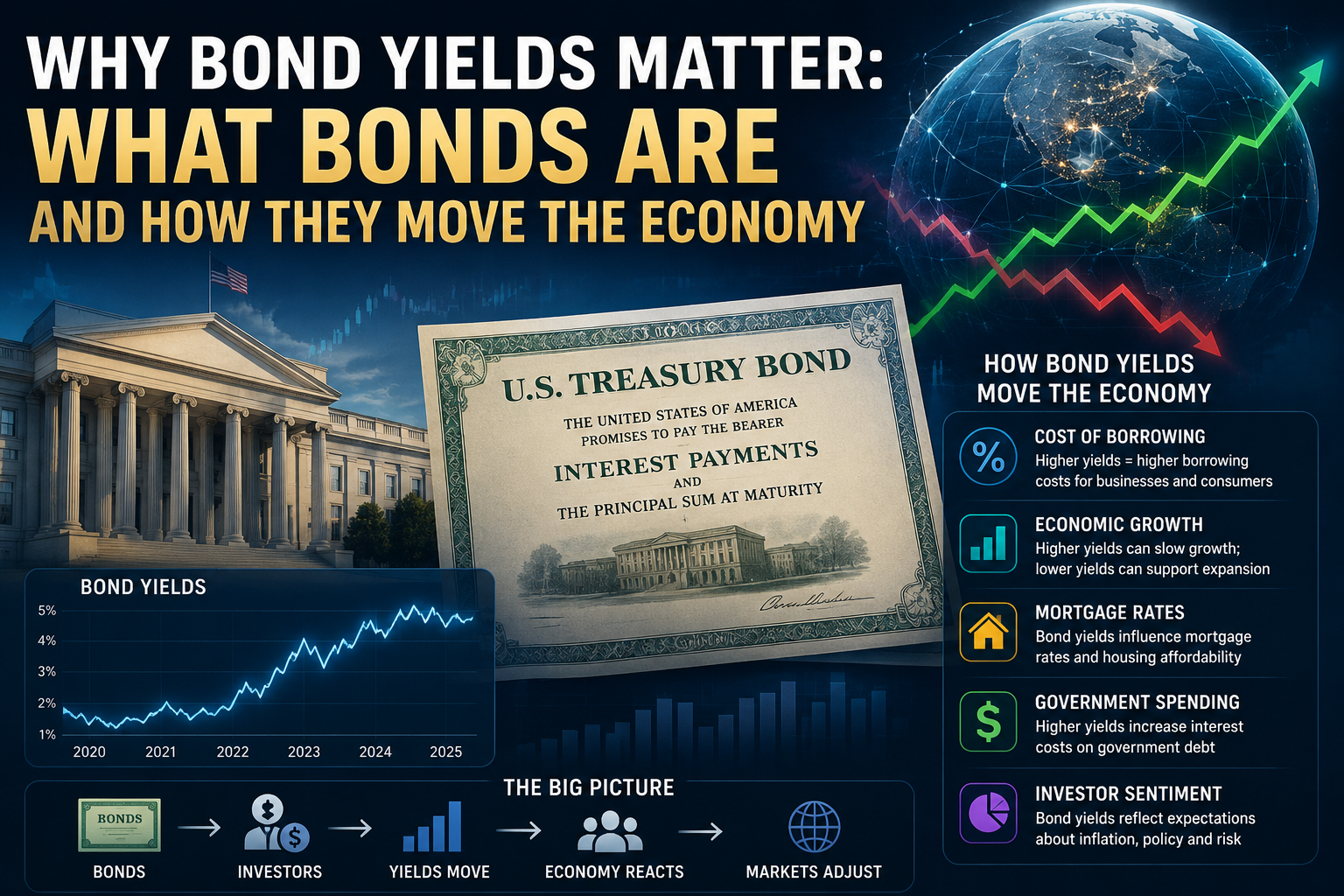
When I look at financial markets, I usually start with bonds.
That may sound strange because bonds do not get the same attention as stocks, crypto, artificial intelligence names, or whatever sector is moving aggressively that week. But in my view, the bond market is one of the most important parts of the entire financial system. It quietly influences mortgage rates, business loans, government budgets, stock valuations, the dollar, inflation expectations, recession fears, and global capital flows.
That is why bond yields matter.
A lot of people hear the words bond market or Treasury yields and immediately assume the topic is too technical. I get it. Bonds are often presented as boring, conservative, and difficult to understand. But I think that is exactly why they are underrated. Bonds are not just investments. They are the pricing system for money over time.
If stocks are the market’s story about growth, bonds are the market’s story about trust, inflation, risk, and patience.
In this guide, I’ll break down what bonds are, what bond yields mean, why they matter so much, how they affect the global economy, what the bond market is saying right now, and why I personally think every investor should understand the 10-year Treasury yield.
What Is a Bond?
A bond is basically a loan.
When a government, company, or municipality wants to borrow money, it can issue a bond. Investors buy that bond, which means they are lending money to the issuer. In return, the issuer usually promises to pay interest over time and repay the original amount when the bond matures.
Simple enough.
For example, if the U.S. government issues a 10-year Treasury bond, investors are lending money to the government for 10 years. If a corporation issues a bond, investors are lending money to that company. The safer the borrower is perceived to be, the lower the interest rate it usually has to pay. The riskier the borrower, the higher the yield investors usually demand.
That is why U.S. Treasuries are so important. They are widely treated as a benchmark for relatively low-risk borrowing in the global financial system. Corporate bonds, mortgages, loans, and many other financial products are priced in relation to Treasury yields.
In my opinion, the easiest way to understand bonds is this:
A bond is not just an investment. It is a price tag on trust.
If investors trust the borrower and believe inflation will stay under control, they may accept a lower yield. If they are worried about inflation, deficits, default risk, or uncertainty, they usually demand a higher yield.
That is where the real story begins.
What Is a Bond Yield?
A bond yield is the return an investor earns from a bond.
At a basic level, it measures how much income a bond pays compared with its price. Investopedia defines bond yield as the return an investor realizes on a bond investment and notes that current yield is calculated by dividing the bond’s coupon rate by its market price. It also highlights the most important rule in bond math: bond prices and yields move in opposite directions. When bond prices rise, yields fall; when bond prices fall, yields rise.
That inverse relationship is the part everyone needs to understand.
Imagine a bond pays $50 per year. If that bond trades at $1,000, the yield is 5%. But if the price of that bond falls to $900, the $50 payment becomes more attractive relative to the lower price. The yield rises. If the bond price rises to $1,100, the same $50 payment becomes less attractive relative to the higher price. The yield falls.
This is why bond yields are always moving.
They move because investors are constantly reassessing inflation, Federal Reserve policy, economic growth, credit risk, government borrowing, and market uncertainty.
To me, a bond yield is not just an income number. It is a signal.
It tells us what investors are demanding in order to lend money. That demand changes depending on how confident or nervous the market feels.
Why Bond Yields Matter So Much
Bond yields matter because they help set the cost of money. That sounds abstract, but it affects real life quickly.
When Treasury yields rise, borrowing generally becomes more expensive. Mortgage rates can move higher. Companies may pay more to issue debt. Governments may spend more on interest payments. Investors may become less willing to pay high prices for stocks. Consumers may slow spending. Businesses may delay expansion.
Fidelity explains this idea clearly: the bond market helps determine the interest rate at which governments borrow, and that influence eventually affects mortgages, personal loans, corporate borrowing, and public finances. Fidelity also notes that higher government bond yields can make bonds more attractive compared with stocks, which can pressure equity prices.
That is the key. Bond yields are not isolated numbers on a financial website. They are part of a chain reaction.
Here is how I think about it:
When yields are low, money is cheaper. Borrowers can finance themselves more easily. Stock valuations often get support because future earnings are discounted at lower rates. Housing can become more affordable. Companies may invest more aggressively.
When yields are high, money becomes more expensive. Borrowing slows. Stock valuations face pressure. Government interest costs rise. Consumers feel it through mortgage rates, credit cards, car loans, and business conditions.
That is why I like to say bond yields are the economy’s gravity.
When gravity is light, risk assets can float higher. When gravity gets heavier, everything has to work harder.
Why the 10-Year Treasury Yield Matters
The 10-year Treasury yield is one of the most important numbers in global finance.
It is watched by investors, banks, central banks, governments, mortgage lenders, pension funds, hedge funds, and corporate finance teams. In my view, if someone wants to understand the mood of the market, the 10-year Treasury is one of the first places to look.
Why?
Because it sits in the middle of the financial system. It is long enough to reflect expectations about inflation, growth, and government borrowing. But it is liquid enough to be used as a benchmark across markets.
The 10-year Treasury yield affects:
- Mortgage rates.
- Corporate borrowing costs.
- Stock valuations.
- Pension fund assumptions.
- Currency flows.
- Risk appetite.
- Recession expectations.
- Government debt servicing costs.
If the 10-year yield rises sharply, the market is usually saying one or more of the following: inflation may stay higher, growth may be stronger, the government may need to borrow more, or investors want more compensation for long-term risk.
If the 10-year yield falls sharply, the market may be signaling weaker growth, lower inflation expectations, a flight to safety, or expectations that the Federal Reserve will cut interest rates.
That is why I do not see the 10-year Treasury as just a bond-market statistic. I see it as one of the cleanest windows into what investors believe about the future.
How Bond Yields Affect Stocks
Bond yields affect stocks because they change the competition for investor money.
If a safe Treasury bond offers a very low yield, investors may be more willing to buy stocks, real estate, private equity, or other risk assets. They need to take more risk to earn a decent return. But if Treasury yields rise, the equation changes.
Suddenly, investors can earn more from bonds. That makes stocks less attractive by comparison, especially expensive growth stocks whose valuations depend heavily on future earnings.
There is also a valuation effect. In finance, future profits are discounted back to the present. When interest rates and bond yields rise, the discount rate rises. That usually lowers the present value of future earnings.
This is especially important for long-duration stocks, such as fast-growing technology companies. These companies may be expected to generate large profits far in the future. When yields rise, those distant profits become worth less in today’s dollars.
That does not mean stocks always fall when yields rise. Markets are never that simple. If yields rise because growth is strong, some stocks may still do well. But if yields rise because inflation is sticky, deficits are worrying, or investors demand a higher term premium, stocks can come under pressure.
In my own market framework, rising yields are not automatically bearish. But they do raise the bar. Stocks have to justify their valuations in a world where cash and bonds offer more competition.
How Bond Yields Affect the Federal Reserve
The Federal Reserve directly controls short-term interest rates, but it does not fully control long-term bond yields.
That distinction matters. The Fed can set the federal funds rate. It can guide expectations. It can use its balance sheet. But the bond market has its own opinion about inflation, growth, supply of debt, and policy credibility.
Sometimes the bond market does part of the Fed’s work. If long-term yields rise, financial conditions tighten even without another rate hike. Mortgages become more expensive. Corporate borrowing costs rise. Stock valuations may compress. Credit becomes less generous.
In that sense, higher bond yields can slow the economy.
But if yields fall too quickly because investors expect recession, that sends another kind of message. It may show that the market thinks the Fed has already tightened enough, or even too much.
This is why central banks pay close attention to the yield curve. The shape of the curve can reveal whether investors expect growth, inflation, rate cuts, or stress.
To me, the Fed and the bond market are in constant conversation. The Fed speaks through policy. The bond market replies through prices.
Bond Yields and Recession Risk
Bond yields also matter because they can signal recession risk.
One of the most watched indicators is the yield curve, especially the difference between short-term and long-term Treasury yields. Normally, long-term bonds yield more than short-term bonds because investors demand extra compensation for lending money over a longer period.
But sometimes the curve inverts. That means short-term yields rise above long-term yields. Historically, an inverted yield curve has often been associated with recession risk, although it is not a perfect timing tool.
Why does inversion matter?
Because it can suggest that investors expect the Fed to cut rates in the future, usually because growth may weaken. It can also signal that monetary policy is tight enough to slow the economy.
But the yield curve is not just about recession. It is also about inflation expectations, bond supply, fiscal deficits, and term premium. That is why I try not to read it mechanically. A curve can steepen because growth expectations improve, or because investors demand more compensation to hold long-term debt. Those are very different stories.
The important point is that bond yields are not just reacting to the economy. They are constantly trying to forecast it.
How Bond Yields Affect the Global Economy
The bond market is global.
U.S. Treasury yields are especially important because the U.S. dollar and Treasury market sit at the center of global finance. When U.S. yields move, capital moves.
If U.S. yields rise, global investors may shift money toward dollar assets. That can strengthen the dollar. A stronger dollar can create pressure for emerging markets, especially countries or companies with dollar-denominated debt.
Higher U.S. yields can also tighten global financial conditions. Borrowing becomes more expensive. Risk appetite may fall. Equity markets outside the U.S. can feel pressure. Global real estate, commodities, and credit markets can also be affected.
This is why I think of Treasury yields as a global thermostat. They help set the temperature for risk-taking around the world.
If yields are low and liquidity is abundant, investors often search for return in riskier places. If yields rise and liquidity tightens, money becomes more selective. That is not just a Wall Street issue. It affects trade, currencies, investment, government budgets, and growth across countries.
What Bond Yields Are Saying Right Now
As of the latest available U.S. Treasury data I reviewed, Friday, May 15, 2026, Treasury yields showed a curve where short-term rates remained elevated, but long-term yields were even higher. The Treasury’s daily par yield curve showed the 1-month yield at 3.71%, the 2-year at 4.09%, the 10-year at 4.59%, the 20-year at 5.14%, and the 30-year at 5.12%.
| Treasury Maturity | Yield |
|---|---|
| 1-Month | 3.71% |
| 2-Year | 4.09% |
| 5-Year | 4.26% |
| 10-Year | 4.59% |
| 20-Year | 5.14% |
| 30-Year | 5.12% |
This matters because the curve is not screaming “cheap money.” It is showing a market where investors still require meaningful compensation to lend for longer periods.
My interpretation is simple: the bond market is still focused on inflation persistence, fiscal deficits, long-term debt supply, and uncertainty about where rates settle over time.
The fact that the 20-year and 30-year yields are above 5% is especially important. That suggests investors are demanding a higher return for long-term exposure. In plain English, the market is saying: lending money for decades is not free, and investors want to be paid for that risk.
For stocks, this creates a higher hurdle. For governments, it raises borrowing costs. For consumers, it can keep pressure on mortgage and loan rates. For global markets, it keeps the cost of capital elevated.
That is why I think today’s bond market deserves close attention.
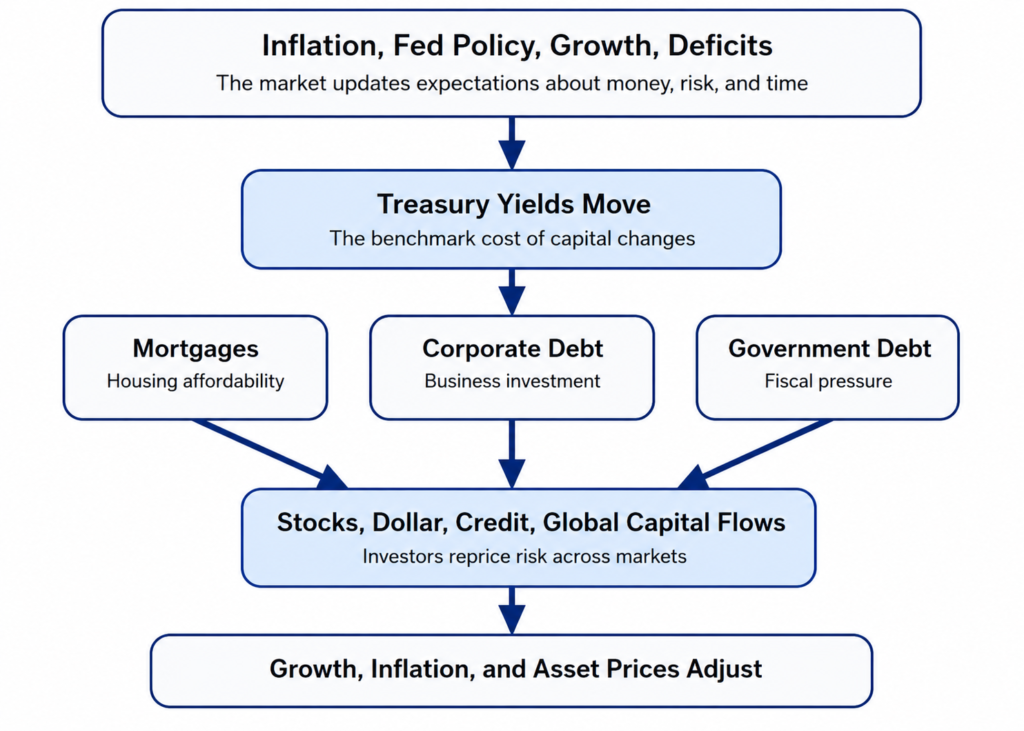
How Bond Yields Move Through the Economy
Here is the simple version of how bond yields travel through the economy:
Final Thoughts
Bond yields matter because they sit at the center of the financial system.
They tell us how much investors demand to lend money. They influence how much governments, companies, and households pay to borrow. They affect stock valuations, mortgage rates, currencies, credit conditions, recession signals, and global capital flows.
That is why I do not see bonds as boring. I see them as the market’s foundation.
A bond is a loan. A yield is the price of that loan. But when you scale that across trillions of dollars, the bond market becomes much more than a place for conservative investors. It becomes one of the most powerful forces in the global economy.
If I had to simplify everything into one sentence, it would be this:
Bond yields matter because they tell us the real-time price of money, risk, and time.
And when that price changes, everything else eventually has to adjust.
FAQs
What are bond yields in simple terms?
Bond yields are the returns investors earn from bonds. They show how much investors are being paid to lend money to a government, company, or other borrower.
Why do bond prices fall when yields rise?
Bond prices and yields move in opposite directions. If newer bonds offer higher yields, older bonds with lower payments become less attractive, so their prices usually fall.
Why does the 10-year Treasury yield matter?
The 10-year Treasury yield matters because it influences mortgage rates, corporate borrowing costs, stock valuations, investor sentiment, and global financial conditions.
Are rising bond yields good or bad?
Rising bond yields can be good for investors seeking income, but they can also hurt existing bond prices, pressure stocks, increase borrowing costs, and slow economic activity.
How do bond yields affect stocks?
Higher bond yields can make bonds more attractive compared with stocks and reduce the present value of future corporate earnings. This can pressure stock valuations, especially for growth stocks.
How do bond yields affect mortgages?
Mortgage rates often move in relation to longer-term bond yields. When Treasury yields rise, mortgage rates often become more expensive, which can reduce housing affordability.
Do bond yields predict recessions?
Bond yields do not perfectly predict recessions, but the yield curve is an important recession-risk indicator. An inverted yield curve has often appeared before past downturns, though timing can vary.
Why should regular people care about bond yields?
Regular people should care because bond yields influence mortgage rates, loan rates, savings returns, job conditions, business investment, government budgets, and the overall economy.