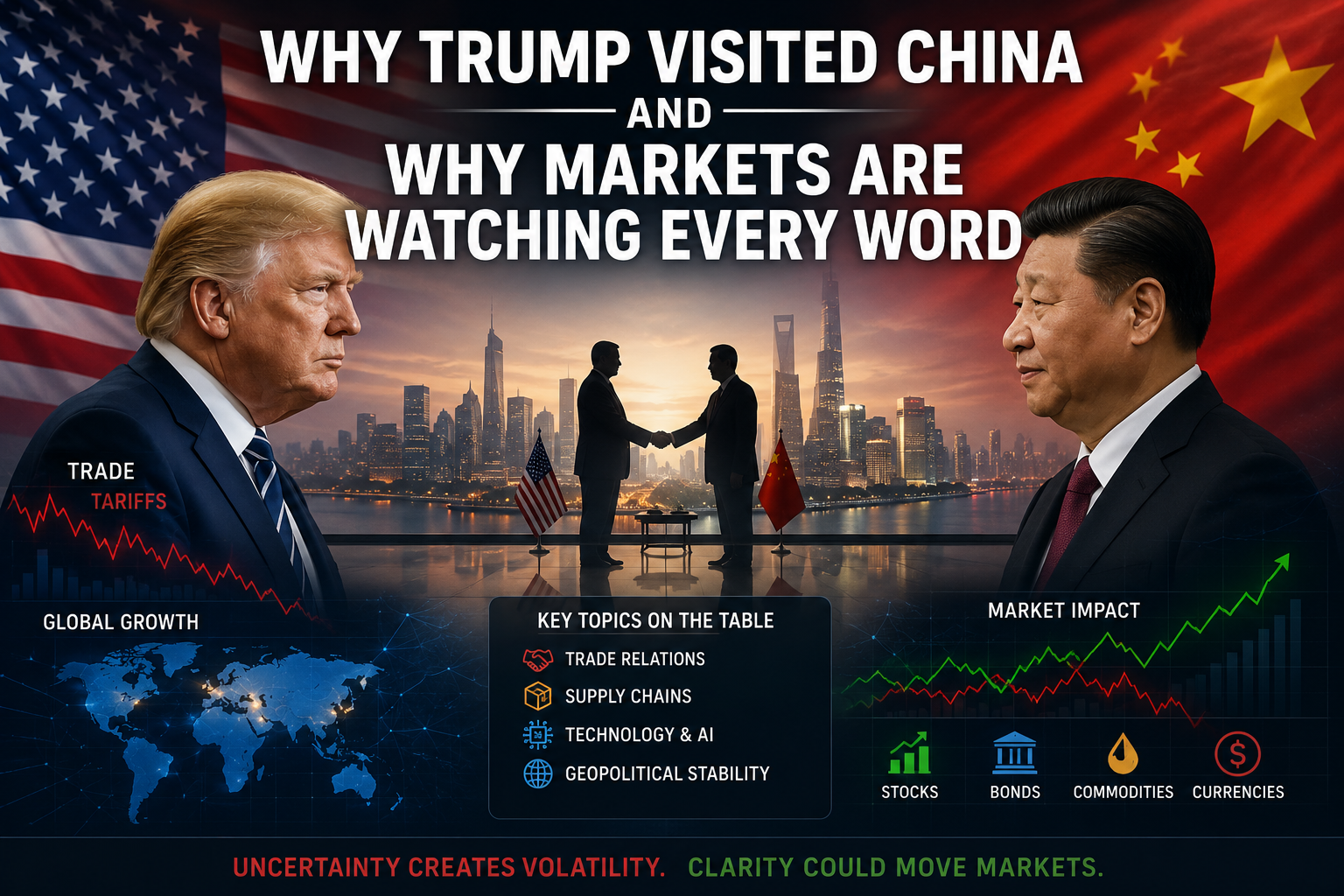
Donald Trump’s trip to China was never just about a handshake, a state dinner, or another round of diplomatic theater. At least, that’s not how I see it.
When a U.S. president sits down with Xi Jinping in Beijing, especially at a time when trade, tariffs, inflation, oil, bonds, and global supply chains are all under pressure, the meeting becomes much bigger than politics. It becomes a market event.
Trump went to China because the United States and China still sit at the center of the global economy. They compete, they depend on each other, and when their relationship gets tense, investors feel it almost everywhere: in stocks, Treasury yields, the dollar, oil, commodities, technology shares, farm exports, and business confidence.
The key question is simple: was Trump’s China visit a real economic reset, or just a headline-friendly pause in a much bigger conflict?
That distinction matters. A real deal could reduce uncertainty, calm parts of the bond market, support global trade, and give businesses more confidence. A vague political announcement, on the other hand, may give markets a short-term lift but leave investors asking the same uncomfortable question: where are the numbers?
According to Reuters, China described the agreements from Trump’s visit as productive but still preliminary, with unresolved details around timelines, volumes, and values. The talks included tariffs, agriculture, aviation, trade boards, investment boards, and market access, but the exact commitments were still not fully nailed down.
And that is exactly why I think markets are right to pay attention but also right to stay skeptical.
Why Markets Are Watching Trump’s China Visit So Closely
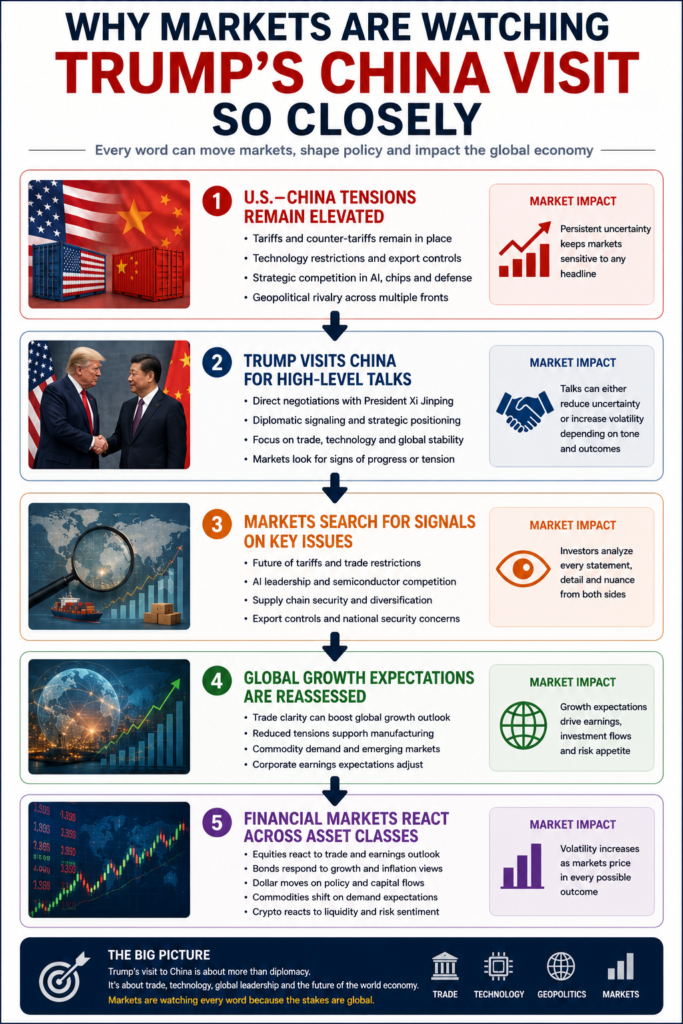
Markets are closely monitoring every statement from Trump and Xi Jinping because U.S.–China relations influence global trade, inflation, supply chains, technology competition and worldwide liquidity conditions.
Trump’s China Trip Wasn’t Just Diplomacy
It is tempting to look at Trump’s visit to China as a political spectacle. There were warm words, big claims, corporate executives, and the usual symbolism that comes with a meeting between the leaders of the world’s two largest economies.
But behind the cameras, this trip was about leverage.
Trump wanted to show that his tariff-heavy approach could bring China to the table. Xi wanted to show that China remains too important to isolate. American CEOs wanted access. Farmers wanted purchases. Investors wanted clarity. And the global economy wanted one thing above all: fewer surprises.
That is why I don’t look at this trip as just another diplomatic photo-op. The real story is not the handshake. The real story is what happens after the handshake.
Reuters reported that major U.S. corporate leaders from companies including Boeing, GE Aerospace, Qualcomm, Cargill, Visa, Goldman Sachs, and Citigroup were involved in business diplomacy around the visit. That tells you a lot. This was not only about foreign policy. It was also about aircraft, engines, finance, payments, agriculture, market access, and regulatory approvals.
In other words, Trump’s China trip was a political event wrapped around a business negotiation.
Why Did Trump Visit China?
Trump visited China because the U.S.-China relationship has too many economic pressure points to ignore.
The first one is trade. The United States has long complained about its trade deficit with China, market access barriers, state support for Chinese industries, and China’s role in global manufacturing. Trump has made tariffs one of his favorite tools for trying to force concessions, and China knows that trade pressure is central to his political brand.
The second one is inflation. Tariffs can protect domestic industries, but they can also raise costs for consumers and companies. If Chinese imports become more expensive, that can feed into prices. If supply chains become more uncertain, companies may hold back on investment. That matters for the Federal Reserve, for Treasury yields, and for every investor trying to figure out whether inflation is really under control.
The third one is leverage. China controls important parts of global supply chains, including rare earth minerals and manufacturing capacity. The United States controls access to the world’s deepest capital markets, advanced technology restrictions, tariffs, and consumer demand. Neither side is powerless.
To me, this is the most important point: Trump went to China because both countries need something from each other, even if neither wants to admit it too loudly.
The U.S. wants China to buy more American goods, open parts of its market, reduce trade barriers, and ease pressure on global supply chains. China wants tariff relief, investment stability, access to certain technologies, and reassurance that the relationship will not spiral into a full economic rupture.
That is why the visit mattered. Not because one meeting can fix everything, but because one meeting can signal whether both sides want escalation or managed competition.
What Trump and Xi Jinping Talked About
Trump and Xi’s conversations appear to have centered on trade, tariffs, agriculture, aviation, investment, technology, and geopolitical risks.
One of the biggest issues was tariffs. Reuters reported that both sides discussed trade and investment boards that would negotiate product-specific tariff reductions and address market access issues. That kind of structure matters because it suggests the two countries may avoid one giant symbolic deal and instead move toward managed, sector-by-sector negotiations.
They also talked about agriculture. Trump said American farmers would be happy with the trade outcomes and that China would buy “billions of dollars” of soybeans, although Reuters noted that he did not provide detailed purchase commitments at the time.
That lack of detail is important. Farmers, commodity traders, and investors do not just want a promise. They want volumes, dates, contracts, enforcement, and delivery schedules.
Aviation was another major piece. Trump announced that China had agreed in principle to buy 200 Boeing aircraft and hundreds of GE Aerospace engines, but China’s Commerce Ministry did not provide full specifics and said further negotiations were still required.
Again, that is the pattern: big headline, limited detail.
Technology and strategic goods were also part of the broader backdrop. Rare earth minerals, semiconductors, artificial intelligence, and supply chains are not side issues anymore. They are central to U.S.-China competition. A trade conversation between Trump and Xi is also a conversation about who controls the inputs that power modern industry.
Then there are the geopolitical issues: Taiwan, Iran, energy markets, and global security. Reuters previously reported that Trump and Xi were expected to discuss issues including Taiwan, Iran, artificial intelligence, nuclear weapons, and rare earths.
That matters for markets because geopolitics is no longer separate from economics. A Taiwan crisis would hit semiconductors. An Iran crisis can hit oil. Oil can hit inflation. Inflation can hit bond yields. Bond yields can hit stocks. Everything is connected.
Was There a Real Deal Or Just Big Headlines?
This is where I think investors need to be careful. Trump’s political style is built around strong announcements. He likes big numbers, big wins, and simple messages. That can move headlines quickly. But markets eventually ask harder questions.
Was there a signed agreement?
Are there exact tariff reductions?
Did China commit to specific purchase volumes?
Are there enforcement mechanisms?
When does implementation begin?
What happens if either side fails to deliver?
China’s own description of the agreements as preliminary makes this distinction even more important. Reuters reported that the deals covered tariffs, agriculture, and aviation, but lacked key specifics such as participating companies, values, volumes, and timelines.
That is why I would separate this trip into two categories:
| Headline deal | Enforceable deal |
|---|---|
| Sounds positive | Has written details |
| Moves news cycles | Moves business decisions |
| Uses big numbers | Includes deadlines |
| Creates optimism | Reduces uncertainty |
| Helps politicians | Helps investors price risk |
Right now, based on available reporting, Trump’s China visit looks more like a preliminary framework than a fully enforceable economic deal.
That does not mean it is meaningless. A framework can still reduce tension. It can create momentum. It can give negotiators space to work. It can reassure CEOs and investors that neither side wants a trade war to spiral out of control.
But vague promises are not enough for long-term market confidence. As I see it, China wants stability, Trump wants leverage, and investors want details.
What This Could Mean for the Global Economy
If the visit leads to real follow-through, the global economy could benefit in several ways.
First, reduced tariff uncertainty would help companies plan. Businesses hate uncertainty more than they hate high costs. A company can adapt to a tariff schedule if it knows what the rules are. What it cannot easily handle is a world where tariffs change with every speech, tweet, meeting, or diplomatic dispute.
Second, stronger U.S. exports to China could help specific sectors. Agriculture, aircraft, energy, and industrial firms could benefit if China follows through on purchases. Boeing, GE Aerospace, soybean producers, meat exporters, and logistics companies could all become part of the story.
Third, a calmer U.S.-China relationship could ease pressure on supply chains. That does not mean companies will abandon diversification. The “China plus one” strategy is not going away. But less tension could reduce the urgency of emergency supply-chain decisions.
Fourth, lower trade tension could help inflation expectations. If tariffs ease or if supply chains become more predictable, some cost pressures may soften. That would matter for the Federal Reserve and for bond investors. But there is a flip side.
If the visit produces only vague statements and no implementation, the global economy may not get much relief. Companies may remain cautious. Investors may price in continued geopolitical risk. And the bond market may keep focusing on inflation, deficits, oil, and interest-rate uncertainty.
This is why the follow-through matters more than the ceremony.
How Trump’s China Visit Could Affect Markets
For markets, Trump’s China visit has several possible channels.
Stocks: Relief Rally or Disappointment?
Stocks usually like trade de-escalation. If investors believe the U.S. and China are moving toward tariff relief, better market access, and renewed business deals, risk assets can benefit.
Technology stocks could react positively if the tone around semiconductors, AI, and export restrictions improves. Industrial companies could benefit from aircraft and machinery orders. Agricultural names could benefit from Chinese purchases. Banks and payment companies could benefit if China opens more room for financial activity.
But the stock market can also get disappointed quickly.
If investors decide the visit was mostly symbolic, the rally may fade. Reuters’ reporting on the preliminary nature of the agreements is important here because equity markets may initially like the headlines but later demand proof.
Bonds: Why Treasury Yields Matter Here
This is the part I would watch very closely.
When Trump meets Xi, I immediately think about tariffs, inflation, oil, bonds, and the dollar. The bond market is often less emotional than the political news cycle. It wants to know whether this visit changes the inflation outlook, the growth outlook, or the risk outlook. If the China trip reduces tariff risk, that could be mildly helpful for inflation expectations. Lower trade friction can reduce cost pressure. That could support bonds and push yields lower.
But if the visit disappoints, or if it comes at the same time as higher oil prices and persistent inflation, Treasury yields may stay under pressure.
The Wall Street Journal reported that global government bonds sold off sharply on May 15, 2026, with the 10-year U.S. Treasury yield climbing to a 14-month high and the 30-year yield reaching levels last seen in 2007. The report linked the pressure to inflation concerns, energy prices, and disappointment around diplomatic progress, including Trump’s China visit.
That is why I am watching Treasury yields almost as closely as the official statements. If yields rise after a supposedly successful diplomatic visit, that tells me investors are not fully convinced.
Oil, Inflation, and the Federal Reserve
Oil is another major piece. If U.S.-China talks reduce global risk, oil markets may calm somewhat. But if geopolitical issues involving Iran, energy routes, or broader security tensions remain unresolved, oil prices can stay elevated.
Higher oil prices feed inflation. Inflation pressures the Federal Reserve. The Federal Reserve influences interest rates. Interest rates affect everything from mortgages to tech valuations. That is why a China visit is not just a China story. It can become an inflation story, a Fed story, and a bond-market story.
The U.S. Dollar and Global Risk Appetite
The dollar could move in different directions depending on how investors interpret the visit.
If the trip reduces global uncertainty, investors may move into riskier assets and away from safe-haven dollar demand. But if the deal looks weak and geopolitical risks remain high, the dollar may stay supported.
For emerging markets, this matters a lot. A strong dollar can tighten financial conditions globally. Higher U.S. yields can pressure foreign currencies, dollar-denominated debt, and capital flows.
So yes, Trump’s China visit may look like a bilateral meeting. But the market impact can be global.
What Investors Should Watch Next
This is the section I think most news coverage misses. The next few weeks matter more than the photo-op. Here is what I would watch.
1. Actual Chinese Purchase Commitments
If China commits to buying U.S. soybeans, aircraft, energy, or other goods, the details matter.
Watch for:
- Volumes;
- Dollar value;
- Delivery timeline;
- Companies involved;
- Whether purchases are new or repackaged from earlier discussions.
A vague “billions of dollars” promise is not the same as signed contracts.
2. Tariff Reductions by Product
The most important market signal would be specific tariff relief.
Watch whether the trade boards produce:
- Product-specific tariff cuts;
- Exemptions for non-sensitive goods;
- Clear timelines;
- Enforcement rules.
Reuters reported that Trump and Xi were weighing tariff cuts on about $30 billion of imports as part of a managed trade push, focused on non-sensitive goods and numerical trade targets.
That kind of detail would matter much more than a broad statement about “progress.”
3. Treasury Yields
If the 10-year Treasury yield keeps rising, markets may be saying that inflation and deficit concerns matter more than China diplomacy. If yields fall, it may suggest investors believe trade tensions are easing and inflation risks are cooling.
4. Oil Prices
Oil is the bridge between geopolitics and inflation. If oil stays high, any positive impact from trade talks could be offset by inflation pressure.
5. Corporate Follow-Through
Watch Boeing, GE Aerospace, agricultural exporters, banks, payment companies, and chip-related firms. If executives return from Beijing with real approvals, contracts, or market access, the visit becomes more meaningful.
If not, it stays mostly political.
My Take: The Handshake Matters Less Than the Follow-Through
Here is how I see it.
Trump’s China visit matters because it signals that both sides still want a managed relationship, not a complete economic break. That alone is important. The U.S. and China may compete aggressively, but neither country benefits from total chaos.
However, I would not call this a breakthrough yet. A breakthrough requires detail. It requires signed commitments. It requires tariff schedules. It requires purchase orders. It requires enforcement. It requires both sides to do something after the cameras leave.
For markets, vague promises are not enough. They need numbers, timelines, and proof.
That is why I think the best way to understand Trump’s China visit is this: it may have reduced the risk of immediate escalation, but it has not eliminated the deeper uncertainty in the U.S.-China relationship.
Investors should not ignore it. But they also should not overreact to the first headline.
The real test will come when the trade boards start negotiating, when China confirms or delays purchases, when Treasury yields respond, and when companies decide whether this visit actually changes their investment plans.
Key Takeaways From Trump’s China Visit
Trump visited China to push for progress on trade, tariffs, agriculture, aviation, investment, and strategic competition.
The meeting with Xi Jinping was important because the U.S.-China relationship affects inflation, supply chains, global markets, commodities, and Treasury yields.
The biggest reported outcomes involved preliminary agreements on tariffs, agriculture, aviation, and market access, but many details remain unresolved.
American CEOs were part of the broader business diplomacy, which shows that this trip was as much about corporate access as it was about geopolitics.
The market impact depends on whether this becomes an enforceable deal or remains a headline-driven diplomatic moment.
For investors, the most important things to watch next are tariff details, Chinese purchase commitments, Treasury yields, oil prices, and corporate follow-through.
FAQs About Trump’s China Visit
Why did Trump visit China?
Trump visited China to negotiate on trade, tariffs, market access, agriculture, aviation, and broader U.S.-China economic tensions. The visit was also about leverage: Trump wanted to show that his tariff strategy could produce concessions, while China wanted stability and potential tariff relief.
What did Trump and Xi Jinping talk about?
They discussed tariffs, agriculture, aviation, investment, market access, rare earths, technology, and geopolitical issues such as Taiwan and Iran. Reuters reported that the two sides reached preliminary understandings on tariffs, agriculture, and aviation, but many details were still unresolved.
Did Trump make a real trade deal with China?
Not fully, based on the available reporting. China described the agreements as preliminary, and key details such as timelines, values, volumes, and participating companies were still unclear. That means the visit may be better understood as a framework for further negotiations rather than a completed trade deal.
How could Trump’s China visit affect the U.S. economy?
If the visit leads to real tariff relief and Chinese purchases of U.S. goods, it could support farmers, manufacturers, aircraft companies, and exporters. It could also reduce some inflation pressure by lowering trade uncertainty. But if the agreements remain vague, the economic impact may be limited.
What does Trump’s China visit mean for stocks?
Stocks may benefit if investors believe U.S.-China tensions are easing. Industrial, agricultural, financial, and technology-related companies could react positively. But if the visit lacks follow-through, markets may fade the initial optimism.
What does it mean for bonds and Treasury yields?
Treasury yields will be one of the most important indicators to watch. If investors believe the visit reduces inflation and trade uncertainty, yields could ease. If markets remain worried about inflation, oil prices, deficits, and weak diplomatic follow-through, yields could stay elevated.
Why are markets skeptical?
Markets are skeptical because political announcements often sound stronger than the actual agreements behind them. Investors want details: signed contracts, tariff reductions, purchase volumes, timelines, and enforcement mechanisms.
What should investors watch next?
Investors should watch Chinese purchases of U.S. goods, specific tariff reductions, Boeing and GE Aerospace order details, soybean commitments, Treasury yields, oil prices, and corporate announcements from companies that participated in the Beijing business diplomacy.