
The S&P 500 is back near record highs, and Bank of America is not exactly telling investors to run for the hills. But it is telling them something more uncomfortable: do not buy the index blindly just because the chart looks strong.
And honestly, I think that is the right debate to have.
When I see the S&P 500 at all-time highs, my first reaction is not, “This must crash tomorrow.” Markets can stay strong for much longer than people expect. But my reaction is also not, “Great, let’s throw money at the index without thinking.” The real question is not whether the S&P 500 is high. The real question is why it is high, what is driving it, and whether there are better risk-reward opportunities elsewhere.
That is exactly where BofA’s latest message becomes interesting. The bank is urging investors to stay selective rather than simply buying the S&P 500 at new highs, arguing that the broad index rally hides important risks underneath the surface.
So, is this still a good moment to invest in the S&P 500? My answer is: yes for some investors, no for others, and definitely not without a plan.
The S&P 500 Is Back at Highs, But That Does Not Tell the Whole Story
The phrase “all-time high” sounds scary. It makes investors feel as if they are arriving late to the party, buying from someone smarter just before the music stops.
But that is not always how markets work. A strong market naturally makes new highs. In fact, long bull markets spend a lot of time near highs. If an investor avoided the S&P 500 every time it reached a record, they would have missed many of the best compounding periods in market history.
That said, buying at highs still requires discipline.
The danger is not the high itself. The danger is buying because of FOMO, because everyone is suddenly bullish, or because the index has gone up and therefore feels “safe.” That is usually backwards. The higher the price, the more important the quality of the underlying earnings, valuations and market breadth becomes.
In my case, I would not avoid the S&P 500 just because it is at record levels. But I would also not buy it mechanically without asking one basic question:
Am I buying a diversified U.S. market, or am I mostly buying a handful of expensive megacap stocks?
That distinction matters a lot right now.
Why Is the S&P 500 at Record Highs?
There are several reasons why the S&P 500 is trading so strongly.
First, corporate earnings have been resilient. Investors are still willing to pay up for companies that can grow profits, defend margins and benefit from long-term themes like artificial intelligence, automation, cloud computing and digital infrastructure.
Second, technology remains a dominant force. The biggest companies in the index have continued to attract capital because they combine scale, profitability and exposure to AI. This creates a powerful feedback loop: the largest stocks rise, they become an even bigger part of the index, and their performance pushes the S&P 500 higher.
Third, the market is still pricing in a relatively constructive macro environment. Investors are watching central banks, inflation and economic growth closely, but the broad mood remains optimistic enough to support risk assets. Recent market commentary has also pointed to strong momentum in the S&P 500 and Nasdaq, although investors are being warned not to panic-buy extended stocks.
But here is the problem: the index can look strong even when the average stock is not doing nearly as well.
That is one of the biggest reasons I would be careful here. If the S&P 500 is rising because hundreds of companies are participating, that is one thing. If it is rising because a small group of megacaps is carrying the entire market, that is a very different type of rally.
Recent market breadth data suggests that participation has narrowed, with only around 53% of S&P 500 stocks trading above their 50-day moving average, down from 60% the prior week. Charles Schwab’s Joe Mazzola noted that megacap and large-cap technology stocks have been doing much of the heavy lifting.
That does not mean the rally must end. But it does mean investors should be more selective.
What Bank of America Says About Buying the S&P 500 Now
Bank of America’s message is not that investors should abandon equities. It is more nuanced than that.
BofA is saying that the S&P 500 is no longer the obvious “buy everything” trade. According to recent coverage of the bank’s view, the index screens expensive on a wide range of valuation measures, including 17 of 20 metrics in one recent note.
That is important because when valuations are already high, future returns depend much more on earnings growth. In simple terms: if investors are already paying a premium price, companies need to keep delivering.
That is where the risk-reward becomes less attractive.
A cheap market can rise because valuations expand. An expensive market usually needs earnings to justify the price. If earnings disappoint, or if investors start questioning the long-term AI growth story, the downside can arrive quickly.
Goldman Sachs recently warned that long-term growth expectations are doing a huge amount of work in U.S. equity valuations, with “terminal value” representing roughly 75% of the S&P 500’s equity value, near a 25-year high. The firm also noted that a small reduction in long-term growth assumptions could have a large impact on the index’s value.
That is exactly why BofA’s warning matters. The S&P 500 can keep rising, but it is not cheap. And when something is not cheap, selectivity becomes more important.
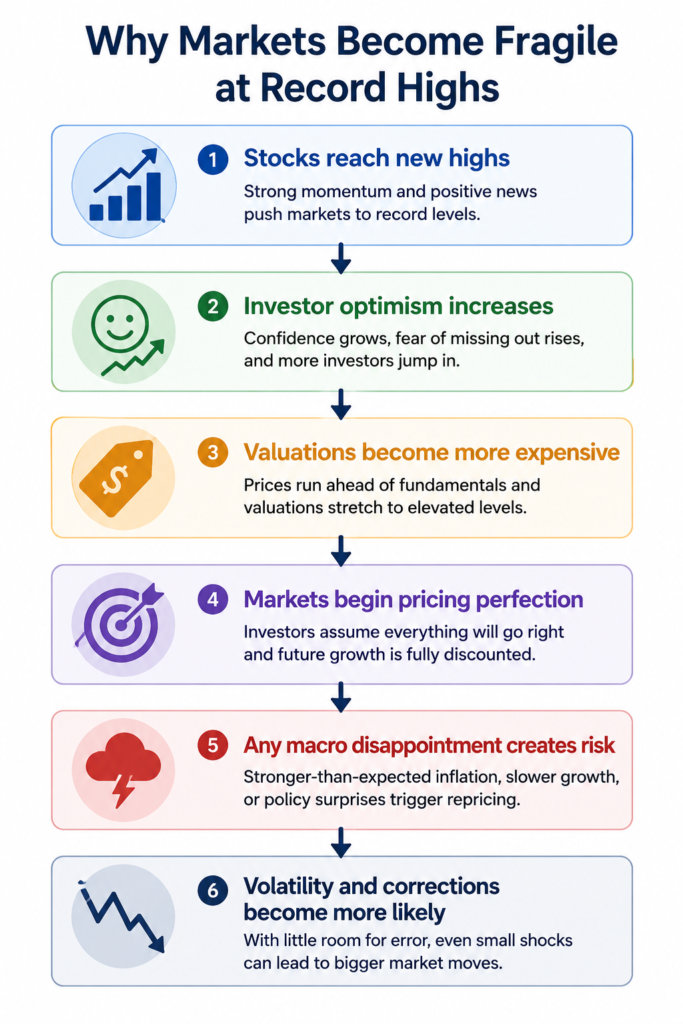
Why Markets Become Fragile at Record Highs
Why Higher Interest Rates Matter More Than Many Investors Realize
One of the biggest differences between today’s market environment and previous bull markets is the level of interest rates.
For years, ultra-low rates helped support higher equity valuations by making future growth look more attractive and keeping borrowing costs extremely cheap. That environment rewarded aggressive risk-taking and pushed investors further out on the risk curve.
But today, the macro backdrop is very different.
Higher interest rates increase the cost of capital across the economy. Companies face more expensive refinancing conditions, governments carry heavier debt-servicing burdens and consumers feel greater pressure from mortgages, credit cards and loans.
From a valuation perspective, higher yields also reduce the present value of future earnings.
This matters especially for high-growth sectors like technology and artificial intelligence, where a large part of market value depends on expectations far into the future.
In other words, markets are increasingly pricing perfection in an environment where financing conditions are no longer easy.
That creates fragility.
Because if:
- Inflation remains sticky.
- Economic growth slows.
- Or central banks keep policy restrictive for longer than expected.
Equity valuations could face significant pressure despite strong enthusiasm surrounding AI and mega-cap technology companies.
From my perspective, this is one of the key macro tensions currently sitting underneath the market rally.
My View: Buying at Highs Is Not the Problem, Buying Without a Plan Is
I do not think investors should automatically wait for a crash before entering the S&P 500. That sounds smart, but in practice it often leads to paralysis.
Many people wait for a 10% correction. Then, when it arrives, they wait for 20%. Then the market rebounds without them. Timing the perfect entry is much harder than it looks.
For a long-term investor with a 10-year or 20-year horizon, buying the S&P 500 at highs can still make sense, especially through regular contributions. Dollar-cost averaging reduces the pressure of choosing the perfect day. You are not betting everything on one entry point; you are building exposure over time.
But for a tactical investor, or someone with a large lump sum, I would be more careful.
At current levels, I would not want my entire decision to be: “The S&P 500 is going up, so I’m buying.” That is not a strategy. That is momentum chasing.
A better approach is to ask:
- How much U.S. equity exposure do I already have?
- How much of that exposure is concentrated in megacap technology?
- Am I comfortable with short-term drawdowns?
- Would I rather buy the broad index, equal-weight exposure, value stocks or specific sectors?
- Am I investing for 12 months or 10 years?
For me, this is the key point: the S&P 500 is still a fantastic long-term vehicle, but it may not be the best short-term opportunity at any price.
A Simple S&P 500 Analysis: What I Would Watch Now
Valuation
The first thing I would watch is valuation. If the S&P 500 is expensive across most traditional metrics, then the margin of safety is lower. That does not mean the index cannot go higher. Expensive markets can become more expensive. But it does mean investors are paying for a lot of good news in advance.
At this point, the market needs earnings growth to keep supporting prices. If profits keep rising, high valuations can be defended. If earnings slow, the index becomes more vulnerable.
Breadth
Breadth is one of the most important indicators right now. A healthy rally usually broadens. More sectors participate. Mid-cap and smaller companies start to confirm the move. The equal-weight S&P 500 performs better. The average stock begins to catch up with the headline index.
A narrow rally is different. It can still be profitable, but it is more fragile. If the leaders stumble, the index has fewer places to hide. That is why I would keep an eye on whether the rally expands beyond the largest technology and AI-related names.
Concentration
The S&P 500 is market-cap weighted, which means the biggest companies have the biggest influence. That is fine when the biggest companies are delivering. But it also means investors may be less diversified than they think.
Buying the S&P 500 today is not the same as buying 500 equally weighted companies. It is buying a portfolio where the largest names matter enormously. That is not automatically bad. Many of those companies are exceptional businesses. But there is a difference between owning great companies and overpaying for a crowded trade.
Technical picture
From a technical perspective, momentum remains strong. A market making new highs is not weak by definition. In fact, new highs often confirm that buyers are still in control.
But I would be cautious about entering aggressively after a fast move. Pullbacks are normal. Retests are normal. Even strong bull markets shake out late buyers.
So, if I were investing fresh money, I would prefer either:
- gradual entries over time;
- buying during pullbacks;
- or splitting exposure between the S&P 500 and more selective alternatives.
Are There Better Alternatives to the S&P 500 Right Now?
This is where BofA’s argument becomes more practical. The bank has previously suggested that investors favor areas such as energy, consumer staples and large-cap value over simply buying the broad S&P 500.
I would not treat that as a blind shopping list. But I do think the logic makes sense.
Energy
Energy can act differently from the growth-heavy S&P 500. It may benefit from geopolitical risk, supply constraints, inflation surprises or stronger commodity prices.
The downside is that energy is cyclical. It can be volatile, and it depends heavily on oil and gas dynamics. But as a portfolio diversifier, it can make sense if the rest of your exposure is dominated by technology and growth.
Consumer staples
Consumer staples are defensive. These companies sell products people continue buying even when the economy slows: food, household goods, beverages and basic necessities.
They are not usually the most exciting stocks in the market. But that is partly the point. When the S&P 500 looks expensive and concentrated, a defensive sector can help balance risk.
Large-cap value
Large-cap value is probably one of the more interesting alternatives. It gives investors exposure to established companies that may trade at more reasonable valuations than the high-growth megacap leaders.
This does not mean value will automatically outperform. But if the market starts rotating away from expensive growth, value could benefit.
Financials, technology and healthcare
I would be selective here.
Technology is still powerful, but not every tech stock deserves a premium valuation. AI winners may continue to perform, but the market is becoming more demanding. Companies need to show real revenue, real margins and real returns on AI investment.
Financials can benefit from a healthier economy and improving capital markets, but they remain sensitive to rates, credit risk and regulation.
Healthcare can offer defensive growth, but stock selection matters. Some companies face pricing pressure, patent cliffs or political risk, while others have strong pipelines and durable demand.
Equal-weight S&P 500
This is one of my favorite alternatives to discuss.
If you still like U.S. equities but worry that the standard S&P 500 is too concentrated, the equal-weight S&P 500 can be a useful middle ground. It reduces dependence on the largest companies and gives more weight to the average stock.
The trade-off is that equal-weight exposure can underperform when megacap technology is leading. But if market participation broadens, it may become more attractive.
So, Should You Buy the S&P 500 at All-Time Highs?
The answer depends on what kind of investor you are.
If you are investing for 10+ years
Buying the S&P 500 at highs is not necessarily a mistake. If your plan is to invest regularly for many years, the exact entry point matters less than consistency, costs and discipline. In that case, I would not overcomplicate it. A monthly investment plan can still make sense.
If you are investing a lump sum today
I would be more cautious. Not because the market must fall, but because the risk of regret is higher. If you invest everything at once and the market pulls back 8% or 10%, you need to be emotionally prepared.
A phased approach may be better: invest part now, keep part for pullbacks, and avoid making the decision emotionally.
If you already own a lot of U.S. megacap exposure
This is where I would be most careful.
Many investors think they are diversified because they own the S&P 500, a Nasdaq fund, a global ETF and maybe some individual tech stocks. But when you look underneath, the same large U.S. companies appear again and again.
If that is your situation, the better opportunity may not be “more S&P 500.” It may be diversification into value, equal-weight exposure, international equities, bonds, cash-like instruments or specific sectors.
If you want to reduce risk without leaving the market
You do not have to choose between being fully invested and sitting entirely in cash.
There are middle-ground options:
| Investor concern | Possible approach |
|---|---|
| S&P 500 feels expensive | Dollar-cost average instead of lump sum |
| Too much megacap concentration | Consider equal-weight S&P 500 |
| Worried about economic slowdown | Add defensive sectors |
| Want inflation/geopolitical hedge | Look at energy exposure |
| Want cheaper equity exposure | Explore large-cap value |
| Already heavily invested | Rebalance instead of adding blindly |
This is why I like BofA’s “be selective” message. It is not bearish for the sake of being bearish. It is a reminder that price matters, concentration matters and portfolio construction matters.
Final Takeaway: Be Invested, But Be Selective
I would not look at the S&P 500 hitting record highs and immediately conclude that investors should stay away. That is too simplistic. But I also would not ignore BofA’s warning.
The S&P 500 can be a great long-term investment and still be expensive today. It can keep rising and still offer a worse risk-reward than more selective alternatives. It can look strong at the index level while hiding weakness beneath the surface.
For me, the smarter question is not:
“Should I buy the market or stay in cash?”
The smarter question is:
“What kind of exposure do I actually want at this point in the cycle?”
If you are a long-term investor, buying gradually can still make sense. If you are tactical, I would be more selective. And if you already own a lot of U.S. megacap exposure, I would think twice before adding even more through the standard S&P 500.
BofA’s message is not that the party is over. It is that investors should stop dancing with their eyes closed.
FAQs
Is the S&P 500 overvalued right now?
By many valuation measures, yes, the S&P 500 looks expensive. BofA has recently argued that the index screens rich across most of its valuation metrics, which means future returns may depend heavily on earnings growth.
Is it bad to buy the S&P 500 at all-time highs?
Not always. All-time highs are normal in strong markets. The problem is not buying at highs; the problem is buying without a plan, especially if valuations are stretched and the rally is concentrated in a few large stocks.
What sectors does BofA prefer over the S&P 500?
Recent coverage says BofA has favored areas such as energy, consumer staples and large-cap value instead of simply buying the broad S&P 500.
Is dollar-cost averaging better than investing all at once?
For investors worried about buying near highs, dollar-cost averaging can reduce timing risk. It may not always maximize returns, but it can make the process easier emotionally and reduce the impact of a bad short-term entry.
What is the biggest risk in the S&P 500 today?
The biggest risk is not just valuation. It is the combination of high valuation, heavy concentration and narrow market breadth. If a small group of megacap stocks drives most of the gains, the index becomes more vulnerable if those leaders weaken.
Could the S&P 500 keep rising despite high valuations?
Yes. Expensive markets can keep rising if earnings are strong, liquidity remains supportive and investor sentiment stays positive. But the higher valuations go, the less room there is for disappointment.