
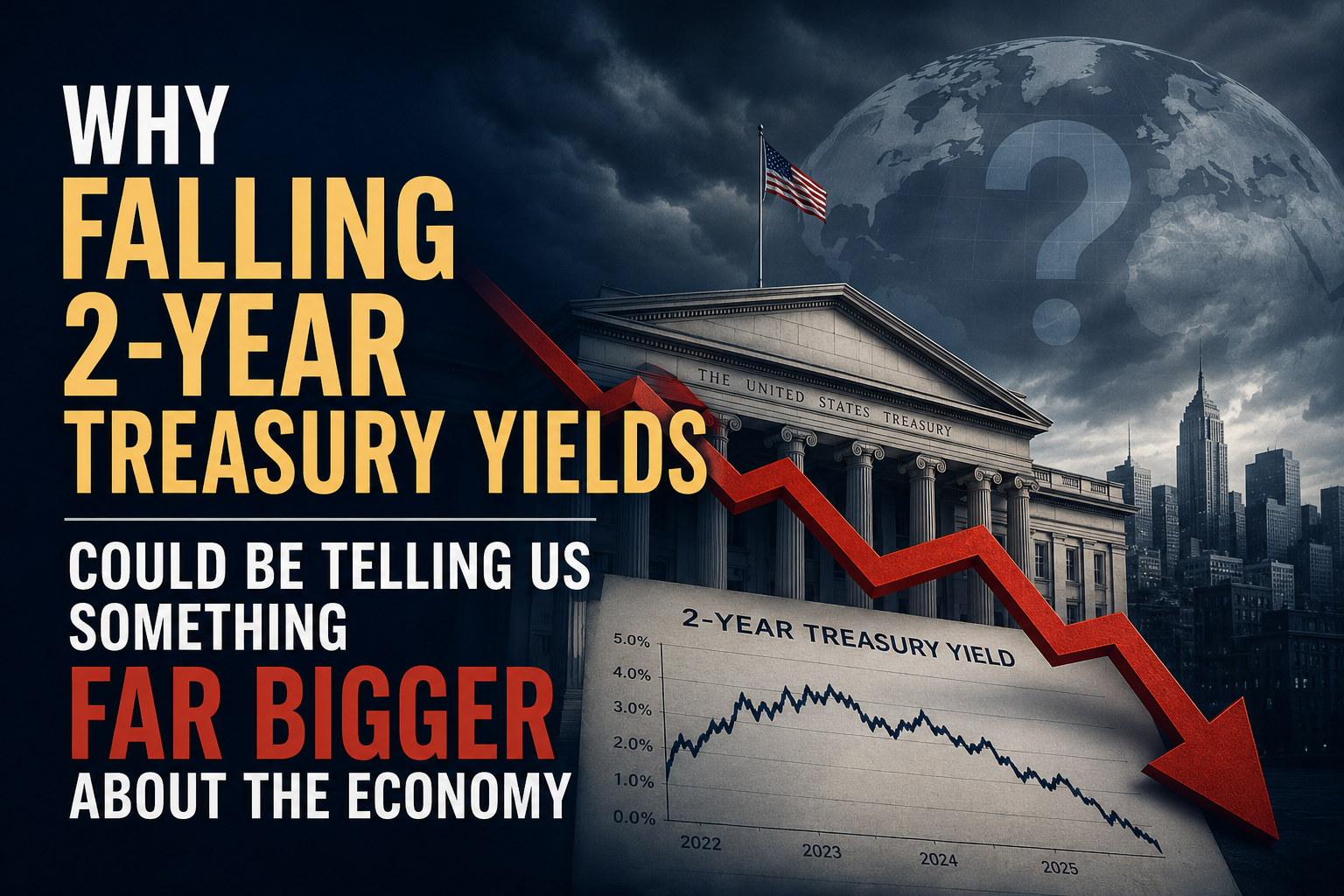
Whenever I try to understand what is really happening inside the economy, I have learned to ignore the noise.
I do not start by looking at the stock market, even though that is where most people naturally direct their attention. I do not begin with social media, where every small move in the S&P 500 suddenly becomes a reason for celebration or panic. I do not even begin with economic headlines, because by the time those headlines are published, markets have often already processed the information and moved on.
Instead, I almost always begin in the bond market.
Over time, I have come to believe that if someone truly wants to understand where the economy may be heading over the next six months, twelve months, or even two years, one of the most important places to look is not equities, not commodities, and not corporate earnings reports. It is the Treasury market, and more specifically, one very particular instrument that receives far less attention than it deserves: the United States 2-Year Treasury note.
At first glance, the movement of the 2-year Treasury yield may seem deeply uninteresting. To most people, it sounds like the kind of financial statistic that exists purely for economists, institutional investors, or traders sitting behind Bloomberg terminals in Manhattan. It feels abstract, technical, and disconnected from ordinary life.
But the reality is very different.
In my view, the 2-year Treasury yield is one of the most honest indicators in the entire financial system. It reflects something incredibly important: collective expectations regarding what the Federal Reserve will do next, where inflation may be heading, how investors perceive future economic growth, and increasingly, whether markets believe economic conditions are beginning to deteriorate beneath the surface.
And right now, the fact that 2-year Treasury yields are falling deserves far more attention than most people realize.
Because when short-term Treasury yields begin moving lower, markets are often quietly signaling that something fundamental is changing.
The real question is whether investors are paying attention early enough.
Why The 2-Year Treasury Matters More Than Most People Understand
To understand why this particular bond matters so much, we first need to understand how the financial system itself actually functions.
Most people naturally assume that the stock market sits at the center of the economy. This is understandable because stocks dominate financial media coverage. Every major news network tracks the Dow Jones Industrial Average, the Nasdaq, and the S&P 500 as if they represent the economy itself.
But in reality, stocks are not the foundation of the financial system.
Debt is.
The modern economy is built on borrowing. Governments borrow money to fund spending programs, corporations borrow money to expand operations, banks borrow money to facilitate lending, consumers borrow money to buy homes and finance consumption, and entire industries depend on continuous access to credit in order to survive.
All of this borrowing is connected to interest rates.
And interest rates are deeply connected to bond markets.
This is why I often think of the bond market as the hidden nervous system of the global economy. It quietly determines the price of money itself.
The Treasury market, specifically, sits at the center of that system because U.S. government debt is widely considered the global benchmark for risk-free borrowing.
And among all Treasury instruments, the 2-year note occupies a particularly fascinating position.
Unlike longer-duration bonds such as the 10-year Treasury, which reflect broad long-term growth expectations and inflation forecasts, the 2-year Treasury behaves almost like a direct reflection of short-term monetary policy expectations.
In simple terms, when investors buy or sell 2-year Treasuries, what they are really expressing is an opinion about what they think the Federal Reserve is likely to do with interest rates over the next several quarters.
That is why I watch it so closely.
It is essentially the market voting in real time on the future direction of monetary policy.
And markets, collectively, are often surprisingly intelligent.
What A Falling 2-Year Yield Usually Means Beneath The Surface
One of the biggest mistakes I think people make when they look at financial markets is assuming that price movements themselves are the story.
They are not.
Price movements are symptoms.
The real story is the reason behind those movements.
When the 2-year Treasury yield begins falling, what we are observing is not simply investors deciding that bonds look attractive.
Something much deeper is happening.
At a mechanical level, Treasury yields fall when demand for Treasuries rises. Investors buy bonds, bond prices rise, and because bond prices move inversely to yields, the yield declines.
But why does demand suddenly increase?
Usually because investors are changing their expectations about the future.
The most obvious explanation is that markets believe the Federal Reserve may eventually lower interest rates.
If traders become convinced that the Fed will not be able to maintain high interest rates indefinitely, demand for short-duration Treasuries often increases rapidly.
After all, if rates are going to be lower in the future, locking in existing yields suddenly becomes more attractive.
But there is a second possibility that concerns me more.
Sometimes falling yields indicate that investors are becoming increasingly worried about economic weakness.
This is where things become more complicated.
Large institutional investors pension funds, sovereign wealth funds, insurance companies, hedge funds, and large banks constantly assess macroeconomic conditions. They are continuously analyzing employment data, inflation trends, credit conditions, consumer spending patterns, corporate margins, housing activity, manufacturing surveys, and dozens of other variables.
When enough institutional capital begins suspecting that future growth may weaken, money often starts flowing into Treasuries as a defensive move.
This demand pushes yields lower.
In other words, falling 2-year yields can sometimes represent an early shift toward risk aversion.
And historically, those shifts deserve attention.
Why I Trust Bond Markets More Than Headlines
One lesson I have learned after years of watching financial markets is that bond investors often see economic deterioration before the broader public does.
This happens because bond markets are fundamentally different from stock markets.
Stocks are often driven by narratives.
Excitement drives equities.
Optimism drives equities.
Momentum drives equities.
Speculation drives equities.
But bond markets are much colder.
Bond investors think in probabilities.
They calculate future cash flows.
They analyze inflation expectations.
They model default risks.
They evaluate central bank behavior.
There is very little room for emotional storytelling.
This is why I have gradually developed a habit of trusting bond markets more than political narratives or media narratives.
When stocks rally aggressively while bond markets begin signaling caution, I become suspicious.
When Treasury yields suddenly move sharply despite reassuring headlines, I pay attention.
Because history repeatedly shows that the bond market often notices structural weakness first.
Before the 2008 financial crisis fully exploded, stress signals were already emerging in credit markets long before the average person understood what was happening.
Before multiple recessions throughout modern history, Treasury markets were already repricing future growth expectations.
This pattern repeats itself over and over again.
The market for government debt often whispers before the economy begins screaming.
The Federal Reserve Connection Most People Miss
To really understand why falling 2-year yields matter, we need to understand the relationship between Treasury markets and central banking.
The Federal Reserve controls short-term interest rates through monetary policy.
When inflation becomes too high, the Fed raises rates in order to slow economic demand.
Higher rates make borrowing more expensive.
Mortgages become more expensive.
Business loans become more expensive.
Credit card debt becomes more expensive.
Auto financing becomes more expensive.
Expansion projects become harder to justify.
Consumers reduce discretionary spending.
Economic activity begins slowing.
Eventually, inflation pressures decline.
That is the intended outcome.
But monetary tightening is dangerous because the Fed is essentially applying pressure to the economy without knowing exactly when damage begins appearing.
Rate hikes do not affect the economy immediately.
There is often a lag.
Sometimes six months.
Sometimes twelve months.
Sometimes longer.
This delayed effect creates uncertainty.
The Federal Reserve can easily tighten too aggressively and unintentionally push the economy toward recession.
Now here is where the 2-year Treasury becomes fascinating.
The bond market is constantly trying to predict whether the Fed will eventually be forced to reverse course.
If investors begin believing that current interest rates cannot be sustained indefinitely because economic weakness is emerging, Treasury demand increases.
That demand drives yields downward.
So when I see 2-year Treasury yields falling meaningfully, I immediately ask myself one question.
What is the bond market seeing that equity investors may not fully appreciate yet?
That question matters enormously.
Why Falling Yields Can Sometimes Be More Dangerous Than Rising Yields
At first glance, many people assume falling yields are automatically positive.
Lower rates sound beneficial.
Cheaper mortgages.
Lower borrowing costs.
Improved stock valuations.
Higher liquidity.
More accessible credit.
Everything sounds supportive.
But the reason yields are falling is what truly matters.
This distinction is something I think many retail investors completely overlook.
If Treasury yields fall because inflation is cooling gradually while economic growth remains healthy, that is generally constructive.
The economy stabilizes, monetary policy becomes less restrictive, and financial conditions improve naturally.
But if Treasury yields fall because investors are becoming increasingly concerned about deteriorating economic growth, then falling yields can represent an entirely different story.
Sometimes lower yields are not a signal of economic improvement.
Sometimes they represent fear.
And fear inside bond markets tends to spread slowly throughout the broader economy.
Banks begin tightening lending standards.
Corporate borrowing becomes more selective.
Hiring slows.
Consumer spending weakens.
Credit expansion contracts.
Eventually unemployment rises.
Economic deterioration usually begins quietly.
That is why I never interpret falling Treasury yields in isolation.
The cause matters more than the move itself.
How Treasury Markets Quietly Affect Everyday Life
One thing I think financial media consistently fails to explain properly is how deeply bond markets affect ordinary people who never invest a single dollar.
People often assume Treasury markets exist somewhere far away on Wall Street, disconnected from daily life.
Nothing could be further from reality.
Treasury yields influence nearly every financial decision in the economy.
Mortgage rates are directly connected to Treasury markets.
Corporate borrowing costs are connected to Treasury markets.
Bank lending standards are influenced by Treasury markets.
Savings account yields eventually reflect Treasury conditions.
Pension funds allocate based on Treasury returns.
Insurance companies structure portfolios around Treasury yields.
Government spending costs depend on Treasury financing.
Even if someone has never purchased a stock or bond in their life, Treasury markets still influence their financial reality.
This interconnectedness is why I think understanding bond markets should not be limited to professional investors.
It matters to everyone.
If Treasury yields continue falling because economic conditions deteriorate, households eventually feel the effects.
Maybe not immediately.
But eventually.
Could Falling 2-Year Yields Be Warning About Recession?
This is the uncomfortable question.
And unfortunately, there is no simple answer.
Falling Treasury yields alone do not automatically predict recession.
Markets move for many reasons.
But sustained declines in short-duration Treasury yields deserve careful observation.
Historically, major economic slowdowns are often preceded by changing bond market behavior.
Investors begin reassessing growth expectations.
Future rate cuts become increasingly likely.
Treasury demand increases.
Short-term yields begin adjusting.
The economy itself may still look stable on the surface.
Employment may remain strong.
Consumer spending may appear resilient.
Stock markets may continue rising.
But underneath that apparent stability, financial conditions may already be changing.
This is what makes macroeconomics so fascinating.
Economic deterioration rarely begins dramatically.
It begins quietly.
Small shifts accumulate beneath the surface.
And sometimes bond markets notice those shifts long before anyone else does.
If I Were Trying To Protect Myself Right Now, Here Is How I Would Think About It
Whenever markets begin signaling uncertainty, I personally stop thinking about maximizing returns and begin thinking more seriously about resilience.
I believe this mindset shift is something most investors ignore.
During stable periods, aggressive investing often works.
During uncertain periods, preserving flexibility becomes more valuable.
If Treasury yields are falling because markets increasingly expect future economic weakness, I would focus first on liquidity.
Cash reserves matter far more than people realize during uncertain economic transitions.
I would also begin reviewing debt exposure carefully.
High-interest debt becomes dangerous when income uncertainty increases.
I would pay close attention to sectors that historically remain more resilient during slower economic periods.
Healthcare.
Utilities.
Consumer staples.
Short-duration fixed income instruments.
I would avoid becoming excessively exposed to highly speculative assets that depend on cheap capital environments.
This includes companies with weak profitability, heavily leveraged investments, and sectors dependent on aggressive credit expansion.
More importantly, I would start paying closer attention to signals coming from bond markets rather than simply following equity market sentiment.
Because by the time recession headlines begin appearing everywhere, institutional investors often repositioned months earlier.
And the bond market usually left clues.
The Deeper Lesson Investors Should Learn
The biggest lesson I have learned over years of watching markets is that economic transitions almost never happen suddenly.
People imagine recession like a dramatic event.
A sudden collapse.
A giant market crash.
A catastrophic headline.
But real economic deterioration is usually much quieter.
Credit conditions tighten slowly.
Consumer confidence weakens gradually.
Corporate investment decisions become more conservative.
Hiring slows incrementally.
Demand begins fading sector by sector.
Financial stress accumulates invisibly.
And somewhere during that long process, the bond market starts noticing first.
This is precisely why I believe movements in the 2-year Treasury deserve far more attention than they receive.
Not because every decline predicts disaster.
But because bond markets often begin adjusting before economic reality fully reveals itself.
And if investors learn how to listen carefully enough, they gain something incredibly valuable.
Time.
Time to prepare.
Time to reduce unnecessary risk.
Time to become more defensive.
Time to think clearly before fear spreads everywhere.
And in markets, having time is often the greatest advantage anyone can possess.
Final Thoughts
The falling 2-year Treasury yield may look like a small technical movement buried somewhere deep inside financial news.
But I think that interpretation misses the bigger picture entirely.
This yield represents one of the clearest real-time expressions of what large institutional investors collectively believe about the future.
When it rises sharply, markets are pricing tighter monetary policy.
When it falls, markets are reassessing future economic conditions.
Maybe inflation is cooling.
Maybe future Fed cuts are becoming more likely.
Maybe growth expectations are weakening.
Maybe recession risks are increasing.
We do not know with certainty.
But one thing history teaches repeatedly is that the bond market often sees change before the rest of society fully understands what is happening.
That is why I pay attention.
Not because falling yields guarantee economic trouble.
But because they remind us that beneath every headline, beneath every stock rally, beneath every optimistic economic narrative, an enormous financial machine is constantly processing information and quietly communicating expectations.
And sometimes the most important warnings never arrive loudly.
Sometimes they begin with something as seemingly boring as a falling 2-year Treasury yield.
And by the time everyone else finally notices…
The people watching bonds have already moved first.
FAQ
Should I worry when 2-year Treasury yields fall?
Not automatically. Context matters. Falling yields can reflect positive inflation trends or negative recession expectations.
Does this mean recession is coming?
Not necessarily, but historically sustained declines combined with yield curve behavior deserve close monitoring.
Can falling yields hurt banks?
Yes. Lower short-term yields can reduce bank profitability and tighten lending conditions.
Should I move money into bonds?
It depends on your risk tolerance, but short-duration Treasuries often become attractive during uncertainty.
Why do professional investors watch the 2-year Treasury so closely?
Because it reflects real-time expectations about Federal Reserve policy better than almost any other market instrument.