
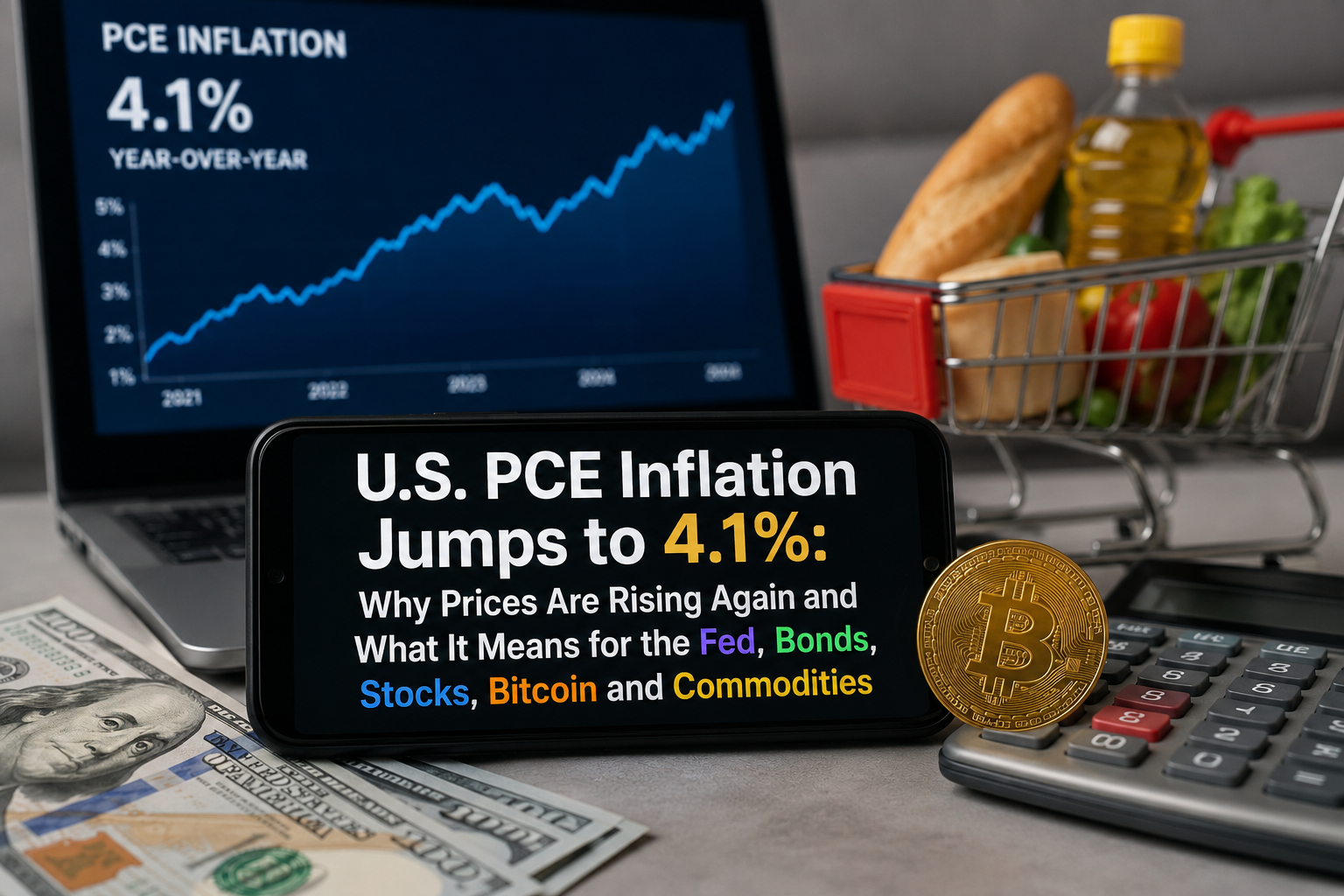
The latest U.S. inflation report just sent a very clear message to markets: the inflation problem is not over.
The Personal Consumption Expenditures price index, better known as the PCE inflation index, rose 4.1% year-over-year in May, up from 3.8% in April, according to the Bureau of Economic Analysis. On a monthly basis, headline PCE increased 0.4%. More importantly for the Federal Reserve, core PCE inflation, which excludes food and energy, rose 3.4% from a year earlier and 0.3% month-over-month.
That matters because PCE is the inflation gauge the Fed watches most closely. CPI gets more attention in the media, but PCE is the measure that better reflects changes in consumer behavior and is central to the Fed’s long-term 2% inflation target. And right now, at 4.1%, inflation is still running at more than double that target.
The way I read this report, the headline number is bad, but the core number is the real issue. Energy can spike and reverse. Oil can surge because of geopolitical tensions and then fall back when supply fears calm down. But when core inflation stays sticky, that tells me the pressure is not only coming from gasoline or temporary shocks. It tells me the inflation story is still embedded in services, wages, insurance, transportation, financial costs and everyday household expenses.
And that is exactly why markets are paying attention.
This is not just an inflation report. It is a Fed report, a bond-market report, a stock-market report, a Bitcoin liquidity report and a commodities report all at once.
Why Did PCE Inflation Rise So Much?
The first reason is energy.
A major part of the latest inflation acceleration came from higher energy prices. The TradingView/Invezz report pointed to the effect of rising energy costs linked to tensions in the Middle East, which fed into gasoline prices and broader transportation costs.
That matters because energy is not just one category. It spreads through the economy. When oil rises, gasoline rises. When gasoline rises, transportation gets more expensive. When transportation gets more expensive, companies face higher logistics costs. Eventually, some of that gets passed on to consumers.
This is why energy shocks are so uncomfortable for the Fed. They may begin as supply-side events, but if they last long enough, they can bleed into broader inflation expectations.
The second reason is resilient consumer demand.
The BEA data showed that current-dollar personal consumption expenditures rose 0.7% in May, while real PCE rose 0.3%. Personal income and disposable personal income also increased 0.7%.
That is a big deal. If consumers were collapsing, inflation pressure would probably cool faster. But if households are still spending, companies may have more room to raise prices or avoid cutting prices. Strong spending keeps nominal growth alive, but it also makes the Fed’s job harder.
The third reason is sticky core inflation.
Core PCE rose to 3.4%, up from 3.3% in April, according to BEA data. This is the number I would focus on. A hot headline inflation print can sometimes be dismissed if it is all oil or food. But core inflation staying above 3% means underlying price pressure remains too strong.
The fourth reason is that inflation is broad enough to worry investors.
Investopedia noted that May’s inflation pressure was driven not only by energy, but also by areas such as healthcare, transportation, financial services and insurance. That matters because a broad inflation mix is harder to solve than a single-category spike.
In simple terms: this was not just “gasoline went up.” This was “inflation is still showing up across parts of the economy that the Fed cares about.”
Why the PCE Report Matters More Than CPI for the Fed
The Fed’s inflation target is based on PCE, not CPI.
That is why a hot PCE report tends to hit markets differently. CPI can move markets immediately because it is released earlier and gets huge media coverage. But PCE is the Fed’s preferred inflation gauge, so when PCE comes in hot, investors reassess the actual path of monetary policy.
The Fed wants inflation at 2%. Headline PCE is now 4.1%. Core PCE is 3.4%. That gap is too large to ignore.
For me, the key question is not whether the Fed is happy or unhappy with the number. The answer is obvious: the Fed is not happy. The real question is whether this report is hot enough to force the Fed into another rate hike, or at least keep rates higher for much longer than markets wanted.
At the June meeting, the Fed kept the federal funds target range at 3.50% to 3.75%, while policymakers’ projections showed the possibility of a rate hike in 2026. After this PCE report, the market has even less room to price in quick rate cuts.
That is the main market takeaway: cuts are harder to justify when the Fed’s favorite inflation gauge is moving in the wrong direction.
What This Means for the Fed
The Fed now has a credibility problem to manage.
If the Fed ignores inflation at 4.1%, investors may start questioning its commitment to the 2% target. But if the Fed hikes too aggressively, it risks damaging growth, credit conditions and employment.
This is the classic central-bank trap: inflation is too high, but the economy is not weak enough to make the decision easy.
Reuters reported that most economists in a recent poll still expected the Fed to hold rates steady through the rest of 2026, even as markets priced in a greater chance of hikes. That split is important. Economists are saying, “Maybe the Fed waits.” Markets are saying, “Maybe the Fed cannot wait.”
I think the Fed has three possible paths from here.
Scenario 1: The Fed Holds Rates but Sounds More Hawkish
This is probably the cleanest short-term option.
The Fed can keep rates unchanged while using speeches and meeting statements to remind markets that inflation is too high. This would avoid shocking the economy, but it would still push back against rate-cut expectations.
For markets, this means fewer dreams of easy money.
Scenario 2: The Fed Signals One More Hike
This is the scenario that would matter most for bonds and growth stocks.
If the Fed signals that one more hike is likely, short-term yields could rise, the dollar could strengthen, and high-valuation equities could come under pressure.
Scenario 3: The Fed Waits for Oil to Cool the Next Inflation Print
This is the more patient approach.
Some analysts argue that the recent oil-price spike may fade, which could bring headline inflation down in future reports. MarketWatch reported that falling oil prices could bring some relief, although core inflation remains a concern.
The Fed may want to see whether May was a peak inflation month before acting again. But the problem is that core inflation is still elevated, so waiting is not risk-free.
Bond Market Impact: Why Treasury Yields Are the First Place to Watch
When inflation rises, the bond market usually reacts before anything else.
Higher inflation can push yields higher because investors demand more compensation to hold fixed-income assets. If inflation erodes the real value of future interest payments, bonds become less attractive unless yields rise.
But the bond-market reaction is not always simple.
Short-term yields are more sensitive to Fed policy. Long-term yields are more sensitive to inflation expectations, growth expectations and demand for safe assets.
So when PCE inflation jumps, I look at the Treasury curve in three layers:
- Two-year yields: What does the market think the Fed will do?
- Ten-year yields: What does the market think about inflation and growth?
- Real yields: Are inflation-adjusted rates tightening financial conditions?
MarketWatch reported that Treasury yields were actually falling despite elevated inflation, partly because investors believed the Fed’s tougher anti-inflation stance could help anchor long-term inflation expectations.
That is an interesting market signal. It suggests investors may be saying: “Yes, inflation is hot, but maybe the Fed is serious enough to contain it.”
Still, I would be careful with long-duration bonds. If inflation stays sticky and the Fed has to stay restrictive, long-duration assets can remain vulnerable. The iShares 20+ Year Treasury Bond ETF, TLT, was trading around $87.36 in the latest market data, nearly flat on the session.
For bond investors, the question is whether this inflation spike is temporary or persistent. If it is temporary, long bonds may stabilize. If it is persistent, yields may need to reprice higher again.
Stock Market Impact: Why This Is Complicated for the S&P 500 and Nasdaq
A hot PCE report is usually not good news for stocks.
Higher inflation can hurt equities in several ways. It can push the Fed toward higher rates. It can raise discount rates. It can pressure corporate margins. It can reduce consumer purchasing power. And it can make bonds more competitive versus stocks.
But the stock-market reaction is not always immediately bearish.
Why? Because inflation can also come with strong nominal growth. If consumers are still spending and companies can still pass through higher prices, corporate revenues may hold up. That is why markets sometimes rally after hot inflation data if the numbers are close to expectations and growth looks resilient.
Bolsamania noted that personal income, disposable income and consumer spending all increased in May, while U.S. first-quarter GDP was revised up to 2.1% from 1.6%. That gives equity bulls something to work with.
But I would separate the stock market into groups.
Growth Stocks and Tech
High-growth stocks are very sensitive to interest rates because much of their valuation is based on future earnings. When yields rise, those future earnings are discounted more heavily.
That is why hot inflation can pressure the Nasdaq more than defensive sectors.
If investors believe the Fed will hike again, expensive tech stocks can become vulnerable. AI-related names may still have strong secular demand, but even great companies can correct when rates move higher.
Banks and Financials
Banks can benefit from higher rates up to a point, especially if net interest margins improve. But if rates rise too much and credit stress increases, the story changes.
For financials, this PCE report is mixed. Higher-for-longer can help margins, but persistent inflation can also increase default risks and reduce loan demand.
Consumer Discretionary
This is one of the most exposed areas.
If inflation keeps eating into household budgets, discretionary spending can weaken. Consumers may still spend on essentials, but big-ticket items, travel, entertainment and luxury purchases can become more vulnerable.
Energy and Materials
Energy stocks may benefit if inflation is being driven by oil. Materials and commodity-linked equities can also act as partial inflation hedges.
But if inflation triggers a Fed-driven slowdown, demand expectations can fall, which would eventually hurt cyclical sectors.
Defensive Stocks
Utilities, healthcare and consumer staples may attract capital if investors become more cautious. But even defensives are not immune if yields rise sharply, because dividend-paying stocks compete with bonds.
In the latest market data, the SPDR S&P 500 ETF, SPY, traded around $728.99, down slightly on the session. To me, that kind of reaction says the market is not panicking, but it is definitely reassessing the rate path.
What This Means for Bitcoin
Bitcoin is one of the most interesting assets in this environment because it sits at the intersection of inflation, liquidity and risk appetite.
Some people call Bitcoin an inflation hedge. In the very long run, that may be part of the story because BTC has a fixed supply schedule. But in the short and medium term, Bitcoin often trades more like a liquidity-sensitive risk asset.
When inflation rises and the Fed becomes more hawkish, liquidity expectations usually tighten. That can pressure Bitcoin.
Markets.com reported that Bitcoin briefly fell below $59,000 after the hot PCE data revived Fed rate-hike fears. Current market data shows BTC around $60,328, with an intraday low near $58,761.
The way I look at Bitcoin here is simple: BTC does not only care about inflation. It cares about the Fed’s response to inflation.
If inflation rises but the Fed cannot or will not tighten, Bitcoin may benefit from currency-debasement fears. But if inflation rises and the Fed tightens aggressively, Bitcoin can struggle because liquidity gets drained from risk assets.
That is the tension right now.
Bitcoin bulls will argue that persistent inflation strengthens the case for hard assets and scarce digital assets. Bitcoin bears will argue that higher real yields and a stronger dollar are bad for crypto.
Both sides have a point.
For me, the key levels are not just technical price levels. The key macro levels are:
- U.S. real yields.
- The dollar index.
- Fed rate-hike probabilities.
- Liquidity conditions.
- ETF flows.
- Risk appetite in tech stocks.
If those improve, Bitcoin can recover quickly. If they deteriorate, BTC can remain under pressure even if the inflation narrative looks bullish on paper.
Gold and Commodities: Inflation Hedge or Rate-Hike Victim?
Gold is another asset where the reaction can be complicated.
In theory, gold benefits from inflation because it is viewed as a store of value. But gold can struggle when real yields rise, because gold does not pay interest. If investors can earn a higher inflation-adjusted return in Treasuries, gold becomes less attractive.
That said, gold can still perform well when inflation is paired with geopolitical risk, dollar uncertainty or central-bank credibility concerns.
The SPDR Gold Shares ETF, GLD, was trading around $373.63, up about 1.15% in the latest market data. That suggests investors are still using gold as a hedge in this environment.
Oil is different.
Oil was one of the reasons inflation rose in the first place. But oil can also reverse quickly if geopolitical risk cools or supply concerns fade. The United States Oil Fund, USO, was trading around $105.48, down about 3.5% in the latest market data.
That matters because if oil keeps falling, headline PCE inflation could cool in future months. But if oil stabilizes at elevated levels or rises again, the Fed will have a much bigger problem.
For broader commodities, the picture depends on whether inflation is demand-driven or supply-driven.
If inflation is demand-driven, commodities may benefit from strong economic activity. If inflation is supply-driven and the Fed tightens into it, commodities can become more volatile because demand expectations weaken.
U.S. Dollar Impact: Hot Inflation Can Support the Dollar
A hot inflation report can be bullish for the U.S. dollar if it increases expectations for Fed rate hikes.
Higher U.S. rates can attract capital into dollar assets. That tends to support the dollar, especially against currencies whose central banks are closer to cutting rates.
But there is another side. If inflation rises because investors fear U.S. policy credibility is weakening, the dollar can become more volatile. For now, the more direct channel is rate expectations.
TMGM reported that the dollar gained support as markets priced a higher probability of a September rate increase after the PCE report.
For global markets, a stronger dollar can create pressure. It can weigh on emerging markets, commodities priced in dollars and multinational corporate earnings.
That is why the dollar is one of the most important assets to watch after a hot PCE print.
The Bigger Macro Picture: Inflation Is Becoming Harder to Kill
The biggest issue is that inflation is no longer just a simple post-pandemic story.
At first, inflation was explained by supply chains, stimulus, reopening demand and energy shocks. But now the market is dealing with a more complicated mix:
- Energy volatility.
- Services inflation.
- Wage pressure.
- Insurance and healthcare costs.
- Tariffs and import costs.
- Strong consumer spending.
- Geopolitical risk.
- Financial-market wealth effects.
That makes the Fed’s job harder.
If inflation were only about oil, the Fed could look through it. If inflation were only about housing, the Fed could wait for shelter data to cool. If inflation were only about goods, supply-chain normalization could help.
But when inflation shows up across multiple categories, the policy response becomes more difficult.
This is why I think the market should not dismiss the PCE report too quickly. Yes, oil may cool. Yes, one month does not make a trend. Yes, some of the data may already be backward-looking.
But core PCE at 3.4% is not comfortable. And headline PCE at 4.1% is not close to the Fed’s target.
What Investors Should Watch Next
The next few weeks will be important because markets need to decide whether May was a one-off inflation spike or the start of a renewed inflation wave.
I would watch five things closely.
1. Oil and Gasoline Prices
If oil keeps falling, headline inflation may cool. If oil rebounds, inflation fears will intensify.
2. Core Services Inflation
This is the sticky part. If services inflation remains strong, the Fed will stay hawkish.
3. Treasury Yields
The bond market will tell us whether investors believe the Fed has inflation under control.
4. Fed Communication
The market will analyze every speech for clues about whether another hike is coming.
5. Bitcoin and High-Growth Stocks
These are liquidity-sensitive assets. If they sell off together, it may mean markets are pricing tighter financial conditions.
My Take: This PCE Report Keeps the Fed in Control of the Market Narrative
My personal view is that this report changes the tone of the market, even if it does not immediately force a Fed hike.
Before this data, investors could still hope that inflation was slowly moving back toward target and that the Fed might eventually pivot. After this data, that hope looks weaker.
The Fed does not need to panic. But it also cannot declare victory.
For stocks, that means valuations matter again. For bonds, duration risk remains important. For Bitcoin, liquidity is still the key macro driver. For gold, inflation and geopolitical hedging remain supportive, but real yields are the risk. For oil and commodities, the outlook depends heavily on whether the energy shock fades or returns.
This is the kind of inflation report that does not just move one market. It affects the entire cross-asset map.
And the biggest message is this: as long as PCE inflation is running above 4% and core PCE is stuck above 3%, the Fed is not done being the most important force in markets.
Conclusion
The May PCE inflation report was a major reminder that U.S. inflation remains a serious problem. Headline PCE rose to 4.1%, core PCE climbed to 3.4%, consumer spending stayed resilient and the Fed now faces renewed pressure to keep policy tight.
For markets, the implications are broad. Bonds must price the risk of higher-for-longer interest rates. Stocks must deal with valuation pressure. Bitcoin must navigate tighter liquidity expectations. Gold can benefit from inflation anxiety, but remains sensitive to real yields. Oil and commodities remain central to the next inflation move.
The key question now is whether May was the peak of the inflation rebound or the beginning of a more persistent problem.
Until that answer is clear, I would expect markets to stay highly sensitive to every inflation print, every Fed speech and every move in Treasury yields.
FAQs
What is PCE inflation?
PCE inflation measures changes in the prices of goods and services purchased by consumers. It is the Federal Reserve’s preferred inflation gauge because it captures consumer behavior more broadly than CPI.
Why did PCE inflation rise to 4.1%?
The increase was driven largely by higher energy prices, resilient consumer spending and sticky underlying inflation pressures. Core PCE also rose, showing that inflation was not only an energy story.
What does higher PCE inflation mean for the Fed?
It makes rate cuts less likely and keeps the possibility of further rate hikes on the table. The Fed’s target is 2%, so inflation above 4% is still far too high.
Is this bad for stocks?
It can be. Higher inflation can lead to higher interest rates, which pressure valuations, especially in growth stocks. However, strong consumer spending can support corporate revenues in the short term.
Is PCE inflation bullish or bearish for Bitcoin?
It depends on the Fed reaction. Inflation can support Bitcoin’s long-term scarcity narrative, but if it leads to higher rates and tighter liquidity, BTC can fall as a risk asset.
What happens to gold when PCE inflation rises?
Gold can benefit from inflation fears and geopolitical risk, but it can also face pressure if real yields rise sharply.
What should investors watch next?
Oil prices, core services inflation, Treasury yields, Fed communication, the dollar, Bitcoin liquidity conditions and the next CPI/PCE reports.