
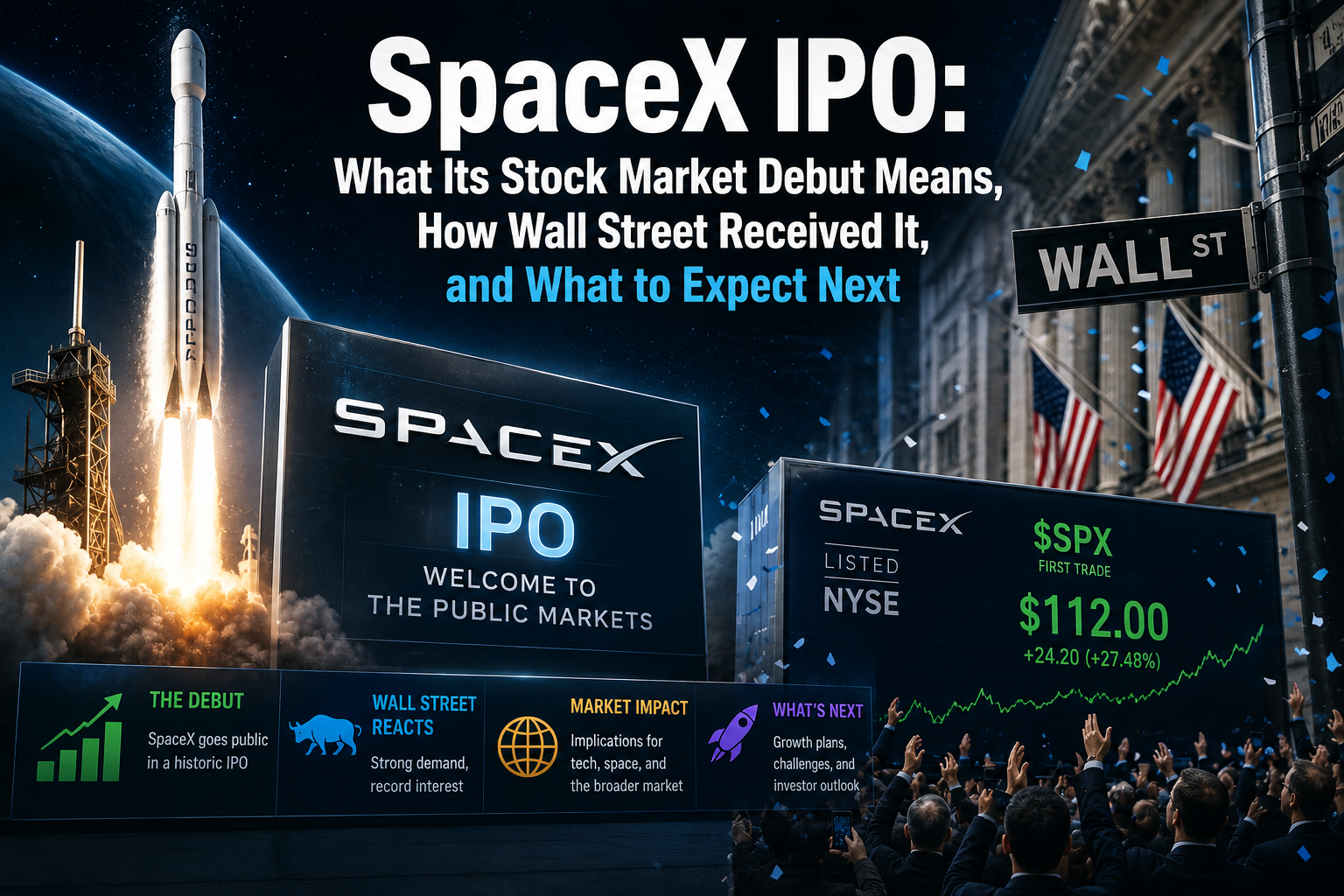
SpaceX is no longer just the private rocket company everyone talks about. It is now one of the biggest stories on Wall Street.
And honestly, the way I see it, SpaceX did not come public as just another aerospace company. It came public as a symbol: part space company, part satellite internet giant, part Elon Musk vehicle, part artificial intelligence infrastructure story, and part bet on the future of humanity beyond Earth.
That mix explains why the SpaceX IPO received such an intense reaction. Investors were not only buying a company with rockets, satellites and government contracts. They were buying access to a narrative that had been private for years. For a long time, ordinary investors could watch SpaceX launch rockets, follow Starlink’s expansion and hear Elon Musk talk about Mars, but they could not easily own the company directly. The IPO changed that.
According to SpaceX’s own investor-relations release, the company closed its initial public offering with 638,888,888 Class A shares sold after underwriters fully exercised their overallotment option, bringing gross proceeds to approximately $85.7 billion. Nasdaq described the debut as historic, with SpaceX opening at $150 per share, above its $135 IPO price, and raising an initial $75 billion before the overallotment exercise.
That is an enormous number. It is not just large for an aerospace company. It is large for any company, in any sector, at any point in market history.
But the real question is not whether SpaceX is impressive. It obviously is. The real question is whether investors are paying a reasonable price for that impressiveness.
That is where the story gets complicated.
SpaceX Did Not Enter the Market Like a Normal Company
Most IPOs are judged by fairly standard questions. Is the company growing? Is it profitable? How large is the market? What are the margins? Who are the competitors? How much dilution is involved? What does management plan to do with the money?
SpaceX forces investors to ask all of those questions, but it also adds several others.
Can a rocket company deserve a technology multiple? Can Starlink become one of the most important connectivity businesses in the world? Can Starship open markets that do not fully exist yet? Can Elon Musk keep investor trust while running multiple high-profile companies? Can SpaceX justify a valuation that already places it among the most valuable companies on Earth?
That is what makes the IPO so fascinating to me. SpaceX is not easy to place in a single category. If you call it an aerospace company, you miss Starlink. If you call it a satellite internet company, you miss launch dominance. If you call it a defense contractor, you miss the Mars ambition. If you call it a tech company, you may underestimate the brutal capital intensity of rockets, factories, launch pads and regulatory approvals.
This is exactly why the stock can attract both extreme enthusiasm and extreme skepticism at the same time.
The bullish investor sees a company that has already changed the economics of space launch, built a massive satellite network and created a brand almost no competitor can match. The cautious investor sees a company with massive capital needs, enormous expectations and a valuation that may already discount years of success.
Both sides have a point.
How SpaceX’s IPO Was Received by Wall Street
The reception was explosive.
Reuters reported that SpaceX’s IPO proceeds rose to $85.7 billion after the underwriters exercised the greenshoe option, with the company originally raising $75 billion by selling 555.56 million shares at $135 each. The same report said investor interest exceeded $250 billion, showing the offering was heavily oversubscribed.
That matters because IPO demand tells us something about market psychology. When an offering is oversubscribed, it means investors wanted more stock than was available at the IPO price. In SpaceX’s case, that demand came from both institutional and retail interest, which gave the debut a powerful base of support.
From my perspective, the strongest signal was not just that SpaceX went public successfully. It was that the company entered the market with enough demand to turn the IPO into a broader market event.
This was not a quiet listing. It was a statement.
A Record-Breaking Offering
The scale of the IPO immediately put SpaceX in rare company. Nasdaq described the offering as the largest and most anticipated IPO in Wall Street history, with the company raising $75 billion and reaching an implied valuation of about $1.77 trillion at the IPO price.
SpaceX later announced the full exercise of the overallotment option, lifting gross IPO proceeds to approximately $85.7 billion.
For context, that means SpaceX did not simply test public-market appetite. It absorbed a huge amount of capital and still saw strong early trading interest.
That is rare.
But it also creates a problem: when a company enters the market at such a massive valuation, the margin for disappointment becomes much smaller. The higher the starting point, the more perfect the execution needs to be.
Why Investors Rushed Into SpaceX
The immediate demand for SpaceX stock was not surprising. The company has several qualities that investors love.
First, SpaceX dominates a market that is strategically important. Launch capacity is no longer just a science project. It is tied to communications, national security, satellite infrastructure, defense, climate monitoring, internet access and potentially future lunar and Mars activity.
Second, SpaceX has Starlink. That gives the company a recurring-revenue angle that a pure launch business would not have. Investors tend to reward predictable, scalable revenue streams, especially when they are attached to a global market.
Third, SpaceX has Elon Musk. Whether someone likes him or not, Musk has a proven ability to create investor attention. Tesla showed how powerful a founder-led narrative can become when the market believes the company is shaping the future.
Fourth, public investors had waited years for access. That scarcity created pent-up demand.
I think that last point is underrated. Sometimes IPOs work not just because of fundamentals, but because investors feel they are finally being allowed into a story that was previously closed to them. SpaceX had that exact dynamic.
Why Some Analysts Are Already Cautious
The caution is also understandable.
XTB highlighted that SpaceX’s valuation had already reached extreme territory while the company still had major fundamental questions. The article noted that SpaceX had recorded a net loss of $4.94 billion in 2025, after a smaller net profit in 2024, and argued that traditional valuation models struggle to justify the stock’s price.
That is the tension at the heart of the SpaceX IPO.
The company may be extraordinary. But extraordinary companies can still become expensive stocks.
I would not treat SpaceX like a normal stock, at least not yet. In the near term, it will likely trade as a belief asset. That means sentiment, Musk’s comments, Starship milestones, Starlink growth, analyst coverage and market liquidity may matter almost as much as quarterly earnings.
That can create huge upside. It can also create violent downside.
The Valuation Question: Is SpaceX Already Too Expensive?
The valuation is the hardest part of the SpaceX story.
If investors only look at current earnings, the stock can look stretched. If they look at the possible size of Starlink, launch services, defense applications, lunar infrastructure, Mars logistics and AI-related infrastructure, the valuation starts to look like a bet on multiple future industries at once.
That is why there is no simple answer.
SpaceX is expensive if you value it like an industrial company. It may be more reasonable if you value it like a platform controlling critical space infrastructure. It may still be expensive even then, depending on how quickly revenues and profits scale.
The Bull Case Behind the Premium
The bull case is powerful.
SpaceX has a launch business with high barriers to entry. Rockets are difficult. Reusability is difficult. Scaling launch cadence is difficult. Regulatory approval is difficult. Building customer trust is difficult. Competing with a company that has years of operational data and proven infrastructure is even harder.
That gives SpaceX a strategic advantage.
Then there is Starlink, which could become the financial engine of the company. Satellite internet is not just about rural broadband. It can serve aircraft, ships, military users, emergency zones, remote industries and markets where terrestrial infrastructure is weak or unavailable.
From a market perspective, Starlink gives SpaceX something investors can understand more easily than Mars: recurring revenue.
The bull case also includes Starship. If Starship works at scale, SpaceX could radically reduce the cost of moving mass to orbit. That could unlock new commercial markets, support NASA programs, strengthen national-security relationships and potentially make lunar or Mars missions more economically realistic.
That is why some investors are willing to pay a premium. They are not buying the company as it exists today. They are buying what SpaceX could become if several ambitious pieces work at the same time.
The Bear Case Investors Cannot Ignore
The bear case is just as important.
SpaceX needs capital. A lot of it. Rockets, satellites, launch sites, Starship testing, manufacturing capacity and regulatory compliance all require enormous spending.
The company also faces execution risk. Starship is central to the long-term story, but major rocket programs do not move in straight lines. Delays, failures and redesigns are part of the process. Investors may love iteration when SpaceX is private. They may react very differently when the company is public and the stock price moves every day.
There is also valuation risk. If the company is priced for perfection, even good results may not be enough.
This is one of the most important lessons in investing: a great company and a great stock are not always the same thing.
I can believe SpaceX is one of the most important companies in the world and still think the stock may be risky at the wrong price.
Why Traditional Valuation Models Struggle With SpaceX
Traditional discounted cash-flow models are useful, but SpaceX stretches them.
What revenue multiple should investors assign to a company that has launch services, satellite internet, defense contracts, lunar ambitions, Mars optionality and potential AI infrastructure demand? What terminal margin makes sense? How should investors discount Starship success? How should they value a Mars mission that may be strategically historic but financially unclear?
This is where the debate becomes less mathematical and more philosophical.
The stock market often values companies based on what they might become. That is especially true for companies associated with technological transformation. But when expectations rise too far, the market can punish even small disappointments.
That is why SpaceX’s valuation may remain controversial for a long time.
Elon Musk, Market Psychology, and the Power of the SpaceX Story
Elon Musk is central to the SpaceX investment case.
That does not mean SpaceX is only about Musk. The company has engineers, operators, manufacturing teams, launch teams and technical leaders who have built something extraordinary. But public markets do not separate SpaceX from Musk psychologically.
When Musk speaks, the stock may move. When he sets ambitious targets, investors listen. When he breaks with convention, the market debates whether it is visionary or risky.
That dynamic became visible almost immediately after the IPO.
Why Musk’s Revenue Forecast Changed the Conversation
CapitalBolsa reported that Musk suggested SpaceX could exceed $1 trillion in revenue by 2031, and possibly reach that level around 2030. The same article noted that those figures were far above estimates from Goldman Sachs and Morgan Stanley, which reportedly projected much lower revenue levels for 2030.
This kind of statement matters because it shifts the conversation.
Before the comment, investors could debate SpaceX as a large growth company. After the comment, the debate becomes whether SpaceX can become one of the biggest revenue machines in corporate history.
That is a much higher bar.
What stands out to me is the gap between ambition and proof. Musk is known for setting goals that sound almost impossible and then forcing organizations to move toward them. Sometimes that works spectacularly. Sometimes the timing is far too optimistic.
For investors, the key is not whether Musk’s ambition is inspiring. It is whether the market price already assumes too much of it.
The Risk of Expectations Running Ahead of Reality
Markets can fall in love with stories. SpaceX has one of the best stories in modern business.
Reusable rockets. Global satellite internet. Mars. Defense relevance. AI infrastructure. Founder mythology. Retail enthusiasm. Institutional demand. Scarcity. National importance.
That is a powerful cocktail.
But stories can become dangerous when investors stop asking what has to go right.
For SpaceX to justify the most aggressive expectations, Starlink likely needs to keep scaling, launch dominance must remain intact, Starship must progress, regulatory issues must stay manageable, capital spending must translate into revenue and public-market communication must remain credible.
That is a lot.
The way I see it, SpaceX has earned a premium. The question is how large that premium should be.
Starlink: The Business That Makes SpaceX More Than a Rocket Company
Starlink may be the most important part of the SpaceX stock story.
Rockets made SpaceX famous. Starlink may help make SpaceX financially scalable.
A launch business can be powerful, but it is project-based. Customers pay for missions. Revenue can be large, but it depends on contracts, cadence and capacity. Starlink is different because it has the potential to create recurring service revenue across consumer, enterprise, aviation, maritime and government markets.
That matters enormously for valuation.
Public markets love recurring revenue because it can be modeled, expanded and valued at higher multiples when growth is strong. If Starlink becomes a global connectivity platform, SpaceX may be valued less like a traditional aerospace contractor and more like a hybrid telecom, defense-tech and infrastructure company.
Why Starlink Matters to the Stock
Starlink gives investors a bridge between today and the future.
Mars is exciting, but hard to model. Starship is transformative, but technically risky. Launch services are impressive, but not always enough to justify extreme valuations on their own.
Starlink is easier for investors to understand.
Subscribers. Terminals. Monthly revenue. Enterprise contracts. Military use cases. Aviation connectivity. Maritime coverage. Remote broadband. Global expansion.
That is a language Wall Street understands.
It also creates a strategic feedback loop. SpaceX launches Starlink satellites using its own rockets. More launches support the satellite network. The network creates revenue. Revenue funds more infrastructure. More infrastructure improves the overall ecosystem.
That is one of the strongest arguments for SpaceX.
The Strategic Value of Satellite Internet
Satellite internet has become more than a consumer broadband product. It is now strategically relevant.
The war in Ukraine showed how satellite connectivity can matter in real-world conflict and emergency conditions, a point also highlighted in XTB’s analysis of SpaceX’s strategic value.
That gives Starlink a role beyond ordinary internet service. It can be infrastructure for governments, militaries, disaster-response agencies, ships, aircraft, remote communities and industries that operate far from fiber networks.
From an investor’s point of view, that strategic importance can support long-term demand. But it can also bring regulatory, diplomatic and political complexity.
SpaceX is not just selling internet. It is operating infrastructure that governments may increasingly view as critical.
That is powerful, but it comes with scrutiny.
Starship: The High-Risk, High-Upside Engine of the SpaceX Narrative
If Starlink is the financial bridge, Starship is the dream engine.
Starship is the part of SpaceX that makes investors imagine a radically different future. Lower launch costs. Larger payloads. Moon missions. Mars missions. Orbital refueling. Space-based infrastructure. New commercial markets that are not practical under today’s launch economics.
That is why Starship matters so much to the stock.
Why Starship Could Transform the Company
If Starship becomes reliably reusable and commercially useful, SpaceX could gain an even stronger cost advantage. That could help the company launch more Starlink satellites, serve NASA missions, support defense customers and open markets that require very heavy payload capacity.
In that scenario, SpaceX becomes more than a launch provider. It becomes the company that controls the transportation layer for a much larger space economy.
That is the kind of possibility investors are paying for.
This is where I understand the enthusiasm. Very few companies have a credible path to changing the economics of an entire frontier. SpaceX does.
Why Starship Could Also Pressure the Stock
The risk is that Starship development is expensive, visible and uncertain.
Public investors may celebrate test progress, but they may also react sharply to failures. SpaceX has built its culture around rapid iteration, and in rocket development, failures can produce useful data. But the public market is not always patient with nuance.
A failed test may be technically valuable and still hurt the stock.
This is one of the biggest changes for SpaceX after going public. The company’s development culture now exists under daily market observation.
That can create tension.
Engineers may think in years. Traders think in minutes.
What Could Happen to SpaceX Stock During the Rest of 2026?
For the rest of 2026, I think SpaceX stock will trade less on traditional earnings and more on four things: belief, execution, communication and supply of shares.
That does not mean financial results do not matter. They absolutely do. But in the early post-IPO period, the market is often trying to decide what kind of stock a new public company will become.
Will SpaceX trade like a mega-cap growth stock? Like a speculative technology leader? Like a defense-and-infrastructure company? Like a Musk-linked momentum name? Or some mix of all four?
That identity will form over the next several months.
Bullish Scenario
In the bullish scenario, SpaceX continues to rise or holds most of its IPO gains.
For that to happen, several things probably need to go right.
First, the company must deliver financial updates that reassure investors. Revenue growth needs to look strong, especially from Starlink. Losses or capital spending may be tolerated if investors believe the spending is building durable future revenue.
Second, Starship progress needs to remain credible. The market does not need perfection, but it needs signs that development is advancing.
Third, SpaceX must manage communication carefully. Reuters reported that SpaceX plans to release financial results through its own website and X rather than traditional wire services, which is an unusual approach for a public company. If investors accept that model and information remains easy to access, the issue may fade. If not, it could become a trust problem.
Fourth, the broader market environment needs to remain supportive. Mega-cap growth stocks usually perform better when liquidity is strong, risk appetite is high and interest-rate expectations are friendly.
In this bullish version, SpaceX becomes the defining IPO success story of 2026. The stock remains expensive, but investors continue to reward the company because they believe it owns one of the most important growth platforms in the world.
Base Case Scenario
The base case, in my view, is more volatile.
SpaceX may remain a market favorite, but the stock could swing sharply as investors digest the valuation. After a huge IPO and early rally, it would be normal to see pullbacks, sharp rebounds and heavy debate among analysts.
This scenario does not require anything to be “wrong” with SpaceX. It only requires investors to become more selective after the initial excitement.
The stock could spend the rest of the year building a range. Bulls would buy dips because they believe in the long-term story. Bears would sell rallies because they believe the valuation is too stretched.
That kind of action would actually be healthy.
A stock cannot go straight up forever without creating fragility. If SpaceX consolidates, releases credible results and shows execution progress, it could build a stronger base for 2027.
Bearish Scenario
The bearish scenario is also realistic.
If financial results disappoint, if Starship faces visible setbacks, if Musk’s comments create regulatory concerns, if the broader market weakens or if early shareholders sell aggressively after lock-up restrictions ease, SpaceX could fall hard.
CapitalBolsa noted that the rally may face an important test after second-quarter results, with early investors potentially allowed to sell up to 20% of their shares in later windows, while Musk remains blocked for a year.
That matters because supply can change the stock’s behavior. When more shares become available for sale, the market has to absorb them. If demand remains strong, no problem. If demand weakens, the stock can come under pressure.
In the bearish case, investors decide that SpaceX is a great company but that the IPO price and early rally pulled too much future success into the present.
That is the core risk.
What Investors Should Watch Next
SpaceX will be judged by more than headlines now.
As a public company, it has to build a rhythm of trust with investors. That means financial reporting, operational milestones, regulatory clarity and capital allocation all matter.
Financial Results and Communication Strategy
The first major thing to watch is how SpaceX communicates as a public company.
The decision to publish financial results through its own website and X instead of traditional wire services is very on-brand for Elon Musk, but it is also unusual. Reuters described the move as a departure from standard corporate communication practices.
This could be smart if it gives SpaceX direct control and faster distribution. But it could also frustrate investors who rely on traditional financial information systems.
My view is simple: direct communication is fine, but public-company information must be clear, timely and easy for all investors to access. If SpaceX gets that right, the market may accept the approach. If it looks selective or chaotic, it could create unnecessary risk.
Lock-Up Expirations
Lock-up periods matter after major IPOs.
When insiders and early investors become eligible to sell, the stock can face pressure. That does not mean it must fall, but it does mean investors should pay attention to supply.
If early holders sell heavily, the market may interpret it as a lack of confidence. If selling is modest, the stock could take it as a positive sign.
For SpaceX, this will be especially important because the early valuation is already massive.
Starship Progress
Starship may be the most visible operational catalyst.
Every test, delay, regulatory update or technical milestone can affect sentiment. A strong Starship update could reinforce the long-term bull case. A major setback could remind investors that space development remains difficult.
I would watch Starship not as a single event, but as a trend. Is the program moving forward? Is reliability improving? Are launch timelines becoming more predictable? Is the system getting closer to commercial usefulness?
Those questions matter more than any one headline.
Starlink Growth
Starlink is probably the key financial metric area.
Investors should watch subscriber growth, enterprise adoption, government contracts, margins, churn, capacity, pricing and geographic expansion.
If Starlink shows strong growth and improving economics, it can support a large part of the SpaceX valuation. If Starlink growth slows or margins disappoint, the market may start questioning the premium.
Regulatory and SEC Risk
Public companies operate under rules that private companies can sometimes avoid or manage more quietly.
Musk’s communication style has always been direct and unconventional. That can energize supporters, but it can also create regulatory tension.
CapitalBolsa noted that Musk’s ambitious revenue comments came shortly after the IPO and raised questions about how regulators might view communications during the post-IPO quiet period.
This is an area investors should not ignore.
SpaceX can be bold. But as a public company, it also has to be disciplined.
My Personal Take on SpaceX After Its IPO
The way I see it, SpaceX is one of the most impressive companies of this generation.
It has already changed the launch market. It has built Starlink into a strategically important satellite network. It has made space feel commercially relevant in a way that few companies ever have. It has a founder who can pull attention, capital and talent toward extremely ambitious goals.
But I would separate admiration from valuation.
I can admire SpaceX and still be careful with the stock. I can believe Starship may be transformative and still recognize that public investors may be paying for success years before it is fully visible. I can see Starlink as a massive opportunity and still worry that the market may be underestimating capital intensity, regulation and execution risk.
That is the balance investors need.
SpaceX is not a boring stock. It is not a simple stock. It is not a stock I would analyze with one metric.
It is a company where the story is huge, the opportunity is huge and the expectations are huge. That combination can create extraordinary returns, but it can also create painful corrections.
For the rest of 2026, I would expect volatility. I would expect strong opinions on both sides. I would expect every Musk comment, Starship update and financial release to matter. I would also expect analysts to disagree widely, because SpaceX does not fit neatly into existing valuation boxes.
That does not make the stock uninvestable. It makes it demanding.
Investors need to know what they own.
Are they buying a profitable near-term business? A Starlink growth story? A launch monopoly? A Musk premium? A Mars option? A defense-tech platform? A speculative mega-cap growth stock?
The answer may be all of the above.
And that is exactly why the stock is so fascinating.
Final Thoughts: SpaceX Is a Great Company, But Is It a Great Stock?
SpaceX’s IPO was a massive success by almost any market-reception standard.
The company raised extraordinary capital, attracted huge investor demand and became one of the most talked-about public companies in the world almost instantly. Its combination of reusable rockets, Starlink, Starship, government relevance and Elon Musk’s vision gives it a story that few companies can match.
But the stock now has to grow into that story.
That is the key.
In the short term, SpaceX may keep benefiting from momentum, scarcity and belief. In the medium term, it will need to prove that Starlink can scale profitably, Starship can advance, financial losses can be understood within a credible growth plan and public-company communication can meet investor expectations.
The company has earned attention. It has earned respect. It has probably earned a premium.
Whether it has earned this much premium is the debate that will define the stock for the rest of 2026.
My personal view: SpaceX is one of the most important companies to watch this year, but investors should not confuse excitement with safety. The opportunity is real. So are the risks.
FAQs About SpaceX Stock and Its IPO
Did SpaceX go public?
Yes. SpaceX completed its IPO and began trading on Nasdaq under the ticker SPCX, according to Nasdaq’s report on the company’s market debut.
How much did SpaceX raise in its IPO?
SpaceX announced that it closed its IPO with approximately $85.7 billion in gross proceeds after underwriters fully exercised their overallotment option.
Was the SpaceX IPO well received?
Yes. Demand was very strong. Reuters reported that the IPO attracted more than $250 billion in investor interest and that the stock rose after its debut.
Why did investors get so excited about SpaceX?
Investors were drawn to SpaceX’s launch dominance, Starlink’s growth potential, Starship’s long-term upside, Elon Musk’s leadership and the rare chance to own a company that had been private for years.
Is SpaceX overvalued?
That depends on how investors value the company. Based on current earnings and losses, the valuation looks demanding. Based on long-term expectations for Starlink, Starship and space infrastructure, bulls argue the premium is justified. XTB noted that traditional fundamental analysis is difficult because the market is pricing a very large future opportunity.
What should investors watch for the rest of 2026?
The most important things to watch are financial results, Starlink growth, Starship progress, lock-up expirations, Musk’s public comments, regulatory issues and how SpaceX communicates with public investors.
Could SpaceX become more valuable than Amazon or Nvidia?
Some market commentary has already framed SpaceX as a company that could challenge the valuation of the world’s largest companies. TradingView’s Reuters headline described SpaceX as aiming to surpass Amazon in market value after its IPO. However, reaching and maintaining that level would require enormous execution.
What is the biggest risk for SpaceX stock?
The biggest risk is that expectations are already extremely high. If growth, profitability, Starship progress or Starlink economics disappoint, the stock could fall even if the company remains fundamentally impressive.
Is SpaceX a good long-term investment?
It may be for investors who understand the risks and can tolerate volatility. SpaceX has exceptional long-term potential, but the stock’s valuation, capital needs and execution risks mean it is not a simple or low-risk investment.