
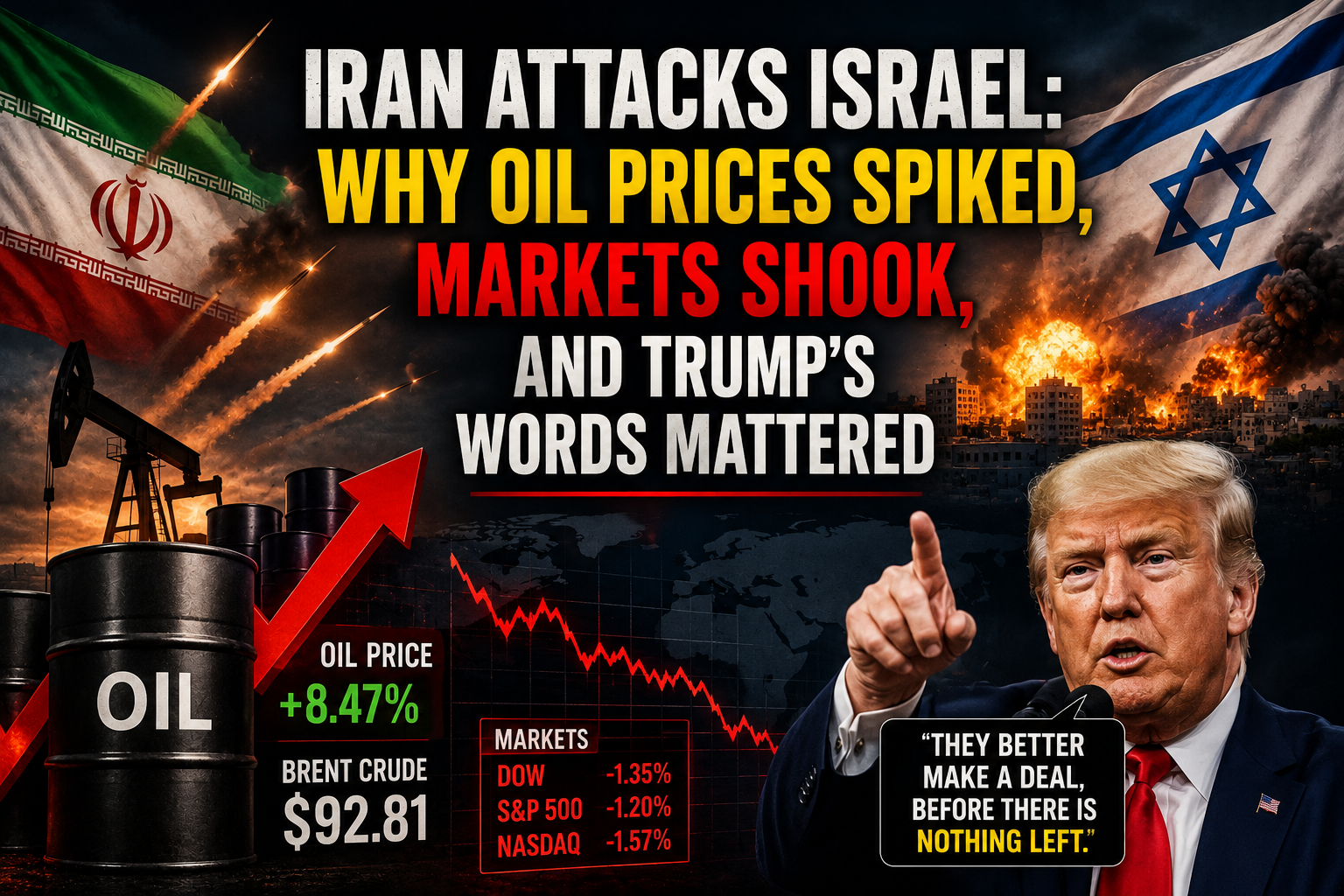
When I saw oil jump overnight after Iran’s attack on Israel, my first thought was not only about gasoline prices. It was about inflation, the Federal Reserve, Wall Street, and whether markets were suddenly being forced to price in a much wider Middle East war.
That is the key point here: oil did not spike simply because missiles were launched. Oil spiked because traders immediately started asking a bigger question: could this conflict threaten energy supply routes, drag in more countries, and keep inflation higher for longer?
Crude prices surged after the escalation between Iran and Israel, with oil briefly rising more than 5% before giving back part of those gains after both sides signaled a halt in attacks following an appeal from President Donald Trump. Brent crude was still trading higher, around $94.85 a barrel, while U.S. WTI was near $92.07, according to Reuters reporting on June 8, 2026.
That kind of move matters because oil is not just another commodity. It is the price sitting underneath transportation, shipping, airlines, manufacturing, food distribution, and inflation expectations. When oil moves sharply, markets listen.
Oil Spiked Overnight Because Markets Priced In a Bigger Middle East War
The first market reaction was pretty straightforward: Iran attacked Israel, Israel responded, and traders immediately added a geopolitical risk premium to crude.
In plain English, that means investors were willing to pay more for oil because the probability of a supply disruption went up. Nobody needed actual barrels to disappear from the market for prices to rise. The fear was enough.
Brent and WTI jumped as traders rushed to price geopolitical risk
Brent and WTI both moved higher because the conflict sits in the world’s most sensitive energy region. Iran is not just another country in the oil market. It is connected to the Persian Gulf, the Strait of Hormuz, regional militias, shipping routes, and the broader balance of power in the Middle East.
That is why the initial spike was so violent. The market was not calmly analyzing supply-and-demand spreadsheets. It was asking: what happens if this becomes a regional war?
To me, the most important part was not the first jump. It was the partial reversal. Oil prices pared gains after Iran and Israel said they had halted attacks for now, following Trump’s call for a ceasefire.
That tells us the market is trading escalation risk more than current supply loss.
The Strait of Hormuz is the real fear behind the oil move
The Strait of Hormuz is always the nightmare scenario in this kind of conflict. A large share of global oil and gas trade moves through that narrow route, so even the possibility of disruptions can send prices higher.
Reuters reported that the recent oil move was partly driven by concerns about prolonged restrictions in the Strait of Hormuz, while Houthi threats in the Red Sea added another layer of shipping risk.
This is why I think the market reaction makes sense. Traders are not only looking at Iran and Israel. They are looking at the map. If shipping routes are threatened, insurance costs rise, tankers reroute, supply gets delayed, and energy prices become more volatile.
That is how a military exchange becomes an inflation story.
How the Attack Hit Global Markets
The market reaction went beyond oil. Stocks, currencies, bonds, and energy-sensitive sectors all had to adjust.
European stocks fell on Monday as Middle East tensions pushed crude higher. Reuters reported that the STOXX 600 hit a two-week low, with airlines such as Lufthansa and Air France under pressure because higher fuel costs hurt margins.
That is exactly the kind of pattern I would expect. When oil rises quickly, energy producers may benefit, but airlines, transport companies, manufacturers, and consumers often take the hit.
Stocks initially struggled as investors moved away from risk
When geopolitical risk rises, investors often sell risk assets first and ask questions later.
That does not mean every stock falls equally. Energy stocks can rise. Defense names may get attention. Safe-haven assets can attract flows. But broad markets usually dislike uncertainty, especially when it comes with a potential inflation shock.
The problem is simple: higher oil can squeeze corporate profits and consumer spending at the same time.
Companies pay more for fuel. Consumers pay more at the pump. Airlines pay more for jet fuel. Shipping costs rise. And if businesses pass those costs on, inflation pressure builds again.
The dollar, bonds, and safe-haven trades also moved
The U.S. dollar initially benefited from safe-haven demand and stronger expectations around Federal Reserve policy, but it retreated after Iran said its strikes had ended, reducing immediate panic in the market.
That detail matters because it shows how fast markets can change their mind. One headline can make traders buy safety. Another headline can make them unwind that trade.
This is the same reason oil recovered part of its losses later. Traders were not making a moral judgment about the conflict. They were constantly repricing probabilities: escalation, retaliation, ceasefire, shipping disruption, inflation, and central-bank reaction.
Why Trump’s Words Helped Calm Oil Prices
This is probably the most interesting part of the story.
Trump’s words mattered because markets believed he had influence over the next move. Not total control, obviously. But enough influence to affect the probability of escalation.
According to Reuters, Trump said Israel and Iran were looking to implement an immediate ceasefire, while diplomatic efforts continued.
That kind of statement can move oil because traders are not only pricing what happened. They are pricing what may happen next.
Markets heard a signal that Washington wanted to avoid escalation
When Trump called for a halt in hostilities, the market heard something important: Washington did not appear to want the conflict to spiral.
That matters because the United States is still the most powerful external actor in this equation. It has influence over Israel, leverage through sanctions, military power in the region, and diplomatic channels with other governments.
So when Trump speaks, oil traders listen for policy signals:
Is the U.S. pushing Israel to stop?
Is the U.S. threatening Iran?
Is Washington preparing military action?
Is there a path to a deal?
Could sanctions change?
Could the Strait of Hormuz reopen more fully?
That is why I do not see Trump’s words as “just words.” In the oil market, words can change expectations before physical supply changes.
Why Trump has unusual influence over oil traders
Trump’s influence comes from three things.
First, he can affect the military temperature. If markets believe the U.S. is restraining Israel or pressuring both sides to pause, oil prices can cool.
Second, he can affect sanctions and diplomacy. Any hint of a deal with Iran can change expectations about supply and shipping.
Third, he can move market psychology. Trump communicates directly, loudly, and often in a way that markets cannot ignore. Whether traders like him or not is irrelevant. They watch his statements because his words can signal a policy shift.
That is why oil prices pared gains after ceasefire language emerged. The market was not suddenly convinced everything was fine. It simply reduced the odds of the worst-case scenario.
Is the Iran-Israel Conflict Close to Ending?
Nobody can honestly say exactly when this conflict will end.
And I would be careful with anyone who claims they know. The Middle East is full of conflicts that look like they are cooling one day and then flare up again the next.
What we can say is this: markets are treating every ceasefire signal as important, but fragile.
Reuters reported that Iran and Israel announced a temporary halt in attacks, but also noted that future action could resume if either side felt provoked.
That means this is not the same as a durable peace agreement. A pause is not peace. A ceasefire is not a settlement. And a statement from leaders does not automatically remove the risk of miscalculation.
The difference between a pause, a ceasefire, and a real peace deal
A pause means both sides stop for now.
A ceasefire means there is some kind of agreement, formal or informal, to stop attacks under certain conditions.
A real peace deal means the deeper issues are addressed: security guarantees, sanctions, regional proxies, borders, military activity, and political commitments.
Markets love ceasefire headlines because they reduce immediate risk. But oil will not fully relax unless traders believe the supply routes are safe and the political risk premium can come down.
That is why I would watch actions more than speeches. Are missiles actually stopping? Are shipping routes becoming safer? Are sanctions talks moving? Are the U.S., Iran, and Israel maintaining communication?
Those are the signals that matter.
What a Longer Middle East War Would Mean for Monetary Policy
This is where the story becomes much bigger than oil.
If the conflict drags on and keeps oil prices high, central banks get a serious problem: inflation can become sticky again.
The Federal Reserve has already discussed how energy and commodity prices tied to the Middle East conflict affected inflation expectations. In March 2026 FOMC minutes, Fed officials noted that some near-term inflation expectations increased as energy and commodity prices surged with the conflict.
That is the nightmare for central banks. They do not want to overreact to a temporary oil shock, but they also cannot ignore it if consumers and businesses start expecting higher inflation.
Higher oil can make inflation sticky again
Oil affects inflation in several ways.
First, gasoline prices hit consumers directly.
Second, diesel and jet fuel raise transportation costs.
Third, companies may pass higher costs on to customers.
Fourth, inflation expectations can rise if people see energy prices climbing and assume everything else will follow.
That final point is crucial. Central banks care deeply about expectations. If people believe inflation will stay high, wage demands and pricing decisions can reinforce that belief.
A Dallas Fed analysis in April 2026 estimated that a one-quarter closure of the Strait of Hormuz could lift headline inflation meaningfully in 2026, showing how a major energy disruption could feed directly into U.S. inflation dynamics.
Why the Fed may have less room to cut rates
If oil stays high because the war lasts longer, the Fed has less flexibility.
In a normal slowdown, the Fed might cut rates to support growth. But if inflation is being pushed up by energy prices, cutting rates becomes more complicated.
That is the political-monetary problem: higher oil can hurt growth and raise inflation at the same time. Economists call that a stagflationary pressure.
In that environment, the Fed may prefer to wait longer before cutting rates, or it may communicate more cautiously. The European Central Bank and other central banks would face a similar dilemma, especially if energy costs feed into broader prices.
So when people ask, “How does a Middle East war affect monetary policy?” my answer is: it makes every decision harder.
Central banks do not control oil wells, missile strikes, or shipping lanes. But they do control interest rates. If energy prices keep inflation elevated, monetary policy can stay tighter than markets want.
My Take: The Oil Market Is Trading Fear, Not Just Barrels
Here is how I see it: the market is not only trading the attack. It is trading the possibility that the attack becomes something bigger.
That is why oil spiked overnight. That is why markets shook. And that is why Trump’s words mattered.
The first move was fear. The second move was relief. But neither move should be mistaken for certainty.
If the ceasefire holds, oil can continue to give back some of the geopolitical premium. Stocks may recover. The dollar may cool. Bond yields may stabilize. And central banks may avoid an even more complicated inflation problem.
But if the conflict escalates again, especially around the Strait of Hormuz or Red Sea shipping routes, oil could move sharply higher. In that case, markets would quickly shift back to inflation risk, lower growth expectations, and tighter central-bank policy.
The key question now is simple:
Was this a one-night shock, or the beginning of a longer energy-price problem?
That is what I would watch next.
Not just the oil price itself, but the headlines behind it: Trump’s next statement, Israel’s next military move, Iran’s response, shipping-route security, OPEC+ supply decisions, the dollar, Treasury yields, and inflation expectations.
Because in this market, one sentence from Washington can move prices almost as much as one missile in the Middle East.
FAQs About Iran, Israel, Oil Prices, and Markets
Why did oil prices jump after Iran attacked Israel?
Oil jumped because traders feared the conflict could disrupt energy supplies or shipping routes in the Middle East. The biggest concern is not only Iran and Israel directly, but the risk of escalation around the Strait of Hormuz, the Red Sea, and regional energy infrastructure.
Why did oil prices recover after Trump spoke?
Oil prices pared gains because Trump’s call for a ceasefire reduced the perceived probability of immediate escalation. Markets interpreted his words as a sign that Washington wanted to contain the conflict rather than allow it to widen.
Why does Trump’s word influence oil prices so much?
Trump influences oil prices because U.S. policy can affect military escalation, sanctions, diplomacy, and market psychology. Traders listen to him because his statements can change expectations about whether the conflict gets worse or cools down.
Could oil prices keep rising?
Yes, oil could keep rising if attacks resume, shipping routes are threatened, or the Strait of Hormuz remains restricted. But oil could also fall if the ceasefire holds and traders become more confident that supply will not be disrupted.
When will the Middle East war end?
No one can predict that with certainty. A temporary halt in attacks is not the same as a lasting peace deal. The conflict will likely depend on whether Iran, Israel, the U.S., and regional actors can maintain de-escalation and move toward a broader agreement.
How could a prolonged war affect monetary policy?
A prolonged war could keep oil prices high, which may push inflation higher or make it harder to bring inflation down. That could force the Fed and other central banks to delay rate cuts, keep policy tighter, or communicate more cautiously.