
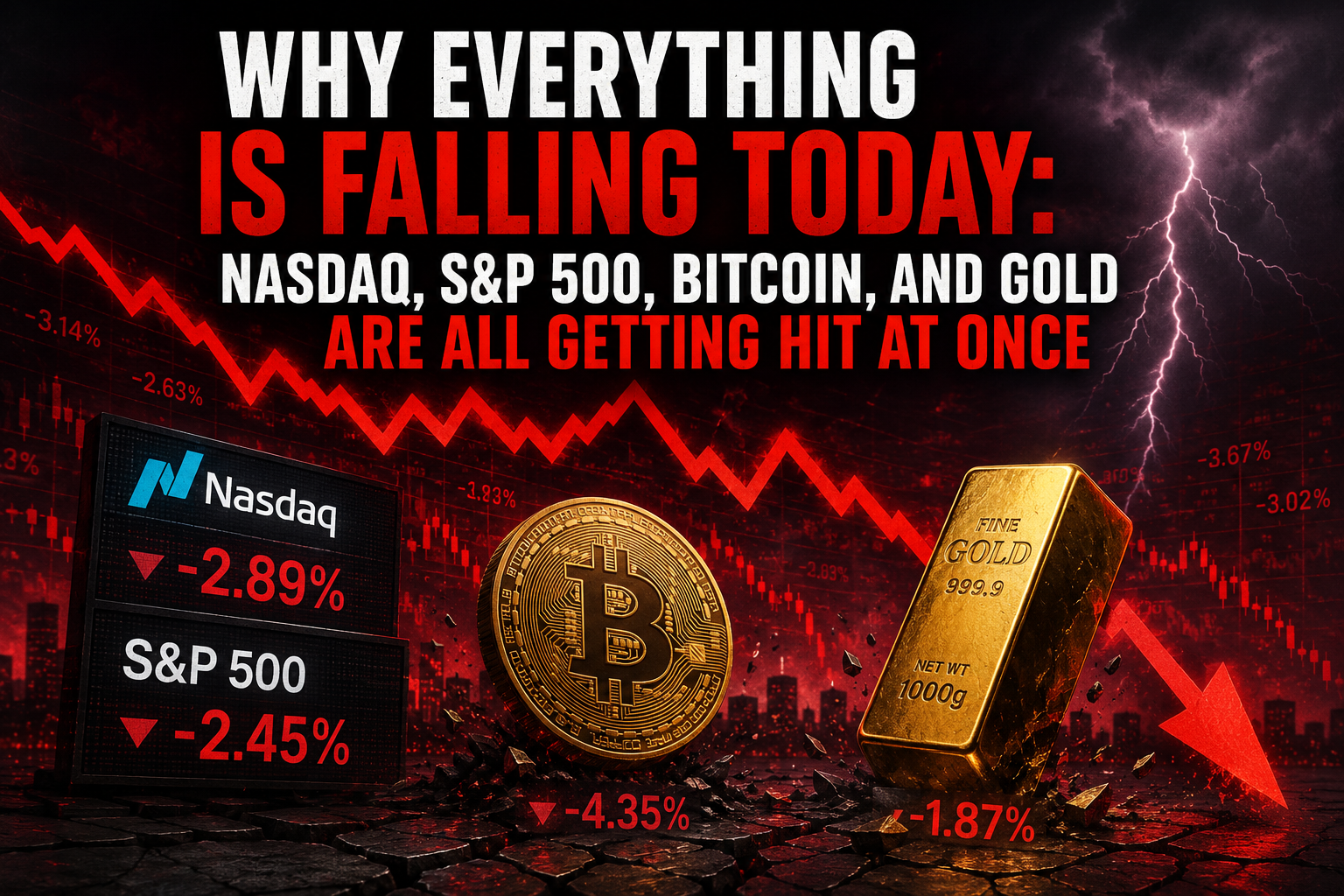
When I see the Nasdaq, the S&P 500, Bitcoin, and gold all falling on the same day, I do not read it as four separate stories.
I read it as one big macro message:
The market is repricing the cost of money.
That is the key. Today’s selloff is not just about tech stocks. It is not just about Bitcoin weakness. It is not just about gold losing its safe-haven bid. It is a cross-asset reset driven by a sudden change in expectations around the Federal Reserve, Treasury yields, inflation risk, liquidity, and crowded positioning.
The trigger was the U.S. jobs report. U.S. employers added 172,000 jobs in May, far above expectations, while the unemployment rate stayed at 4.3%. That sounds positive on the surface, but in today’s market environment, strong economic data can become bad news for asset prices because it reduces the pressure on the Fed to cut rates and increases the probability that policy stays tight for longer. Reuters reported that rate futures moved to price a sharply higher probability of a Fed hike later this year after the jobs data.
And that is why everything moved together.
As I’m looking at this market, the real story is not “stocks are down” or “Bitcoin is weak” or “gold is selling off.” The real story is that investors were positioned for a friendlier liquidity environment, and today they were forced to question that entire setup.
The Big Picture: This Is a “Higher-for-Longer” Shock
The market has spent a lot of time hoping for lower rates, easier financial conditions, and a Fed that eventually comes back to support risk assets.
Today’s jobs report challenged that.
A strong labor market gives the Fed less reason to ease. If employment is holding up and inflation is still a concern, the Fed does not have the same urgency to cut rates. In fact, the discussion can shift from “when do cuts arrive?” to “could the Fed need to hike again?”
That is a massive change for markets.
Reuters reported that after the jobs data, the probability of a December rate hike rose significantly, while investors still expected the Fed to hold rates steady at the June meeting. Another Reuters market view noted that the strong jobs number pushed yields and rate expectations higher, with the 2-year Treasury yield around 4.15% and the 10-year around 4.54%.
That matters because rates are the foundation of asset pricing.
When rates rise, the present value of future cash flows falls. That hurts growth stocks. When real yields rise, non-yielding assets become less attractive. That hurts gold. When liquidity expectations tighten, speculative assets struggle. That hurts Bitcoin. When volatility rises, investors cut exposure across portfolios. That hits almost everything.
So the simplest explanation is this:
Today’s market drop is a broad repricing of risk caused by stronger economic data, higher yields, and a less dovish Fed outlook.
Why Strong Jobs Data Can Hurt the Market
A lot of people look at a strong jobs report and think: “Wait, if the economy is strong, shouldn’t stocks go up?”
In a vacuum, yes.
But markets do not trade in a vacuum. They trade relative to expectations.
And right now, expectations matter more than the headline number.
Investors had been hoping for a softer economy, lower inflation pressure, and eventually easier Fed policy. A strong labor market breaks that narrative because it tells the Fed: the economy can probably handle tighter policy for longer.
That is why good economic news can become bad market news.
The labor market added more jobs than expected, unemployment stayed steady, and prior weakness concerns eased. Reuters described the report as hawkish because it reduced concerns about labor market weakness while keeping inflation worries alive.
From a macro perspective, the market is asking:
- If jobs are still strong, why would the Fed cut?
- If inflation is still above target, why would the Fed ease?
- If yields keep rising, how much should investors pay for growth?
- If liquidity tightens, can Bitcoin and other speculative assets keep rallying?
- If real yields rise, why hold gold aggressively right now?
That is the chain reaction.
Today’s market is not just reacting to what happened. It is reacting to what the data implies about the next six months of monetary policy.
The Common Thread: The Discount Rate Went Up
The most important concept today is the discount rate.
Every asset is, in some way, priced against the return investors can get from safer alternatives like Treasury bonds. When Treasury yields rise, everything else has to compete harder.
That is why higher yields can pressure assets that otherwise have very different stories.
The Nasdaq is about earnings growth.
The S&P 500 is about broad corporate profits.
Bitcoin is about liquidity, risk appetite, and monetary debasement narratives.
Gold is about real yields, the dollar, inflation protection, and safety demand.
Different assets. Different narratives.
But all of them are affected by the cost of money.
If the risk-free rate rises, investors demand more compensation to hold risky or non-yielding assets. That means valuation multiples compress, leverage gets reduced, and crowded trades unwind.
That is what I think happened today.
Why the Nasdaq Is Getting Hit So Hard
The Nasdaq is usually the most sensitive major equity index when rates rise because it is packed with growth stocks, mega-cap technology companies, and semiconductor names.
Growth stocks are long-duration assets. Their valuations depend heavily on earnings expected years into the future. When yields rise, those future earnings are worth less in today’s dollars.
That is why the Nasdaq tends to get punished when Treasury yields spike.
Today, the pressure was even more intense because the selloff hit chip stocks and AI-related names. Reuters reported that Wall Street fell as chip stocks lost steam after a sharp rally, while strong jobs data fueled hawkish Fed fears. Yahoo Finance, citing Reuters, also noted weakness across Nvidia, Intel, Micron, AMD, and Broadcom in premarket trading.
This matters because semiconductors have been one of the most important leadership groups in the entire market.
The AI trade has carried a lot of investor enthusiasm. When investors believe rates will fall and liquidity will improve, they are willing to pay high multiples for future growth. But when rates rise, even excellent companies can see their valuations compressed.
That is the uncomfortable truth of markets:
A great company can still be an expensive stock.
When the macro environment shifts, investors stop asking only “how good is the story?” and start asking “what multiple should I pay for that story?”
Today, the answer got lower.
The AI Trade Was Already Crowded
Another reason the Nasdaq is vulnerable is positioning.
AI has been the dominant market theme. Semiconductors, data centers, cloud infrastructure, power demand, networking, and memory chips have attracted huge flows. Many investors are already heavily exposed.
When a trade gets crowded, it does not need terrible news to fall. It only needs a reason for investors to take profits.
Today gave them that reason.
Higher yields pressured valuations. The jobs report reduced rate-cut hopes. Chip stocks were already extended after a strong run. That combination is enough to create a fast selloff.
In my view, this is not necessarily the market saying “AI is dead.” That would be too simplistic.
It is more likely the market saying:
AI may still be real, but the stocks were priced for near-perfection, and the macro backdrop just became less forgiving.
That distinction matters. A long-term theme can remain intact while the stocks tied to that theme correct sharply.
Why the S&P 500 Is Falling Too
The S&P 500 is broader than the Nasdaq, but it is still heavily influenced by large technology and AI-linked companies.
So when mega-cap tech and semiconductors fall, the S&P 500 falls too.
SPY, the major S&P 500 ETF, was trading lower today, down about 1.72% at the time of the market snapshot, while QQQ, the Nasdaq-100 ETF, was down about 3.39%.
That gap tells the story clearly. The broader market is weak, but the pain is concentrated in long-duration growth and tech-heavy exposure.
The S&P 500 is also vulnerable because valuations have been elevated. When the index is priced richly, it becomes more sensitive to changes in rates. If earnings expectations remain solid but the discount rate rises, the index can still fall.
This is one of the most important lessons in macro investing:
Markets can fall even when the economy is strong if the price paid for assets was too high relative to the new rate environment.
That is what today looks like.
Why Bitcoin Is Falling With Stocks
Bitcoin is often marketed as a hedge against the traditional financial system. Sometimes it behaves that way. But on days like today, Bitcoin often trades like a high-beta liquidity asset.
That means when liquidity expectations tighten, Bitcoin can fall hard.
Bitcoin was trading around $60,809, down roughly 4.18% from the previous close, with an intraday low near $59,885.
The reason is not complicated: Bitcoin does not produce cash flow, does not pay a dividend, and does not benefit directly from higher interest rates. Its price is heavily influenced by liquidity, risk appetite, leverage, dollar conditions, and investor demand for speculative assets.
When the Fed looks more hawkish, the market tends to reduce exposure to assets that depend on abundant liquidity.
That includes Bitcoin.
There is also a leverage component. Crypto markets often carry a lot of leveraged long positioning. When price starts falling, liquidations can accelerate the move. Investing.com reported that Bitcoin had already slid to a four-month low around $61,000 amid Iran tensions and ETF outflows before today’s broader macro pressure.
So Bitcoin was not entering today from a position of strength. It was already under pressure, and then the macro shock made things worse.
Bitcoin’s Bigger Problem: Liquidity Beats Narrative in the Short Term
Long term, Bitcoin investors may still believe in scarcity, decentralization, debasement protection, and a non-sovereign store of value.
But short term, liquidity usually wins.
When yields rise and the dollar strengthens, investors have less incentive to hold speculative assets. Cash and Treasuries become more attractive. Margin gets more expensive. Risk appetite declines. Leveraged positions get cut.
That does not mean Bitcoin’s long-term thesis is invalid. It means that in a macro shock, Bitcoin can behave less like “digital gold” and more like a volatile risk asset.
That is exactly what we are seeing.
I would describe today’s Bitcoin move as part of a broader de-risking trade, not a Bitcoin-specific collapse.
The market is not saying only “sell Bitcoin.” It is saying “reduce exposure to assets that need easy money.”
Why Gold Is Falling Even Though Markets Are Nervous
Gold falling during a risk-off day is the piece that confuses a lot of people.
If investors are scared, shouldn’t gold rise?
Sometimes, yes. But not always.
Gold is a safe-haven asset, but it is also a non-yielding asset. It does not pay interest. When Treasury yields rise, the opportunity cost of holding gold rises too.
That means gold can fall even during market stress if the stress is driven by higher real yields and a stronger dollar rather than pure panic.
GLD, the major gold ETF, was down about 3.15% at the time of the market snapshot. A market report from TradingKey also noted that spot gold fell below $4,400 after stronger payrolls boosted rate-hike expectations, the dollar, and Treasury yields.
This is important because it shows the type of selloff we are dealing with.
If gold were rising sharply while stocks fell, I would call it a classic fear trade.
But gold falling with stocks and Bitcoin tells me this is more of a real-yield shock and liquidity shock.
The market is not simply hiding in safety. It is repricing the attractiveness of everything relative to higher yields.
Gold Is Not Broken The Macro Setup Changed
I would not say gold “failed” today.
Gold is doing what gold often does when real yields rise: it sells off.
Gold tends to perform well when investors fear inflation, currency debasement, financial instability, or falling real rates. But when nominal yields and real yields rise quickly, the metal can struggle.
The key question is what kind of fear dominates.
There are two very different fear regimes:
1. Systemic fear
This is when investors worry about banks, credit markets, war escalation, sovereign risk, or a true financial accident. Gold can do very well in that environment.
2. Rate fear
This is when investors worry that the Fed will stay tighter for longer. Gold can fall in that environment because higher yields raise the opportunity cost of holding it.
Today looks more like the second one.
Investors are not necessarily rushing out of the financial system. They are repricing assets because the Fed may not deliver the easing markets wanted.
The Dollar Matters Too
When U.S. data comes in strong and Fed expectations turn hawkish, the dollar often strengthens.
A stronger dollar can pressure gold, Bitcoin, commodities, and multinational earnings.
Gold is priced globally in dollars, so a stronger dollar makes gold more expensive for non-U.S. buyers. Bitcoin also tends to struggle when dollar liquidity tightens. For U.S. equities, a stronger dollar can reduce overseas earnings translation for large multinational companies.
This creates another layer of pressure.
The market does not just see “higher yields.” It sees:
- Higher yields
- Stronger dollar
- Less chance of rate cuts
- More expensive liquidity
- Lower appetite for duration
- Lower appetite for leverage
- Lower tolerance for stretched valuations
That is why the move can spread across assets so quickly.
The Role of Treasury Yields
Treasury yields are the transmission mechanism.
When the jobs report came in strong, traders sold Treasuries, pushing yields higher. Reuters noted that the strong May jobs number sent yields and rate expectations higher, with the 2-year yield around 4.15% and the 10-year yield around 4.54%.
The 2-year yield is especially important because it is highly sensitive to Fed policy expectations. If the 2-year yield rises, it tells you the market is pricing tighter monetary policy.
The 10-year yield matters for valuation. It affects mortgage rates, corporate borrowing costs, equity multiples, and long-duration asset pricing.
When both move higher, financial conditions tighten.
That is what hit markets today.
This Is a Cross-Asset Duration Shock
The phrase I would use for today is:
cross-asset duration shock.
Duration is not just a bond concept. It also applies to growth stocks, speculative assets, and even gold in a broader macro sense.
Long-duration assets are assets whose value depends heavily on future expectations. The farther out the expected payoff, the more sensitive the asset is to changes in interest rates.
That includes:
- High-growth technology stocks
- AI and semiconductor names
- Unprofitable or expensive growth companies
- Long-maturity bonds
- Bitcoin and other speculative crypto assets
- Gold when real yields move sharply
When the discount rate rises, all of those assets can fall together.
That is exactly what we saw today.
Why “Everything Is Down” Does Not Mean Everything Is the Same
It is important not to oversimplify.
The Nasdaq, S&P 500, Bitcoin, and gold are not falling for identical reasons. They are falling because one macro shock affects each of them through a different channel.
| Asset | Main pressure today | Macro channel |
|---|---|---|
| Nasdaq | Growth and AI valuation compression | Higher discount rates |
| S&P 500 | Mega-cap tech drag and multiple pressure | Higher yields |
| Bitcoin | Risk-off and liquidity tightening | Lower speculative appetite |
| Gold | Higher opportunity cost | Rising real yields |
| Semiconductors | Crowded AI trade unwinding | Positioning and valuation |
| Treasuries | Strong jobs report | Fed expectations |
| Dollar | Hawkish repricing | Rate differential support |
That is why the market feels synchronized.
Different doors, same house.
The Fed Is Back at the Center of the Market
For a while, investors wanted to believe the Fed was moving toward a more supportive stance.
Today’s data complicates that.
The Fed has two main mandates: maximum employment and stable prices. If employment is strong and inflation is still not fully under control, the Fed has less room to cut.
Reuters reported that the jobs report shifted focus toward inflation risk and reduced concerns about labor market weakness.
That is a big deal because the market had been leaning toward the idea that policy would eventually become easier. If that assumption changes, asset prices have to adjust.
This is the market’s problem:
Risk assets were priced for a world where the Fed could ease.
The data pointed toward a world where the Fed may stay tight.
So prices had to fall.
Why Inflation Risk Still Matters
The jobs report is not only about jobs. It is also about inflation.
A strong labor market can support consumer spending, wage growth, and demand. If inflation is already sticky, strong employment makes the Fed more cautious.
The Fed does not want to cut too early and reignite inflation. It also does not want to overtighten and break the economy. But today’s data pushes the balance of risks toward staying restrictive.
That is why the market reacted so sharply.
Investors are not just looking at the employment number. They are thinking about the next Fed meeting, the next inflation report, the next wage data, and the path of real rates.
Markets are forward-looking. Today’s selloff is about what the jobs report implies for policy, not just what it says about employment.
The Market Was Probably Too Comfortable
Another reason the selloff feels sharp is that markets had become comfortable.
When markets rally for a while, investors often become conditioned to buy dips. Volatility falls. Leverage builds. Crowded trades get more crowded. Expensive assets get more expensive.
Then one macro shock forces everyone to reassess at the same time.
That is when correlations go to one.
In plain English: assets that normally behave differently all start moving together because investors are not making fine distinctions. They are cutting risk.
That is what makes days like this feel so violent.
It is not only fundamental selling. It is mechanical selling too.
The Mechanical Side: Deleveraging, Stops, and Risk Models
Markets are not just humans reading headlines and making calm decisions.
A lot of selling is systematic.
When volatility rises, risk-parity funds may reduce exposure. When price levels break, trend-following strategies can sell. When crypto falls, leveraged positions can get liquidated. When hedge funds are crowded in similar trades, they may all cut risk at once.
That is why the first move can become larger than the original news would suggest.
The jobs report may be the trigger, but the size of the move can be amplified by positioning.
This is especially relevant for:
- Nasdaq momentum trades
- Semiconductor longs
- AI basket exposure
- Leveraged crypto positions
- Gold momentum longs
- Multi-asset portfolios that were long risk
When all of those positions need to be adjusted at once, the market can move fast.
Why This Does Not Necessarily Mean a Recession Is Coming
I would be careful not to call today’s move a recession signal.
The trigger was a strong jobs report, not weak economic data.
That means the market is not primarily selling because growth is collapsing. It is selling because growth is strong enough to keep the Fed restrictive.
That is a very different setup.
A recession scare usually looks like:
- Stocks fall
- Treasury yields fall
- Gold may rise
- Defensive sectors outperform
- Credit spreads widen aggressively
- The market prices rate cuts
Today looks more like:
- Stocks fall
- Yields rise
- Gold falls
- Bitcoin falls
- The dollar strengthens
- The market prices a more hawkish Fed
That is not classic recession pricing.
It is tighter-liquidity pricing.
The Key Difference: Growth Scare vs. Inflation Scare
This is one of the most important distinctions for investors.
In a growth scare:
Bad economic data makes investors worry about recession. Yields usually fall because markets expect the Fed to cut. Growth stocks may eventually benefit from lower yields, even if earnings worries rise.
In an inflation or Fed scare:
Strong or inflationary data makes investors worry the Fed will stay tight. Yields rise. Valuations compress. Gold can fall. Bitcoin can fall. Growth stocks often get hit first.
Today looks much more like an inflation/Fed scare than a growth scare.
That matters because the playbook is different.
In a growth scare, investors often look for duration and safety.
In a Fed scare, investors often reduce duration and raise cash.
What This Means for Tech Stocks
For tech, the key question is no longer only whether earnings are strong.
The question is whether earnings are strong enough to justify high valuations in a higher-rate environment.
That is a tougher test.
Mega-cap tech companies may still be profitable, dominant, and structurally important. But if the 10-year yield is rising and the Fed is not cutting, investors may not be willing to pay the same multiple they paid before.
This is especially true for companies tied to AI infrastructure. The AI story is powerful, but a powerful story can still become over-owned.
Today’s move suggests investors are starting to separate the long-term AI theme from the short-term price paid for AI exposure.
That is healthy in the long run, but painful in the short run.
What This Means for Bitcoin
For Bitcoin, the most important variable right now is liquidity.
If yields continue rising and the dollar keeps strengthening, Bitcoin may remain under pressure. If yields stabilize and investors regain confidence that the Fed will not overtighten, Bitcoin could recover.
Bitcoin’s long-term believers may view this as noise. Traders will view it as a liquidity event.
Both can be true.
Personally, I would not analyze today’s Bitcoin drop in isolation. I would look at it alongside QQQ, Treasury yields, the dollar, and crypto liquidations.
If Bitcoin is falling while yields rise and tech sells off, that is a macro move.
If Bitcoin is falling while everything else is stable, that is more likely a crypto-specific issue.
Today looks macro-driven.
What This Means for Gold
For gold, the key variable is real yields.
If real yields keep rising, gold can struggle. If inflation fears rise while real yields fall, gold can recover. If geopolitical or financial-system stress escalates, gold can regain safe-haven demand.
So gold’s decline today does not destroy the bullish long-term case. It simply tells us that the short-term driver is rates, not panic.
Gold investors need to ask:
- Are real yields rising or falling?
- Is the dollar strengthening or weakening?
- Is the market afraid of inflation, recession, or systemic risk?
- Is the Fed becoming more hawkish or more dovish?
Today, those answers leaned against gold.
What Would Stop the Selloff?
For markets to stabilize, I would want to see at least one of these things happen.
1. Treasury yields stop rising
This is the most important one. If yields stabilize, growth stocks, Bitcoin, and gold may all find some relief.
2. Fed officials push back against hike expectations
If Fed speakers suggest the market is overpricing the chance of hikes, risk assets could bounce.
3. Inflation data cools
A softer inflation print would matter more than almost anything else because it would give the Fed room to stay patient or eventually ease.
4. Semiconductor stocks stabilize
The Nasdaq needs chip leadership to stop bleeding. If semis continue falling, the broader tech complex probably remains under pressure.
5. Bitcoin holds key liquidity levels
If Bitcoin avoids deeper liquidation waves, that would help risk sentiment. If it breaks lower, it could add pressure to speculative assets.
6. Gold finds support despite higher yields
If gold stabilizes, it may signal that forced selling is easing.
What Could Make the Selloff Worse?
The selloff could deepen if several things happen at once:
- Treasury yields keep rising
- The dollar strengthens further
- Fed officials sound hawkish
- Inflation data comes in hot
- Semiconductors continue breaking down
- Bitcoin loses major support
- Credit spreads widen
- Investors start selling winners to raise cash
The biggest risk is not one asset falling. The biggest risk is correlation.
When correlations rise, diversification stops working in the short term. That is when investors feel like “there is nowhere to hide.”
Today had some of that feeling because stocks, Bitcoin, and gold all fell together.
My Personal Take: This Is a Warning Shot, Not a Full-Blown Crisis Yet
The way I see it, today is a warning shot.
It is the market reminding investors that the Fed still matters, yields still matter, and liquidity still matters.
It is not necessarily the start of a financial crisis. It is not automatically a recession signal. It is not proof that AI is over or that Bitcoin is broken or that gold has lost its role.
But it is a reminder that when too many assets are priced for easy money, a hawkish macro surprise can hit everything at once.
The market was leaning one way. The data pushed the other way. Prices adjusted.
That is what markets do.
The Real Lesson: Asset Classes Are More Connected Than They Look
A lot of investors think in categories:
Stocks are one thing.
Bitcoin is another thing.
Gold is another thing.
Bonds are another thing.
But in reality, all of these assets are connected by liquidity, rates, risk appetite, and the dollar.
When the Fed outlook changes, the entire map changes.
That is why today’s move matters. It shows that the market is not just trading individual narratives anymore. It is trading the macro regime.
And the macro regime today shifted toward:
higher yields, tighter liquidity, stronger dollar pressure, lower risk appetite, and less tolerance for expensive assets.
That combination is toxic for Nasdaq, difficult for the S&P 500, negative for Bitcoin, and temporarily painful for gold.
Bottom Line
The reason so many assets are falling today is that investors are repricing the path of interest rates after a much stronger-than-expected U.S. jobs report.
The labor market added 172,000 jobs in May, unemployment stayed at 4.3%, and markets moved to price a higher chance that the Fed could keep policy tight or even hike later this year.
That pushed yields higher, pressured tech valuations, triggered selling in semiconductors, hit the S&P 500 through mega-cap exposure, weakened Bitcoin through the liquidity channel, and dragged gold lower through higher real-yield pressure.
So no, this is not four separate crashes.
It is one macro repricing.
The market is waking up to the possibility that money may stay tighter for longer — and almost every major asset class is adjusting to that reality at the same time.
FAQs
Why did the Nasdaq fall so much today?
The Nasdaq fell because higher Treasury yields hurt growth-stock valuations, and chip stocks came under pressure after a strong rally. The AI and semiconductor trade had become crowded, so the stronger jobs report gave investors a reason to take profits and reduce exposure.
Why did the S&P 500 fall if the economy looks strong?
The S&P 500 can fall on strong economic data if that data makes the Fed less likely to cut rates. Today’s jobs report increased expectations for tighter policy, which pressured equity valuations.
Why did Bitcoin fall with stocks?
Bitcoin fell because it is highly sensitive to liquidity, leverage, and risk appetite. When yields rise and the Fed looks more hawkish, speculative assets often sell off.
Why did gold fall during a market selloff?
Gold fell because higher yields increase the opportunity cost of holding a non-yielding asset. This was more of a rate shock than a classic safe-haven panic.
Is this the start of a recession?
Not necessarily. Today’s trigger was strong jobs data, not weak growth. This looks more like a Fed and liquidity scare than a recession scare.
What should investors watch next?
The most important indicators are Treasury yields, Fed commentary, inflation data, the dollar, semiconductor stocks, Bitcoin liquidation levels, and whether gold stabilizes despite higher real yields.