
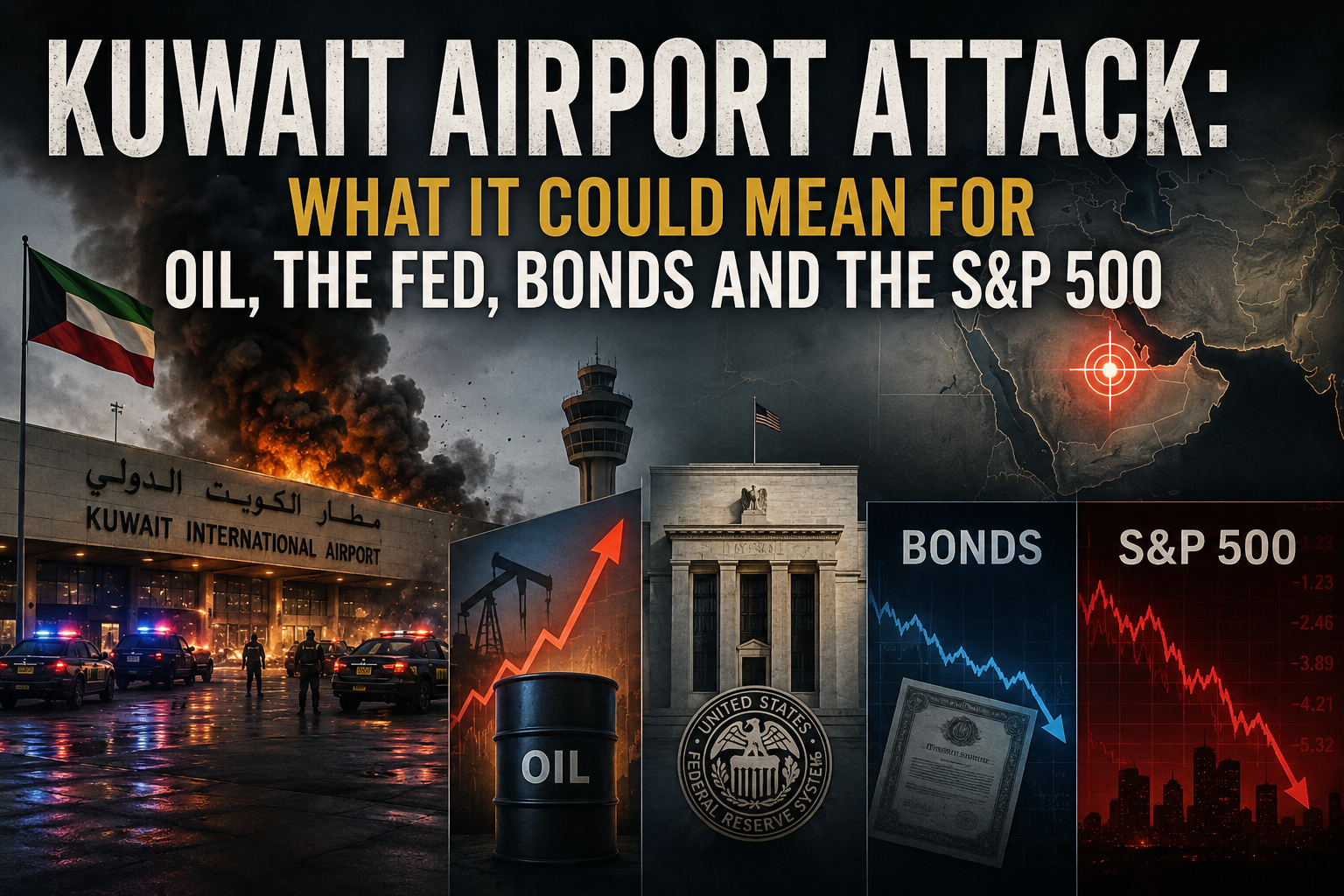
The attack on Kuwait International Airport is not just another Middle East headline. For U.S. investors, this is now a macro event.
Iran’s drone and missile strikes on Kuwait, including damage to airport infrastructure, mark a dangerous escalation in the Gulf. Reuters reported that the attack damaged Kuwait International Airport, disrupted flights and came alongside broader regional hostilities, while U.S. forces responded with strikes near the Strait of Hormuz. Oil prices jumped as traders repriced geopolitical risk.
But here is how I would read this before tomorrow’s U.S. market open: the key question is not only whether the attack was contained. The key question is whether markets start treating this as an oil shock, an inflation shock, or the beginning of a broader financial tightening event.
That distinction matters a lot.
A short-lived geopolitical spike in oil can be absorbed by markets. A persistent move toward higher crude prices is very different. That can hit inflation expectations, complicate the Federal Reserve’s policy path, lift Treasury yields and pressure the S&P 500, especially growth stocks that depend on lower discount rates.
In my view, the Kuwait airport attack matters because it connects several pressure points at once: Gulf security, energy supply, U.S.-Iran negotiations, the Fed’s inflation problem and investor risk appetite.
Why the Kuwait Airport Attack Matters for U.S. Markets
The first mistake would be to look at this as a local security incident. Kuwait is not just another country on the map for global markets. It sits inside the Gulf security architecture, close to vital energy routes, U.S. military interests and the wider conflict dynamics involving Iran, the United States, Israel and regional allies.
That is why markets reacted quickly. Reuters reported that U.S. stocks fell, oil moved closer to $100 per barrel, and Treasury yields rose as investors digested the escalation. The Dow, S&P 500 and Nasdaq all declined, while Brent crude traded near $97.72.
For U.S. investors, this matters because the attack hits three channels at the same time.
First, it raises the geopolitical risk premium in oil. Second, it threatens to make inflation stickier. Third, it reduces the Fed’s flexibility if policymakers were hoping for a cleaner path toward rate cuts.
What worries me most is not only the attack itself. It is what the attack does to expectations. Markets do not wait for full confirmation. They move when probabilities change.
If traders believe the Gulf is becoming less secure, oil can rise before there is any actual supply loss. If investors believe higher oil will feed into gasoline, transportation and headline inflation, bond markets can reprice quickly. If the Fed sees inflation expectations moving up, it may avoid sounding dovish, even if growth starts to slow.
That is the macro chain investors need to watch.
Oil Prices Are the First Market Signal to Watch
Oil is the cleanest and fastest signal after the Kuwait airport attack.
The reason is simple: the Gulf is central to global energy flows. Any escalation involving Iran, Kuwait, Bahrain, U.S. forces or the Strait of Hormuz immediately forces traders to ask whether supply routes are safe. Even if barrels continue moving, the market often prices the risk before the disruption.
Reuters reported that oil prices rose nearly 2% after the flare-up, with Brent approaching the $100 area as hostilities intensified and talks appeared stalled.
That does not automatically mean oil is heading into a sustained spike. But it does mean the market is rebuilding a geopolitical premium.
There are two very different scenarios here.
The first is a temporary spike. In that case, oil jumps, investors panic for a session or two, and prices cool if there is no further escalation. The S&P 500 may wobble, but the move does not become a full macro shock.
The second is a persistent oil shock. That is the dangerous one. If Brent pushes above key psychological levels and stays there, the conversation changes. Suddenly, this is not only about Kuwait. It becomes about U.S. gasoline prices, consumer confidence, inflation expectations and the Fed.
I would not watch the S&P 500 in isolation tomorrow. I would watch oil first. If crude stabilizes, equities may find a floor. If crude keeps climbing, the equity market will probably struggle to ignore it.
What the Attack Could Mean for the S&P 500
The S&P 500 can handle bad geopolitical news when two conditions are present: oil does not spiral, and the Fed is still seen as supportive.
The Kuwait airport attack threatens both conditions.
A risk-off open would not surprise me. Investors may rotate out of cyclical stocks and high-beta growth names, while defensive sectors and energy companies could outperform. That does not mean the whole market has to collapse. But it does mean leadership could change quickly.
Technology stocks are especially interesting here. If Treasury yields rise because investors fear sticky inflation, long-duration growth stocks can come under pressure. These companies are valued on future earnings, and higher yields make those earnings less attractive in today’s dollars.
Energy stocks, on the other hand, could benefit from higher oil prices. That creates a strange market: the headline S&P 500 may fall, but parts of the index tied to energy could hold up or even rally.
Financials are more complicated. Higher yields can help banks in some contexts, but geopolitical stress and risk-off sentiment can hurt credit appetite. Industrials and airlines may be vulnerable if fuel costs rise and travel disruption fears grow.
My base case is not an immediate market crash. My base case is a volatility shock with sector dispersion. The broader index may fall, but the real story will be under the surface: energy versus growth, defensives versus cyclicals, dollar strength versus multinational earnings pressure.
Bonds, Treasury Yields and the Safe-Haven Trade
The bond market reaction may be the most important signal after oil.
Normally, geopolitical stress can push investors into U.S. Treasuries. That means bond prices rise and yields fall. This is the classic safe-haven trade.
But this situation is more complicated because the shock is energy-related. If the market sees the Kuwait airport attack as inflationary, Treasury yields may rise instead of fall. That appears to be what investors were already starting to price, with Reuters reporting higher U.S. interest rate expectations and rising Treasury yields amid strong job data and war-related uncertainty.
That is the tension: safe-haven demand versus inflation risk.
If investors are mostly afraid of war, Treasuries can rally. If investors are mostly afraid of oil-driven inflation, yields can move higher. If both forces hit at the same time, the Treasury market may become choppy and difficult to read.
The 10-year Treasury yield is the one I would watch most closely.
If the 10-year yield falls sharply, the market is saying: “growth shock, flight to safety.” If the 10-year yield rises, the market is saying: “inflation shock, Fed problem.” If yields rise while stocks fall, that is the more uncomfortable setup for risk assets.
For the S&P 500, the worst combination would be higher oil, higher yields and a stronger dollar. That would tighten financial conditions without the Fed doing anything.
The Fed’s Problem: Oil Shock or Inflation Shock?
The Federal Reserve is now in a difficult position.
The Fed can look through a one-off oil spike. Policymakers often say they focus on underlying inflation rather than short-term energy volatility. But they cannot ignore a persistent oil shock if it starts affecting inflation expectations, wages, consumer behavior or business costs.
Recent Fed minutes already showed concern that a persistent increase in oil prices could keep inflation elevated for longer and, in some cases, might even require tighter policy to keep inflation expectations anchored.
That is why this attack matters for rate-cut expectations.
If energy prices rise and stay high, the Fed has less room to sound dovish. Even if the labor market cools, policymakers may hesitate to signal easing if gasoline prices are moving higher and consumers are feeling the squeeze.
In my opinion, the Fed does not need to react directly to the Kuwait attack. But the Fed does need to react to the market consequences of the attack.
That means policymakers will watch:
- Oil prices.
- Gasoline prices.
- Inflation expectations.
- Treasury yields.
- Financial conditions.
- Consumer sentiment.
- Any signs of broader Gulf disruption.
The Fed’s nightmare is not simply higher oil. The nightmare is higher oil combined with weaker growth. That is a stagflationary mix: more inflation pressure, less economic momentum and fewer easy policy choices.
For markets, that is why the Kuwait airport attack cannot be separated from the Fed conversation.
Are U.S.-Iran Negotiations Now Broken?
The attack does not necessarily mean negotiations are officially over. Governments often keep diplomatic channels open even while military pressure increases.
But markets care less about official statements and more about practical reality.
If Iran is striking Gulf targets and the U.S. is responding militarily near sensitive energy routes, investors will assume negotiations have become much harder. Reuters reported that diplomatic efforts had stalled despite signs of possible talks, with the conflict affecting oil markets and regional stability.
That is the key point: talks may continue on paper while trust collapses in practice.
For investors, the question is not “Are they still talking?” The question is “Can talks still reduce risk?”
If negotiations lose credibility, the market has to price a longer conflict. That means a higher oil risk premium, more defense spending expectations, more pressure on Gulf allies and a potentially more aggressive U.S. posture.
The biggest risk is not that diplomacy ends with a dramatic announcement. The bigger risk is that diplomacy becomes irrelevant because events on the ground move faster than negotiators.
That is when markets start demanding a larger risk premium.
What Could the U.S. Do Next?
The U.S. has several possible options after the Kuwait airport attack.
The first is targeted military retaliation. That could mean strikes against launch sites, drone infrastructure, radar systems or assets linked to threats against U.S. forces and allies. Reuters reported that U.S. forces had already carried out strikes near the Strait of Hormuz after the escalation.
The second is stronger maritime protection. If the Strait of Hormuz or nearby Gulf routes are seen as vulnerable, Washington may increase naval patrols, air defense coordination and regional deterrence.
The third is sanctions pressure. The U.S. could tighten enforcement on Iranian oil flows, financial networks or military procurement channels. That would likely add another layer of energy-market uncertainty.
The fourth is diplomacy with force in the background. This is probably the preferred path if Washington wants to avoid a full regional war while still showing that attacks on allies and infrastructure carry consequences.
For markets, the distinction matters.
A limited U.S. response may calm investors if it restores deterrence without widening the conflict. But a larger military campaign could push oil higher and create a deeper risk-off move.
My view: the U.S. will likely try to respond forcefully enough to deter Iran, but carefully enough to avoid turning this into an uncontrolled Gulf war. The problem is that markets may not wait to see whether that balance works.
My Base Case for Tomorrow’s Market Reaction
Here is how I would frame tomorrow’s market reaction.
Scenario 1: Controlled Risk-Off
This is my base case.
Oil remains elevated but does not break decisively higher. The S&P 500 opens weaker, energy stocks outperform, defensives catch a bid and Treasury trading is mixed. The dollar may strengthen modestly.
In this scenario, investors treat the attack as serious but not yet systemic.
Scenario 2: Oil-Led Inflation Scare
This is the scenario that would worry me more.
Oil continues rising, Brent moves closer to or above the $100 area, Treasury yields climb and Fed rate-cut expectations get pushed out. Growth stocks sell off more sharply. The market starts using words like “inflation shock” instead of “geopolitical headline.”
This is where the Kuwait airport attack becomes a real macro problem for U.S. portfolios.
Scenario 3: Escalation and Sharp De-Risking
This is the tail-risk scenario.
There are more attacks, more U.S. strikes, direct threats to shipping lanes or signs that Gulf airspace and energy infrastructure are at broader risk. Equities fall harder, volatility spikes, oil jumps, and safe-haven flows become more aggressive.
In this case, the S&P 500 reaction would not be about Kuwait alone. It would be about the possibility of a wider Gulf security crisis.
What Investors Should Watch Next
The most important signals are not complicated.
First, watch oil. If Brent and WTI keep rising, the macro pressure builds. If oil fades after the initial spike, markets may calm down.
Second, watch the 10-year Treasury yield. Falling yields would suggest a classic flight to safety. Rising yields would suggest an inflation scare.
Third, watch the dollar. A stronger dollar can signal risk aversion, but it can also tighten financial conditions for global markets.
Fourth, watch Fed speakers. If officials sound more cautious about inflation after the attack, rate-cut optimism may weaken.
Fifth, watch White House and Pentagon messaging. Markets will react differently to “limited defensive response” than to language suggesting a longer campaign.
Sixth, watch Gulf airspace and shipping updates. Flight disruptions, tanker route changes or insurance cost increases would all signal that the conflict is spilling into the real economy.
For me, the key is simple: do not only watch the headline. Watch the transmission mechanism.
The attack matters if it moves oil. Oil matters if it moves inflation expectations. Inflation expectations matter if they move the Fed. And the Fed matters because it sets the discount rate for almost every asset in the market.
Bottom Line: The Kuwait Attack Is Now a Macro Event
The Kuwait airport attack has moved beyond regional politics. It is now part of the U.S. macro conversation.
For investors, the story is not just missiles, drones or airport damage. The story is whether this event changes the path of oil, inflation, Treasury yields and Federal Reserve policy.
If the situation stabilizes quickly, markets may absorb the shock. But if oil keeps rising and diplomacy keeps deteriorating, this could become a much bigger problem for the S&P 500 and U.S. financial conditions.
My view is that tomorrow’s market reaction will depend on one question above all:
Does Wall Street treat this as a contained geopolitical event, or as the start of a new oil-driven inflation shock?
That is the line between volatility and a deeper macro repricing.
FAQs
Why does the Kuwait airport attack matter for U.S. investors?
It matters because Kuwait sits in a strategically important Gulf region linked to oil flows, U.S. military interests and regional security. If the attack raises oil prices or inflation expectations, it can affect the Fed, Treasury yields and the S&P 500.
Could the Kuwait airport attack push oil above $100?
Yes, it could if markets price a higher risk premium around the Gulf and the Strait of Hormuz. Reuters reported Brent near the $100 area after the escalation, reflecting supply concerns and geopolitical risk.
Is this bad for the S&P 500?
Potentially, yes. A short geopolitical shock may be manageable, but a sustained oil spike could hurt growth stocks, raise inflation concerns and reduce expectations for Fed rate cuts.
What happens to bonds after this kind of attack?
Treasuries can rally if investors seek safety. But yields can also rise if the market sees the attack as inflationary because of higher oil prices. That makes the 10-year Treasury yield especially important to watch.
Could the Fed delay rate cuts because of higher oil?
Yes. The Fed may look through temporary oil volatility, but a persistent oil shock could keep inflation elevated and make policymakers more cautious about cutting rates.
Are U.S.-Iran negotiations over?
Not necessarily officially. But the attack makes negotiations harder and may reduce market confidence that diplomacy can lower risk quickly.
What should investors watch tomorrow?
Oil prices, the 10-year Treasury yield, the dollar, Fed commentary, White House messaging, Gulf airspace updates and any signs of disruption near the Strait of Hormuz.