
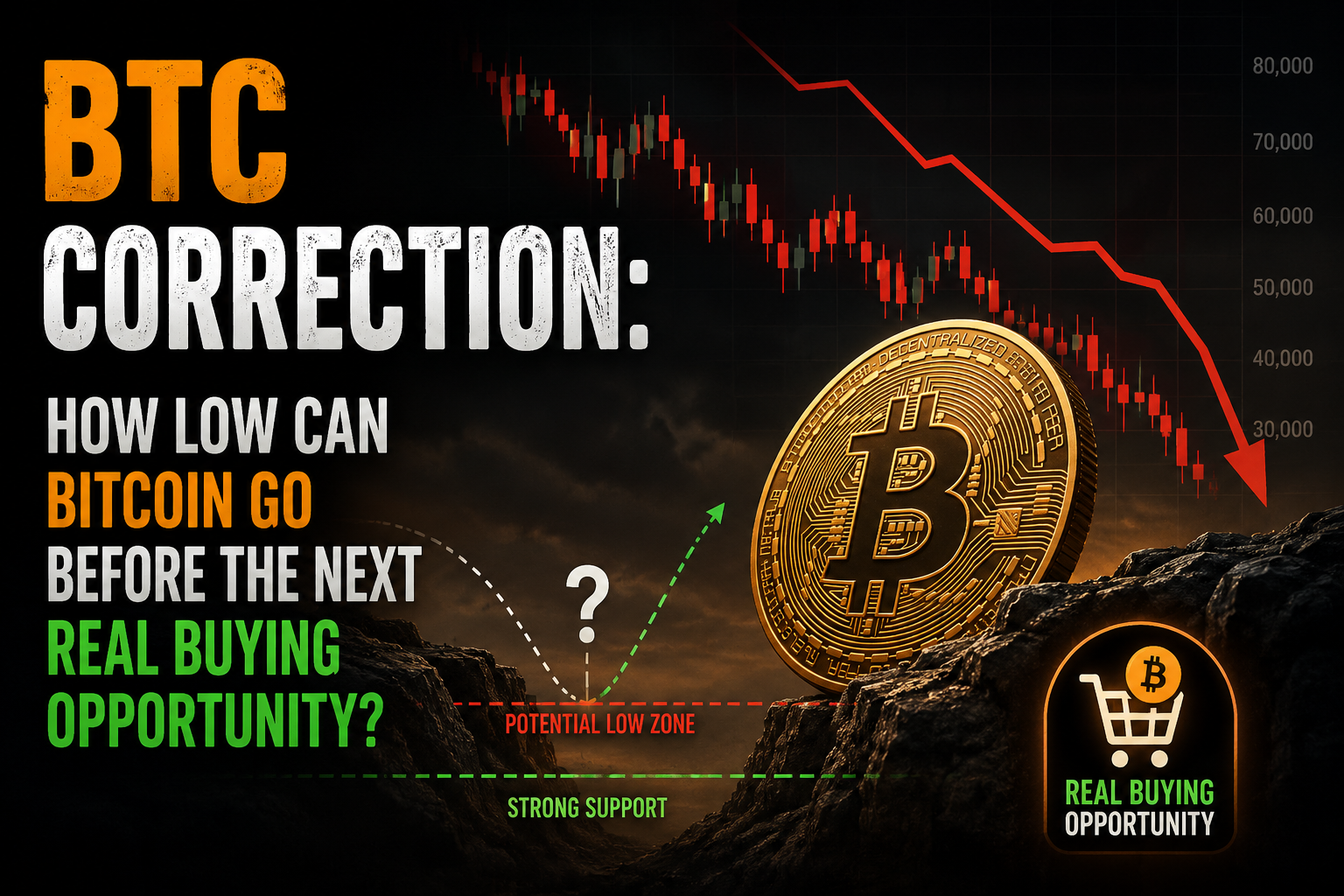
Bitcoin is correcting again, and honestly, this is exactly the kind of moment where I try not to get emotional.
When BTC starts dropping fast, everyone suddenly wants the same answer: how low can Bitcoin go? Is the bottom already in? Are we looking at a normal BTC correction, or is this the beginning of something much uglier? And maybe the most important question: is this one of those rare buying opportunities that only shows up every few years?
My view is simple: I do not want to guess the exact bottom. I want to identify the zones where risk starts to become attractive, then wait for the market to confirm that sellers are losing control.
Right now, Bitcoin is trading around $69,967, with an intraday low near $69,753, based on current market data. That places BTC right around the zone everyone is watching: the high-$60Ks to low-$70Ks.
And that matters because the current correction is not happening in a vacuum. The top market narratives are all pointing in the same direction: ETF outflows, institutional caution, geopolitical risk, profit-taking after a strong rally, and uncertainty around U.S. interest rates. TradingView’s Finanzas.com article highlighted the $70,000 area as the key short-term support, while also pointing to ETF outflows and macro risk as major pressure points.
So the question is not just “will BTC go lower?”
The better question is:
Where does this correction stop being scary and start becoming an opportunity?
Is This BTC Correction Different?
Every Bitcoin correction feels different while it is happening.
In the middle of the move, the market always finds a reason to make the drop feel final. Sometimes it is regulation. Sometimes it is the Fed. Sometimes it is war risk. Sometimes it is ETF outflows. Sometimes it is simply too much leverage getting flushed out.
This time, the correction has a few clear drivers.
First, Bitcoin has been under pressure from a broader risk-off environment. When investors reduce exposure to volatile assets, BTC usually gets hit. That does not mean the long-term Bitcoin thesis is broken. It means liquidity matters.
Second, institutional flows have become a bigger part of the market. That is a huge change compared with previous cycles. Spot Bitcoin ETFs brought new demand, but they also made ETF inflows and outflows a daily sentiment gauge. When ETF money leaves, traders notice. When ETF demand returns, the market can recover fast.
Third, BTC had already rallied hard before this correction. A pullback after a major move is not automatically bearish. In fact, some of the best long-term entries in Bitcoin have appeared during ugly corrections inside broader bullish structures.
That is why I do not treat this as a simple “bullish” or “bearish” moment. I treat it as a decision zone.
The cycle still looks alive to me, but I would not blindly assume that Bitcoin has to behave exactly like it did in 2017 or 2021. The market is more institutional now. ETFs matter. Liquidity matters. Macro matters. The old cycles are still useful, but they are not a law of physics.
The Key BTC Support Zones I’m Watching Right Now
I am watching four major downside zones.
Not because I think Bitcoin must hit all of them, but because each one tells a different story.
Zone 1: $70,000. The Psychological Line
The first level is obvious: $70,000.
This is the psychological level the market keeps circling. When BTC trades around a big round number, traders react. Algorithms react. Headlines react. Retail sentiment reacts.
A clean reclaim of $70K after a dip below it would be constructive. But if Bitcoin loses $70K and fails to recover it quickly, then I would expect the market to test deeper liquidity.
TradingView’s Finanzas.com article also identified the $70,000 area as the main short-term support, warning that a clear break could open the door to deeper corrections.
For me, $70K is not the final floor. It is the first test.
Zone 2: $68,500. The Critical Short-Term Support
The next level I care about is around $68,500.
DiarioBitcoin’s technical analysis listed $68,500 as critical support, with $70,643 as immediate support and $74,175 as short-term resistance through the SMA-7.
This is where the correction starts to become more serious.
If BTC loses $68.5K with volume and cannot reclaim it, the market will likely start pricing in a move toward the mid-$60Ks. That would not automatically kill the cycle, but it would confirm that the correction needs more time.
Personally, I would not panic at $68.5K. But I would pay attention to how price behaves there.
Does it bounce with strong volume?
Does it wick below and reclaim?
Do funding rates reset?
Do ETF outflows slow?
Those details matter more than the level itself.
Zone 3: $65,000–$66,000. The Higher-Low Zone
This is the zone I find most interesting: $65,000 to $66,000.
Why?
Because this area could allow BTC to correct deeply enough to reset sentiment without destroying the broader structure.
The Weiss Crypto analysis cited by TradingView / NewsBTC also described the $65K–$66K area as more likely than a deeper collapse, because it would preserve a higher low and keep the broader cycle structure intact.
That is the key.
If Bitcoin drops into the $65K–$66K zone, sentiment will probably get ugly. People will call for $50K. Social media will get bearish. Short-term traders will be exhausted. But from a cycle perspective, that could actually be healthy.
In my view, this is where BTC could become a serious accumulation candidate.
Not an automatic buy.
Not a guaranteed bottom.
But a zone where I would start paying much closer attention.
Zone 4: $60,000. The Pain Trade, Not My Base Case
Could BTC correct to $60,000?
Yes.
Would that automatically destroy the bullish cycle?
Not necessarily.
The Weiss Crypto framework mentioned that a move toward $60K is still possible without invalidating the broader bullish structure, although the $65K–$66K area was presented as the more likely zone.
For me, $60K is the pain trade.
It is the level that would shake out late buyers, scare long-term holders, and make the market feel broken. But sometimes Bitcoin needs that kind of move to create a real bottom.
That said, I would not make $60K my base case unless BTC loses the mid-$60Ks with no meaningful demand response.
What Signal Would Tell Me the BTC Bottom Is In?
This is the most important part.
A price level alone does not confirm a bottom.
BTC can touch $66K and keep falling. It can wick into $60K and reverse violently. It can hold $70K and still chop sideways for weeks.
So I am looking for a combination of signals.
1. A Reclaim of Lost Support
The first signal is a reclaim.
If BTC loses $70K, I want to see it reclaim $70K. If it loses $68.5K, I want to see it reclaim $68.5K. If it dips into $65K–$66K, I want to see buyers push price back above that zone with conviction.
A bottom is not just where price stops falling.
A bottom is where sellers fail to push price lower and buyers start controlling the structure again.
2. Volume Without Panic
High volume during a drop can mean capitulation, but it can also mean continuation.
DiarioBitcoin noted that BTC’s recent drop came with a significant increase in trading volume, which can indicate elevated participation and possible capitulation, but not necessarily confirmed buying conviction.
That distinction is important.
I want to see heavy volume followed by stabilization. If volume spikes and price keeps bleeding, that is not enough. But if volume spikes, price wicks lower, and BTC starts building higher lows, that is much more interesting.
3. ETF Outflows Slowing or Reversing
ETF flows are now one of the cleanest sentiment indicators in this market.
The recent correction has been linked to institutional caution and ETF outflows, with TradingView / Finanzas.com pointing to billions in recent Bitcoin ETF outflows as a major factor pressuring BTC.
So I want to see that pressure cool down.
If ETF outflows slow, stabilize, or flip back into inflows while BTC holds a support zone, that would be one of the stronger bottom signals for me.
4. Funding Rates Resetting
When funding rates get too bullish, the market is crowded with longs.
When funding rates reset or go negative, excessive leverage may be getting flushed out. DiarioBitcoin noted that recent negative funding rates showed short-term bearish positioning in perpetual contracts.
That can be painful, but it can also be useful.
A healthier bottom often forms after leverage has been cleared, not while everyone is still overexposed.
5. A Higher Low on the Daily or Weekly Chart
This is the signal I care about most.
If BTC holds above the prior major low and prints a higher low, the cycle remains constructive.
That is why the $65K–$66K area matters so much to me. A correction into that zone could be scary in the short term but still bullish structurally if Bitcoin then reclaims lost levels.
Is This a Once-in-Years Bitcoin Buying Opportunity?
It might be.
But I would phrase it carefully.
This BTC correction could become one of the better buying opportunities in years if Bitcoin holds the broader structure and confirms demand in the support zones.
That “if” matters.
The bullish argument is strong: Bitcoin’s supply schedule remains fixed, institutional demand has changed the market, ETFs have created a new access channel, and the long-term adoption story is not invalidated by a correction.
DiarioBitcoin’s analysis also argued that the current correction does not alter Bitcoin’s long-term narrative and framed support-zone accumulation as a possible medium-term strategy, while still emphasizing risk management.
But the bearish argument also deserves respect.
If BTC loses $65K, fails to reclaim it, ETF outflows accelerate, and macro liquidity worsens, then the correction could extend. In that case, buying too aggressively too early would be a mistake.
So my personal approach would be staged.
I would not try to go all in on one candle. I would rather scale into zones, wait for confirmation, and keep dry powder in case the market gives one more ugly flush.
The opportunity is real.
The timing still needs confirmation.
Are Bitcoin Cycles Still Intact?
For now, I think the cycle structure is still intact.
But I also think this cycle can change.
That is not a contradiction.
Bitcoin still appears to respect broad cycle behavior: expansion, overheating, correction, accumulation, and renewed trend. The halving cycle still matters. Liquidity still matters. Sentiment still swings from greed to fear and back again.
But this cycle has a new ingredient: institutional demand through ETFs.
That can make corrections shallower than older cycles. It can also make the market more sensitive to U.S. macro conditions and ETF flow data.
The Weiss Crypto analysis cited by TradingView / NewsBTC even suggested that Bitcoin could be forming one of the shallowest bear structures in crypto history because of institutional demand.
That is the big idea.
Maybe BTC does not need an old-school 70% collapse anymore to reset the market. Maybe a 30%–45% correction can do the job in a more mature, ETF-driven market.
But I would not rely on that blindly.
The cycle is intact as long as BTC preserves higher-timeframe structure. If that structure breaks, I change my view.
My Base Case for the BTC Correction
My base case is this:
Bitcoin is in a real correction, but not necessarily a cycle-ending breakdown.
The first battleground is $70K. Below that, $68.5K matters. If sellers remain in control, the $65K–$66K zone becomes the most important area for a potential higher low. A move toward $60K is possible, but I would treat it as the deeper pain scenario rather than the clean base case.
What I want to see is simple:
BTC flushes into support, leverage resets, ETF outflows cool, funding normalizes, and price reclaims a lost level.
That would tell me the correction is probably becoming an opportunity.
Until then, I would stay patient.
Bitcoin rewards conviction, but it punishes impatience.
What Would Prove Me Wrong?
I would change my view if Bitcoin loses the $65K–$66K area decisively and cannot reclaim it.
I would become more cautious if ETF outflows accelerate, funding stays negative without any bounce, volume rises on continued downside, and BTC fails to build a higher low.
The worst version of this correction would be a slow bleed: no capitulation, no strong bounce, no ETF demand, no reclaim.
That would suggest the market needs more time.
And if BTC loses $60K with force, then I would stop treating this as a normal correction and start looking for a deeper structural reset.
Final Thoughts
The BTC correction is uncomfortable, but it is not automatically bearish for the long term.
The levels I am watching are clear: $70K, $68.5K, $65K–$66K, and $60K.
The signal I care about most is not a single price wick. It is a combination of reclaim, volume, ETF flow stabilization, funding reset, and a higher low.
Could this be one of the best Bitcoin buying opportunities in years?
Yes, it could.
But only if the market confirms.
For me, this is not the moment to panic. It is the moment to prepare a plan.
FAQs
How low can BTC correct?
My main downside zones are $70K, $68.5K, $65K–$66K, and $60K. The $65K–$66K area is especially important because it could preserve a higher-low structure.
Is $60K Bitcoin possible?
Yes. A move to $60K is possible, but I would not treat it as my base case unless BTC loses the mid-$60Ks with weak demand.
What confirms the Bitcoin bottom?
I would look for a reclaim of lost support, strong volume followed by stabilization, ETF outflows slowing or reversing, funding rates resetting, and a higher low on the daily or weekly chart.
Is this a good time to buy BTC?
It may become a strong buying opportunity, but I would prefer staged accumulation and confirmation rather than trying to catch the exact bottom.
Are Bitcoin cycles still intact?
For now, yes. The cycle structure still looks alive, but this cycle may behave differently because ETFs and institutional flows now play a much bigger role.