
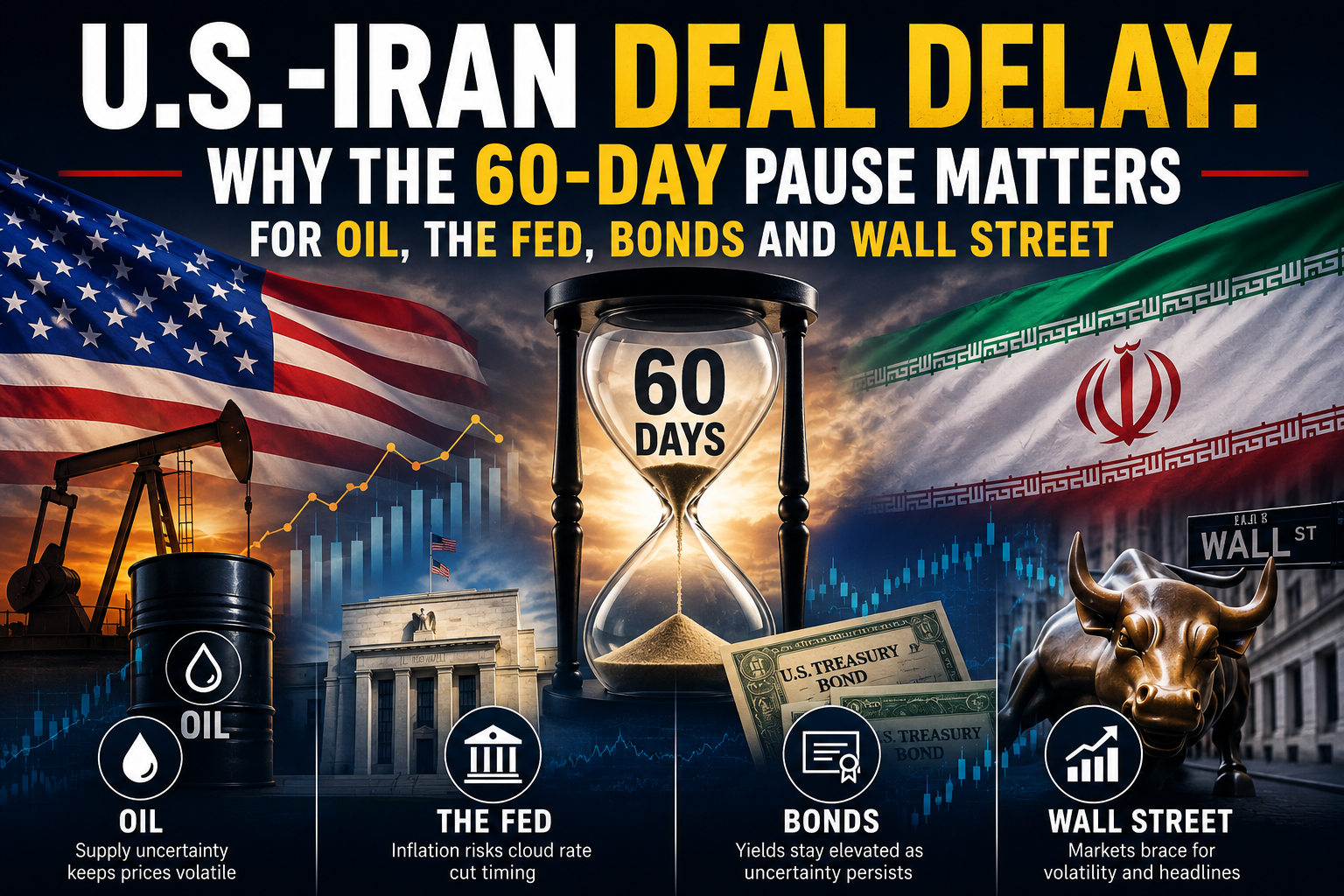
The possible 60-day delay in the U.S.-Iran deal is not just another diplomatic headline. In my view, this is a market event.
I don’t see this delay as a harmless pause. I see it as a new risk window for oil, inflation expectations, Treasury yields, the Federal Reserve and Wall Street. The key question is not only whether Washington and Tehran eventually reach an agreement. The real question is what investors have to price during the next 60 days before a final deal is actually signed.
As of Sunday, May 31, 2026, the U.S. and Iran appear to have reached a tentative memorandum of understanding to extend the ceasefire for 60 days, but the deal still needs final approval from President Donald Trump. The unresolved issues include Iran’s nuclear program, highly enriched uranium, sanctions relief, the Strait of Hormuz and broader regional security.
That is why I think markets may open cautiously on Monday, June 1, 2026. Not necessarily in panic mode, but not with full confidence either. A delay can be bullish if investors believe diplomacy is working. But it can quickly become bearish if oil spikes, the Strait of Hormuz remains uncertain, or new military headlines hit before the opening bell.
What the 60-Day U.S.-Iran Deal Delay Really Means
The 60-day delay gives both sides more time, but it also keeps uncertainty alive.
For the United States, the delay allows the White House to keep pressure on Iran without immediately forcing a final yes-or-no decision. Trump can say he is negotiating from strength, while still leaving room for diplomacy.
For Iran, the delay creates space to push for sanctions relief, access to frozen funds and a better political deal at home. Tehran does not want to look like it surrendered under U.S. pressure. At the same time, Iran needs economic relief.
In my view, the delay buys time for diplomats, but it sells uncertainty to investors.
That matters because markets hate unresolved risk. A signed deal gives investors something concrete to price. A failed deal gives them another kind of clarity. But a 60-day extension leaves markets in the middle: not war, not peace, not resolution.
What the U.S. and Iran May Negotiate During the Delay
This is not just about signing a paper. The real negotiation is about leverage.
During the delay, the main topics are likely to include:
- Iran’s nuclear program.
- Highly enriched uranium.
- Inspection and verification mechanisms.
- Sanctions relief.
- Frozen Iranian assets.
- The reopening and security of the Strait of Hormuz.
- Oil flows through the Persian Gulf.
- Regional security guarantees.
- Political language that both sides can sell domestically.
The Strait of Hormuz is especially important. Reports indicate that reopening the strait, preventing shipping tolls and securing oil flows are central issues in the talks. The nuclear question is also unresolved, with U.S. demands reportedly focused on uranium stockpiles and limits on enrichment.
For me, this is the part investors cannot ignore. This delay is not only diplomatic. It touches the physical flow of oil, the cost of energy, inflation expectations and the way central banks think about risk.
The U.S. Position: Pressure Without an Oil Shock
From the U.S. side, the posture looks clear: keep maximum pressure on Iran, but avoid an oil shock that would hit American consumers.
That is a difficult balance.
Trump wants to look tough on Iran. He also wants to avoid a surge in gasoline prices, a selloff in stocks or a renewed inflation problem that could complicate the Federal Reserve’s job.
This is where geopolitics and domestic economics collide. A hard line against Iran may appeal politically, but if it pushes crude oil sharply higher, the cost shows up quickly in energy prices, transportation costs and inflation expectations.
The Fed is not at the negotiating table, but it may still be forced to deal with the consequences.
Iran’s Position: Time, Leverage and Sanctions Relief
Iran’s posture is also understandable from a strategic point of view. Tehran knows that time can be leverage.
The longer uncertainty lasts, the more oil markets, inflation expectations and political pressure start doing part of the negotiating. Iran can use the 60-day window to push for sanctions relief and access to frozen funds while resisting terms that look like surrender.
Reports suggest Iran is seeking economic relief, including access to frozen assets, while the U.S. continues to push for nuclear restrictions and security guarantees.
That is why I would not treat this as a simple diplomatic delay. Iran’s economic needs are real, but so is its desire to preserve leverage. That combination can make negotiations slow, tense and market-moving.
How the Iran Deal Delay Could Affect Oil Prices
Oil is the first market I would watch.
If traders believe the 60-day delay means diplomacy is alive, crude prices can stay under pressure or stabilize. In fact, oil prices recently fell sharply as investors hoped for progress on a U.S.-Iran ceasefire arrangement. Brent crude was reported near $92 on Friday, down about 19% since the end of April, as peace-deal hopes reduced the geopolitical risk premium.
But that trade can reverse quickly.
If investors start to believe the delay is not progress but merely escalation postponed, oil could jump again. Any uncertainty around the Strait of Hormuz is especially sensitive because it is one of the most important routes for global energy flows.
So my view is simple: oil can fall on hope, but it can spike on doubt.
That makes crude the key signal before Monday’s U.S. market open.
Why the Fed Should Care About the U.S.-Iran Delay
The Federal Reserve does not set policy based on one geopolitical headline. But it does care about inflation expectations, energy prices and financial conditions.
A sharp oil move would matter because energy prices can feed into:
- headline inflation,
- consumer expectations,
- business costs,
- transportation prices,
- market expectations for rate cuts.
If oil stays lower because investors believe a deal is coming, that could help the disinflation narrative. It would make life easier for the Fed.
But if oil spikes again, the Fed may have to sound more cautious. Even if core inflation remains the main focus, a sustained energy shock can make rate cuts harder to justify.
This is why the Iran delay matters for monetary policy. The Fed is not negotiating with Iran, but it absolutely has to react to the inflationary consequences of an oil shock.
Treasury Yields, Bonds and Safe-Haven Flows
Treasury bonds are tricky in this situation because there are two forces pulling in opposite directions.
If investors get scared, they may buy Treasuries as a safe haven. That could push yields lower.
But if oil prices rise sharply, investors may worry about inflation. That could push yields higher, especially in shorter and intermediate maturities.
So the bond market reaction depends on which fear dominates:
| Market fear | Likely bond reaction |
|---|---|
| Geopolitical escalation | Treasury buying, yields lower |
| Oil-driven inflation | Yields higher |
| Calm diplomacy | Yields stable or slightly lower |
| Strong risk appetite | Less safe-haven demand |
That is why I would watch the 10-year Treasury yield closely. If yields fall while oil rises, markets are pricing fear. If yields rise with oil, markets are pricing inflation. If both oil and yields calm down, investors may be treating the delay as manageable.
How Wall Street Could Open Tomorrow
My base case for Monday, June 1, 2026, is a cautious or mixed open, not a panic open.
But that depends heavily on overnight oil futures and any new headlines before the U.S. opening bell.
If crude remains stable or lower, Wall Street may interpret the delay as diplomacy still working. That could support risk assets, especially after investors spent the previous week pricing in hopes of de-escalation.
If crude jumps, the market reaction could become more defensive. Energy stocks may outperform, while airlines, transports, consumer discretionary names and rate-sensitive growth stocks could face pressure.
Here is the scenario map I would use:
| Scenario | Oil | Fed expectations | Bonds | Stocks |
|---|---|---|---|---|
| Delay seen as diplomacy | Lower or stable | More room for cuts | Yields stable/lower | Stocks mixed to higher |
| Delay seen as uncertainty | Higher | Fed more cautious | Yields volatile | Stocks mixed/defensive |
| Hormuz risk rises | Sharp jump | Inflation fears rise | Safe-haven bid or inflation selloff | Energy up, broad market down |
| Final approval comes quickly | Lower | Better inflation outlook | Yields ease | Risk assets higher |
| Talks collapse | Spike higher | Rate-cut hopes fade | Volatility rises | Risk-off open |
I would not treat this as a simple headline risk. I would expect investors to separate winners and losers.
Energy and defense could benefit from tension. Airlines, shipping, transports and consumer-sensitive sectors could suffer if oil rises. Big tech may react more to Treasury yields than to the Iran headline itself.
What I’m Watching Before the Opening Bell
Before Monday’s opening bell, these are the signals I would watch:
1. Brent and WTI crude futures
If oil keeps falling or stabilizes, markets may stay calm. If oil jumps sharply overnight, that changes everything.
2. Any statement from Trump or the White House
The deal reportedly still needs Trump’s approval. That makes any statement from the White House extremely important.
3. Iran’s response
If Tehran confirms the framework, markets may breathe. If Iran rejects U.S. terms or accuses Washington of bad faith, volatility could return.
4. The Strait of Hormuz
This is the real pressure point. If shipping flows look safer, oil can relax. If Hormuz remains uncertain, crude can regain its risk premium.
5. Treasury yields
Yields will tell us whether the market is more worried about fear or inflation.
6. Sector rotation
I would watch energy, defense, airlines, banks and tech. The index level matters, but the sector reaction may tell the real story.
Bottom Line: This Is a Market Risk Window, Not Just Diplomacy
The 60-day U.S.-Iran deal delay should not be dismissed as just another diplomatic extension.
In my view, this is a market risk window.
If the delay leads to a real deal, lower oil prices could help inflation expectations, support Fed rate-cut hopes and give Wall Street a reason to breathe. But if the delay turns into a drawn-out standoff, markets may have to reprice oil risk, inflation risk and geopolitical uncertainty all over again.
My base case is a cautious open, not a panic open, unless oil futures spike sharply or new military headlines hit before the bell.
The real question is not only whether the U.S. and Iran reach a deal. The real question is what markets are forced to price during the 60 days before they get there.
FAQs
Why is the U.S.-Iran deal delayed?
The deal appears delayed because key issues remain unresolved, including Iran’s nuclear program, sanctions relief, highly enriched uranium, the Strait of Hormuz and broader security guarantees. A tentative 60-day ceasefire extension has reportedly been reached, but it still requires final approval from President Trump.
What could be negotiated during the 60-day delay?
The main issues are likely to include nuclear limits, inspection rules, sanctions relief, frozen Iranian funds, oil flows, the Strait of Hormuz and guarantees designed to prevent renewed escalation.
How could the delay affect oil prices?
Oil could fall if investors see the delay as a step toward peace. But oil could rise quickly if the market sees the delay as unresolved escalation, especially if the Strait of Hormuz remains at risk.
Could the Iran deal delay affect the Fed?
Yes. The Fed is not part of the talks, but a major oil shock could raise inflation expectations and make the central bank more cautious about cutting interest rates.
How could Treasury yields react?
Treasury yields could fall if investors seek safety. But they could rise if the market focuses more on inflation risk from higher oil prices.
How could Wall Street open tomorrow?
A cautious or mixed open looks more likely than panic, unless oil futures spike or new military headlines appear before the bell. Energy and defense could outperform, while airlines, transports and rate-sensitive growth stocks could come under pressure.