
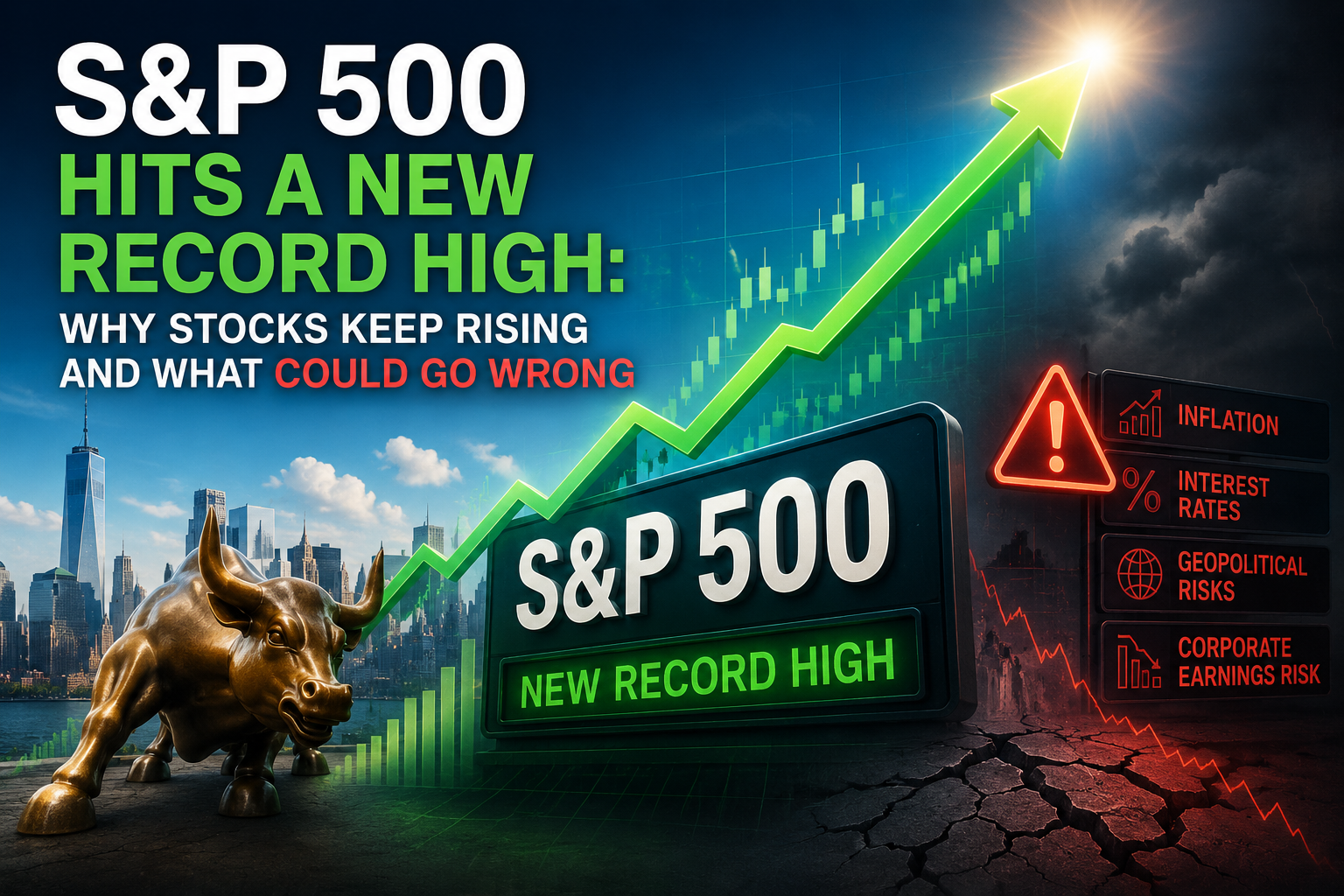
The S&P 500 just hit another new record high, and honestly, I get why investors are excited. A market making fresh highs usually sends a clear message: buyers are still in control, risk appetite is alive, and Wall Street is willing to look past a lot of uncertainty.
But when I look at this S&P 500 rally, my first reaction is not just excitement. It is also caution.
The index’s latest record came as investors reacted to a mix of strong corporate earnings, renewed optimism around artificial intelligence, falling bond yields, and improving hopes around U.S.-Iran negotiations. Reuters reported that the S&P 500 and Nasdaq closed at record highs on May 28, 2026, helped by optimism over a potential extension of a U.S.-Iran ceasefire, while tech and health care stocks led the market higher.
That combination matters. This is not a rally based on one single headline. It is part AI enthusiasm, part earnings strength, part macro relief, and part momentum. The problem is that when all of those forces push in the same direction, the market can start to feel unstoppable — and that is usually when I pay closer attention to risk.
So, is the S&P 500’s new record a healthy sign? Is AI really driving the move? Are we entering bubble territory? And could the market still face a correction before the end of the year?
Here is how I see it.
What Happened With the S&P 500’s New Record?
The S&P 500 reached another record high as investors piled back into growth stocks, especially technology, software, and AI-related names. The Nasdaq also hit a record, which tells us this was not just a defensive rally. Investors were clearly willing to own risk.
One of the biggest catalysts was the rebound in software and AI-linked stocks. Snowflake surged after strong earnings and an AI-related deal with Amazon Web Services, while Microsoft, Marvell, and other tech names also helped push the broader market higher.
MarketWatch also noted that S&P 500 futures leaned higher after the rally, with Dell Technologies reinforcing the AI story after reporting a major jump in demand for AI servers.
That is important because the AI trade is no longer just about one or two chip stocks. It is spreading into servers, cloud infrastructure, enterprise software, data centers, power demand, and productivity expectations. In other words, the market is trying to price in a full AI investment cycle.
At the same time, geopolitical relief helped. Oil prices came under pressure as investors became more optimistic about U.S.-Iran ceasefire negotiations and potential progress around the Strait of Hormuz. Lower oil prices can ease inflation fears, reduce pressure on consumers, and make it easier for investors to believe the Federal Reserve may not need to become more aggressive.
In my view, that is why the rally feels so powerful right now. It is not just “AI stocks went up.” It is AI plus earnings, plus lower yields, plus oil relief, plus momentum.
That can be a strong setup. It can also become crowded very quickly.
Why Does the S&P 500 Keep Going Up?
The simple answer is that investors are still willing to pay for growth.
The more complete answer is that the S&P 500 keeps rising because several major forces are lining up at the same time.
First, corporate earnings have been stronger than many investors expected. Earlier in May, Reuters reported that S&P 500 companies were on track for their strongest profit growth in more than four years, with more than 80% of companies that had reported through May 1 beating profit estimates, according to LSEG I/B/E/S data.
That matters because a market rally built only on hype is fragile. A rally supported by earnings has a stronger foundation.
Second, AI remains the dominant growth narrative. Investors are not just buying the idea of artificial intelligence anymore. They are looking for revenue, orders, cloud demand, server sales, chip demand, and software monetization.
Dell is a good example. Investopedia reported that Dell’s stock surged after earnings beat expectations, helped by a huge increase in AI-optimized server orders and stronger revenue guidance.
Third, the macro backdrop has improved compared with the worst-case fears. Lower oil prices, softer bond yields, and reduced geopolitical panic all support higher equity valuations. When investors believe inflation pressure may cool and the Fed may avoid additional hikes, growth stocks usually benefit.
But here is where I try to stay balanced: the S&P 500 is not going up because everything is perfect. It is going up because the market believes the good news is strong enough to outweigh the risks.
That distinction matters.
AI Is Still the Main Story
There is no honest way to talk about the S&P 500’s new record without talking about AI.
AI is the emotional center of this market. It is also one of the biggest fundamental drivers. Investors are betting that artificial intelligence will increase productivity, expand profit margins, drive cloud spending, and create new revenue streams across the economy.
I do think AI is a real force. This is not just a buzzword anymore. Companies are spending serious money on infrastructure. Data centers are being built. Servers are being ordered. Software companies are racing to add AI tools. Semiconductor demand remains central to the story.
But I also think investors need to separate two things:
- AI as a real long-term technology shift.
- AI as a short-term excuse to overpay for anything with the right label.
Those are not the same thing.
When I see a stock jump simply because it mentions AI, I get cautious. When I see actual revenue growth, backlog, margins, and customer demand, I take it more seriously.
That is why the current rally is both exciting and dangerous. The exciting part is that AI may genuinely improve earnings for many companies. The dangerous part is that markets tend to extrapolate good stories too far.
The internet was real in 1999. That did not mean every internet stock was worth the price investors paid for it.
AI may be real today. That still does not mean every AI stock is cheap.
Is This S&P 500 Rally Actually Healthy?
I would describe this S&P 500 rally as healthy in some ways, but stretched in others.
The healthy part is that earnings are participating. This is not purely a liquidity-driven rally. Investors have real reasons to be optimistic: corporate profits, AI demand, lower oil pressure, and better risk sentiment.
The unhealthy part is concentration.
A rally becomes more fragile when too much of the index depends on a small group of mega-cap technology and AI-related companies. If leadership is narrow, the market can look stronger on the surface than it really is underneath.
That is one reason I am watching market breadth very closely. If the S&P 500 keeps making records but fewer stocks participate, that is a warning sign. It means the index is rising, but the average stock may not be doing nearly as well.
Investing.com’s technical analysis of the recent record-high rally highlighted that breadth has been weaker than usual, noting that only about 60% of S&P 500 components were trading above their 200-day moving average, compared with a historical average closer to 73% during record highs.
That does not mean a crash is coming. But it does mean investors should not blindly assume the index’s strength reflects the entire market.
In my view, the rally becomes healthier if leadership broadens beyond AI mega-caps. I want to see industrials, financials, health care, small caps, and value stocks participate more consistently. If the market becomes less dependent on a handful of AI winners, the record high becomes more convincing.
Is AI Driving the Market or Creating a Bubble?
My honest answer: both forces may be happening at the same time.
AI is driving real investment. That part is not imaginary. The demand for chips, servers, cloud infrastructure, and data center capacity is visible in earnings reports and corporate spending plans.
But that does not automatically mean valuations are safe.
A bubble does not usually start with a fake story. It often starts with a true story that investors take too far. Railroads were real. The internet was real. Housing demand was real. The problem was not that the underlying theme had no value. The problem was that prices eventually disconnected from realistic future cash flows.
That is the risk with AI.
Right now, investors are pricing in a future where AI creates enormous productivity gains and profit growth. That may happen. But if the timeline is slower, costs are higher, margins are thinner, or monetization is weaker than expected, some of today’s winners could reprice sharply.
Recent academic research has also examined whether AI-exposed equities show signs of speculative exuberance, especially in technology and semiconductor names. The point is not that a bubble has definitely formed everywhere, but that the AI trade has become large enough and intense enough to deserve serious scrutiny.
Personally, I do not think the entire S&P 500 is in a classic bubble right now. But I do think certain AI-related pockets may be priced for perfection.
And when a stock is priced for perfection, even good news may not be enough.
Could the S&P 500 Reverse Into a Bubble?
Yes, it could but I would be careful with the word “bubble.”
A bubble usually needs three things:
| Bubble Ingredient | Is It Present Now? | My View |
|---|---|---|
| A powerful story | Yes | AI is the dominant market narrative |
| Easy investor excitement | Yes | Record highs attract more buyers |
| Valuation discipline fading | Partly | Some AI names look stretched |
| Broad retail mania | Not fully | Speculation exists, but it is not everywhere |
| Weak fundamentals | Not broadly | Earnings are still supporting the market |
So, I would not say the whole S&P 500 is definitely in a bubble. But I would say the market is vulnerable to bubble-like behavior if AI expectations keep rising faster than actual earnings.
That is the line I am watching.
If earnings keep improving, the rally can continue. If valuations rise while earnings expectations flatten, then the risk changes. At that point, the market is not climbing because businesses are doing better. It is climbing because investors are willing to pay more for the same future profits.
That is when I get more defensive.
Is a Stock Market Correction Possible This Year?
Yes. A correction is absolutely possible.
In fact, after a strong run to record highs, a correction would not surprise me at all.
That does not mean I expect a crash. A correction and a crash are different things. A 5% to 10% pullback can happen even inside a strong bull market. Sometimes, it is exactly what the market needs to reset sentiment, cool off crowded trades, and create better entry points.
The key question is what causes the correction.
Here are the risks I would watch:
- AI earnings disappointments.
- Inflation staying hotter than expected.
- The Fed sounding more hawkish.
- Oil prices rising again.
- U.S.-Iran negotiations breaking down.
- Treasury yields moving higher.
- Mega-cap tech losing momentum.
- Market breadth continuing to narrow.
The S&P 500 can keep climbing as long as earnings and liquidity expectations remain supportive. But if investors suddenly lose confidence in the AI growth story or the Fed outlook, the same stocks leading the market higher could lead it lower.
That is why I would not chase blindly after a new record high. I would rather own quality companies, keep some cash flexibility, and avoid assuming every dip will be instantly bought.
What Could Happen for the Rest of 2026?
For the rest of 2026, I see three realistic scenarios.
Scenario 1: The Rally Continues
This happens if earnings stay strong, inflation cools, oil prices remain contained, and AI-related companies continue proving that demand is real.
In this scenario, the S&P 500 could keep making new highs. The rally would become more convincing if more sectors joined in and market breadth improved.
Scenario 2: The Market Moves Sideways
This may be the most underrated scenario.
After a big rally, the S&P 500 may need time to digest gains. Prices could move sideways while earnings catch up to valuations. That would not be bearish. It could actually be healthy.
A sideways market would let overbought conditions cool without requiring a major sell-off.
Scenario 3: A Correction Hits
This could happen if AI stocks disappoint, inflation surprises higher, the Fed pushes back against rate-cut hopes, or geopolitical risk returns.
In that case, a 5% to 10% correction would be very possible. If earnings estimates also fall, the decline could become more serious.
My base case is not a major crash. My base case is a market that still has upside potential but is becoming more sensitive to disappointment.
That means selectivity matters more now than it did earlier in the rally.
What I’m Watching Now
When the S&P 500 hits a new record, I do not just look at the headline number. I look underneath the market.
Here is what I am watching most closely.
1. Earnings Growth
If earnings keep growing, the rally has a stronger foundation. If earnings expectations start falling while prices keep rising, that is a problem.
2. Market Breadth
I want to see more stocks participate. A rally led by only a few mega-cap names is more fragile than a rally supported by many sectors.
3. Fed Policy
If inflation stays sticky, the Fed may stay cautious. Higher-for-longer rates could pressure valuations, especially in growth stocks.
4. AI Spending
AI infrastructure demand is one of the strongest parts of the market. But investors need to see real returns on that spending over time.
5. Oil and Geopolitical Risk
Lower oil prices helped sentiment. If oil spikes again because of geopolitical stress, inflation fears could return quickly.
6. Valuations
Even great companies can become bad investments at the wrong price. That is especially true when investor expectations are extremely high.
My Take: I’m Bullish, But Not Blind
My personal view is simple: I do not think the S&P 500’s new record high is meaningless, and I do not think this rally is fake.
There are real reasons stocks are rising. AI demand is real. Earnings have been strong. Investors are responding to lower oil pressure, better sentiment, and the possibility that the Fed may not need to become more aggressive.
But I also do not think this is a market investors should treat as risk-free.
The higher the S&P 500 goes, the more important it becomes to ask what is already priced in. If AI keeps delivering, the rally can continue. If earnings broaden out, the market can become healthier. If inflation cools, the Fed backdrop can improve.
But if AI expectations get too stretched, if market breadth weakens, or if inflation and oil pressure return, a correction could come fast.
So, I would not panic because the S&P 500 is at a record high. Historically, record highs can lead to more record highs. But I also would not assume that every stock deserves to rise just because the index is rising.
For me, the right mindset is cautious optimism.
Stay invested, but stay selective. Respect the AI trend, but do not worship it. Watch earnings, not just headlines. And remember that a correction would not necessarily break the bull market — it might actually make it healthier.
FAQs About the S&P 500 New Record High
Why did the S&P 500 hit a new record high?
The S&P 500 hit a new record high because of strong corporate earnings, renewed AI optimism, lower oil pressure, softer bond yields, and improved market sentiment around geopolitical risk.
Is AI driving the S&P 500 rally?
Yes, AI is one of the biggest drivers. The rally is being supported by demand for chips, servers, cloud infrastructure, software, and AI-related productivity growth. But AI is not the only factor; earnings and macro conditions also matter.
Is the S&P 500 in a bubble?
I would not call the entire S&P 500 a bubble, but some AI-related areas may be priced very aggressively. The risk is that investors start paying too much for future growth that may take longer to arrive.
Is this S&P 500 rally healthy?
It is partly healthy because earnings are supporting the move. But it also has risks because leadership is concentrated in technology and AI-related stocks. The rally would look healthier if more sectors participated.
Could the S&P 500 correct this year?
Yes. A correction is possible, especially after a strong move to record highs. A 5% to 10% pullback would not be unusual if inflation, Fed policy, oil prices, or AI earnings disappoint.
Should investors buy when the S&P 500 is at a record high?
That depends on time horizon and risk tolerance. Long-term investors should not automatically avoid record highs, but chasing overvalued stocks after a big rally can be risky. Selectivity matters.
What should investors watch next?
The most important things to watch are earnings growth, market breadth, Fed policy, inflation, oil prices, AI spending, and whether leadership expands beyond mega-cap technology stocks.