
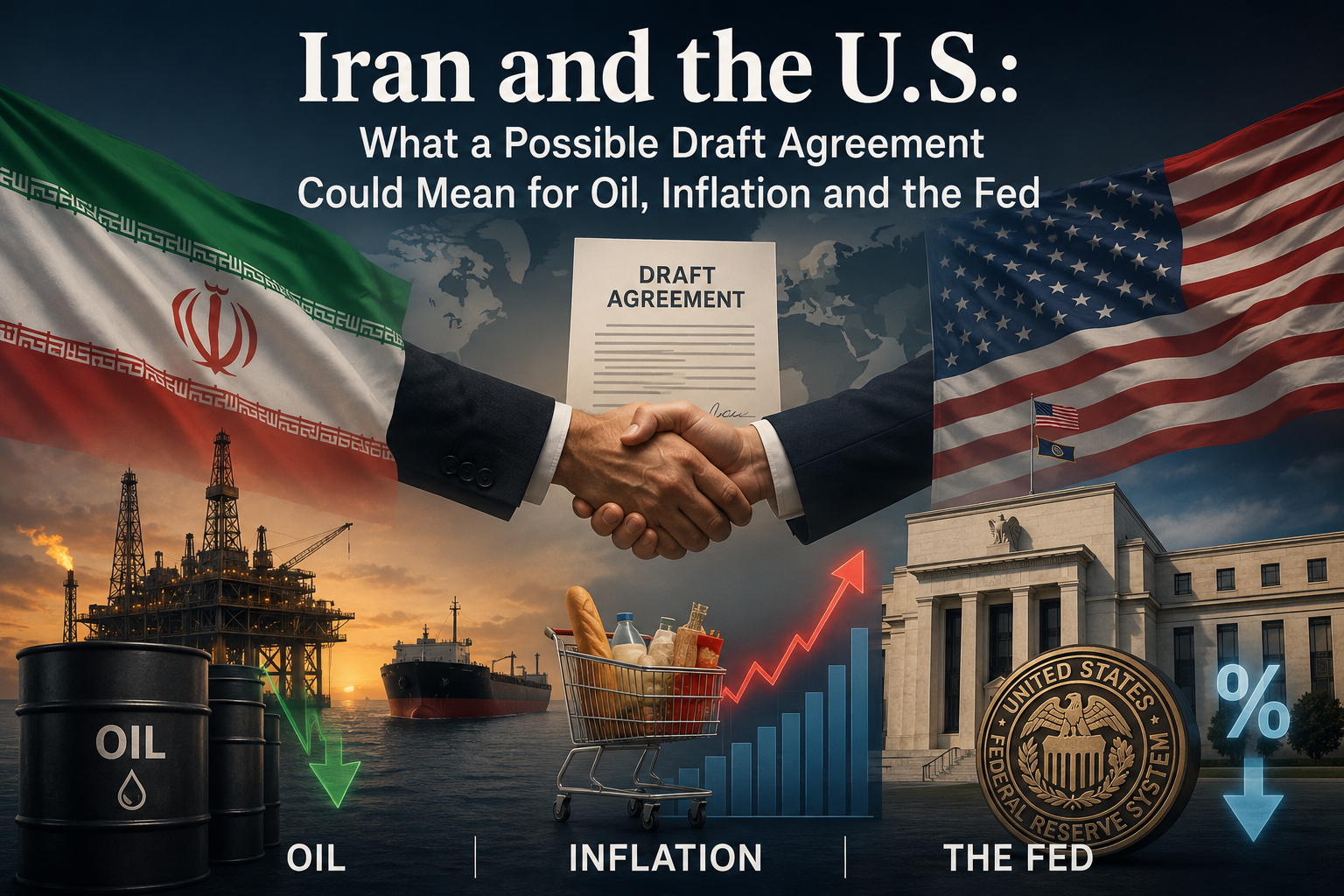
Introduction: Why I Think This Is Bigger Than Another Geopolitical Headline
The way I see it, the latest Iran–U.S. situation is not just another foreign-policy story. It is a macroeconomic event hiding inside a geopolitical crisis.
As of May 27, 2026, markets are reacting to two opposite signals at the same time. On one side, Iranian state TV reported the existence of a possible draft framework that could reopen commercial shipping through the Strait of Hormuz and reduce military pressure in the region. On the other side, the White House dismissed that report as false, calling the alleged memorandum a fabrication. That contradiction matters because investors are not pricing certainty; they are pricing probabilities.
And those probabilities are already moving markets. Oil settled roughly 5% lower as traders watched for progress in U.S.–Iran peace talks, with Brent crude closing at $94.29 a barrel and WTI at $88.68. That is not a small move. It tells me the market sees even a partial diplomatic opening as a potential release valve for inflation, energy costs and risk sentiment.
For the U.S. economy, the key question is not simply whether Iran and the United States sign something. The real question is whether a credible agreement can reduce the energy risk premium that has built up around the Strait of Hormuz, global oil supply and broader Middle East instability.
That is why I am watching this through three lenses: oil, inflation and the Federal Reserve.
Where the Iran–U.S. Situation Stands Right Now
Right now, the situation is messy, fragile and highly market-sensitive.
Iranian state TV has claimed there is an unofficial draft framework for a memorandum of understanding between Iran and the United States. According to that report, Iran would restore commercial shipping through the Strait of Hormuz to pre-war levels within one month, while the U.S. would withdraw military forces from the area and lift a naval blockade. The alleged framework also mentions Oman’s role in managing ship traffic and a possible path toward U.N. Security Council backing if a final deal is reached.
But the U.S. side has publicly rejected that version. The White House said the Iranian media report was not true and described the reported memorandum as a complete fabrication. So, from my perspective, the market is dealing with a classic geopolitical gray zone: there may be talks, there may be pressure, there may be trial balloons, but there is no clean, confirmed agreement yet.
That distinction is important. A rumor can move oil prices for a day. A verified agreement can change inflation forecasts for months.
This is why the Strait of Hormuz sits at the center of the whole story. According to the U.S. Energy Information Administration, oil flows through the Strait of Hormuz averaged 20.9 million barrels per day in the first half of 2025, equal to about 20% of global petroleum liquids consumption and roughly one-quarter of maritime-traded oil.
In plain English: if Hormuz is blocked, restricted or militarized, the world has an oil problem. If Hormuz reopens in a credible and stable way, the world gets immediate relief.
That is why I do not see this as only a diplomatic story. I see it as a global inflation story.
Why the Strait of Hormuz Matters So Much for the U.S. Economy
For many Americans, Iran can feel geographically distant. But oil markets do not care about distance. They care about chokepoints, supply routes and risk premiums.
The Strait of Hormuz is one of the most important oil transit corridors in the world. When shipping through Hormuz becomes uncertain, traders immediately price in the risk of lower supply, higher insurance costs, delayed cargoes and potential military escalation. That risk shows up first in crude oil prices, then in gasoline, diesel, airline fuel, shipping costs and eventually consumer prices.
In my view, this is the bridge between foreign policy and everyday inflation.
When oil rises sharply, the first-order impact is obvious: gasoline gets more expensive. But the second-order effects can be even more important. Higher energy prices raise transportation costs, pressure airlines, increase input costs for businesses and can make consumers feel poorer even before official inflation data catches up.
That is why a possible Iran–U.S. agreement matters so much. If a deal reduces the risk of disruption in Hormuz, oil can fall quickly. We already saw that dynamic when crude dropped sharply on hopes of progress in the talks.
But if the draft agreement collapses, or if the White House and Tehran continue sending contradictory signals, the opposite can happen. Oil could regain its risk premium fast. In that scenario, inflation expectations could become harder for the Fed to manage.
This is the part I think many headline-driven articles miss. The Iran–U.S. conflict is not only about missiles, sanctions and diplomacy. It is also about whether U.S. inflation gets another energy shock at the exact moment policymakers are trying to decide what comes next.
The Macro Impact of a Possible Iran–U.S. Draft Agreement
If a real agreement emerges, the macroeconomic impact would likely come through five channels.
1. Lower Oil Prices
The most immediate impact would be lower crude prices. Markets have already shown that they are willing to sell oil when the probability of a deal rises. A credible reopening of Hormuz would reduce the fear of supply disruptions and lower the geopolitical premium embedded in crude.
That does not mean oil would collapse overnight. Supply chains do not normalize instantly. Insurers, shippers and energy buyers would still need proof that the route is safe. But the direction would be clear: less war risk usually means lower oil risk premium.
2. Lower Headline Inflation Pressure
A sustained decline in oil would help headline inflation. Gasoline prices would be the most visible channel for U.S. households. Lower fuel costs could also ease pressure on freight, airlines and energy-intensive industries.
This matters because consumers often experience inflation emotionally through gas and grocery bills. Even if economists prefer core inflation, households feel energy prices immediately.
3. Better Market Sentiment
A real agreement would likely support risk assets. Reuters reported that U.S. stocks closed at record highs as investors watched for progress in U.S.–Iran peace talks, while lower oil prices helped ease fears around inflation and monetary tightening.
From my perspective, that makes sense. Lower geopolitical risk can support equities by reducing input-cost pressure and improving confidence. But I would be careful here. If the agreement is vague, disputed or politically fragile, markets may rally first and ask questions later.
4. Lower Treasury Yield Pressure
If oil falls and inflation expectations cool, Treasury yields may face less upward pressure. That would be important for mortgages, corporate borrowing and equity valuations.
The Fed does not control long-term yields directly, but geopolitical inflation shocks can push bond markets around. If investors believe energy inflation is fading, the bond market can begin pricing a less aggressive Fed path.
5. A Stronger Case for Fed Patience
This is where the Fed comes in.
A credible Iran–U.S. deal would not automatically trigger rate cuts. But it could make it easier for the Federal Reserve to stay patient, especially if oil prices keep falling and inflation data improves.
In other words, a deal would not be a monetary policy decision. But it could change the macro backdrop in which monetary policy decisions are made.
Could This Affect the Fed’s Decisions?
Yes, but indirectly.
The Federal Reserve is not going to cut or hike rates simply because of a headline about Iran. The Fed will look at inflation, labor markets, inflation expectations, financial conditions and incoming data. But the Iran–U.S. situation can influence several of those variables at once.
Federal Reserve Governor Lisa Cook said she currently supports holding rates steady, but she is prepared to raise rates if inflation does not ease. Reuters reported that she specifically pointed to risks including oil prices driven by the conflict with Iran.
That tells me the Fed is watching this closely.
If oil prices fall because a credible agreement reduces the Hormuz risk, the Fed gets more room to wait. Inflation pressure may ease, market conditions may improve and the case for additional hikes weakens.
But if the agreement fails and oil spikes again, the Fed’s problem gets harder. Policymakers would have to decide whether to “look through” an energy shock or respond to the risk that higher oil prices feed into broader inflation expectations.
That is the real danger. A one-time oil spike is painful but manageable. A persistent oil shock that changes wage demands, business pricing and consumer expectations is much more dangerous.
So, my base view is this: a credible Iran–U.S. agreement would support a Fed pause and could bring rate-cut expectations back into the conversation later. A failed agreement, especially if it causes another oil surge, would push the Fed toward a more hawkish stance.
Where Are We Heading Next?
I see three realistic scenarios.
Scenario 1: A Credible Agreement Takes Shape
In the best-case scenario, the U.S. and Iran move from disputed reports to a verifiable framework. Hormuz shipping normalizes, military pressure eases and oil prices continue to fall.
For the U.S. economy, this would be the cleanest outcome. Lower oil prices would help consumers, reduce inflation pressure and improve market confidence. The Fed would still need data confirmation, but the direction would be favorable.
This would not solve every macro problem. Tariffs, wages, housing costs and fiscal pressures would still matter. But it would remove one of the biggest inflationary tail risks from the table.
Scenario 2: Talks Continue, But No Clear Deal Emerges
This is probably the most realistic near-term scenario.
In this case, markets stay volatile. Oil falls on hopeful headlines and rises on denials or military escalation. Investors try to trade every statement from Washington, Tehran, Oman or other intermediaries.
For the Fed, this is awkward. Policymakers would probably avoid overreacting to daily oil moves, but they would keep warning that inflation risks remain tilted to the upside.
This is the environment where communication matters. The Fed would want to sound patient, but not complacent.
Scenario 3: The Draft Collapses and Escalation Returns
This is the risk scenario.
If the reported draft framework collapses completely, or if military escalation disrupts Hormuz again, oil could move sharply higher. That would hit gasoline prices, inflation expectations and consumer confidence.
In this case, the Fed would face a difficult trade-off. Higher oil hurts growth, but it also raises inflation. Cutting rates into an oil-driven inflation shock could look irresponsible. Hiking rates into a growth slowdown could look dangerous.
That is why this situation matters so much. It puts the Fed in a box.
What I Would Watch From Here
The first thing I would watch is not the political language. It is shipping data around the Strait of Hormuz. If commercial shipping activity improves and insurers become more comfortable, that would be a real-world sign that risk is easing.
Second, I would watch Brent crude. If Brent keeps falling below recent levels, markets are saying they believe de-escalation is becoming more likely. If Brent reverses sharply, traders are telling us the deal narrative is losing credibility.
Third, I would watch Treasury yields. If yields fall alongside oil, that suggests investors see lower inflation risk and less pressure on the Fed.
Fourth, I would watch Fed language. If officials keep emphasizing inflation risks from oil, then the conflict remains a live monetary policy issue. If they start sounding more balanced, that would suggest the energy shock is fading from the policy debate.
Finally, I would watch the White House’s wording. Right now, the U.S. has rejected the Iranian media report. Until that changes, I would treat the draft agreement as a market-moving possibility, not a confirmed breakthrough.
My Bottom Line
My view is simple: the Iran–U.S. draft agreement story is less about diplomacy alone and more about whether the global economy can remove a major oil shock from the system.
If the deal becomes real, the macro impact could be meaningful. Oil prices could fall further, inflation pressure could ease, risk assets could get support and the Fed could gain more room to stay on hold.
If the deal fails, the opposite risk returns. Oil could spike, inflation could remain sticky and the Fed could be forced to sound more hawkish than markets want.
So, yes, this can affect Fed decisions not because the Fed cares about diplomacy for its own sake, but because oil prices, inflation expectations and financial conditions are all connected.
The way I see it, this is one of those moments where geopolitics becomes macro. And when that happens, the Fed cannot ignore it.
FAQs
Is there already a confirmed Iran–U.S. agreement?
No. As of May 27, 2026, Iranian state TV reported a possible draft framework, but the White House rejected that report as false. The situation remains uncertain.
Why does the Strait of Hormuz matter so much?
Because it is one of the world’s most important oil chokepoints. In the first half of 2025, about 20.9 million barrels per day flowed through the strait, roughly 20% of global petroleum liquids consumption.
Would an Iran–U.S. deal lower oil prices?
A credible deal could lower oil prices by reducing the geopolitical risk premium. Oil already fell sharply as investors reacted to hopes of progress in peace talks.
Could the Iran conflict change Fed policy?
Yes, indirectly. If the conflict keeps oil prices high, inflation risks rise and the Fed may stay hawkish. If a deal lowers oil prices and inflation pressure, the Fed may have more room to pause or eventually consider cuts.
What is the biggest risk for the U.S. economy?
The biggest risk is a persistent energy shock. A short-term oil spike is manageable, but a prolonged increase in oil prices could feed into inflation expectations, business costs and Fed policy.