
The SpaceX IPO could become one of the most exciting stock market events in years. And honestly, I get why.
SpaceX is not just another company trying to sell investors a growth story. It launches rockets. It operates Starlink. It works with NASA. It has changed the economics of space transportation. It is tied to Elon Musk, one of the most polarizing and market-moving entrepreneurs of our time. And now, according to recent reports, SpaceX may be moving closer to a public listing, with Reuters reporting that the company has accelerated its IPO timeline and is targeting a Nasdaq listing around June 2026.
That combination is powerful: rockets, satellites, Mars, internet infrastructure, defense contracts, artificial intelligence, Elon Musk, and retail-investor hype all wrapped into one stock market story.
But that is exactly why I would be careful.
As an investor, I would not confuse an amazing company with an automatically amazing stock. A business can be world-changing and still become a painful investment if the IPO price already assumes perfection.
That is the real issue with the SpaceX IPO. The question is not only: “Is SpaceX a great company?” The better question is: “At what price does SpaceX become too expensive?”
Is SpaceX Really Going Public?
SpaceX has long been one of the most desired private companies in the world. For years, retail investors could not easily buy SpaceX stock directly. Exposure was mostly limited to private markets, venture funds, select investment vehicles, or indirect routes.
Now, that may be changing.
Recent reports suggest SpaceX has been preparing for what could become one of the largest IPOs in history. Reuters previously reported that SpaceX was considering a mid-June 2026 IPO at a valuation of roughly $1.5 trillion, while later reports pointed to an accelerated timeline and a possible Nasdaq listing.
Other market reports have discussed even higher possible valuation ranges, including figures around $1.75 trillion to $2 trillion. MarketWatch reported that the IPO could raise up to $80 billion at a valuation of about $2 trillion, with Wall Street banks potentially earning huge underwriting fees from the deal.
So yes, based on current reporting, the SpaceX IPO appears to be much more than a rumor. But until the final public prospectus is available and pricing is confirmed, investors should treat the exact date, valuation, and share price as moving targets.
That matters because IPO stories can change quickly. The initial narrative may sound clean and exciting, but the final investment decision depends on details: revenue, margins, growth, cash flow, voting rights, insider selling, debt, dilution, and valuation.
Personally, I would not make a decision based only on the headline “SpaceX is going public.” I would wait for the numbers.
Why This Could Become One of the Biggest IPOs Ever
SpaceX is not a normal IPO candidate.
Most companies go public because they need capital, visibility, liquidity, or a currency for acquisitions. SpaceX may want all of those things, but it also has something most companies do not: a huge cultural narrative.
The company sits at the center of several powerful themes:
- Reusable rockets.
- Satellite internet.
- Dpace infrastructure.
- Defense technology.
- NASA and government contracts.
- Starlink subscriptions.
- Starship development.
- Potential Mars missions.
- Elon Musk’s personal brand.
That is why the SpaceX IPO could attract both institutional investors and retail investors. Big funds may want exposure to the space economy. Retail investors may want to own a piece of a company they associate with the future.
And that emotional demand can be dangerous.
When investors believe a company is “the future,” they often stop asking boring but essential questions. What is the margin profile? How much capital does the business need? How cyclical is demand? What happens if execution slows? What valuation already prices in the next decade of success?
This is where I would be cautious. SpaceX may deserve a premium valuation, but no company deserves an infinite valuation.
Why Investors Are So Excited About SpaceX
SpaceX is exciting because it has real achievements behind the hype.
The company was founded by Elon Musk in 2002 and became known for pushing reusable rocket technology forward. Its Falcon 9 rocket helped change launch economics, and its Dragon spacecraft became part of the broader commercial spaceflight ecosystem. SpaceX also built Starlink, a satellite internet business that gives the company a recurring-revenue angle beyond launches.
That is a rare mix.
A lot of high-growth companies sell investors a vision. SpaceX has both a vision and tangible infrastructure. Rockets launch. Satellites operate. Starlink customers pay for internet service. Government and commercial customers rely on its systems.
That is why I understand the excitement.
If SpaceX goes public, investors may see it as a chance to buy into something bigger than a typical technology stock. It could be seen as exposure to the next generation of communications, transportation, defense, and space infrastructure.
But again, the key word is price.
A great story can be ruined by a bad entry point.
The Big Problem: A Great Company Can Still Be an Overpriced Stock
This is the part I think many investors forget during famous IPOs.
A company can be excellent. Its product can be real. Its founder can be brilliant. Its market can be massive. And the stock can still disappoint if the valuation is too aggressive.
That is why the SpaceX IPO should not be treated like a lottery ticket.
As an investor, I always come back to one uncomfortable question: what am I actually paying for?
If SpaceX lists at a valuation around $1.5 trillion, $1.75 trillion, or even $2 trillion, the market is not pricing it like a speculative startup. It is pricing it like one of the most important companies on Earth. That means expectations would already be extremely high.
At that kind of valuation, investors are not just paying for today’s SpaceX. They are paying for future Starlink growth, successful Starship execution, continued launch dominance, government contracts, satellite expansion, and possibly future space-based infrastructure that may take years or decades to fully monetize.
That does not mean the valuation is automatically wrong. But it does mean the margin for error could be very small.
My personal rule is simple: never buy an IPO only because the company is famous.
Fame does not protect you from overpaying.
Could SpaceX Stock Drop After the IPO?
Yes, SpaceX stock could absolutely drop after the IPO.
That does not mean SpaceX is a bad company. It means IPOs can be brutal when expectations are too high.
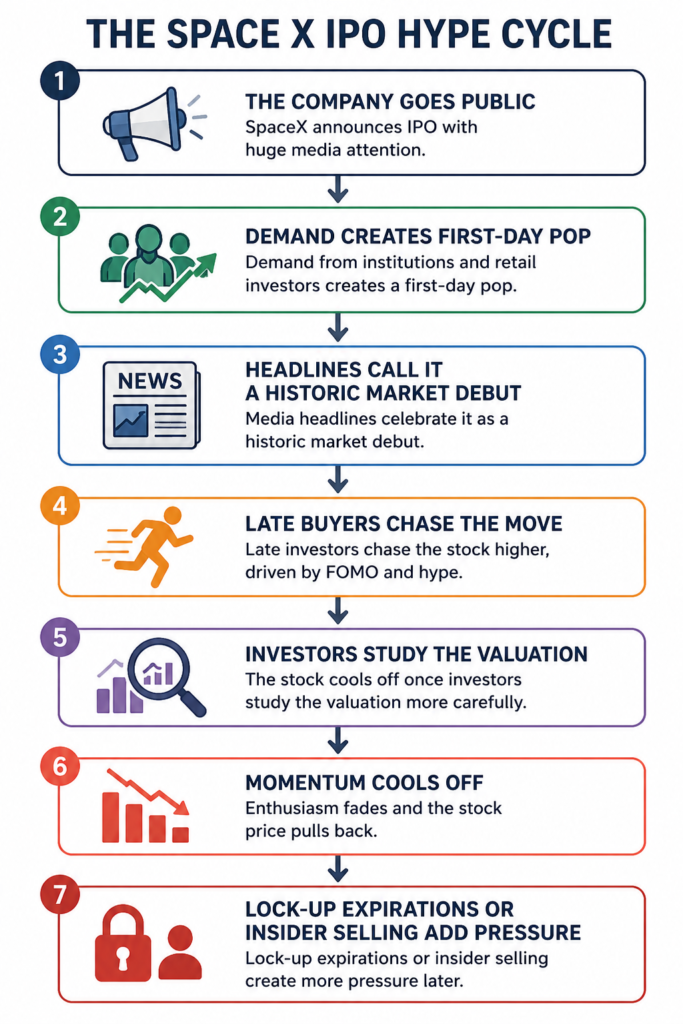
That scenario would not surprise me with SpaceX. In fact, I would be more surprised if the stock traded calmly.
If SpaceX becomes one of the largest IPOs ever, the first few weeks could be driven by emotion, scarcity, allocations, media coverage, and FOMO. A lot of people may buy simply because they want to say they own SpaceX.
That is not a strategy. That is a reaction.
Personally, I would rather miss the first move than buy the top of a euphoric IPO.
The biggest risk is not that SpaceX lacks ambition. The biggest risk is that everyone already knows the story, and the IPO price may reflect years of success before those results are fully visible.
Why a Big First-Day Pop Can Turn Into a Painful Correction
A big first-day gain sounds exciting, but it can also create a trap.
If SpaceX prices its IPO aggressively and then jumps even higher on the first trading day, retail investors who buy after the opening may be paying a premium on top of an already premium valuation.
That is when the risk-reward can get ugly.
Imagine a stock that comes public with huge expectations. Then imagine investors start asking harder questions:
- Is Starlink profitable enough to support the valuation?
- How much capital will Starship still require?
- What happens if launch schedules slip?
- How dependent is SpaceX on government contracts?
- How much control will Elon Musk retain?
- Will early investors sell after lock-up periods expire?
- Does the company need more capital after the IPO?
- Are retail investors buying the story too late?
If the answers disappoint, the stock could fall sharply.
A 20%, 30%, or even larger decline after a euphoric IPO would not be impossible in a risk-off market. Again, that would not necessarily destroy the long-term SpaceX thesis. But it could punish anyone who bought blindly at peak enthusiasm.
A great company can still become a painful investment if you buy it when expectations are already sky-high.
The AI Bubble Question: Is SpaceX Listing Into a Dangerous Market?
This is one of the most important parts of the SpaceX IPO story.
SpaceX is not simply an “AI stock.” But it may go public in a market environment where investors are already obsessed with anything that sounds futuristic.
Artificial intelligence has changed market psychology. Many investors are willing to pay huge premiums for companies connected to AI, chips, cloud infrastructure, automation, robotics, defense technology, data centers, and next-generation computing.
SpaceX fits into that broader futuristic basket, even if it is not a pure AI company.
It has satellites. It has data infrastructure. It has robotics-like engineering. It has defense relevance. It has Elon Musk. It has a connection to xAI in the broader Musk ecosystem. It has a story that sounds bigger than the present.
That is powerful.
But it also worries me.
What worries me is not only SpaceX. What worries me is the kind of market mood that turns every futuristic company into a must-own asset.
If SpaceX lists while investors are already euphoric about AI and frontier technology, the IPO could be priced for perfection. And when stocks are priced for perfection, even good news may not be enough.
The danger is not that SpaceX has no value. The danger is that the market may try to value it like every possible future success has already happened.
What Happens If Market Sentiment Turns?
Market sentiment can change fast.
When investors are excited, they focus on total addressable market, visionary founders, technological leadership, and long-term optionality. When sentiment turns, they suddenly care about margins, cash flow, dilution, debt, regulation, and execution risk.
The same company can be loved in one market and punished in another.
That is especially true for high-growth, high-valuation companies.
If the AI trade cools off, or if investors become less willing to pay extreme multiples for future growth, SpaceX could be vulnerable even if its business continues to progress. A stock can fall because expectations were too high, not because the company collapsed.
That is the difference between business risk and valuation risk.
Business risk asks: “Will SpaceX succeed?”
Valuation risk asks: “How much success is already priced in?”
For the SpaceX IPO, I think valuation risk could be the bigger issue.
How I Would React as an Investor
If SpaceX goes public, I will absolutely watch it.
But watching closely is not the same as chasing blindly.
I would not buy SpaceX stock just because the first day looks exciting. I would want to understand the business like any other investment. That means reading the prospectus, studying the revenue mix, and separating the emotional story from the financial reality.
Here is how I would think about it:
First, I would check the valuation
The valuation is the starting point.
At $500 billion, SpaceX would be one type of investment. At $1.5 trillion, it is a very different investment. At $2 trillion, the company would need to justify one of the most demanding valuations in the market.
The higher the IPO valuation, the more future success investors are paying for upfront.
Second, I would study Starlink
Starlink may be one of the most important pieces of the SpaceX IPO.
Launches are impressive, but Starlink gives SpaceX a recurring-revenue business. I would want to know:
- How much revenue comes from Starlink?
- How fast is it growing?
- What are the margins?
- How expensive is satellite maintenance and replacement?
- What is customer churn?
- How much competition exists in satellite broadband?
If Starlink is highly profitable and growing fast, that could support a premium valuation. If the margins are weaker than expected, the IPO story could change.
Third, I would look at cash flow
Revenue is not enough.
SpaceX operates in capital-intensive markets. Rockets, satellites, launches, manufacturing, testing, and infrastructure are expensive. I would want to know whether the company generates strong free cash flow or still needs large amounts of outside capital.
A company can grow quickly and still consume cash aggressively.
Fourth, I would watch insider selling
One thing that would concern me is whether early investors, employees, or insiders use the IPO as a liquidity event.
That is not automatically bad. Early investors deserve exits. Employees may want to diversify. But if a large number of insiders sell aggressively after lock-up periods expire, the stock could face pressure.
Fifth, I would respect Elon Musk risk
Elon Musk is part of the upside and part of the risk.
His companies attract attention, talent, capital, and media coverage. But they also bring volatility, controversy, governance questions, and headline risk.
As an investor, I would not ignore that.
SpaceX IPO Investor Checklist
Before buying SpaceX stock, I would want answers to these questions:
| What I Would Check | Why It Matters |
|---|---|
| IPO valuation | A great company can still be overpriced. |
| Starlink revenue | Recurring revenue may be central to the thesis. |
| Starlink margins | Growth is less valuable if profitability is weak. |
| Launch business economics | Reusable rockets are powerful, but costs still matter. |
| Starship progress | A lot of future value may depend on execution. |
| Free cash flow | Capital-intensive businesses can burn cash. |
| Debt and funding needs | Future dilution could hurt shareholders. |
| Insider selling | Early investors may use the IPO for liquidity. |
| Lock-up expiration | Selling pressure can appear months after listing. |
| Voting control | Shareholder rights matter, especially in founder-led firms. |
| Elon Musk risk | Brand power and volatility come together. |
| AI bubble sentiment | A euphoric market can inflate the entry price. |
| Retail FOMO | Buying because everyone else is buying is dangerous. |
The item I would focus on most is valuation. Not because the other risks are irrelevant, but because valuation determines how much room investors have for disappointment.
If the IPO price already assumes flawless execution, then even small problems could hurt the stock.
What Would Make Me Nervous About Buying SpaceX Stock?
Here are the main red flags I would watch:
1. A valuation that feels disconnected from fundamentals
If the IPO is priced mainly on hype, brand power, and scarcity, I would be cautious.
2. Weak disclosure around Starlink profitability
Starlink is a major part of the story. I would want clear numbers, not just growth language.
3. Too much retail excitement
When everyone is convinced a stock “can’t lose,” I usually get more careful, not more aggressive.
4. Heavy insider selling after lock-up
This could create selling pressure and damage sentiment.
5. A broader market reversal
If AI and futuristic growth stocks start selling off, SpaceX could get hit even if its own business remains strong.
6. Governance concerns
If public shareholders have limited influence, they need to be comfortable with that structure before buying.
What Excites Me vs. What Worries Me
| What Excites Me | What Worries Me |
|---|---|
| SpaceX has real technological achievements. | The IPO valuation may already price in perfection. |
| Starlink could become a massive recurring-revenue business. | Starlink margins and long-term costs need close inspection. |
| Reusable rockets changed launch economics. | Space remains capital-intensive and execution-heavy. |
| NASA and government contracts add credibility. | Government dependence and regulation can create risk. |
| Elon Musk attracts attention and capital. | Musk also brings volatility and governance concerns. |
| The space economy could grow for decades. | Investors may be too early, too emotional, or too aggressive. |
| The IPO could open access to retail investors. | Retail investors may be buying after private investors already captured huge gains. |
That last point matters.
By the time a company like SpaceX reaches the public market, a lot of value creation may have already happened in private markets. Retail investors may finally get access, but not necessarily at an early-stage price.
That does not mean the stock cannot work. It simply means public investors need to be honest about what stage of the story they are buying.
Should I Buy SpaceX Stock on the First Day?
Personally, I would be very careful about buying on the first day.
The first day of trading can be chaotic. Price discovery is messy. Demand can be emotional. Media coverage can create pressure to act quickly. And with a company like SpaceX, the FOMO could be extreme.
I would rather wait for the market to calm down.
That might mean missing an initial rally. I am okay with that. I would rather miss the first 20% than buy into a euphoric spike and watch the stock fall 40%.
For me, the better approach would be:
- Read the prospectus.
- Study the numbers.
- Watch the first few trading sessions.
- Compare valuation with fundamentals.
- Decide whether the risk-reward still makes sense.
That may sound boring, but boring discipline is often what protects investors from expensive mistakes.
Final Take: SpaceX May Be Historic, But Price Still Matters
The SpaceX IPO could be historic.
It could become one of the biggest public listings ever. It could give everyday investors access to one of the most important private companies in the world. It could also become a defining moment for the space economy.
But I would not approach it with blind excitement.
I would approach it with respect and caution.
SpaceX may be an incredible company. Starlink may become a major business. Reusable rockets may keep reshaping launch economics. Starship may open new opportunities. Elon Musk may continue proving skeptics wrong.
But none of that removes the most basic rule of investing:
Price matters.
If SpaceX goes public at a reasonable valuation with strong financials, it could become a serious long-term opportunity. If it goes public at an extreme valuation during a market obsessed with AI, futuristic technology, and high-growth stories, I would be careful.
The stock could soar. It could also drop hard.
As an investor, I would watch SpaceX closely. But I would not chase it blindly.
FAQs About the SpaceX IPO
Can I buy SpaceX stock before the IPO?
Most retail investors cannot easily buy SpaceX stock before the IPO. Access has generally been limited to private markets, certain funds, and specialized investment vehicles. If SpaceX completes a public listing, retail investors should be able to buy shares through regular brokerage accounts after trading begins.
Is SpaceX a good investment?
SpaceX may be a great company, but whether it is a good investment depends on the IPO valuation, financials, growth outlook, profitability, shareholder rights, and market conditions. I would not decide based only on the brand name.
Could SpaceX stock crash after going public?
Yes. Any IPO can fall after listing, especially if expectations are too high. With SpaceX, the risk could be larger because investor excitement may push the valuation to aggressive levels. A post-IPO correction would not necessarily mean SpaceX is a bad business; it could simply mean the stock was overpriced.
How is the AI bubble connected to the SpaceX IPO?
SpaceX is not a pure AI company, but it belongs to the broader group of futuristic, high-growth, technology-driven companies that investors may treat with similar enthusiasm. If the market is already euphoric because of AI, SpaceX could list into a risky environment where investors overpay for future potential.
Should I buy SpaceX stock on the first day?
I would be cautious. The first day may be driven by hype, scarcity, and media excitement. Personally, I would rather wait, read the prospectus, study the valuation, and avoid buying purely because of FOMO.
What should worry investors most about the SpaceX IPO?
The biggest concerns are valuation, Starlink profitability, cash flow, insider selling, lock-up expirations, governance, execution risk, Elon Musk volatility, and the broader market mood around AI and growth stocks.