
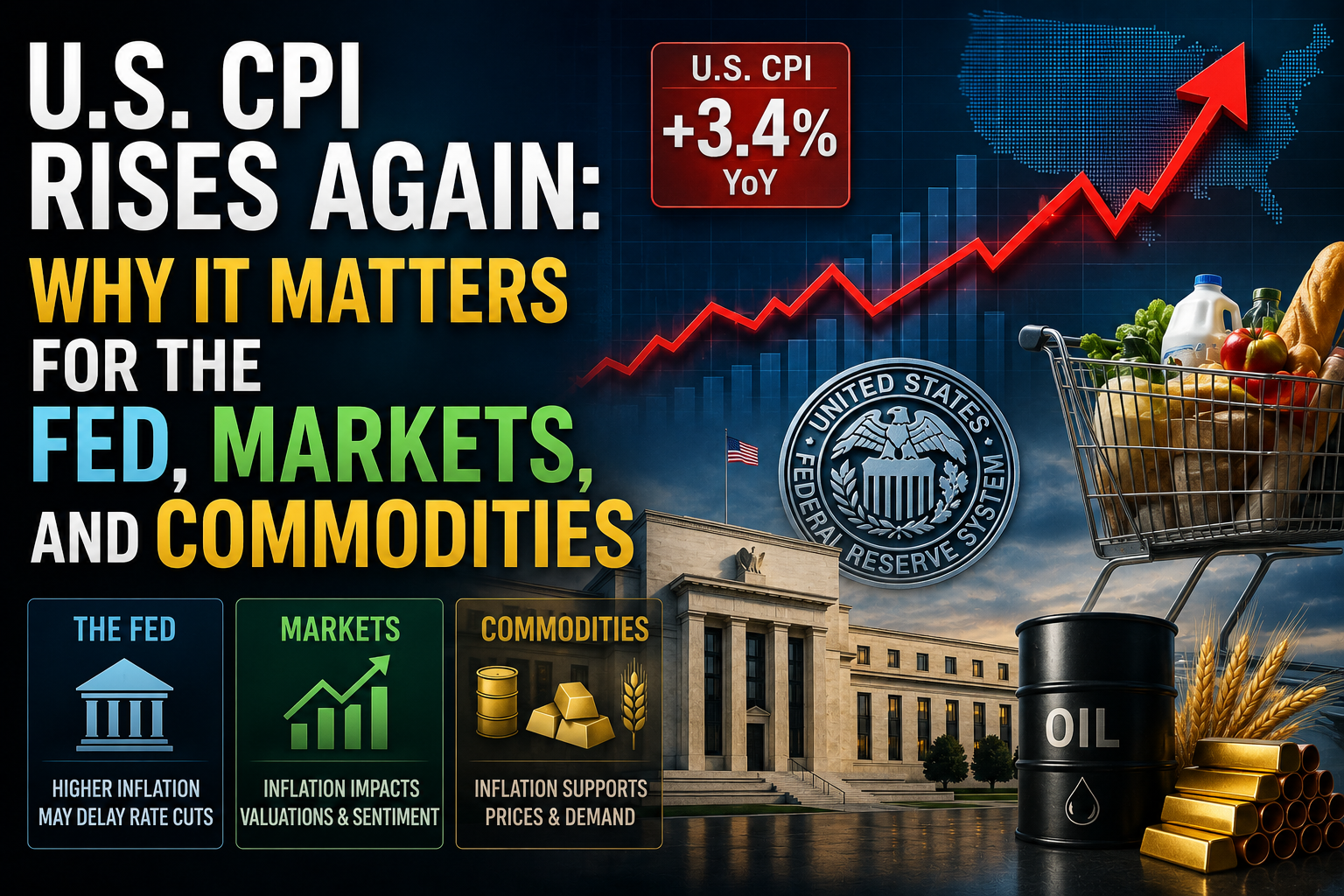
The latest U.S. inflation data has put pressure back on the market narrative. The U.S. Consumer Price Index rose to 3.8% year-over-year in April, above the 3.7% expected and well above the 3.3% recorded in March. On a monthly basis, CPI increased 0.6%, while core CPI which excludes food and energy rose 0.4% month-over-month and 2.8% year-over-year. (fxstreet.com)
And here is the key point: this is not just “another macro data release.” When I look at a CPI report like this, I do not only focus on whether inflation moved higher or lower. I look at what message the data is sending to the Federal Reserve and how it may shift expectations for interest rates, the U.S. dollar, stocks, bonds, Bitcoin, gold, oil, and commodities.
A hotter-than-expected inflation reading usually has one clear implication: the Fed has less room to cut interest rates. And when markets start pricing in higher rates for longer, almost everything adjusts currencies, Treasuries, equities, crypto, and commodities.
The Key CPI Data: U.S. Inflation Comes In Hotter Than Expected
The headline number is straightforward: U.S. inflation accelerated more than markets had expected. Annual CPI rose from 3.3% in March to 3.8% in April, beating the 3.7% forecast. On a monthly basis, prices increased 0.6%, while the core reading also came in stronger than expected.
Headline CPI, Monthly CPI, and Core CPI: What to Watch First
When an inflation report is released, there are three numbers worth watching closely:
- Year-over-year CPI: compares prices with the same month one year earlier.
- Month-over-month CPI: shows how much prices changed from the previous month.
- Core CPI: excludes food and energy, which tend to be more volatile.
Headline CPI gets the most attention, but the Fed pays very close attention to core CPI because it gives a cleaner view of underlying inflation pressure. In this case, core CPI rose 0.4% month-over-month, above the 0.3% expected, which makes the report more uncomfortable for policymakers.
Why Markets Reacted to the Inflation Report
Markets reacted because this CPI report changes expectations around monetary policy. If inflation cools, investors can price in rate cuts. But if inflation heats up again, the story changes: the Fed may need to stay restrictive for longer.
After the release, the U.S. Dollar Index rose around 0.4%, moving near the 98.30 area, according to FXStreet. That reaction makes sense. A stronger CPI print can reinforce the idea that U.S. interest rates will remain elevated, and that tends to support the dollar.
What Is CPI and Why Is It So Important for the Economy?
The Consumer Price Index, or CPI, measures changes in the prices of a basket of goods and services purchased by households. Put simply, it tries to show how much more expensive everyday life is becoming for consumers.
But CPI is not just about groceries, gasoline, rent, or utility bills. Its impact goes much further. It affects mortgage rates, corporate borrowing costs, consumer purchasing power, central bank decisions, and the valuation of financial assets.
That is why CPI matters so much: it connects the real economy with the price of money. What consumers pay eventually influences Fed policy, and Fed policy moves markets.
CPI Measures More Than Just Price Increases
When inflation rises, consumers lose purchasing power. If wages do not rise at the same pace as prices, people can buy less with the same amount of money. That affects consumption, and consumption is a major driver of the U.S. economy.
Higher inflation also forces businesses to make tough decisions: raise prices, absorb lower margins, renegotiate costs, or delay investment. All of that eventually feeds into corporate earnings expectations and, by extension, the stock market.
Headline CPI vs. Core Inflation
Headline CPI includes all categories, including food and energy. Core CPI excludes food and energy because those prices can be highly volatile.
That difference matters. If gasoline rises because of a temporary oil shock, headline CPI can jump quickly. But if housing, services, insurance, transportation, and rents are also rising, inflation becomes much stickier.
In my view, that is the real issue. It is not enough to ask whether oil pushed the data higher. The bigger question is whether inflation is spreading into the broader economy.
Why Inflation Has Risen in the United States
The rise in CPI did not come out of nowhere. In April’s report, one of the main drivers was energy. According to the data cited by FXStreet, the energy index rose 3.8% in April and accounted for more than 40% of the monthly increase in headline CPI. Housing and food prices also increased.
Energy and Oil: The Component Adding the Most Pressure
Oil matters because it can act as an inflation trigger. If crude oil rises, gasoline becomes more expensive. If gasoline becomes more expensive, transportation costs rise. And if transportation costs rise, companies may pass part of that increase on to consumers.
In this case, FXStreet linked inflation pressure to higher oil prices amid tensions between the U.S. and Iran, noting that WTI crude had climbed sharply since tensions in the Middle East escalated.
Housing, Food, and Services: The Harder Inflation to Cool
The problem is not only energy. Housing increased 0.6% in April, while food prices rose 0.5% during the month. These categories matter because they directly affect household budgets.
Inflation driven by energy can be concerning, but inflation that also affects housing, food, and services is harder for the Fed to ignore. That mix suggests price pressure is not fully under control.
The Role of Geopolitical Tensions and the Dollar
Geopolitical tensions can add more pressure if they affect oil, shipping routes, or supply chains. In that kind of environment, markets often move toward assets considered safer, such as the U.S. dollar, especially if investors also expect a tougher Fed.
That is why inflation should not be analyzed in isolation. You have to look at the data, but also the broader context: energy, geopolitics, wages, consumption, bonds, and rate expectations.
What This CPI Report Means for Fed Decisions
This CPI report complicates the Federal Reserve’s path. The Fed has an inflation target of around 2%, and a CPI reading of 3.8% is still far from that level.
Less Room to Cut Interest Rates
The most direct consequence is that the Fed has less room to cut rates soon. If the central bank lowers rates too quickly while inflation is accelerating, it risks fueling even more price pressure.
To me, the most important takeaway is this: a hotter-than-expected CPI report lowers the odds of quick rate cuts. Markets may want cheaper money, but the Fed needs data to justify it. And this report does not make that pivot easy.
Why the Fed Needs More Data Before Changing Its Tone
The Fed does not rely on a single data point. It watches trends. But when headline CPI rises, core CPI beats expectations, and energy adds pressure, policymakers have a strong reason to stay cautious.
FXStreet noted that markets were assigning a high probability to the Fed keeping rates unchanged in the 3.5%–3.75% range by year-end, with even some probability of a 25-basis-point rate hike, according to CME FedWatch.
Higher for Longer: The Scenario Markets Fear
The scenario investors dislike most is higher interest rates for longer. Not necessarily because it guarantees a recession, but because it changes asset valuations.
When rates stay higher:
- Government bonds become more attractive.
- Corporate financing becomes more expensive.
- Technology stocks face valuation pressure.
- The U.S. dollar tends to strengthen.
- Risk assets lose some relative appeal.
- Bitcoin and crypto can become more volatile.
In markets, the data itself is not always the only thing that matters. What matters is how the data changes expectations. And this CPI report forces investors to rethink the Fed’s rate-cut timeline.
U.S. CPI Inflation Trend and Market Expectations in 2026
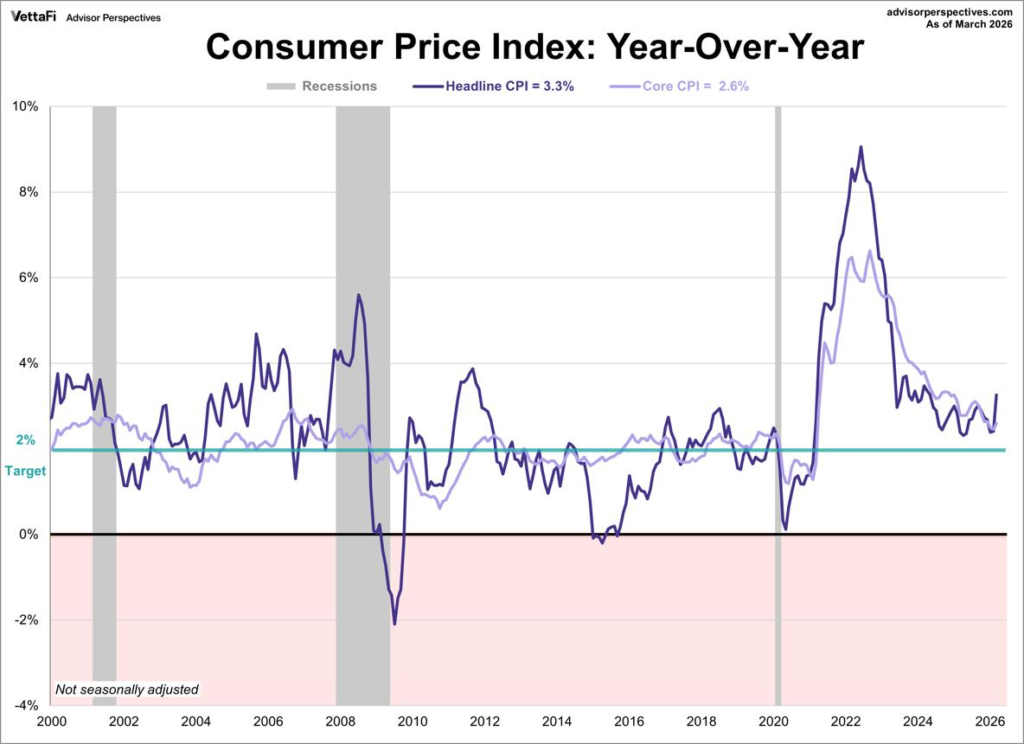
The latest CPI data reinforced concerns that inflation remains more persistent than markets expected, complicating the Federal Reserve’s path toward future rate cuts.
How CPI Can Affect Financial Markets
CPI affects markets because it influences expected liquidity. If investors believe the Fed will cut rates, risk appetite usually improves. If they believe the Fed will stay on hold or turn more restrictive, the opposite can happen.
U.S. Dollar and Bonds: The First to Reprice Expectations
The dollar is usually one of the first assets to react. Higher inflation can mean higher rates for longer, and that can make the U.S. dollar more attractive relative to other currencies.
Bonds also move quickly. If markets price in fewer rate cuts, Treasury yields can rise. And when yields rise, many risk assets have to adjust.
Reuters reported that after the CPI release, stocks fell, Treasury yields climbed, and the dollar advanced a reaction consistent with a hotter-than-expected inflation report.
Stocks and Tech: Pressure on Growth Assets
Stocks do not always fall when inflation rises, but a hotter-than-expected CPI report tends to create pressure, especially for growth companies. Why? Because their valuations depend heavily on future earnings, and those earnings are worth less when discount rates rise.
Technology stocks, the Nasdaq, and high-multiple growth names are usually more sensitive to this kind of repricing. That does not mean they must collapse, but it does mean the market becomes more selective.
Bitcoin and Crypto: Less Liquidity, More Volatility
Bitcoin and crypto markets also watch CPI closely. CoinDesk highlighted that the inflation report cooled expectations for Fed rate cuts and that Bitcoin was trading around $80,814 after the release, down roughly 1.2% over the previous 24 hours. (coindesk.com)
The logic is simple: if markets expect more liquidity, Bitcoin often benefits. If markets expect higher rates for longer, risk appetite cools. That is why I think the real question is not only “what was the CPI number?” but “which assets now need to reprice expectations after this report?”
Will CPI Affect Commodities and Raw Materials?
Yes, but not all commodities react the same way. This is where it is important to avoid an overly simplistic view. Oil is not the same as gold, gold is not the same as copper, and copper is not the same as wheat.
For commodities, the impact usually comes through three channels:
- Inflation itself.
- The U.S. dollar.
- Growth expectations.
Oil: Both a Cause and a Consequence of Inflation
Oil is the clearest case because it can be a direct cause of inflation. If crude rises, gasoline becomes more expensive. That affects energy, transportation, production, and logistics.
In April’s CPI report, energy was one of the main drivers, making oil a central part of the analysis. If crude prices remain high because of geopolitical tensions or supply concerns, the Fed will have a harder time claiming inflation is under control.
Gold: Between a Strong Dollar and Safe-Haven Demand
Gold has a more mixed setup. On one hand, a stronger dollar and higher interest rates are usually negative for gold because they raise the opportunity cost of holding a non-yielding asset.
On the other hand, if inflation comes with geopolitical uncertainty, market stress, or doubts about economic stability, gold can attract safe-haven flows.
That is why I would not put gold in the same category as oil. Gold does not only watch inflation. It also watches the dollar, real rates, and market fear.
Industrial Metals and Agricultural Commodities: An Uneven Impact
Industrial metals, such as copper, are highly sensitive to economic growth expectations. If inflation forces the Fed to keep rates high and that slows activity, metals can come under pressure. A stronger dollar can also weigh on many dollar-denominated commodities.
Agricultural commodities follow a different logic. They can be affected by energy, fertilizer costs, transportation, weather, and supply conditions. If food prices rise inside the CPI basket, the social and political impact can also be more sensitive because it directly hits household budgets.
In short, commodities should not all be treated the same. Oil can be part of the inflation problem, gold can act as a safe haven, and industrial metals often care more about the dollar and growth expectations.
Quick Table: Likely CPI Impact by Asset
| Asset | Likely Impact From Hotter CPI | Key Takeaway |
|---|---|---|
| U.S. dollar | Positive | Higher rates for longer can support the dollar |
| Treasury bonds | Yields may rise | Fewer rate-cut expectations |
| Stocks | Negative pressure | Especially for growth and tech |
| Nasdaq | More sensitive | High valuations suffer when rates rise |
| Bitcoin | More volatility / pressure | Less expected liquidity hurts crypto |
| Gold | Mixed | Strong dollar hurts, fear helps |
| Oil | Can stay supported | If oil drives inflation, it keeps pressure on CPI |
| Industrial metals | Mixed/negative | Depend on dollar and growth expectations |
| Agricultural commodities | Variable | Weather, energy, transport, and supply matter |
Conclusion: CPI Puts the Fed Back in a Tough Spot
The latest U.S. CPI report is a reminder that inflation is not fully under control. The move to 3.8% year-over-year, combined with a core CPI reading that also came in stronger than expected, reduces the Fed’s room to cut interest rates quickly.
My view is straightforward: this report matters not only because of the percentage itself, but because of its consequences. If inflation remains sticky, the Fed will have to stay cautious. And if the Fed stays cautious, markets need to adjust their liquidity expectations.
That can mean a stronger dollar, pressure on bonds and stocks, more volatility in Bitcoin, and a very uneven reaction across commodities. Oil may remain part of the inflation problem, gold may swing between rate pressure and safe-haven demand, and industrial metals will depend heavily on whether markets start worrying about slower growth.
So when CPI comes in hotter than expected, it is not enough to read the headline number. You need to follow the full chain: inflation, the Fed, interest rates, the dollar, bonds, risk assets, and commodities.
FAQs About CPI, the Fed, and Markets
What happens when CPI comes in higher than expected?
When CPI comes in above expectations, markets usually interpret it as a sign that inflation is more persistent. That can reduce the odds of rate cuts and increase volatility across currencies, bonds, stocks, and crypto.
Why can high CPI strengthen the U.S. dollar?
High CPI can lead markets to expect the Fed to keep interest rates elevated for longer. If U.S. rates stay relatively high, the dollar can become more attractive compared with other currencies.
How does CPI affect Bitcoin?
Bitcoin is sensitive to liquidity expectations. If high CPI reduces the chances of rate cuts, crypto markets can come under pressure because risk appetite weakens.
What is the difference between headline CPI and core CPI?
Headline CPI includes all categories, including food and energy. Core CPI excludes those components because they are more volatile and can distort the underlying inflation trend.
Which commodities are most affected by inflation?
Oil is usually the commodity most directly linked to inflation because it affects energy and transportation costs. Gold can act as a safe haven, while industrial metals depend more on the dollar and growth expectations.
Does this CPI report force the Fed to raise rates?
Not necessarily. But it does reduce the room for near-term rate cuts. If inflation keeps accelerating or remains far from the Fed’s target, markets may start pricing in a more restrictive Fed for longer.