
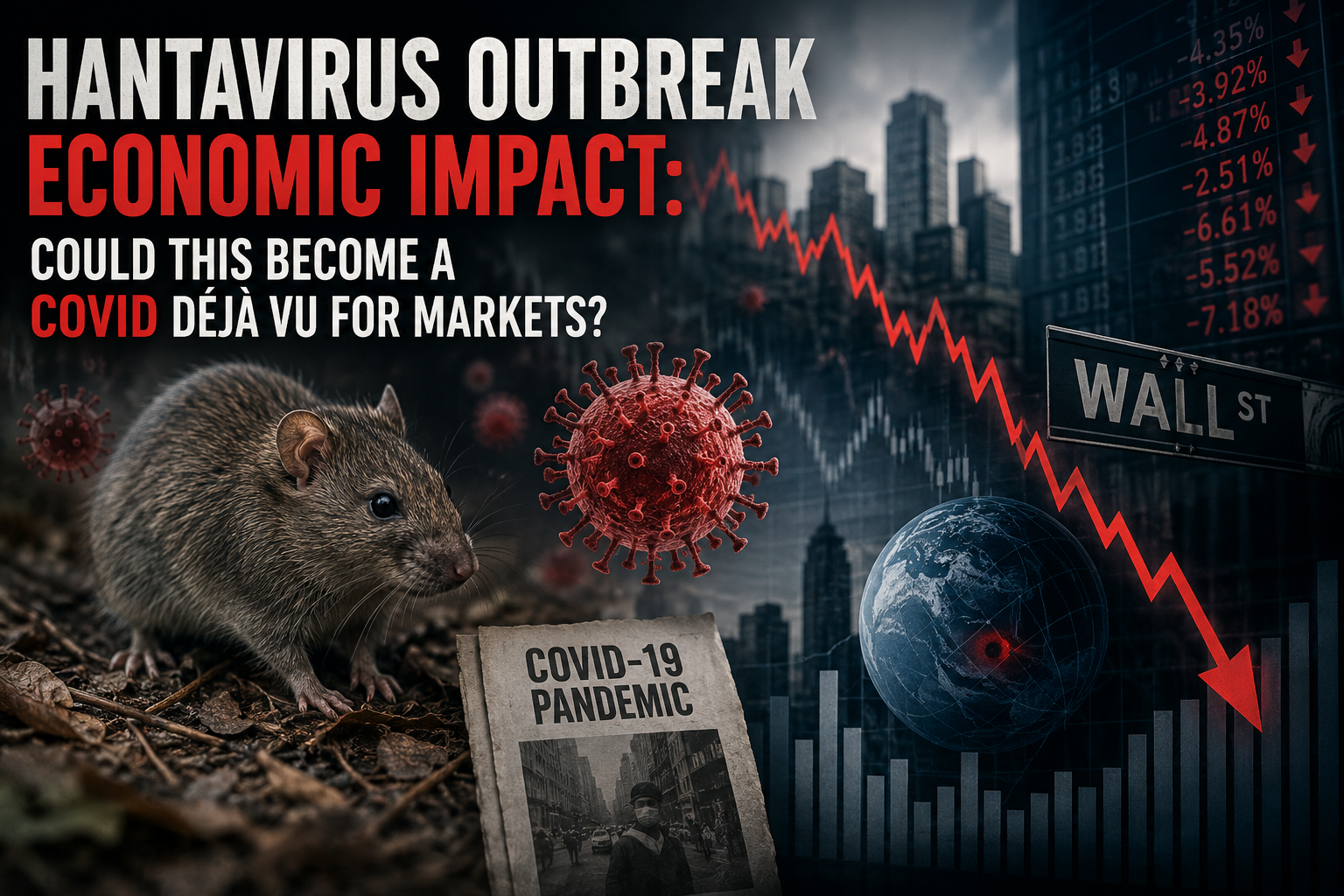
When I first saw the hantavirus headlines, my mind did not go straight to epidemiology. It went to markets.
Not because I think every virus headline is automatically a pandemic trade. It is not. But after 2020, investors have a kind of scar tissue. The market does not need a full-blown global crisis to start pricing uncertainty. Sometimes it only needs a few words: outbreak, cruise ship, human-to-human transmission, quarantine, WHO, contact tracing.
That is why the economic impact of a hantavirus outbreak matters, even if the medical base case remains far from COVID-19.
As of May 7, 2026, the World Health Organization reported eight cases linked to the MV Hondius cruise ship, including three deaths, with five confirmed as hantavirus. The CDC says hantaviruses are mainly spread by rodents, and that Andes virus is the only known hantavirus type that can spread person to person, usually through close contact with someone who is ill.
So the key question is not simply: “Is this the next COVID?”
For investors, the better question is:
What happens if markets start trading it like a COVID déjà vu before the health data justifies that fear?
That is where stocks, bonds, the Fed, the dollar, gold, oil, and Bitcoin all enter the picture.
What Is Happening With the Hantavirus Outbreak?
The current outbreak became global news because it was linked to the MV Hondius, a cruise ship traveling from Argentina through the Atlantic. Health authorities have been tracing passengers and monitoring possible exposures across multiple countries. Reuters reported that the CDC is monitoring US travelers from the ship, including people in Georgia, California, and Arizona, while emphasizing that the risk to the general American public remains very low.
That “very low public risk” part matters. It is the difference between a health scare and a macroeconomic shock.
But markets rarely wait for perfect clarity. They move first and ask questions later. I remember this from COVID: the first reaction was not a neat, rational model of transmission rates and policy responses. It was a wave of repricing. Airlines, cruise lines, hotels, oil, banks, yields, credit spreads, and eventually everything started moving at once.
That does not mean hantavirus is COVID 2.0. In fact, the CDC’s explanation points in the opposite direction: hantavirus is mainly rodent-borne, and person-to-person transmission is known only for Andes virus, generally through close contact.
Still, the MV Hondius story has several ingredients that markets dislike: international travel, a cruise ship, deaths, medical evacuations, uncertainty around exposure, and multi-country monitoring.
For the economy, the immediate issue is not whether the virus shuts down the world tomorrow. It is whether the headlines create enough uncertainty to change consumer behavior, travel bookings, investor positioning, and central-bank expectations.
Why Markets Could React Even If the Virus Stays Contained
Markets do not trade only facts. They trade probabilities, positioning, liquidity, and fear.
That is why a contained hantavirus outbreak could still create volatility. A virus can be medically limited but financially loud. If investors see a cluster of severe cases, even in a narrow setting, they may start asking what sectors are exposed first.
The obvious pressure points would be:
| Asset / Sector | Possible First Reaction |
|---|---|
| Cruise lines | Sharp weakness on booking fears |
| Airlines | Pressure if travel anxiety rises |
| Hotels and leisure | Sentiment-driven selloff |
| Treasury bonds | Rally if investors seek safety |
| US dollar | Could strengthen in risk-off mode |
| Gold | Could benefit as a hedge |
| Oil | Could fall if travel-demand fears grow |
| Bitcoin | Likely volatile; could drop first with risk assets |
The real market risk is not the virus alone. It is the memory of 2020.
That is the déjà vu factor. Investors remember how quickly a “localized health issue” became a global market event during COVID. Even if hantavirus is structurally different, the emotional memory remains. And when enough traders have the same memory, markets can overreact.
In my case, the first thing I would watch is not only the case count. I would watch Treasury yields, credit spreads, Fed funds futures, airline stocks, cruise stocks, Bitcoin, and the VIX. Those are the places where fear usually shows up before it becomes obvious in economic data.
Hantavirus vs COVID: The Economic Similarities and Differences
The comparison with COVID is useful, but only if we are careful.
The similarity is psychological and market-based. Both involve zoonotic disease risk, global headlines, official health-agency updates, travel exposure, and public uncertainty. The moment investors hear that a virus may involve human-to-human transmission, they start reaching for the 2020 playbook.
The difference is biological and economic.
COVID-19 spread efficiently through respiratory transmission and became a global pandemic. Hantaviruses, by contrast, are generally linked to rodent exposure. The CDC says Andes virus is the only known hantavirus type with person-to-person spread, and that this is usually limited to close contact.
That difference matters massively for the economic outlook.
A COVID-style shock required broad lockdowns, collapsing mobility, emergency fiscal programs, aggressive Fed intervention, supply-chain breakdowns, and a global demand shock. A limited hantavirus outbreak would not do that.
But here is the uncomfortable part: markets may not wait to prove the difference.
If the outbreak grows, the first reaction could still look familiar: sell travel, buy Treasuries, price more Fed cuts, rotate into defensive assets, reduce leverage, and reassess global growth. That would not mean investors believe hantavirus is the same as COVID. It would mean they are hedging against the chance that policymakers, consumers, or media narratives create an economic feedback loop.
That is why I would frame this as:
Not COVID 2.0 medically, but potentially COVID déjà vu financially.
What Could Happen to Stocks If the Hantavirus Outbreak Gets Worse?
The stock market would not react evenly. The impact would depend on whether the outbreak remains isolated, spreads through close-contact clusters, or triggers travel restrictions and public fear.
The first casualties would likely be travel-related stocks.
Cruise lines would be the obvious pressure point because the outbreak is linked to a cruise ship. Even a small outbreak can hurt confidence in an industry built on discretionary spending, older travelers, international routes, and the perception of onboard safety. Airlines could follow if investors begin pricing lower travel demand or stricter border screening.
Hotels, casinos, booking platforms, and leisure companies could also weaken if consumers delay trips.
Then comes the broader market.
If investors decide the outbreak is contained, the selloff could remain sector-specific. But if headlines escalate, the pressure could spread to the S&P 500 and Nasdaq. Growth stocks are especially sensitive to changes in risk appetite and interest-rate expectations. In a panic, investors often sell what they can, not only what is directly exposed.
That is where things could get messy. A virus headline can begin as a health story, become a travel story, then become a liquidity story.
Defensive sectors may hold up better: utilities, consumer staples, parts of healthcare, and high-quality dividend stocks. But in a true risk-off event, correlations tend to rise. Almost everything can fall temporarily if funds reduce leverage or investors rush for cash.
My own bias would be to avoid pretending I can predict the first headline-driven move perfectly. Instead, I would separate the market into three buckets:
- Direct losers: cruises, airlines, travel, hospitality.
- Macro-sensitive assets: banks, industrials, small caps, oil.
- Potential relative winners: Treasuries, defensive equities, gold, possibly the dollar.
That is the practical way to think about the economic impact of a hantavirus outbreak.
What Could Happen to Bonds and Treasury Yields?
If the hantavirus outbreak gets worse, bonds may be the cleanest market signal.
In a classic risk-off event, investors buy US Treasuries. That pushes bond prices up and yields down. The logic is simple: when uncertainty rises, capital looks for safety, liquidity, and duration.
This is where the market could move before the economy actually weakens.
If investors start fearing travel disruption, lower consumer confidence, or a hit to global growth, Treasury yields could fall even without hard recession data. The bond market would not be saying, “A recession is already here.” It would be saying, “Growth risk is rising, and the Fed may need to respond.”
The front end of the yield curve would be especially important. If short-term yields fall, it may mean traders are pricing higher odds of Fed rate cuts. If long-term yields fall harder, it could suggest a broader flight to safety and lower growth expectations.
The signal I would watch first is the 2-year Treasury yield. It is highly sensitive to Fed expectations. If hantavirus headlines intensify and the 2-year yield drops sharply, markets are probably beginning to price a policy response.
The second signal would be credit spreads. If corporate borrowing costs start widening, that would suggest investors are no longer treating the outbreak as a narrow health event. They would be pricing a broader tightening of financial conditions.
In a mild scenario, bonds rally modestly and the move fades.
In a severe scenario, Treasury yields fall hard, credit spreads widen, stocks sell off, and the market starts asking whether the Fed needs to step in.
How Could the Fed React to a Larger Hantavirus Shock?
The Federal Reserve would not cut rates simply because of a headline. The Fed reacts to economic conditions: employment, inflation, financial stability, credit stress, and growth expectations.
But markets price the Fed before the Fed acts.
That is why a larger hantavirus outbreak could affect Fed expectations quickly. If investors believe the outbreak will hit travel, consumption, confidence, and corporate earnings, they may price in rate cuts even before the data confirms the damage.
The complication is inflation.
In 2020, the Fed could respond aggressively because the shock was clearly deflationary at first. Demand collapsed, oil crashed, and the priority became preventing financial panic. Today, the Fed’s reaction function would depend on the inflation backdrop. If inflation is still sticky, the central bank may be less willing to deliver emergency cuts unless financial conditions deteriorate sharply.
So the Fed playbook would likely depend on the type of shock:
| Scenario | Possible Fed Interpretation |
|---|---|
| Contained outbreak | No major policy response |
| Travel-sector stress | Dovish communication, monitoring |
| Market liquidity shock | Liquidity tools possible |
| Recession risk | Rate cuts become more likely |
| Inflation + outbreak | Much harder policy tradeoff |
This is why I would not jump straight to “the Fed will cut.” I would say: the market may price Fed cuts first, and the Fed may validate them only if the economic damage becomes visible.
That distinction matters.
The Fed does not need to act immediately for bonds, stocks, and Bitcoin to move. Expectations alone can drive asset prices.
What About Bitcoin and Crypto?
Bitcoin is one of the most interesting assets in this scenario because it can tell two opposite stories.
The first story is Bitcoin as a risk asset. In the early phase of a panic, BTC often trades like high-beta tech: volatile, liquidity-sensitive, and vulnerable to forced selling. If stocks fall sharply and investors reduce risk, Bitcoin could drop too.
The second story is Bitcoin as “digital gold.” If the outbreak becomes a broader monetary-policy story — more Fed cuts, more liquidity, weaker real yields, concerns about fiscal response — Bitcoin could eventually benefit.
That is why I would not assume BTC automatically pumps on virus fear. My base case would be:
Bitcoin drops first if panic hits liquidity, then recovers if the market shifts toward Fed easing and monetary expansion.
This is similar to what many investors learned during COVID. In the early panic, liquidity mattered more than ideology. Later, when stimulus, rate cuts, and balance-sheet expansion became the dominant story, scarce assets and growth assets found a powerful tailwind.
For hantavirus, the same logic could apply, but only in a much more limited way unless the outbreak becomes a true macro shock.
The BTC chart I would watch is not just price. I would watch Bitcoin relative to Nasdaq, gold, and real yields. If BTC falls with tech, it is behaving like a risk asset. If it starts outperforming while real yields drop, the “digital gold” narrative may be taking over.
In my view, Bitcoin would be one of the cleanest ways to read whether markets see this as a temporary scare or the beginning of a liquidity-cycle shift.
Best-Case, Base-Case, and Worst-Case Economic Scenarios
The right way to think about the hantavirus outbreak economic impact is through scenarios, not predictions.
Best Case: Contained Outbreak, Short-Lived Market Noise
In the best case, health authorities trace contacts, isolate suspected cases, and prevent wider spread. The WHO and national agencies continue to communicate that public risk is low. The story remains serious but contained.
Markets may wobble, especially travel stocks, but the broader economic impact stays limited.
In this scenario:
- Cruise stocks may sell off temporarily.
- Airlines may underperform for a few sessions.
- Treasury yields may dip slightly.
- Bitcoin may see volatility but no structural trend change.
- The Fed does nothing.
This is the outcome I would consider most consistent with the current public-health framing, based on the CDC’s explanation of hantavirus transmission and the WHO’s updates on the cluster.
Base Case: Volatility Without a Full Macro Shock
In the base case, more suspected cases appear, but transmission remains limited. The story stays in the headlines long enough to create market nervousness, but not long enough to change the economic cycle.
This would be the “fear premium” scenario.
Markets may price temporary uncertainty:
- Travel and leisure stocks weaken.
- Defensive sectors outperform.
- Treasury yields fall moderately.
- Fed cut expectations rise slightly.
- Bitcoin trades choppy and risk-sensitive.
This is where I think most investors could get trapped emotionally. The headlines may feel like COVID déjà vu, but the data may not justify a full pandemic trade.
Worst Case: Travel Restrictions, Risk-Off Panic, and Policy Intervention
The worst case is not simply “more cases.” The worst case is a combination of more cases, unclear transmission, poor communication, and public fear.
If governments begin imposing travel restrictions, cruise quarantines, broader screening measures, or local containment policies, the economic channel becomes much more serious.
Then the market could move from health concern to macro shock:
- Stocks sell off broadly.
- Travel and leisure collapse first.
- Credit spreads widen.
- Treasury yields fall sharply.
- The dollar strengthens.
- Oil weakens.
- Gold rises.
- Bitcoin may sell off first, then rebound if liquidity expectations shift.
- The Fed faces pressure to sound more dovish.
This is the true COVID déjà vu scenario not because the virus is the same, but because the policy and behavioral feedback loop starts to rhyme.
My Market Playbook If Hantavirus Headlines Escalate
If this outbreak goes further, I would not try to trade every headline. I would build a dashboard.
The first thing I would watch is case growth. Not just total cases, but where they appear, whether they are linked to known exposure, and whether health authorities can trace them.
The second thing is transmission language. If official updates keep emphasizing close-contact transmission and low public risk, markets may calm down. If the language becomes more uncertain, risk assets may struggle.
The third thing is travel policy. Travel restrictions, quarantine rules, port refusals, or airline cancellations would matter far more economically than isolated case numbers.
Then I would watch markets:
| Indicator | Why It Matters |
|---|---|
| 2-year Treasury yield | Fed expectations |
| 10-year Treasury yield | Growth and safety demand |
| Credit spreads | Financial stress |
| VIX | Equity-market fear |
| Airline and cruise stocks | Direct economic exposure |
| Oil | Travel and demand expectations |
| Gold | Safe-haven demand |
| Bitcoin | Liquidity vs digital-gold narrative |
| US dollar | Global risk-off behavior |
The point is not to panic. The point is to know what would make the story economically relevant.
For me, the biggest red flag would be a simultaneous move: travel stocks down, Treasury yields down, credit spreads wider, dollar stronger, and Bitcoin falling with Nasdaq. That would tell me the market is no longer treating hantavirus as a medical headline. It is treating it as a macro risk.
Conclusion: Not COVID 2.0, But Not Market-Irrelevant Either
The hantavirus outbreak is not automatically another coronavirus crisis. Based on current public information, the health-risk profile looks very different from COVID-19. Hantaviruses are mainly rodent-borne, and the CDC says person-to-person spread is known only for Andes virus, usually through close contact.
But markets do not only react to medical reality. They react to uncertainty, memory, positioning, and policy risk.
That is why the economic impact of a hantavirus outbreak could be larger than the case count alone suggests. If the outbreak remains contained, the market impact may fade quickly. If it escalates, the first reaction would likely appear in travel stocks, Treasury yields, Fed expectations, and volatility. Bitcoin would probably be caught between two narratives: risk asset in the short term, monetary hedge if liquidity expectations shift.
So my view is simple:
This is probably not COVID 2.0. But investors should not dismiss the COVID déjà vu effect.
Fear can move faster than facts. And in markets, that is often enough to matter.
FAQs
Could hantavirus crash the stock market?
A contained hantavirus outbreak would be unlikely to crash the entire stock market. The bigger risk would come from escalating headlines, unclear transmission, travel restrictions, and investor panic. Travel, cruise, airline, and leisure stocks would likely be more exposed than the broader market at first.
Would the Fed cut rates because of hantavirus?
The Fed would probably not cut rates because of a small outbreak alone. However, if the outbreak caused financial stress, weaker consumer demand, tighter credit conditions, or recession risk, markets could start pricing Fed cuts before the Fed officially acts.
Is Bitcoin a safe haven during a virus outbreak?
Bitcoin can behave both as a risk asset and as a monetary hedge. In the first phase of a panic, BTC could fall with tech and other risk assets. If the story later becomes about Fed easing, liquidity, and lower real yields, Bitcoin could recover and potentially outperform.
Could hantavirus cause another recession?
A recession would require a much larger economic shock: broad travel disruption, falling consumer confidence, tighter financial conditions, and possibly policy restrictions. Based on current information, that is not the base case, but it is the tail-risk scenario markets would start hedging if the outbreak worsens.
Is hantavirus really comparable to COVID?
Medically, the comparison is limited. COVID-19 spread far more efficiently and became a global pandemic. Hantavirus is mainly associated with rodent exposure, while Andes virus is the known hantavirus type capable of person-to-person spread, usually through close contact. Financially, however, investors may still compare the two because markets remember how quickly COVID changed the economy.