
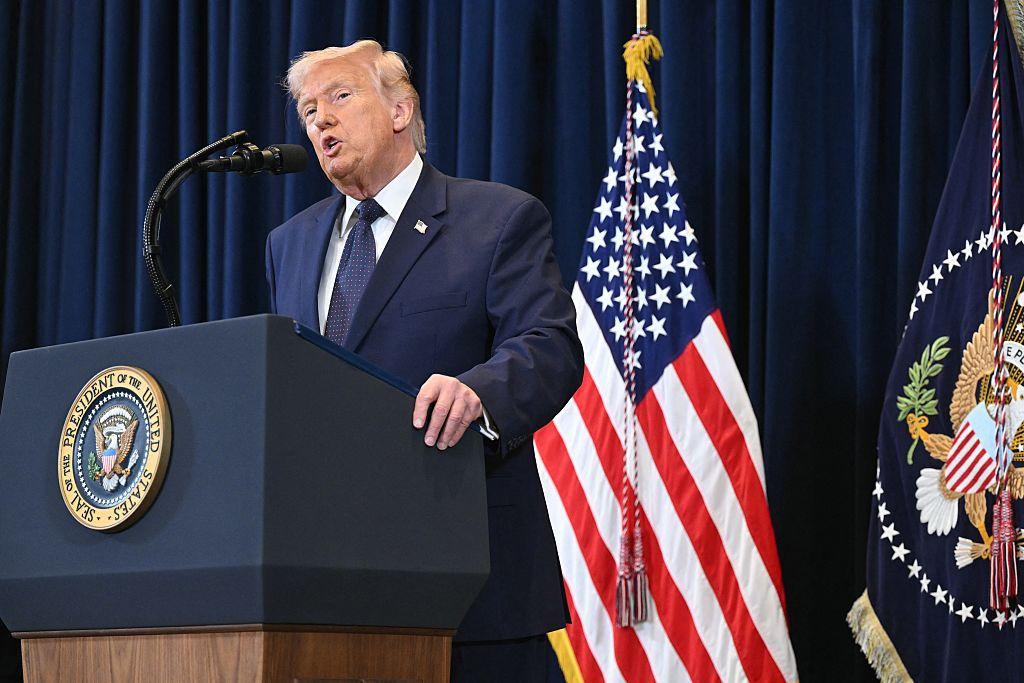
When Donald Trump says he is “not satisfied” with Iran’s latest peace proposal, I do not read it as just another diplomatic quote. I read it as a warning sign: the door to negotiation is still open, but the room is getting colder.
According to current reports, Iran’s proposal was delivered through Pakistani mediation, while Trump said Tehran was asking for things he could not accept. He also suggested that both diplomacy and military options remain on the table.
That is why this headline matters. It is not only about whether Trump liked the proposal or not. It is about what this rejection does to the emotional, political and financial temperature of the conflict.
In my view, this is the kind of news that creates pressure in several directions at once. People feel the uncertainty. Diplomats lose room to maneuver. Oil traders look at the Strait of Hormuz. Stock markets start calculating risk. Crypto traders, often faster and more emotional than traditional investors, react to fear, leverage and liquidity.
The key question now is not simply: Will there be peace?
The better question is:
Does this rejection become a negotiating tactic, or does it become the first step toward another escalation?
Why Trump’s Rejection Matters Beyond the Headline
Trump’s rejection matters because it keeps the conflict in a dangerous middle zone. There is still diplomacy, but not enough trust. There is still a ceasefire framework, but not enough confidence. There is still talk of a deal, but the language coming from Washington suggests frustration rather than momentum.
Reports say Trump described the Iranian leadership as divided and said negotiations were continuing by phone, even as he rejected the latest terms. That combination is important. It means the situation has not collapsed, but it has not improved enough to calm anyone either.
That is the uncomfortable part.
A clear breakdown would be dangerous, but at least markets and governments would understand the direction. A clear agreement would reduce tension. But this situation sits between both outcomes: diplomacy is alive, yet fragile.
I see this as more than a diplomatic disagreement. It is the kind of headline that changes the mood around the conflict. It tells ordinary people, investors and governments that the crisis is not over. It also reminds everyone that one statement from the White House can move expectations before any official decision is made.
The emotional effect is real. When peace sounds possible but unstable, people do not feel relief. They feel suspended. That uncertainty spreads from politics into markets, and from markets into daily life through oil, fuel costs, inflation expectations and financial volatility.
What Iran’s Proposal Means in the Current Conflict
Iran’s proposal appears to be part of a broader attempt to keep negotiations alive through intermediaries, especially Pakistan. The Guardian reported that Pakistan has played a key backchannel role and that the proposal came as both sides remain under pressure over the Strait of Hormuz, sanctions, nuclear issues and the future of the conflict.
The fact that Iran is still proposing something matters. It suggests Tehran may want to avoid a complete rupture, or at least wants to appear open to diplomacy. But Trump’s reaction shows that a proposal is not enough if the terms are seen as politically or strategically unacceptable.
This is where public messaging becomes part of the conflict itself.
Iran wants to show that it is not the side blocking peace. Trump wants to show that he will not accept weak terms. Pakistan wants to keep the diplomatic channel open. Markets want clarity. None of them has it yet.
What I am watching now is not only what Trump says next, but whether Iran treats this rejection as a negotiating setback or as a reason to harden its position. That distinction matters because failed diplomacy can still lead to a better proposal, but it can also become a justification for escalation.
For now, the conflict looks less like a straight road and more like a pressure system: diplomacy, oil, military threats, sanctions, domestic politics and global markets all pushing against each other.
Possible Development of the Conflict After Trump’s Statement
This is the part of the story that competitors often underdevelop. The headline tells us what Trump said. But the real value is in thinking through where the conflict could go next.
Here is the possible development map I would use.
| Scenario | What happens | Likely market mood |
|---|---|---|
| Diplomacy survives | Talks continue through Pakistan or another mediator | Cautious relief |
| Frozen conflict | No deal, but no major attack | Persistent volatility |
| Limited escalation | Targeted military action or renewed strikes | Oil higher, risk assets weaker |
| Wider regional escalation | Strait of Hormuz risk intensifies | Severe risk-off mood |
| Surprise agreement | Both sides accept a face-saving deal | Oil lower, markets calmer |
Scenario 1: Diplomacy survives, but under pressure
This is the best realistic scenario in the short term. Trump rejects the current proposal but uses that rejection to force a revised version. Iran complains publicly but keeps talking. Pakistan or another mediator continues to carry messages between both sides.
In this scenario, the language remains tense, but the practical behavior is cautious.
Brent crude could soften if traders believe the risk around the Strait of Hormuz is easing. Equities could recover some confidence. Crypto could benefit from renewed risk appetite.
But this scenario requires discipline. Both sides would need to avoid turning public frustration into military action.
Scenario 2: A frozen conflict with constant threats
This may be the most probable middle scenario. The ceasefire does not fully collapse, but it does not become peace either. Talks continue, threats continue, and the conflict becomes a long period of stress.
This is bad for emotional stability and bad for markets.
Markets hate unclear endings. And this story, at least for now, has exactly that: no final deal, no total collapse and no obvious next step.
A frozen conflict would likely keep Brent volatile, support safe-haven demand and make crypto more sensitive to headlines.
Scenario 3: Limited military escalation
Trump has reportedly kept military options on the table. A limited strike or targeted military action would not necessarily mean a full regional war, but it would change the tone immediately.
This would probably push energy-risk premiums higher. Investors would move faster into defensive positioning. Crypto could sell off sharply at first, especially if leveraged traders are forced out.
The danger of a limited strike is that “limited” is only one side’s intention. The other side decides how to respond.
Scenario 4: Wider regional escalation
This is the worst scenario: Iran, the U.S., Israel, Gulf states or allied groups become pulled into a broader chain reaction. In that case, the Strait of Hormuz becomes the center of attention again.
The Strait is one of the world’s most important oil chokepoints, and current reporting has already connected the conflict and blockade risks to major pressure on Brent crude. Reuters reported that Barclays raised its 2026 Brent forecast to $100 because of prolonged Hormuz disruption, warning that prices could move toward $110 if the disruption continues through May.
A wider escalation would be the most dangerous path for oil, inflation expectations, equities and global confidence.
Scenario 5: A surprise agreement that calms markets
This remains possible. In geopolitics, leaders sometimes reject one proposal publicly and then accept a revised version privately. A deal that lets both sides claim strength could calm markets quickly.
In this scenario, Brent could fall, equities could rally and crypto could recover if broader risk appetite returns.
But I would not treat this as the base case yet. My impression is that diplomacy is still present, but trust looks thin.
Why Oil Markets React Before Wars Actually Begin
Energy markets rarely wait for official declarations of war before reacting.
From a macro perspective, oil prices are driven not only by current supply and demand, but by expectations surrounding future disruptions. This is why geopolitical tensions in the Middle East can move Brent crude sharply higher even before any physical interruption to energy flows actually occurs.
The market is constantly pricing probabilities.
If traders believe the risk of:
- Sanctions escalation.
- Naval confrontation.
- Attacks on energy infrastructure.
- Or disruptions near the Strait of Hormuz.
Is increasing, oil prices can rise immediately as risk premiums expand.
This is especially important because the Strait of Hormuz remains one of the most critical energy chokepoints in the world. A significant portion of global crude oil and liquefied natural gas exports passes through this corridor every day.
Even small changes in perceived security conditions can therefore have a disproportionate effect on prices.
From my perspective, this explains why markets often react to rhetoric and diplomatic signals long before any real conflict materializes.
Energy markets are forward-looking systems.
They attempt to anticipate future supply shocks before they happen.
That is why:
- Political speeches.
- Military positioning.
- Sanctions threats.
- Failed negotiations.
- And diplomatic breakdowns.
Can all trigger volatility across:
- Oil markets.
- Inflation expectations.
- Bond yields.
- Equities.
- And even crypto markets.
The key issue is not only whether a war begins. It is whether markets start believing the probability of a larger disruption is increasing.
How This Could Affect Brent Crude Prices
For me, Brent crude is one of the clearest thermometers of this crisis because it reflects fear before it reflects certainty.
Oil does not wait for a war to become global. It moves when traders start pricing the possibility that supply routes, exports, shipping insurance, inventories or regional stability may be at risk.
That is why Iran matters so much to Brent. The issue is not only Iran’s own oil production. It is the geography of the conflict. The Strait of Hormuz is central because disruption there can affect the flow of global crude and liquefied natural gas. Current reporting shows that oil markets remain highly sensitive to the conflict, with Brent recently trading around elevated levels and reacting sharply to headlines about war risk and negotiations.
A rejection of Iran’s peace proposal can affect Brent in two opposite ways.
First, it can push prices higher if traders believe diplomacy is failing and escalation risk is increasing.
Second, it can temporarily pull prices lower if traders interpret the rejection as proof that talks are still happening and that both sides are negotiating rather than immediately fighting.
That second reaction may sound strange, but markets often behave that way. The same headline can be bearish or bullish depending on whether traders focus on the rejection or on the fact that diplomacy has not ended.
What could push Brent higher from here?
- A collapse in talks.
- A renewed military strike.
- More direct threats around the Strait of Hormuz.
- Signs of shipping disruption.
- Stronger sanctions or enforcement on Iranian crude.
- Any regional response involving Israel, Gulf states or proxy groups.
What could push Brent lower?
- A revised proposal.
- A confirmed diplomatic meeting.
- A reduction in blockade or shipping risk.
- Clear signs that oil flows are stabilizing.
- A broader ceasefire framework.
This is why I would not reduce the Brent story to one price target. The real issue is the risk premium. As long as traders believe the conflict can still worsen, Brent may carry a geopolitical premium even when prices pull back.
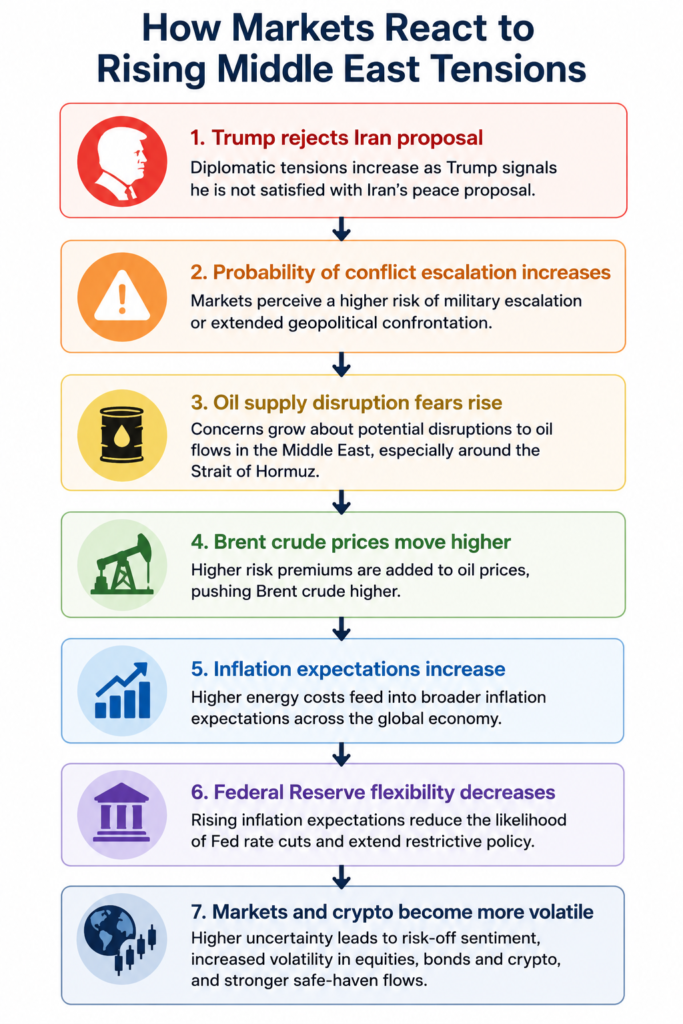
How Markets React to Rising Middle East Tensions
What It Means for Global Markets
Global markets do not only trade facts. They trade probabilities.
That is why Trump’s statement matters. Investors are not waiting for every detail of Iran’s proposal before reacting. They are asking a simpler question: does this make the world safer or riskier?
Right now, the answer is mixed.
The fact that talks continue is positive. The fact that Trump rejected the proposal is negative. The fact that military options remain part of the conversation is clearly destabilizing.
In a situation like this, investors may shift toward a risk-off mood. That usually means less appetite for equities, emerging markets and speculative assets, and more interest in safer or defensive assets such as the U.S. dollar, Treasuries, gold or energy exposure.
The inflation angle is also important. If Brent remains high because of geopolitical risk, markets may start worrying about fuel costs, transport costs and central-bank policy. An oil shock can complicate inflation expectations even when the original problem is geopolitical.
That is where this story moves from foreign policy into everyday economics.
A diplomatic delay is not the same as a real escalation. If talks drag on but violence does not increase, markets may stay volatile but functional. If escalation returns, the reaction can become faster and more defensive.
My own reading is that investors will watch three things above all:
- Whether Pakistan or another mediator announces continued talks.
- Whether the U.S. increases military pressure.
- Whether oil markets show signs of panic around Hormuz risk.
If those three signals deteriorate together, markets could become much more nervous.
What This Could Mean for Crypto
Crypto is where emotion often moves fastest.
I would be careful with the idea that Bitcoin automatically works as a safe haven during moments like this. That may be true in some narratives, but in practice Bitcoin and the wider crypto market often behave like risk assets, especially when leverage is high and liquidity is thin.
Recent crypto-market coverage has linked Bitcoin’s moves to Iran-related geopolitical headlines, with reports describing sharp reactions around ceasefire news, war-powers votes and renewed peace gestures.
That fits how I would read this situation.
When traders are calm, Bitcoin can benefit from risk appetite. When fear rises quickly, crypto can fall because traders reduce exposure, liquidations accelerate and speculative positioning unwinds.
In crypto, I would expect emotion to move faster than analysis. That is usually where volatility begins.
Why Bitcoin is not always a safe haven
Bitcoin has a “digital gold” narrative, but that does not mean it always trades like gold. During geopolitical shocks, Bitcoin may initially fall with equities and other risk assets. Later, if liquidity returns or if investors begin thinking about currency debasement and sovereign risk, Bitcoin can recover.
So the crypto reaction may come in phases:
- Initial fear.
- Liquidations and volatility.
- Repricing of risk.
- Possible recovery if diplomacy improves.
Ethereum and altcoins may be even more sensitive because they usually carry higher beta. If Bitcoin becomes volatile, smaller crypto assets can move harder in both directions.
What I would watch in Bitcoin and Ethereum
I would watch:
- Bitcoin support and resistance levels.
- Funding rates.
- Liquidation clusters.
- Stablecoin flows.
- Ethereum relative strength.
- Whether crypto moves with Nasdaq or gold.
- Whether headlines about Iran trigger immediate risk-off selling.
The key point is simple: crypto may not react to the proposal itself. It may react to what traders think the proposal means for global risk.
The Emotional Effect of Another Failed Peace Signal
This situation produces a strange kind of emotional pressure.
It is not the shock of a sudden new war. It is the exhaustion of a conflict that keeps offering hints of peace without delivering certainty.
That matters because geopolitics is not only about leaders and markets. It also affects how people feel about the future. When a peace proposal appears, people naturally want to believe the situation may improve. When that proposal is rejected, even partially, the emotional effect is heavier than a normal political disagreement.
There is disappointment. There is fatigue. There is fear that the next headline may be worse.
And this fear does not stay abstract. It moves into oil prices, travel costs, inflation concerns, investment decisions and the way people talk about the world.
Why does fragile diplomacy affect people before it affects charts? Because people understand uncertainty instinctively. You do not need to be an oil trader to know that a conflict involving Iran, the U.S. and the Strait of Hormuz can have consequences beyond the battlefield.
That is why I think the emotional layer belongs in the article. A purely technical analysis misses something important: markets are made of people, and people react to uncertainty long before the final outcome is known.
My Reading of the Situation
My reading is that the conflict is entering a more delicate phase.
Diplomacy is not dead. That is important. The existence of a proposal, mediators and ongoing communication suggests that both sides still see some value in talking.
But trust looks thin.
Trump’s rejection sends a message that Washington does not want a symbolic agreement; it wants terms it can present as strong and enforceable. Iran, meanwhile, does not want to look like it is surrendering under pressure. That creates a very narrow space for compromise.
The next move matters more than the statement itself.
If Iran returns with a revised proposal, this moment may be remembered as negotiation theater. If the U.S. increases military pressure, it may be remembered as the point where diplomacy started to fail. If both sides continue to talk while keeping public pressure high, we may enter a longer frozen conflict that keeps Brent, markets and crypto unstable.
For now, I would describe the situation this way:
The conflict is not closed. Peace is not impossible. But the margin for error is shrinking.
That is why Trump saying he is not satisfied with Iran’s peace proposal feels bigger than one headline. It is a signal that the world is still waiting for direction and markets are already trying to price the answer before politics provides one.
Conclusion
Trump’s rejection of Iran’s latest peace proposal does not mean diplomacy is over. But it does mean the path to a deal looks more fragile than investors, governments and ordinary people would like.
The immediate impact is uncertainty. The deeper impact is the possibility that uncertainty turns into a risk premium across several markets.
Brent crude remains the most obvious pressure point because of the Strait of Hormuz and the broader energy-risk story. Global markets may stay cautious because investors are pricing probabilities, not just confirmed events. Crypto could remain especially volatile because Bitcoin, Ethereum and altcoins often react quickly to fear, leverage and liquidity conditions.
My view is that this is one of those moments where the headline is only the surface. Underneath it, there is a bigger question:
Can diplomacy absorb another rejection, or is the conflict moving toward a more dangerous phase?
Until that question has a clearer answer, Brent, markets and crypto will probably keep reacting to every signal.
FAQs
Why is Trump not satisfied with Iran’s peace proposal?
Trump said Iran was asking for things he could not accept, while also suggesting that negotiations were still continuing. Reports indicate that the proposal was delivered through Pakistani mediation and that nuclear issues, sanctions, the Strait of Hormuz and military pressure remain central points of tension.
Could the U.S.-Iran conflict escalate from here?
Yes, escalation remains possible, especially if talks collapse or either side decides to increase pressure. However, diplomacy has not disappeared, which means a revised proposal or continued mediation could still prevent a wider conflict.
How could this affect Brent crude prices?
Brent crude could rise if traders believe the rejection increases the risk of military escalation or disruption around the Strait of Hormuz. It could fall if markets interpret the situation as continued negotiation rather than immediate conflict. Barclays recently raised its 2026 Brent forecast to $100, citing prolonged Hormuz disruption.
What does this mean for stock markets?
Stock markets may become more defensive if investors see the rejection as a sign of rising geopolitical risk. A risk-off move could pressure equities and support safe-haven assets such as gold, the dollar or government bonds.
Is Bitcoin a safe haven during geopolitical conflict?
Not always. Bitcoin can sometimes benefit from distrust in traditional systems, but during fast geopolitical shocks it often behaves like a risk asset. Crypto markets are especially sensitive to leverage, liquidity and sudden changes in investor sentiment.
What should investors watch next?
The most important signals are whether negotiations continue, whether the U.S. increases military pressure, whether Iran revises its proposal, and whether oil markets show renewed stress around the Strait of Hormuz.