
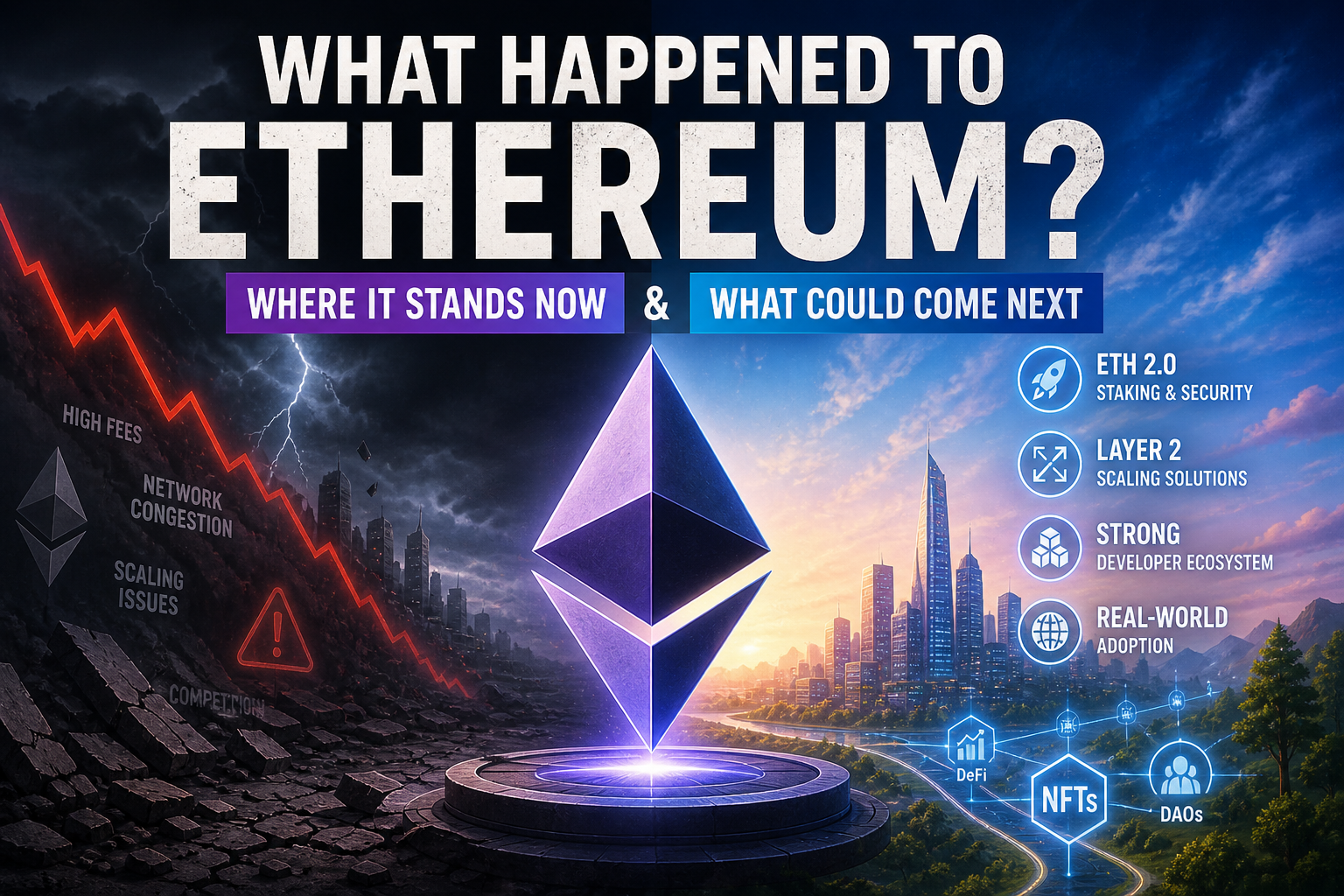
Ethereum is in one of those strange moments where the asset is still massive, the technology is still important, and yet the market mood feels far from euphoric.
After reaching major highs in previous cycles, ETH has gone through sharp corrections, long periods of doubt, and renewed debates about whether Ethereum can still dominate the smart contract economy. That is the real question for me: not just whether Ethereum can pump again, but whether it can keep adapting fast enough to deserve another major re-rating.
This is not financial advice. Crypto is volatile, and Ethereum is no exception. But if we want to understand what could happen next, we need to look at three things: what happened after the highs, where Ethereum stands now, and whether its technology is still strong enough for the next cycle.
Ethereum From All-Time Highs to Today: What Changed?
Ethereum’s story since its highs has not been a clean straight-line decline. It has been a mix of macro pressure, crypto-specific crises, changing investor expectations, and internal technological progress.
LiteFinance notes that Ethereum reached a recorded high of $4,951.66 on August 24, 2025, while also pointing to previous major growth phases driven by DeFi, NFTs, institutional interest, and the transition toward Ethereum 2.0.
The run-up that made ETH a market leader
Ethereum became much more than “another cryptocurrency” because it offered something Bitcoin did not: programmable money.
Smart contracts, DeFi, NFTs, DAOs, decentralized exchanges, tokenized assets, and later staking all gave Ethereum a strong narrative. In simple terms, Bitcoin became the digital store-of-value story, while Ethereum became the infrastructure story.
That distinction still matters. When I look at Ethereum today, I do not see only a token chart. I see a network that has already proven it can attract developers, users, capital, and entire categories of applications.
Why Ethereum lost momentum after the peak
Ethereum’s decline from its highs was not caused by one single factor. Several things stacked up:
- Broader crypto market weakness.
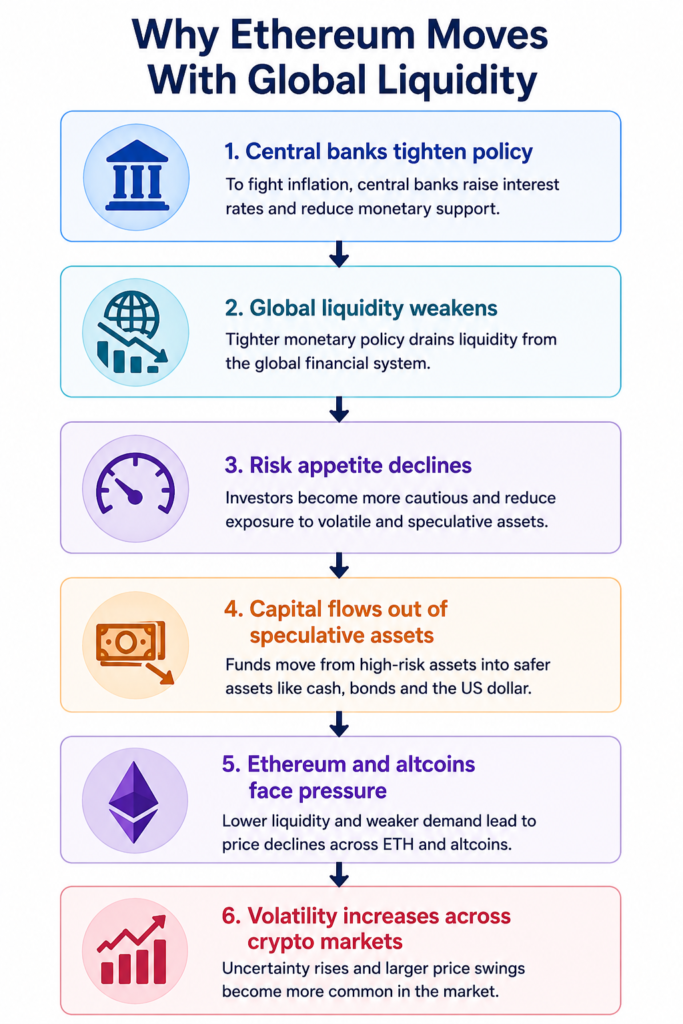
- Liquidity tightening.
- Major collapses across the crypto industry.
- Competition from faster and cheaper blockchains.
- Investor frustration with gas fees and scalability.
- And a cooling-off period after the DeFi and NFT hype.
LiteFinance highlights the 2022 market crash, including Terra and FTX-related stress, as part of the broader pressure that hit Ethereum and the crypto market.
But here is the important nuance: a falling price does not automatically mean a broken network. Sometimes the market overprices a story during euphoria, then underprices the same story during fear.
That is the phase Ethereum seems to be in now.
The difference between a price correction and a broken thesis
For me, the key is separating two questions:
Question 1: Did Ethereum fall hard from its highs?
Yes.
Question 2: Is the Ethereum thesis dead?
Not necessarily.
Ethereum still has one of the deepest ecosystems in crypto. It still powers a large amount of DeFi activity, stablecoin infrastructure, tokenization experiments, and developer activity. The bearish argument is not that Ethereum has no value. The bearish argument is that Ethereum may lose relative dominance if it cannot scale, reduce friction, and compete with faster ecosystems.
That makes the next few years especially important.
Why Ethereum Moves With Global Liquidity
Where Ethereum Stands Right Now
Ethereum is no longer trading with the same level of hype that surrounded previous bull market phases. Current sentiment is more cautious, and that is visible in how analysts talk about ETH: less pure excitement, more scenario-based thinking.
BLOX structures its Ethereum forecast around bearish, neutral, and bullish scenarios, while also using market sentiment tools such as the Fear and Greed indicator.
How far ETH is from its all-time high
At the time referenced by LiteFinance, ETH was listed around $2,295.75 on May 1, 2026, far below the cited high of $4,951.66. That gap matters because it shows Ethereum is still trying to rebuild confidence after a major drawdown.
But being below an all-time high is not automatically negative. It can mean the market is skeptical, but it can also mean expectations have reset.
Personally, this is where I think Ethereum becomes interesting again: not because it is guaranteed to recover, but because the easy hype has faded. When everyone already agrees an asset is unstoppable, the upside is often priced in. When people start doubting it, the analysis becomes more useful.
What the market is pricing in today
The market seems to be asking Ethereum a very direct question:
Can you still grow when newer chains are faster, cheaper, and easier to use?
Ethereum’s answer so far has been to lean into scaling, layer 2 networks, staking, security, and institutional-grade infrastructure. That is a reasonable strategy, but it is not risk-free.
The challenge is that retail users often care about speed and cost more than decentralization theory. If another chain gives them a smoother experience, they may not care that Ethereum has better settlement credibility.
That is why Ethereum cannot rely only on being “the original smart contract platform.” It has to keep improving.
Why sentiment around Ethereum feels mixed
The sentiment is mixed because both sides have valid arguments.
The bullish side says Ethereum still dominates key crypto infrastructure: stablecoins, DeFi, tokenization, institutional narratives, and developer tooling.
The bearish side says Ethereum has become too complex, too expensive at the base layer, and too dependent on layer 2 adoption. It also faces serious competition from Solana and other faster chains.
That is the tension behind ETH today. The technology is not obsolete, but the market wants proof that it can keep adapting.
Is Ethereum Still a Strong Technology Bet?
In my view, this is the most important part of the Ethereum debate.
Price predictions are everywhere. Some are realistic, some are marketing, and some are just designed to get clicks. But the real long-term question is: does Ethereum still have technological relevance?
I think the answer is yes but with conditions.
Ethereum’s biggest strengths in 2026
Ethereum still has several strengths that are hard to copy:
- Network effect: developers, protocols, wallets, exchanges, and users already know Ethereum.
- Smart contract credibility: Ethereum has been battle-tested for years.
- DeFi depth: many of the most important decentralized finance experiments started on Ethereum.
- Layer 2 ecosystem: scaling is increasingly happening through rollups and secondary networks.
- Institutional familiarity: Ethereum is one of the few crypto assets large investors tend to understand.
LiteFinance describes Ethereum as an open-source decentralized network using smart contracts, with ETH as its internal digital currency and Ethereum as a platform for DApps, DEXs, DeFi, NFTs, DAOs, blockchain gaming, identity systems, and supply chain applications.
That ecosystem breadth is Ethereum’s biggest advantage.
The limits: speed, fees and competition
Ethereum’s weaknesses are also obvious.
Base-layer Ethereum can be expensive and slow compared with some competitors. For everyday users, that matters. A technically elegant blockchain does not automatically win if the user experience is painful.
This is where I stay cautious. I do not think Ethereum is “dead,” but I also do not think it can coast on reputation forever.
Solana and other high-throughput chains have shown that users care about cheap transactions, fast confirmation, and simple UX. Ethereum’s long-term success depends on whether its scaling roadmap can deliver a smoother experience without weakening the security and decentralization that made Ethereum valuable in the first place.
Why layer 2 adoption matters more than ever
Ethereum’s future is increasingly tied to layer 2 networks.
The basic idea is simple: Ethereum becomes the secure settlement layer, while layer 2s handle more transactions at lower cost. If this works, Ethereum can scale without sacrificing its core security model.
But this also creates complexity. Users may not always understand bridges, rollups, different networks, fragmented liquidity, or which layer 2 they should use.
So Ethereum’s technical challenge is not only scalability. It is also usability.
If Ethereum and its layer 2 ecosystem can make the experience feel seamless, the bullish case gets stronger. If the experience remains fragmented, faster competitors can keep gaining mindshare.
Can Ethereum Still Adapt?
Ethereum has already shown that it can change. The move from Proof of Work to Proof of Stake was a major example.
LiteFinance notes that Ethereum shifted to Proof of Stake in 2022, improving energy efficiency and security compared with Proof of Work.
That matters because it proves Ethereum is not frozen. It can evolve.
Proof of Stake was only the beginning
The transition to Proof of Stake changed Ethereum’s economic and technical structure. It introduced staking, changed issuance dynamics, and made the network more energy efficient.
But it did not solve everything.
Ethereum still needs better scalability, lower transaction friction, improved user experience, and stronger integration between the base layer and layer 2 ecosystem.
So when I think about Ethereum’s future, I do not see Proof of Stake as the final destination. I see it as proof that Ethereum can execute major upgrades and now the market wants to see the next phase.
How Ethereum is trying to scale
Ethereum’s scaling path is not about turning the base layer into the fastest chain in crypto. Instead, it is about combining base-layer security with layer 2 execution.
That is a different bet from Solana’s approach. Ethereum is effectively saying:
We may not be the cheapest base layer, but we can be the most trusted settlement layer for a large modular ecosystem.
That strategy can work, especially for institutions, tokenized assets, stablecoins, and DeFi. But it needs adoption and clean UX.
Standard Chartered analyst Geoff Kendrick, according to Investing.com, pointed to Ethereum’s role in stablecoins, tokenized real-world assets, and DeFi as long-term growth drivers, while also highlighting plans to increase layer 1 throughput over the next few years.
The challenge from Solana and other faster chains
Ethereum’s competition is real.
Solana, for example, has built a strong narrative around speed, low fees, and consumer-friendly applications. Other chains are also competing for developers and liquidity.
This does not mean Ethereum loses automatically. But it does mean Ethereum has to justify its premium.
In my view, Ethereum’s strongest path is not trying to become “just like Solana.” It is becoming the most trusted settlement and smart contract ecosystem while making layer 2 usage almost invisible to the end user.
That is a difficult balance but if Ethereum gets it right, it remains highly relevant.
Ethereum Price Scenarios for the Next Few Years
Nobody knows exactly where ETH will trade in the future. Any serious forecast should be scenario-based, not presented as certainty.
The competitors use this same logic. BLOX separates forecasts into bearish, neutral, and bullish scenarios, while Investing.com reports a much more aggressive Standard Chartered forecast, including targets of $7,500 by the end of 2026, $15,000 by the end of 2027, $22,000 by the end of 2028, $30,000 in 2029, and $40,000 by the end of 2030.
Those numbers are not guarantees. They are one institution’s scenario. But they are useful because they show how wide the range of expectations can be.
Bull case: what could push ETH higher
The bullish case for Ethereum depends on several things going right:
- Crypto enters another strong risk-on cycle.
- Ethereum ETFs and institutional demand strengthen.
- Layer 2 adoption becomes smoother.
- DeFi activity expands again.
- Tokenized real-world assets grow on Ethereum.
- Stablecoin activity remains Ethereum-centered.
- Regulation becomes clearer.
- And ETH regains momentum against BTC.
In this scenario, ETH could recover strongly because the market would stop seeing Ethereum as “old crypto infrastructure” and start seeing it again as the base layer for digital finance.
This is the version of Ethereum I still find compelling: not hype-driven, but infrastructure-driven.
Base case: slow recovery and steady relevance
The base case is less exciting but probably more realistic.
Ethereum remains highly relevant, but competition prevents it from dominating the narrative the way it once did. ETH recovers over time, but with volatility. Layer 2s grow, but the user experience remains somewhat fragmented. Institutions keep exploring Ethereum, but retail attention rotates between other ecosystems.
In this scenario, Ethereum does not disappear. It becomes more like a mature crypto infrastructure asset: important, widely used, but not always the fastest-growing story in the market.
That may sound less exciting, but it could still support long-term value.
Bear case: what could go wrong
The bearish case is not impossible.
Ethereum could underperform if:
- Layer 2 fragmentation gets worse.
- Users migrate to faster chains.
- Fees remain a psychological barrier.
- DeFi growth disappoints.
- Regulation limits on-chain activity.
- ETH loses monetary premium.
- Or developers gradually shift elsewhere.
The biggest risk, in my opinion, is not one sudden failure. It is slow relevance decay.
Ethereum does not need to collapse to disappoint investors. It only needs to grow slower than expectations while competitors capture the next wave of users.
That is why adaptation matters so much.
Ethereum From ATH to Future Scenarios
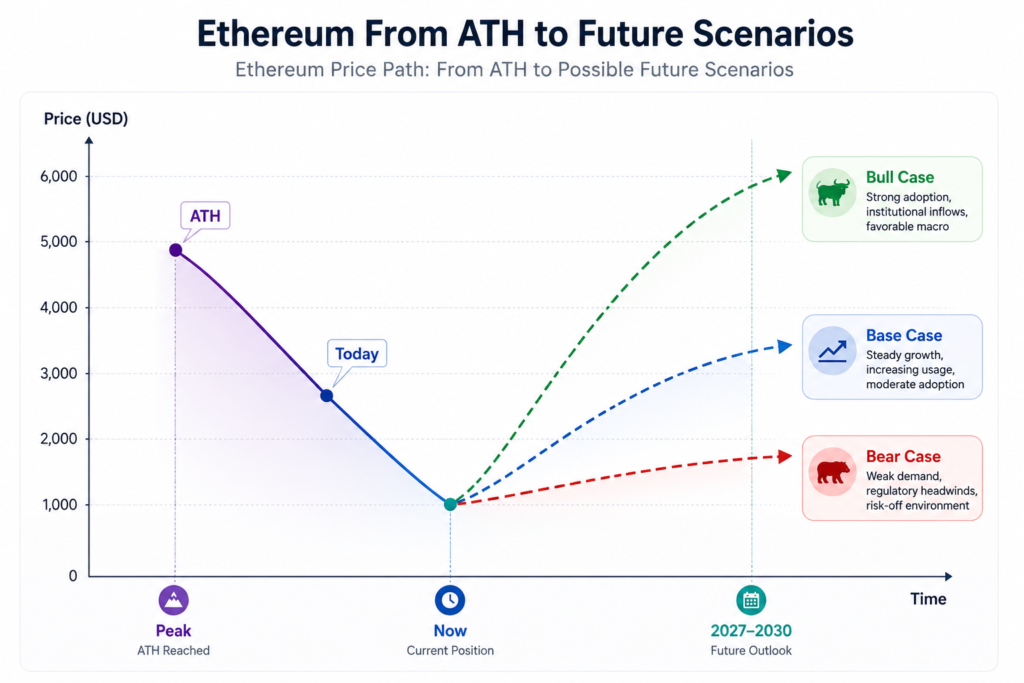
Ethereum has already gone through a major reset from its highs. The next phase depends on whether adoption, scalability, institutional demand, and competition push ETH into a bullish, neutral, or bearish path.
This chart would work well after the “Ethereum Price Scenarios” section because it visually summarizes the entire article.
My Take: Is Ethereum Still Worth Watching?
Yes, Ethereum is still worth watching.
But I would not watch it blindly.
For me, Ethereum is no longer just a “number go up” story. It is an execution story. The network has to prove that it can scale, simplify the user experience, stay attractive to developers, and defend its role in DeFi, stablecoins, tokenization, and smart contracts.
I am not writing Ethereum off because its ecosystem is still too important to ignore. Ethereum has survived multiple market cycles, upgraded its consensus model, and remained central to some of crypto’s most important use cases.
But I am also not ignoring the risks. The market is more competitive now. Users have more options. Developers have more chains to build on. And investors are less willing to pay premium prices for vague promises.
Why I’m not writing Ethereum off yet
I still think Ethereum has one of the strongest long-term foundations in crypto.
The combination of security, developer history, institutional recognition, smart contract infrastructure, and layer 2 expansion gives Ethereum a serious chance to remain central to the industry.
If crypto keeps moving toward tokenized assets, stablecoins, on-chain finance, and decentralized infrastructure, Ethereum is still one of the most obvious places for that activity to happen.
What would make me more bullish
I would become more bullish on Ethereum if I saw:
- stronger ETH performance against BTC,
- simpler layer 2 user experience,
- rising DeFi and stablecoin activity,
- clearer regulation for on-chain finance,
- lower transaction friction,
- and renewed developer momentum.
The biggest signal would be real usage growth, not just price speculation.
What would make me more cautious
I would become more cautious if Ethereum keeps losing attention to faster chains, if layer 2 fragmentation remains confusing, or if ETH fails to capture value from the activity happening across its ecosystem.
That last point is important. Ethereum can be technologically important and still disappoint as an investment if value capture is weak.
That is why investors should look beyond headlines and ask: is ETH itself benefiting from Ethereum’s growth?
Conclusion
Ethereum has fallen far from its most euphoric phases, but that does not mean the story is over.
The better way to frame Ethereum today is this: ETH is in a proof phase. It has already proven that smart contracts matter. It has already proven that decentralized applications can attract capital. It has already proven that the network can upgrade.
Now it has to prove that it can scale, simplify, compete, and stay relevant in a much tougher market.
My view is balanced: Ethereum still has one of the strongest foundations in crypto, but the next few years will be decisive. If scaling improves, institutional adoption grows, and Ethereum remains central to DeFi, stablecoins, and tokenization, ETH could have a strong future. If competition keeps eating into its relevance, the upside becomes harder to defend.
So, what happened to Ethereum?
It went from hype to reality.
What comes next?
That depends on whether Ethereum can turn its technology, ecosystem, and adaptability into real growth again.
From my perspective, Ethereum’s future will depend not only on crypto adoption itself, but on whether the broader global liquidity environment eventually turns supportive again.
FAQ
Will Ethereum recover?
Ethereum can recover, but it depends on market conditions, adoption, scaling progress, regulation, and whether ETH can regain investor confidence. A recovery is possible, but not guaranteed.
Can Ethereum reach a new all-time high?
Yes, it is possible if crypto enters another strong cycle and Ethereum benefits from institutional demand, DeFi growth, tokenization, stablecoins, and better scalability. However, competition and execution risk remain important obstacles.
Is Ethereum still a good long-term asset?
Ethereum is still one of the most important crypto assets, but it is not risk-free. It may appeal to long-term investors who believe in smart contracts, DeFi, tokenized assets, and layer 2 scaling. Investors should also consider volatility, competition, and regulatory risk.
Is Ethereum technology still good?
Yes, Ethereum’s technology is still highly relevant. Its strengths include smart contracts, developer network effects, Proof of Stake, DeFi infrastructure, and layer 2 scaling. The main challenge is making the ecosystem faster, cheaper, and easier to use.
What is the biggest risk for Ethereum?
The biggest risk is not that Ethereum suddenly disappears. The bigger risk is gradual loss of relevance if users, developers, and liquidity move to faster or simpler blockchain ecosystems.
What could drive Ethereum higher in the next few years?
Potential drivers include stronger institutional adoption, Ethereum ETFs, growth in stablecoins, tokenized real-world assets, DeFi activity, clearer regulation, improved scalability, and better ETH value capture.