Key Takeaways
When the dollar strengthens, it usually means global investors are moving toward liquidity, safety and stability.
A stronger dollar can be driven by risk aversion, higher Treasury yields, expectations around the Federal Reserve, geopolitical tension and rising demand for safe-haven assets.
The hidden risk is that dollar strength can quietly tighten global financial conditions, especially for emerging markets, companies with dollar debt and risk assets such as stocks, commodities and crypto.
Recent market coverage has linked the dollar’s strength to oil, geopolitical uncertainty, the Federal Reserve and safe-haven flows. That gives us the headline. But the deeper question is: what is the dollar really telling us?
What Does It Mean When the Dollar Strengthens?
When people say “the dollar is strengthening,” they mean the US dollar is gaining value against other currencies. In simple terms, one dollar can buy more euros, yen, pesos, pounds or other currencies than before.
That may sound like a technical foreign-exchange move, but it matters far beyond the forex market. The US dollar is the world’s dominant reserve currency. It is used in global trade, commodities, debt markets, central bank reserves and cross-border finance. So when the dollar rises, it is not just one currency moving. It is a signal moving through the entire financial system.
A stronger dollar can mean several things at once. It can mean investors prefer US assets. It can mean interest rates in the United States look more attractive than elsewhere. It can mean global uncertainty is rising. It can also mean investors are reducing exposure to riskier assets and moving toward cash-like safety.
When I look at a stronger dollar, I do not see only a powerful currency. I see a thermometer of global fear. Sometimes the dollar rises because the US economy looks strong. But in stressful moments, it often rises because everything else looks fragile.
That distinction is important. A strong dollar is not always a “good news” story. It can be a confidence signal, but it can also be a stress signal.
For example, if the dollar strengthens because investors expect the Federal Reserve to keep rates higher for longer, that can pressure stocks and bonds. If it strengthens because geopolitical tensions are rising, that can mean investors are searching for safety. And if it strengthens while emerging-market currencies fall, that can reveal deeper pressure in global liquidity.
So the real question is not simply: is the dollar going up?
The better question is: why is the dollar going up and who is being squeezed by that move?
Why Does the Dollar Strengthen in Times of Uncertainty?
The dollar often strengthens during uncertainty because investors want three things: liquidity, safety and depth.
Liquidity means investors can enter and exit positions quickly. Safety means they trust the asset during periods of stress. Depth means the market is large enough to absorb huge flows of capital. The US dollar and US Treasury market offer all three.
That is why, during geopolitical tension, financial panic or recession fears, investors often move toward the dollar. This is known as a flight to safety or safe-haven demand.
In my view, the dollar becomes attractive in moments of stress not because investors are necessarily chasing high returns, but because they are trying to protect capital. When uncertainty rises, the first instinct is often not “how much can I make?” but “where can I hide?”
Several forces can push the dollar higher:
Safe-Haven Demand
When investors become nervous, they tend to sell riskier assets and move into assets perceived as safer. The dollar benefits because it is widely used, highly liquid and central to the global financial system.
This is why the dollar can strengthen during wars, banking stress, inflation scares or sudden market selloffs. Recent competitor coverage also framed the dollar’s strength around geopolitical risk, oil pressure and risk aversion.
Treasury Yields and the Federal Reserve
The dollar can also rise when US bond yields increase. Higher Treasury yields may attract foreign capital because investors can earn more on dollar-denominated assets.
The Federal Reserve matters here. If markets believe the Fed will keep rates high, cut rates more slowly or remain cautious on inflation, that can support the dollar. Vanguardia’s market coverage highlighted how US Treasury yields and expectations around the Fed were helping support the dollar.
Geopolitical Tensions, Oil and Risk Aversion
Geopolitical tension can strengthen the dollar in two ways. First, it increases demand for safe assets. Second, it can lift oil prices, which may feed inflation concerns and complicate central bank policy.
That creates a difficult mix: investors become more defensive, inflation expectations can rise, and markets start reassessing interest-rate paths. In that environment, the dollar can become the main beneficiary.
How a Stronger Dollar Impacts Financial Markets
A stronger dollar affects markets because it changes the price of money globally. It influences corporate earnings, commodities, capital flows, debt costs and investor sentiment.
That is why I usually pay attention not only to the dollar itself, but also to what happens next in stocks, commodities, bonds and emerging-market currencies. The dollar is often the first signal. The damage, or opportunity, appears later in other assets.
Stocks: Pressure on Earnings and Risk Appetite
A strong dollar can hurt multinational companies because foreign revenues become less valuable when translated back into dollars. For US companies with large international sales, this can reduce reported earnings.
It can also pressure risk appetite. If the dollar is rising because investors are scared, stocks may struggle. A dollar rally caused by fear is very different from a dollar rally caused by healthy growth.
Technology stocks, growth stocks and highly valued companies can be especially sensitive if dollar strength comes with higher yields. Higher yields reduce the appeal of future earnings, and a stronger dollar can add another layer of pressure.
Bonds: Safety, Yields and Expectations
The bond market can react in different ways. If the dollar rises because US yields are climbing, bonds may be under pressure. If the dollar rises because investors are rushing into safety, Treasuries may benefit.
This is why context matters. A rising dollar with rising yields tells one story. A rising dollar with falling yields tells another.
Commodities: Oil and Gold React Differently
Commodities are often priced in dollars. When the dollar strengthens, commodities can become more expensive for buyers using other currencies. That can pressure demand. Gold is more complicated. It can suffer when the dollar and yields rise, because gold does not pay interest. But it can also rise during severe stress because it is another safe-haven asset.
Oil adds another layer. If oil rises because of geopolitical tension, that can support inflation concerns and strengthen the dollar through expectations of tighter monetary policy.
Emerging Markets: The Weakest Link
Emerging markets are often vulnerable to dollar strength. Many countries and companies borrow in dollars. When their local currency weakens against the dollar, that debt becomes more expensive to service.
This can trigger capital outflows, weaker currencies, higher inflation and pressure on central banks. In a strong-dollar cycle, emerging markets can become the place where global stress becomes visible first.
Crypto and High-Risk Assets
Crypto and other high-risk assets usually depend heavily on liquidity and risk appetite. If dollar strength reflects tighter liquidity or fear, speculative assets can struggle.
A strong dollar can drain enthusiasm from risk markets because investors become less willing to chase volatile returns.
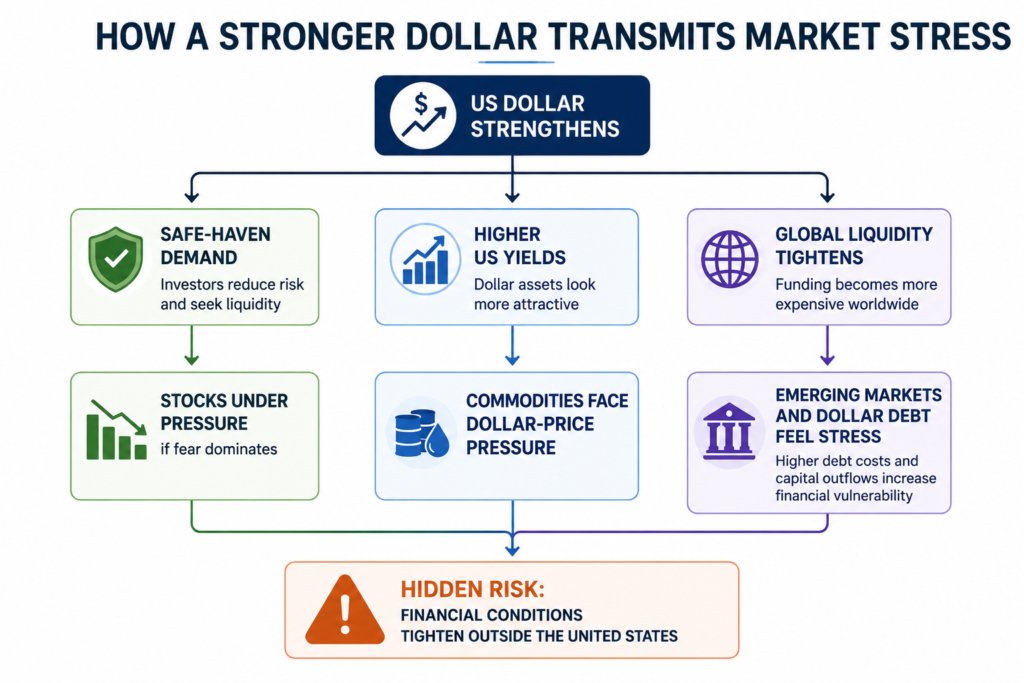
This is the part many headlines miss. The dollar can look strong on the surface, but underneath, that strength may be transmitting pressure through several channels at once.
For me, the hidden risk is not simply that the dollar rises. The hidden risk is that the dollar rises while liquidity becomes more expensive, risk appetite fades and weaker parts of the market start to crack.
The Hidden Risk: A Strong Dollar Can Tighten Global Liquidity
The hidden risk behind a stronger dollar is that it can make global financial conditions tighter.
That sounds abstract, but the mechanism is simple. A large part of the world borrows, trades and saves in dollars. When the dollar becomes more expensive, access to that dollar system can become more difficult.
Companies with dollar-denominated debt may need more local currency to repay the same dollar obligation. Governments with external debt may face rising repayment pressure. Importers may pay more for dollar-priced goods. Central banks may be forced to defend their currencies or keep rates higher than they would like.
This is why dollar strength can become self-reinforcing. As the dollar rises, investors may pull money from weaker markets. That weakens local currencies. Weaker local currencies make dollar debt heavier. That increases stress. More stress creates more demand for dollars.
The cycle can look like this:
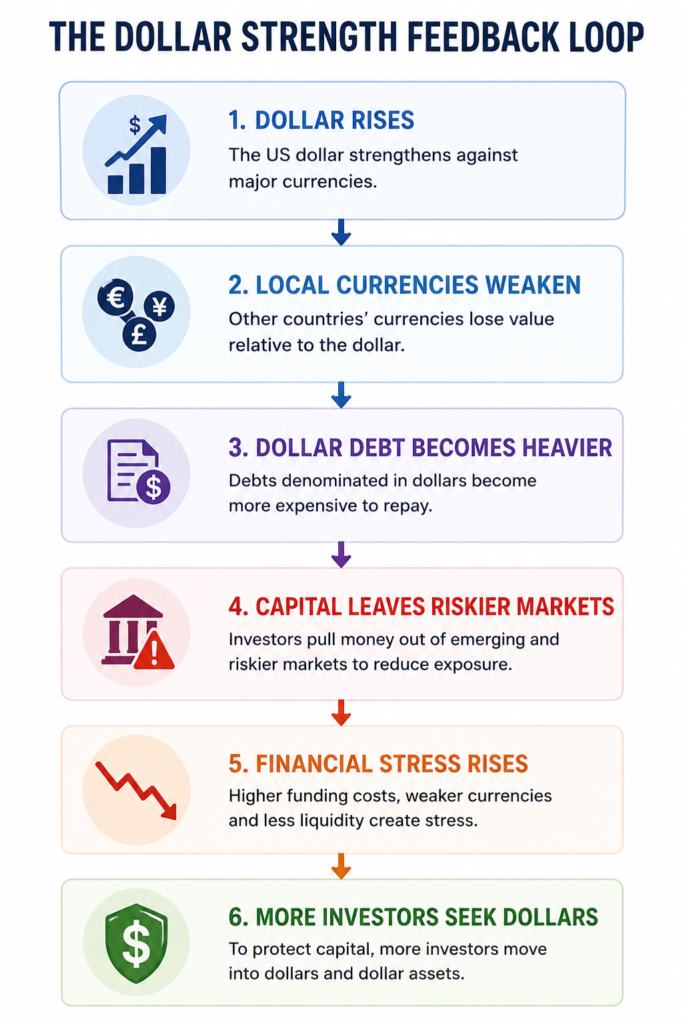
That is the danger. A stronger dollar can become both the result of fear and the cause of more fear.
This is also why I do not like reading dollar strength in isolation. A dollar rally may look clean on a chart, but the consequences can be messy across global markets.
The dollar is not just a currency. In moments of stress, it becomes a pressure test.
Is a Strong Dollar Good or Bad?
A stronger dollar is neither automatically good nor automatically bad. It depends on why it is rising and who you are.
For US consumers, a stronger dollar can make imports cheaper. It can help reduce some imported inflation. It may also make international travel cheaper for Americans.
For US exporters, it can be a problem. A stronger dollar makes American goods more expensive abroad. It can also reduce the value of foreign revenues when companies convert them back into dollars.
For investors, the answer depends on the asset. Dollar strength can support cash and dollar assets, but pressure stocks, commodities and emerging-market exposure.
For emerging markets, a strong dollar is often a challenge. It can weaken local currencies, increase debt costs and force central banks into difficult decisions.
So instead of asking whether a strong dollar is good or bad, I prefer asking:
Who benefits from this dollar move, and who gets squeezed?
That question gives a much clearer market reading.
What Investors Should Watch Next
When the dollar strengthens, investors should not watch the dollar alone. They should watch the chain reaction.
The most important signals are:
- US Dollar Index / DXY: confirms whether dollar strength is broad or isolated.
- Treasury yields: show whether the move is linked to rates.
- Federal Reserve expectations: help explain whether monetary policy is supporting the dollar.
- Oil prices: matter because energy shocks can feed inflation and risk aversion.
- Gold: shows whether investors are also buying alternative safe havens.
- Emerging-market currencies: often reveal stress earlier than developed markets.
- Credit spreads: show whether financial stress is spreading.
- Stocks and high-beta assets: reveal whether risk appetite is weakening.
A strong dollar becomes more worrying when it rises at the same time as emerging-market currencies fall, credit spreads widen and stocks lose momentum.
That combination suggests the dollar is not just strong. It suggests markets are becoming defensive.
Conclusion: The Dollar Is a Refuge, But Also a Warning Signal
The dollar strengthens as a safe haven because investors trust its liquidity, depth and global role. In moments of uncertainty, the dollar becomes the place where capital hides.
But that refuge has a hidden risk.
A stronger dollar can tighten global liquidity, pressure emerging markets, weigh on commodities, hurt multinational earnings and expose debt vulnerabilities. It can also tell us that investors are not simply optimistic about the United States they may be nervous about everything else.
For me, the key is not to ask whether a strong dollar is good or bad. The better question is:
What kind of fear is pushing investors into it?
Because when the dollar rises as a refuge, it may be offering safety to some investors while creating pressure for the rest of the market.
That is the paradox of dollar strength.
It protects.
It pressures.
And sometimes, it warns.
FAQs
What does a stronger dollar mean?
A stronger dollar means the US dollar is gaining value against other currencies. It can buy more foreign currency than before, and it often reflects demand for dollar-denominated assets.
Why is the dollar considered a safe haven?
The dollar is considered a safe haven because it is the world’s most important reserve currency and is supported by deep, liquid financial markets, especially US Treasuries.
Why does the dollar rise during uncertainty?
The dollar often rises during uncertainty because investors move away from riskier assets and toward liquidity and perceived safety. This is known as a flight to safety.
How does a strong dollar affect stocks?
A strong dollar can pressure stocks by reducing multinational earnings, tightening financial conditions and weakening risk appetite, especially if the move is driven by fear or higher yields.
How does a strong dollar affect commodities?
Many commodities are priced in dollars. When the dollar rises, commodities can become more expensive for buyers using other currencies, which may reduce demand. Gold can behave differently because it is also considered a safe-haven asset.
How does dollar strength affect emerging markets?
Emerging markets can suffer when the dollar strengthens because dollar-denominated debt becomes more expensive, local currencies weaken and foreign capital may leave riskier markets.
What is the hidden risk of a stronger dollar?
The hidden risk is that dollar strength can quietly tighten global financial conditions. It can increase debt pressure, reduce liquidity and amplify stress across risk assets and emerging markets.