
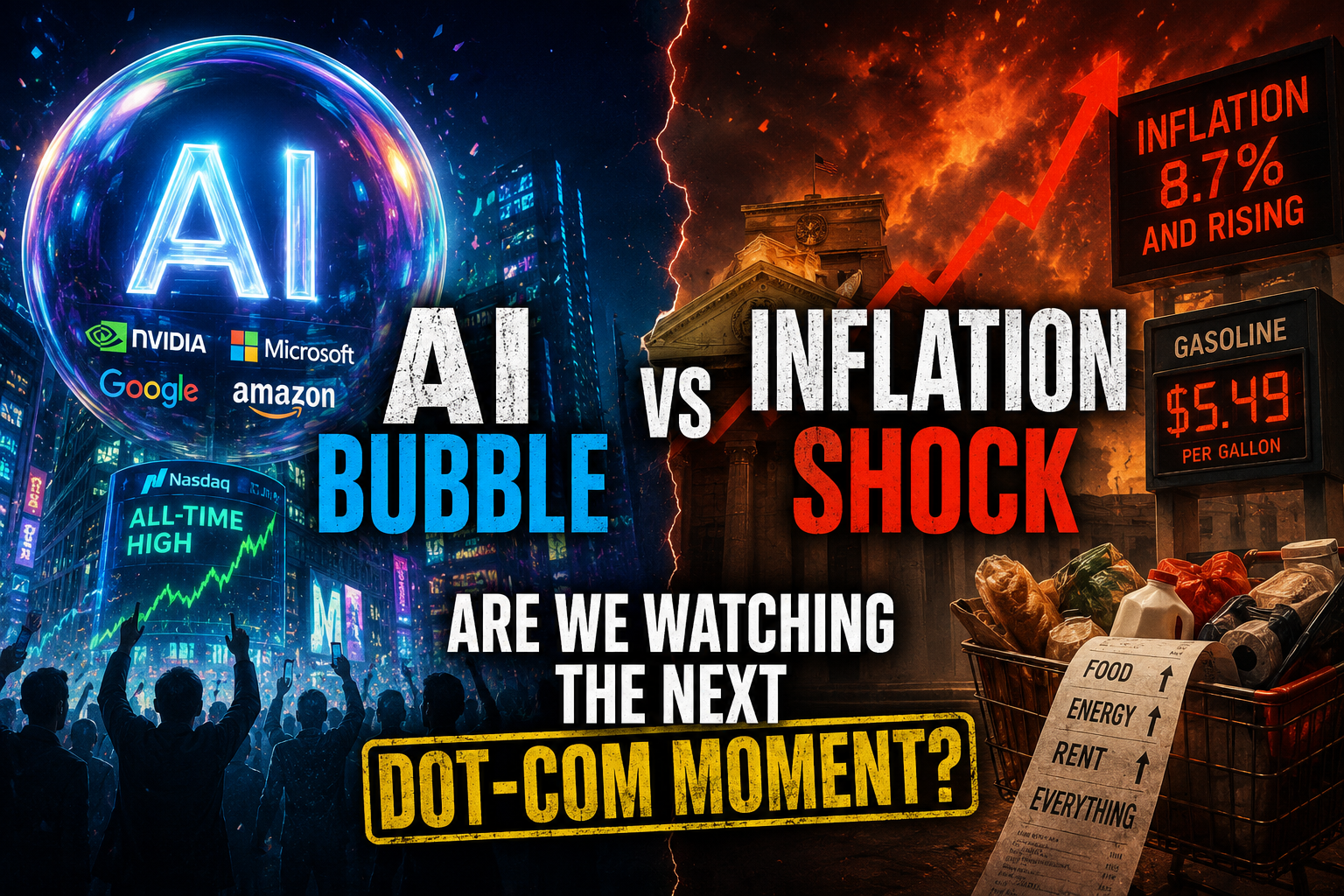
The AI trade has become the stock market’s favorite story. And to be fair, it is a powerful story.
Artificial intelligence is not some random buzzword with no real-world use case. Companies are spending real money. Data centers are being built. Semiconductors are in massive demand. Cloud giants are committing hundreds of billions of dollars to AI infrastructure. Goldman Sachs noted that hyperscalers have committed around $755 billion in capex this year, up 38% year over year, which helps explain why semiconductor earnings have remained so strong.
So no, I’m not here to say AI is fake.
But I do think we need to ask a more uncomfortable question:
Can the technology be real while the stocks are still overpriced?
In my opinion, yes. That is exactly where the danger may be. The market does not need AI to fail for AI stocks to fall. It only needs expectations to get too high, valuations to get too stretched, and inflation to keep interest rates higher than investors expected.
That is why the real debate is not just AI bubble vs no AI bubble.
It is AI bubble vs inflation shock.
And right now, those two risks may be colliding.
The AI Rally Looks Powerful, but It Also Looks Crowded
The current AI rally has a strange feeling to it. On one side, the fundamentals look much better than a classic empty bubble. The largest AI-related companies are not tiny startups with no revenue. Many of them are profitable, dominant, and deeply embedded in the global economy.
That is the main difference between today’s AI boom and the late-1990s dot-com mania. Back then, many internet companies were being valued on clicks, eyeballs, and dreams. Today, the leaders of the AI trade include companies with real earnings, real cash flow, real customers, and real pricing power.
But that does not automatically make the market safe.
Goldman’s Shawn Tuteja described the current setup as a “tale of two markets”: AI-related stocks on one side, and almost everything else on the other. The S&P 500 and Nasdaq have become heavily influenced by AI names, while other parts of the market are dealing with weaker growth, inflation pressure, and rate sensitivity.
That concentration matters.
When a small group of stocks carries the index, the market can look healthier than it really is. The headline S&P 500 may be hitting highs, but under the surface, the rally can become narrow. That is usually one of the first warning signs I watch.
I do not think every AI stock is a bubble. But I do think investors are starting to treat AI as the only place to hide. And when everyone believes the same trade is obvious, safe, and inevitable, that is when I start paying closer attention.
Why I’m Not Calling AI “Fake”
There is a lazy version of the AI bubble argument that says, “AI is just hype.” I do not agree with that.
AI is already changing software, cloud computing, advertising, chip demand, data centers, cybersecurity, enterprise workflows, and even how people search for information. The demand for semiconductors, memory chips, networking equipment, power infrastructure, and cooling systems is not imaginary.
The problem is not the technology.
The problem is the price investors are willing to pay for that technology.
Markets can get the direction right and the valuation wrong. That happened during the dot-com bubble. The internet was real. E-commerce was real. Search was real. Online advertising was real. But investors still overpaid for many companies that either disappeared or took more than a decade to justify their valuations.
That is the risk with AI.
A great theme does not always equal a great entry price.
The Problem Is That Markets May Be Pricing Perfection
When a stock is cheap, it can survive bad news. When a stock is priced for perfection, even good news may not be enough.
That is where AI feels dangerous to me.
Investors are not just pricing in growth. They are pricing in massive AI adoption, endless capex, strong margins, low financing stress, continued earnings beats, and a market that stays willing to pay premium multiples for future profits.
That is a lot to ask.
And the moment one part of that story cracks inflation, yields, guidance, demand, margins, or capex discipline the market could reprice very quickly.
The Biggest AI Bubble Indicators I’m Watching Right Now
A bubble is not just “stocks going up.” Stocks can go up for good reasons.
A bubble is when price, narrative, positioning, and behavior all start feeding on each other. Investors stop asking, “What is this worth?” and start asking, “How much higher can it go before I miss out?”
That is the part of the AI trade that worries me.
Extreme Concentration in a Few Mega-Cap Stocks
The first warning sign is concentration.
If the entire market depends on a handful of AI winners, then the index becomes more fragile than it looks. A broad bull market can absorb weakness in one sector. A narrow bull market cannot.
When AI stocks are pulling the S&P 500 and Nasdaq higher while financials, materials, consumer discretionary, and other cyclical sectors struggle, the market is not as balanced as the headline numbers suggest.
Business Insider recently highlighted this exact split. Tech was leading the market, while inflation-sensitive areas like materials, financials, consumer discretionary, and communication services were under pressure. The spread between the best-performing sector, information technology, and the worst-performing sector, financials, reached 25 percentage points.
That kind of divergence can continue for a while. But it usually does not continue forever.
Valuations That Leave No Room for Error
The second indicator is valuation.
According to Financial News, the S&P 500’s 12-month forward price-to-earnings ratio stood at 21.3x, well above its long-term average of 16x. The same article noted that when rates rise, the present value of future earnings falls, which tends to hurt richly valued growth stocks the most.
That is a major issue for AI stocks.
AI is a long-duration story. Investors are paying today for profits they expect years into the future. That makes the sector highly sensitive to interest rates. If Treasury yields rise, the discount rate rises. If the discount rate rises, future earnings are worth less today.
That does not mean AI companies suddenly become bad businesses.
It means their stocks can fall even if the businesses are still good.
Massive AI Capex and the “Picks and Shovels” Trade
The third indicator is capex.
AI infrastructure spending is enormous. That has been great for semiconductors, networking, data centers, memory, power equipment, and cooling technologies. The “picks and shovels” trade has worked because companies building the AI economy need the hardware and infrastructure to make it happen.
But capex cuts both ways.
When investors believe capex will keep accelerating forever, suppliers can trade at aggressive valuations. If companies later slow spending, delay projects, or become more disciplined, the market may punish the entire AI supply chain.
This is where the dot-com comparison becomes useful. During the internet boom, telecom and fiber infrastructure also attracted massive investment. The long-term need was real, but the short-term spending cycle became overheated.
AI infrastructure could follow a similar pattern: real demand, real technology, but possibly too much enthusiasm priced too quickly.
Leveraged ETFs, Crowded Positioning, and Forced Selling Risk
The fourth indicator is positioning.
This may be the most underappreciated risk.
Goldman highlighted that risk appetite was at five-year highs, semiconductor exposure in its prime book was hitting records, and leveraged ETF products tied to semiconductors could amplify moves. In a selloff, products that target constant leverage may need to sell as prices fall, potentially turning a normal decline into something much sharper.
That is the part that makes me nervous.
A stock that “should” be down 3% on bad news can drop 10% if forced selling kicks in. A 10% correction can become 20% if investors who were overleveraged suddenly need to reduce exposure.
This is why I do not think the main risk is AI disappearing.
The main risk is that everyone is on the same side of the boat.
AI Bubble Indicators vs Inflation Shock Indicators
| What to Watch | AI Bubble Signal | Inflation Shock Signal | Why It Matters |
|---|---|---|---|
| Market concentration | A few AI mega-caps drive most index gains | Defensive and inflation-linked sectors outperform | Narrow leadership makes the market fragile |
| Valuation | Forward P/E multiples rise above historical norms | Higher yields compress growth multiples | Expensive stocks have less room for disappointment |
| Capex | AI infrastructure spending grows aggressively | Financing costs rise for data centers and chip facilities | Higher rates make massive projects more expensive |
| Positioning | Investors crowd into semis, AI ETFs, and mega-cap tech | Bond volatility forces risk reduction | Crowded trades can unwind violently |
| Narrative | “AI changes everything” becomes the dominant belief | “Inflation is not going away” returns | Competing narratives can trigger fast repricing |
| Earnings | Investors expect constant beats | Margins face cost pressure | Even strong earnings may not satisfy high expectations |
| Fed expectations | Market wants rate cuts to support valuations | Inflation delays cuts or raises hike risk | The Fed may not rescue stocks quickly |
| Dot-com comparison | Real technology, excessive pricing | Rising rates expose weak assumptions | The bubble can be in valuation, not the technology |
The Inflation Shock Could Be the Real Trigger
The AI bubble may not burst because people suddenly stop believing in AI.
It may burst because inflation changes the math.
That is the key point.
A lot of investors think of inflation as a consumer problem: groceries, gas, rent, insurance, electricity. But inflation is also a stock market problem. It affects interest rates, bond yields, corporate margins, consumer spending, financing costs, and valuation multiples.
Financial News reported that the U.S. 10-year Treasury yield briefly topped 4.5%, while the 30-year Treasury climbed above the psychological 5% level. The same report said fears of rising long-term rates were hitting markets that had been riding the AI rally.
That is the collision.
AI stocks want low rates, high growth, and patient capital.
An inflation shock brings higher yields, tighter financial conditions, and less patience.
Why Higher Bond Yields Hit AI Stocks So Hard
Higher yields matter because they compete with stocks.
If investors can earn more from bonds, they may become less willing to pay extreme prices for future growth. This is especially painful for growth stocks, where much of the expected value comes from profits far in the future.
That is why tech and AI can be so sensitive to the bond market.
When yields fall, investors often feel comfortable paying high multiples. When yields rise, those same multiples can look excessive.
The danger is not just that yields move higher. The danger is that they move higher quickly.
Fast moves in yields can shock portfolios, trigger risk reduction, and force investors to sell what they can sell which usually means liquid mega-cap tech.
Oil Prices, CPI, PPI, and the Return of Inflation Anxiety
Oil is another risk.
If oil prices rise sharply, inflation pressure can spread through the economy. Transportation costs go up. Input costs go up. Consumers feel pressure. Companies face margin stress. The Fed gets less room to cut rates.
Business Insider reported that inflation fears were creating a new group of market winners and losers. Energy, technology, and consumer staples had been performing well, while materials, financials, consumer discretionary, and communication services were under pressure.
That is not a normal “everything is fine” market.
That is a market trying to hide in the few areas investors believe can survive inflation.
The problem is that tech itself can become vulnerable if yields keep rising. At first, investors may hide in AI because earnings are strong. But if rates rise enough, even the strongest growth stocks can get hit by multiple compression.
Why the Fed May Not Be Able to Save the Market Quickly
A lot of investors have been trained to expect the Federal Reserve to rescue markets.
Bad data? Cut rates.
Market selloff? Turn dovish.
Growth slows? Ease financial conditions.
But inflation complicates that playbook.
If inflation is still hot, the Fed cannot easily rush to cut rates just because tech stocks are falling. A market correction is painful, but renewed inflation can be politically and economically worse.
This is why an inflation shock is so dangerous for the AI trade.
It removes the safety net.
If AI stocks drop because of valuation concerns while inflation is rising, the Fed may not be able to step in quickly. That leaves the market exposed to a deeper repricing.
Stock Market Inflation: When the Price of Everything Gets Stretched
When I talk about “stock market inflation,” I mean the inflation of asset prices.
It is what happens when investors push the price of stocks higher and higher, not always because fundamentals have improved at the same speed, but because liquidity, excitement, and fear of missing out take over.
This is not the same as CPI inflation. CPI measures consumer prices. Stock market inflation is about valuation inflation paying more dollars for the same dollar of earnings.
And AI has created a perfect setup for that.
The Difference Between Economic Inflation and Asset Inflation
Economic inflation shows up in food, energy, wages, rent, insurance, and services.
Asset inflation shows up in stock prices, valuation multiples, crypto, real estate, private markets, and speculative themes.
The two can coexist, but they do not always behave the same way.
In recent years, investors have become comfortable with the idea that great companies deserve high multiples. That may be true. But the question is: how high is too high?
When every AI-related company gets rewarded simply for being near the theme, asset inflation may be taking over. Investors stop separating clear winners from weak imitators. Everything connected to AI gets a premium.
That is when mistakes happen.
Why AI Stocks Can Inflate Faster Than Fundamentals
AI stocks can inflate quickly because the story is easy to understand and hard to disprove.
The market loves big narratives:
- AI will change everything.
- Data centers will need endless chips.
- Cloud companies will spend whatever it takes.
- Productivity will explode.
- Winners will become even bigger.
- Margins will expand.
- Everyone else will be left behind.
Some of that may be true.
But when a narrative is that powerful, investors can get ahead of reality. They may start pricing in five or ten years of success today.
That is how asset inflation forms.
The business grows, but the stock grows faster. Earnings improve, but the multiple expands even more. Eventually, the gap between price and fundamentals becomes too wide.
What Happens When the Market Stops Paying Any Price for Growth
The danger point comes when investors stop saying, “I’ll pay anything for growth.”
That shift can happen fast.
One bad inflation print. One jump in yields. One disappointing earnings report. One cautious capex comment from a hyperscaler. One semiconductor guidance miss. One oil shock. One Fed statement that sounds less dovish than expected.
Suddenly, the market may move from “AI is unstoppable” to “Maybe we paid too much.”
That is not a small change. That is a regime change.
And when a crowded growth trade gets repriced, the downside can be violent.
Could AI Stocks Fall in the Next Few Months?
Yes, they could.
That does not mean they will crash tomorrow. It does not mean the AI story is over. It does not mean long-term investors should panic.
But a correction over the next few months is absolutely possible, especially if inflation data stays hot and bond yields keep rising.
The setup is fragile because expectations are high.
When expectations are low, companies can clear the bar easily. When expectations are high, even strong results may not be enough. That is why high-quality AI stocks can still sell off after good earnings.
The Pullback Scenario Nobody Wants to Talk About
Here is the scenario I think investors should take seriously:
Inflation comes in hotter than expected. Oil prices remain elevated. Treasury yields move higher. The market starts to price out rate cuts. AI stocks initially hold up because investors still trust their earnings power. But then a major AI name gives cautious guidance, or a semiconductor leader signals that supply/demand is normalizing.
At that point, investors do not just sell one stock.
They sell the basket.
Semiconductors fall. AI infrastructure names fall. Mega-cap tech falls. Leveraged ETFs are forced to rebalance. Momentum traders exit. Hedge funds reduce exposure. Retail investors who bought the top start panicking.
That is how a normal pullback can become a fast correction.
What Could Turn a 3% Drop Into a 10% or 20% Correction
The main accelerants are leverage and positioning.
If investors own too much of the same trade, the first decline creates pressure. If that pressure forces selling, the decline deepens. If the decline deepens, more investors sell.
That feedback loop is what matters.
This is why I would watch:
- 10-year and 30-year Treasury yields
- CPI and PPI reports
- Oil prices
- Semiconductor leadership
- AI capex guidance
- Data center spending commentary
- Credit spreads
- Leveraged ETF flows
- Nasdaq breadth
- Mega-cap earnings revisions
A 10% or 20% correction would not require AI to fail. It would only require investors to lower the price they are willing to pay for future growth.
Why a Correction Wouldn’t Necessarily Kill the AI Story
This is important: a correction would not automatically mean AI is dead.
Great themes often go through brutal corrections.
The internet survived the dot-com crash. Cloud computing survived selloffs. E-commerce survived recessions. Semiconductors have gone through many cycles and still became one of the most important industries in the world.
AI can be the future and still experience a major drawdown.
That is the nuance investors need.
Being cautious on AI valuations is not the same as being bearish on AI technology.
Is This Another Dot-Com Bubble?
The dot-com comparison is useful, but it is not perfect.
I would not say today is exactly like 2000. But I also think dismissing the comparison completely is naïve.
There are enough similarities to pay attention.
The Similarities: Euphoria, Narratives, and Future Profits
The biggest similarity is narrative power.
In the late 1990s, the internet was going to change everything. Today, AI is going to change everything. In both cases, the statement was probably true. But markets have a habit of taking a true idea and overpricing it.
Another similarity is the focus on future profits.
Investors are willing to look years ahead and assume enormous value creation. That can be rational up to a point. But if everyone uses optimistic assumptions, valuations can become disconnected from realistic outcomes.
There is also a similarity in behavior.
People start believing old rules do not apply. Valuation becomes less important. Momentum becomes proof. Skepticism gets mocked. Every dip is bought. Every company tries to attach itself to the hot theme.
That is classic bubble psychology.
The Differences: Real Earnings, Real Cash Flow, Real Demand
The biggest difference is quality.
Many leading AI companies today are far stronger than many dot-com companies were. They have real earnings, massive balance sheets, global distribution, enterprise customers, cloud infrastructure, and pricing power.
That matters.
It means the AI trade is not built entirely on air. There is genuine demand underneath it.
But again, that does not eliminate valuation risk.
Cisco was a real company during the dot-com bubble. Microsoft was a real company. Amazon was real. The internet was real. And still, many investors who bought at extreme prices had to wait years to recover.
The lesson is simple:
A real company can still be a bad stock at the wrong price.
My Take: The Technology Can Be Real and the Stocks Can Still Be Overpriced
This is where I land.
I believe AI is real. I believe it will reshape large parts of the economy. I believe some companies will create enormous value from it.
But I also believe parts of the AI trade look crowded, expensive, and vulnerable to an inflation shock.
That is not a contradiction.
It is the difference between a technology thesis and an investment thesis.
AI may be transformational. But if investors already priced in transformation, perfection, and endless growth, then the stocks may still disappoint.
How I’d Think About This Market Right Now
I would not approach this market with blind optimism or blind fear.
The right mindset, in my view, is cautious respect.
Respect the trend. Respect the earnings power. Respect the fact that AI is creating real demand. But also respect valuation, inflation, yields, and positioning.
The market does not owe investors a smooth ride just because the long-term story is exciting.
Don’t Confuse a Great Theme With a Great Entry Price
This is probably the most important point.
A great theme can still be a bad buy if the price is wrong.
Investors often forget this during manias. They find the right story and assume that is enough. But investment returns depend on both fundamentals and price.
If you pay too much, even a good business can produce weak returns.
That is why I would be careful chasing AI stocks after massive runs. I would rather miss the final part of an overheated move than buy aggressively into a market that is pricing perfection.
Watch Yields, Inflation Data, and Semiconductor Leadership
If I had to simplify the whole market into a few indicators, I would watch three things:
First, bond yields.
If the 10-year and 30-year Treasury yields keep rising, AI valuations become harder to justify.
Second, inflation data.
Hot CPI or PPI numbers could reduce the odds of rate cuts and increase the odds that the Fed stays restrictive.
Third, semiconductors.
Semis are the heartbeat of the AI trade. If semiconductor leadership breaks, the broader AI complex may follow.
I would also watch whether the market broadens out. If only AI stocks keep rising while the rest of the market weakens, that is not a sign of strength. That is a sign of dependence.
Stay Open-Minded, but Don’t Ignore the Warning Signs
The most dangerous thing investors can do right now is become ideological.
Bulls should admit that valuations and positioning are stretched.
Bears should admit that AI fundamentals are much stronger than a pure hype bubble.
Both things can be true.
That is what makes this market difficult.
We may not be in a simple 2000-style bubble. But we may be in a market where the AI trade is priced so aggressively that an inflation shock could trigger a serious correction.
And to me, that risk is worth taking seriously.
Final Thoughts: AI May Be the Future, but Price Still Matters
The AI boom may be one of the most important investment themes of this decade.
But that does not mean investors should ignore bubble signals.
Right now, I see several warning signs: extreme concentration, high valuations, crowded positioning, huge capex expectations, leveraged products, and a market increasingly dependent on a small group of AI winners.
At the same time, inflation is coming back into focus. Bond yields are rising. Oil prices are adding pressure. The Fed may not have as much room to cut as investors hoped. And richly valued growth stocks are exactly the kind of assets that can get hit when rates move higher.
So are we in another dot-com bubble?
Not exactly.
But are there dot-com-like elements in the AI trade?
Absolutely.
My personal view is simple: AI can be real, revolutionary, and economically important — and the stock market can still get carried away. The bubble may not be in the technology. The bubble may be in the price investors are willing to pay for the promise.
And if inflation keeps pushing yields higher, that promise could get repriced faster than many people expect.
FAQs
Are AI stocks in a bubble?
Some AI stocks may be in bubble territory, especially if their valuations depend on perfect growth assumptions. However, the entire AI sector is not necessarily a bubble because many leading companies have real earnings, cash flow, and demand.
Could inflation burst the AI bubble?
Yes. Inflation can push bond yields higher, delay rate cuts, raise financing costs, and compress valuation multiples. That combination is especially dangerous for expensive growth stocks tied to AI.
Is the AI boom like the dot-com bubble?
There are similarities: euphoria, future-profit narratives, high valuations, and crowding. But there are also differences. Today’s leading AI companies are generally more profitable and financially stronger than many dot-com companies were.
What indicators suggest a tech correction is coming?
The most important indicators include rising Treasury yields, hot CPI or PPI data, falling semiconductor leadership, weakening market breadth, high forward P/E ratios, crowded positioning, leveraged ETF activity, and cautious AI capex guidance.
Can AI still be a good long-term investment after a pullback?
Yes. A pullback would not necessarily destroy the AI thesis. In fact, corrections can create better long-term entry points. The key is separating real AI winners from overhyped names and avoiding the mistake of paying any price for growth.