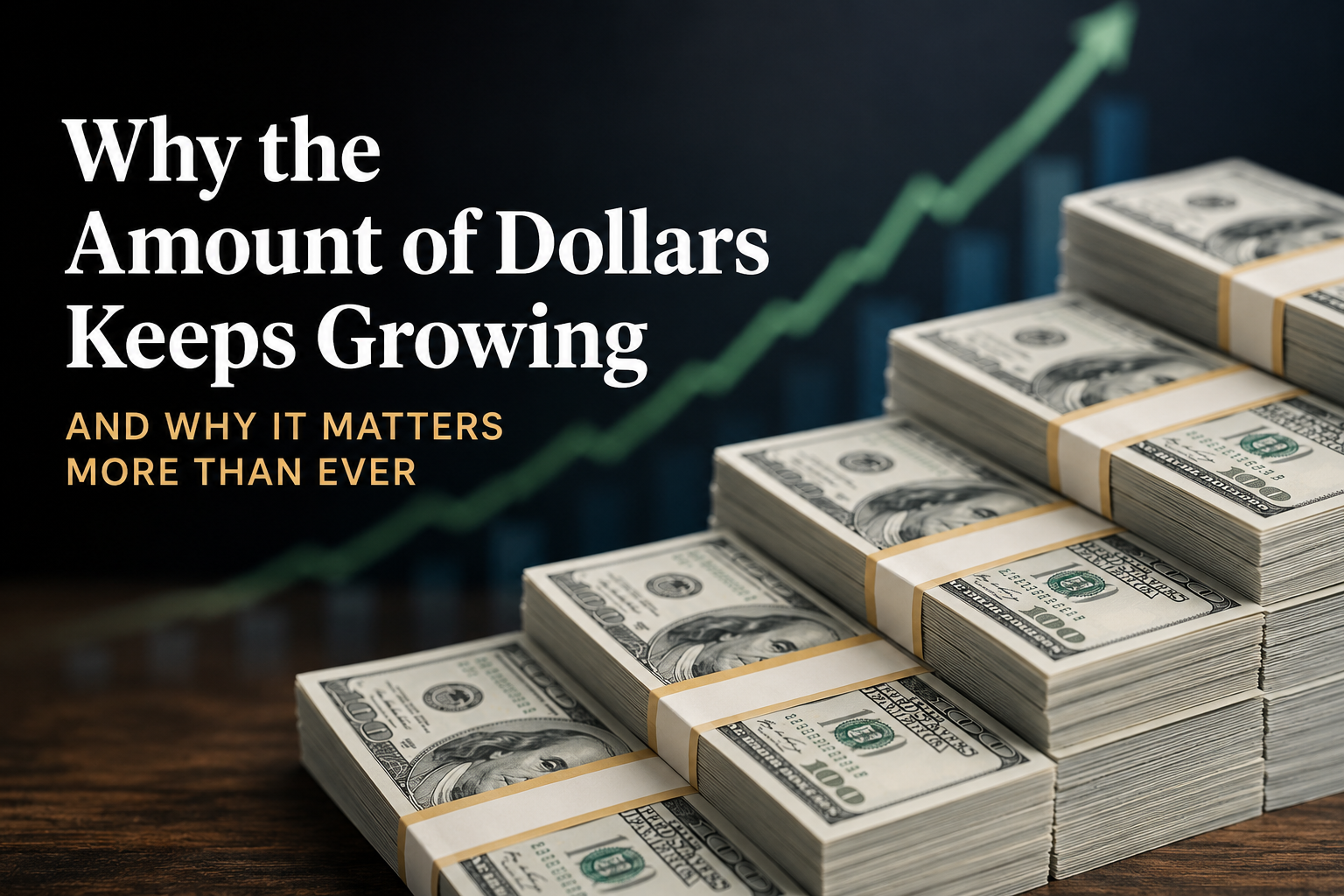
The amount of dollars keeps growing, and I think that simple idea explains a lot more about the modern economy than most people realize.
When people talk about the dollar, they usually focus on the exchange rate. Is the dollar up? Is it down? Is it stronger than the euro? Is it crushing emerging-market currencies? Is it losing purchasing power because of inflation? Those are valid questions, but they only scratch the surface.
To me, the deeper question is this: why does the world keep needing more dollars in the first place?
That question matters because the dollar is not just the currency of the United States. It is the main language of global finance. Oil, debt, trade, central bank reserves, international loans, commodities, technology investment, and even private savings in unstable economies often revolve around the U.S. dollar.
That is why I see the dollar as more than a bill, more than a number on a screen, and more than a foreign exchange quote. The dollar is a measure of trust. It is also a measure of fear. And when the world becomes more uncertain, more indebted, more digital, and more financially connected, demand for dollars often grows with it.
At the same time, the creation of more dollars raises uncomfortable questions. If more dollars are created, does that weaken the value of each dollar? If interest rates rise, does that make the dollar stronger? If people keep saving in dollars instead of local currencies, what does that say about confidence in the system?
These are not abstract questions. They affect savings, mortgages, investments, imports, exports, inflation, stock markets, government debt, and everyday purchasing power.
The Dollar Is Not Just Money. It Is Trust in Motion
The first thing I always try to remember is that a currency only works when people believe it will still be accepted tomorrow.
That sounds obvious, but it is the foundation of everything. A dollar has value because people, companies, banks, governments, and investors accept it as payment, hold it as savings, use it to price contracts, and trust that it will remain liquid.
This is why the dollar has such a powerful role globally. It is not only used inside the United States. It is used by companies that borrow internationally, governments that issue debt, central banks that hold reserves, and individuals who want protection from local currency instability.
In countries where inflation has repeatedly damaged savings, people often develop a very personal relationship with the dollar. They do not see it as a speculative asset. They see it as shelter.
That is one reason the “dollars under the mattress” phenomenon is so important. In Argentina, for example, reports based on INDEC data show that dollars held outside the banking system reached about USD 220.854 billion by March 31, 2026. That figure was up from roughly USD 218.217 billion at the end of 2025.
That tells me something powerful: even when governments try to normalize the financial system, many people still prefer to hold dollars directly.
And I get why. When a local currency has a long history of losing value, people do not need an economics degree to understand the risk. They feel it at the supermarket, in rent prices, in imported goods, in savings accounts, and in the gap between yesterday’s salary and tomorrow’s prices.
In that sense, the dollar becomes emotional. It becomes a personal defense mechanism.
Why More Dollars Keep Being Created
The amount of dollars keeps growing because modern economies are built on credit, spending, borrowing, investment, and liquidity.
Money creation is not only about printing physical bills. Most dollars are digital. They appear through bank lending, government spending, central bank operations, Treasury issuance, and financial markets.
When a bank makes a loan, new money-like purchasing power enters the economy. When the U.S. government runs deficits and issues debt, investors buy Treasury securities that become part of the global dollar-based financial system. When the Federal Reserve expands its balance sheet, it injects liquidity into financial markets. When global companies borrow in dollars, they add another layer of dollar demand.
So the dollar supply grows because the global economy keeps expanding its need for dollar-denominated liquidity.
Money Creation Starts With Demand
One of the biggest misunderstandings about dollars is that they are created only because policymakers “want more money.” That is part of the story, but not the whole story.
Dollars are also created because people demand credit. Businesses borrow to expand. Consumers borrow to buy homes and cars. Governments borrow to fund spending. Investors borrow to finance positions. Technology companies raise debt and equity to build infrastructure. Banks intermediate all of it.
The more complex and capital-intensive the economy becomes, the more dollar liquidity it tends to require.
This is especially clear in sectors like artificial intelligence. One recent analysis discussed the massive financing needs of the AI boom, including estimates of around USD 6 trillion in investment needs by 2030 for hyperscaler infrastructure.
That number is important because it shows how future growth can create future dollar demand. Data centers, chips, electricity infrastructure, cloud networks, and advanced computing capacity all require financing. Much of that financing happens in dollars or through dollar-linked markets.
So when I think about why more dollars are generated, I do not only think about central banks. I also think about the scale of ambition in the economy. A world building AI infrastructure, energy grids, defense systems, semiconductor plants, and global logistics networks is a world that constantly demands capital.
And in many cases, that capital speaks dollar.
Debt Turns Into Dollars
Another reason the amount of dollars keeps growing is debt.
The U.S. government borrows in dollars. U.S. companies borrow in dollars. Many non-U.S. companies also borrow in dollars because dollar markets are deep, liquid, and globally trusted. Emerging-market governments and corporations often issue dollar debt because investors prefer it.
This creates a cycle.
More borrowing creates more dollar assets. More dollar assets create more demand from investors. More demand makes dollar markets even deeper. Deeper markets make the dollar even more attractive as a funding currency. That encourages even more borrowing.
This does not mean the system is risk-free. It means the system is self-reinforcing until confidence breaks or policy changes.
The dollar’s strength is therefore tied to the credibility of U.S. institutions, the depth of Treasury markets, the Federal Reserve’s inflation credibility, and the willingness of global investors to hold dollar-denominated assets.
That is why interest rates matter so much.
The Hidden Side of Dollar Growth: Dollars Outside the Banking System
One of the most interesting parts of this topic is that not all dollar growth looks the same.
Some dollars circulate inside the formal banking system. Others sit in brokerage accounts, Treasury bills, money market funds, corporate reserves, or central bank reserves. But in some countries, a huge amount of dollars is stored outside the formal system.
That “under the mattress” dollar economy is not just a colorful phrase. It reflects deep distrust.
When people hold dollars in cash, safety deposit boxes, or foreign accounts, they are making a statement: “I trust this currency more than I trust the local system.”
In Argentina, this has become a structural economic reality. INDEC-related data cited in recent reporting showed that the stock of dollars outside the banking system was more than five times the level of Argentina’s gross central bank reserves at the same March 2026 cutoff.
That comparison is striking because it shows a paradox: a country can have private citizens with enormous dollar savings while the central bank itself struggles with reserves.
This is one of the reasons I believe the dollar cannot be analyzed only from a U.S. perspective. The dollar is global because people outside the United States often use it to solve local problems.
In some places, the dollar is a savings tool. In others, it is a pricing unit. In others, it is a hedge against inflation. In others, it is a way to escape capital controls. And in global markets, it is the ultimate liquidity asset.
When more people want dollars for safety, the demand side grows. When governments and banks create more dollar instruments to satisfy global demand, the supply side grows too.
That is how the world ends up with more and more dollars.
Why People Still Run Toward the Dollar
I personally think the dollar’s importance comes down to one word: optionality.
A person holding dollars has options. A company holding dollars has options. A government holding dollars has options.
With dollars, you can buy imports, pay international suppliers, settle debts, invest abroad, preserve savings, or move capital quickly. With a weak local currency, those options shrink.
That is why people often move into dollars during crises. They are not necessarily trying to get rich. They are trying not to get trapped.
The dollar becomes the asset people choose when they do not know what else to trust.
This is also why the dollar can strengthen even when the United States has problems of its own. The U.S. may have debt, political conflict, inflation, and fiscal deficits, but compared with many alternatives, the dollar still offers unmatched liquidity.
In global finance, liquidity is power.
That power shows up during market stress. Investors often sell risky assets and buy dollars or dollar-denominated safe assets. Banks seek dollar funding. Central banks arrange swap lines. Companies protect cash flows. Importers secure payment currency. Savers preserve purchasing power.
The dollar is not perfect. It is simply the most accepted solution in an imperfect system.
How Interest Rates Can Push the Dollar Higher
Now let’s connect this to a possible rise in interest rates.
Higher U.S. interest rates can make the dollar more attractive because they increase the return investors can earn on dollar-denominated assets. If Treasury bills, money market funds, savings products, or bonds pay more, global investors may want more dollars to buy them.
That increased demand can strengthen the dollar.
The Federal Reserve held the federal funds target range at 3.50% to 3.75% in June 2026, according to its official FOMC statement. Reuters also reported that the dollar strengthened after that June decision, as policymakers projected a possible rate hike later in 2026.
This is the basic rate-dollar relationship:
When U.S. rates rise, dollar assets often become more attractive.
When dollar assets become more attractive, capital can flow into the United States.
When capital flows into the United States, investors need dollars.
When demand for dollars rises, the dollar can strengthen.
That is the clean version. The real world is messier.
Higher Rates Make Dollars More Attractive
A possible rate hike matters because the dollar competes with other currencies.
If investors can earn more in dollars than in euros, yen, pounds, pesos, or other currencies, they may shift capital toward dollar assets. That does not always happen automatically, but the incentive is clear.
This is especially important for large institutions. Pension funds, hedge funds, insurers, sovereign wealth funds, banks, and multinational companies constantly compare risk-adjusted returns across currencies.
A higher U.S. interest rate can make short-term Treasury bills look more appealing. It can also raise yields across the bond market, making dollar income more attractive.
That can support the dollar’s value.
In July 2026, the broad U.S. dollar remained firm, with some market data showing the DXY around 100.8782 on July 3, 2026, up over the previous month and year.
This matters because the dollar’s value is not just theoretical. A stronger dollar changes global prices. It can make imports cheaper for Americans, make U.S. exports more expensive abroad, pressure emerging markets with dollar debt, and reduce the dollar value of foreign earnings for U.S. multinational companies.
But Higher Rates Also Create Pressure
Higher interest rates are not automatically good.
They can strengthen the dollar, but they can also slow the economy. Higher rates make borrowing more expensive. Mortgages become harder to afford. Corporate refinancing gets tougher. Credit card balances become more painful. Government interest costs rise.
That is the trade-off.
A central bank may raise rates to fight inflation, but if rates go too high or stay high too long, growth can weaken.
This is why I think the dollar’s value is always a balancing act between confidence and strain.
If the Fed raises rates because the economy is strong and inflation needs control, the dollar may rise. But if higher rates trigger financial stress, recession fears, or debt concerns, the picture becomes more complicated.
A strong dollar can be a sign of confidence. It can also be a sign of fear.
That is what makes currency markets so fascinating.
The Value of the Dollar: What Actually Moves It?
The value of the dollar is not determined by one factor. It is shaped by a web of forces.
The most important include:
- Interest rates
- Inflation expectations
- Economic growth
- Fiscal deficits
- Federal Reserve credibility
- Global risk appetite
- Demand for safe assets
- U.S. Treasury market liquidity
- Relative weakness of other currencies
- Geopolitical uncertainty
- Trade and capital flows
When people ask whether the dollar will rise or fall, I always think the better question is: against what, and because of what?
The dollar can rise against one currency and fall against another. It can lose domestic purchasing power through inflation while still strengthening internationally against weaker currencies. It can look expensive on a historical basis but still attract buyers during a crisis.
That is why “the value of the dollar” has two meanings.
First, there is the dollar’s external value: how much it buys in terms of other currencies.
Second, there is the dollar’s internal value: how much it buys inside the United States.
A stronger dollar exchange rate does not necessarily mean Americans feel richer. If domestic inflation is high, the dollar can be stronger internationally but weaker at home.
That distinction is crucial.
The Dollar, Inflation, and the Cost of Confidence
More dollars can contribute to inflation if money growth outpaces real economic production.
But it is not automatic. The relationship between money supply and inflation depends on velocity, productivity, credit conditions, supply chains, energy prices, wages, expectations, and policy credibility.
Still, over the long term, if a currency supply grows much faster than the goods and services available in that economy, purchasing power usually comes under pressure.
This is where the Federal Reserve becomes central.
The Fed has to manage a difficult balance: enough liquidity to keep the economy functioning, but not so much that inflation expectations become unanchored.
When inflation rises, the Fed may raise interest rates. Higher rates reduce borrowing incentives, cool demand, and make saving more attractive. They can also support the dollar by increasing returns on dollar assets.
But higher rates come with costs. They increase debt-service burdens. They can pressure banks, businesses, households, and governments. They may also expose weaknesses that were hidden when money was cheap.
That is why I do not see interest rates as a simple lever. They are more like a pressure valve.
Turn them too low for too long, and inflation or asset bubbles can build.
Turn them too high too quickly, and the economy can crack.
The dollar sits right in the middle of that tension.
Why AI, Debt, and Global Investment Need More Dollars
One reason I believe the amount of dollars will likely keep growing is that the global economy is entering an extremely capital-intensive phase.
Artificial intelligence is one example. Building AI infrastructure is not just about software. It requires chips, servers, data centers, electricity, cooling systems, transformers, grid upgrades, real estate, financing, and long-term power contracts.
The Vozpópuli article based on market commentary highlighted that AI growth is creating major financing needs and infrastructure bottlenecks, especially in electrical systems. It also cited an estimate of around 120 GW of hyperscaler capacity by 2030, with an implied investment need of roughly USD 6 trillion.
That kind of investment does not happen without deep capital markets.
And the deepest capital markets in the world are still dollar-based.
This is why the dollar’s role may remain powerful even in a world that talks about de-dollarization. Countries may want alternatives. They may build payment systems, hold more gold, trade in local currencies, or reduce dependence on U.S. financial infrastructure.
But replacing the dollar is not just about choosing another currency. It requires replacing the entire ecosystem: liquidity, trust, legal systems, bond markets, banking networks, reserve assets, payment rails, derivatives markets, and crisis backstops.
That is not easy.
So while the dollar may lose some share over time, the world still needs a massive amount of dollar liquidity to finance its ambitions.
Could the Dollar Keep Rising?
Yes, the dollar could keep rising, especially if U.S. interest rates move higher or stay elevated while other major economies remain weaker.
A stronger dollar would be consistent with:
- Higher U.S. yields
- Persistent inflation that keeps the Fed hawkish
- Strong U.S. growth
- Global risk aversion
- Weakness in Europe, Japan, or emerging markets
- Demand for safe assets
- Large capital inflows into U.S. technology and AI
But a permanently stronger dollar is not guaranteed.
The dollar could weaken if inflation falls, the Fed signals future cuts, U.S. growth slows, fiscal concerns increase, or investors diversify away from dollar assets.
This is why I prefer to think in scenarios.
Scenario 1: Higher Rates, Stronger Dollar
If the Fed raises rates and the economy stays resilient, the dollar could strengthen further. Investors would have more reason to hold dollar assets, especially short-term Treasuries and money market instruments.
This would likely pressure emerging markets and countries with dollar debt.
Scenario 2: Higher Rates, Slower Economy
If rates rise but the economy weakens, the dollar might initially rise as a safe haven. But later, if markets begin pricing future rate cuts or financial stress, the dollar could lose momentum.
Scenario 3: More Dollars, Lower Confidence
If dollar creation continues while fiscal deficits expand and inflation remains sticky, investors may begin questioning the long-term purchasing power of the dollar. In that case, nominal dollar strength could coexist with real purchasing-power erosion.
Scenario 4: Global Dollar Demand Stays High
Even if the U.S. has problems, global demand for dollars may remain strong because other currencies face bigger credibility issues. In that case, the dollar can remain dominant not because it is flawless, but because it is still the best available option.
That last point is important. The dollar does not need to be perfect to stay powerful.
It only needs to be more trusted than the alternatives.
What I Personally Watch Before Judging the Dollar
When I look at the dollar, I do not only look at one chart.
I watch interest rates. I watch inflation. I watch Treasury yields. I watch central bank language. I watch emerging-market stress. I watch commodity prices. I watch whether people are moving money into or out of the banking system. I watch whether governments are trying to encourage people to spend dollars they previously kept hidden.
Most of all, I watch behavior.
Because people can say they trust a currency, but their actions reveal the truth.
If people save in dollars, price assets in dollars, borrow in dollars, lend in dollars, and panic-buy dollars during uncertainty, then the dollar still has power.
That is why the growth in dollar holdings matters so much. It is not just a statistic. It is a behavioral signal.
When people keep accumulating dollars, they are telling us something about trust.
When companies keep raising dollar financing, they are telling us something about liquidity.
When central banks react to dollar volatility, they are telling us something about dependency.
When higher U.S. rates strengthen the dollar, markets are telling us something about relative value.
And when governments worry about dollars sitting outside the banking system, they are telling us something about the limits of policy.
Conclusion
The amount of dollars keeps growing because the world keeps demanding dollars.
Governments need dollars. Companies need dollars. Investors need dollars. Savers need dollars. Technology booms need dollars. Crisis periods need dollars. Debt markets need dollars. Global trade needs dollars.
That does not mean the dollar is invincible. It does not mean creating more dollars has no consequences. It does not mean the dollar will always rise. But it does mean the dollar remains deeply embedded in the global economy.
A possible rise in U.S. interest rates could make the dollar even more attractive by increasing returns on dollar-denominated assets. But higher rates also create stress, especially for debt-heavy economies and borrowers exposed to dollar financing.
The value of the dollar, then, is not only about supply. It is about trust, scarcity, yield, inflation, alternatives, and fear.
Personally, I think the dollar’s real strength comes from the fact that people reach for it when they want optionality. They may criticize it. They may worry about U.S. debt. They may talk about alternatives. But when uncertainty rises, the dollar is still one of the first places the world runs.
That is why the dollar matters.
And that is why the amount of dollars keeps growing.
FAQs
Why does the amount of dollars keep growing?
The amount of dollars keeps growing because modern economies rely on credit, debt, government spending, bank lending, global trade, and investment. Since the dollar is the main currency of global finance, demand for dollar liquidity keeps expanding.
Does creating more dollars make the dollar weaker?
It can, especially if dollar creation grows faster than real economic output. But the dollar’s value also depends on demand. If global demand for dollars is strong, the dollar can remain firm even as the supply expands.
Can higher interest rates strengthen the dollar?
Yes. Higher U.S. interest rates can make dollar-denominated assets more attractive, drawing capital into the United States and increasing demand for dollars. That can push the dollar higher.
Why do people save in dollars?
People often save in dollars because they trust it more than their local currency. In countries with inflation, devaluation, capital controls, or banking distrust, the dollar becomes a store of value and a form of financial protection.
What determines the value of the dollar?
The dollar’s value is determined by interest rates, inflation, economic growth, Federal Reserve policy, global demand for safe assets, Treasury market liquidity, geopolitical risk, and the relative strength or weakness of other currencies.
Is a strong dollar good or bad?
It depends. A strong dollar can lower import costs and attract global capital, but it can also hurt U.S. exporters, pressure emerging markets, and make dollar debt harder to repay for foreign borrowers.
Why is the dollar so important globally?
The dollar is important because it is widely used in trade, debt markets, reserves, commodities, banking, and global investment. Its liquidity and acceptance make it the dominant currency in international finance.
Could the world stop using the dollar?
Some countries are trying to reduce dollar dependence, but replacing the dollar would require a deep, trusted, liquid alternative financial system. That is difficult, so the dollar is likely to remain highly important even if its dominance gradually declines.