
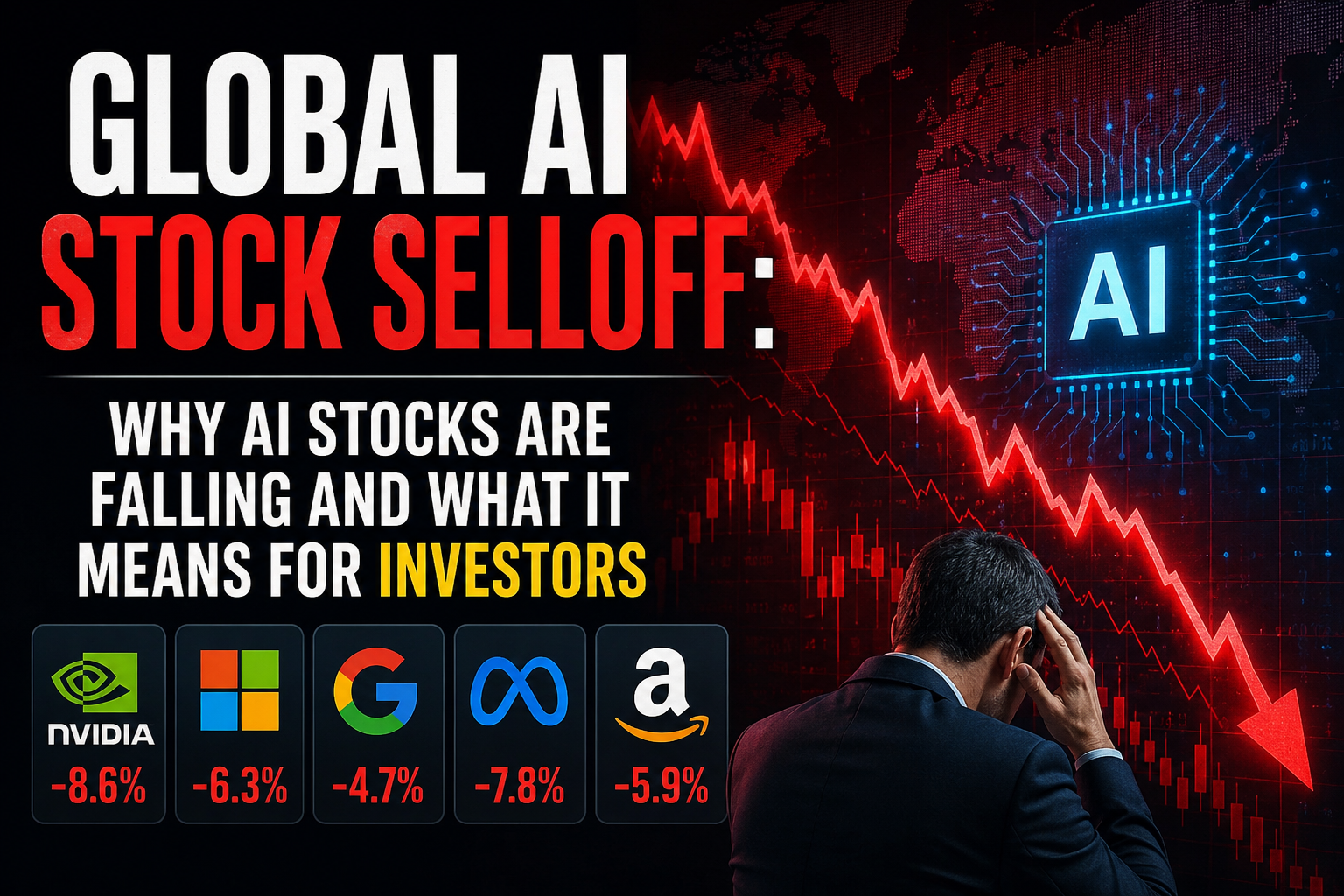
When I see AI stocks falling across the globe, my first reaction is not panic. It is curiosity.
I want to know whether the market is rejecting the artificial intelligence story itself, or simply repricing the expectations around it. That difference matters a lot. A great technology can still become an expensive investment if investors pay too much, too fast.
That is exactly what seems to be happening with many AI-related stocks. The market has spent months rewarding companies tied to artificial intelligence: chipmakers, cloud giants, data center suppliers, software platforms and large tech names. But now investors are starting to ask a harder question: how much of the AI future is already priced into these stocks?
The global AI stock selloff is not just about one bad trading session. It reflects several concerns at once: high valuations, profit-taking, fear of an AI bubble, rising infrastructure costs, semiconductor weakness and doubts about how quickly companies can turn AI spending into real profits.
I do not think this automatically means the AI boom is over. But I do think it is a clear reminder that even the strongest market themes can become vulnerable when expectations get too high.
Why AI Stocks Are Falling Worldwide
AI stocks are falling because the market is starting to treat artificial intelligence less like a dream and more like a business model that needs to prove itself.
For a while, investors were mainly focused on the upside. They looked at AI and saw massive productivity gains, new software revenue, huge demand for chips, explosive cloud growth and the next major technology cycle. That excitement pushed many AI stocks sharply higher.
But markets do not move in straight lines. When a sector gets crowded, expensive and emotionally charged, it does not take much to trigger a selloff.
In my view, the AI stock decline is not caused by one single factor. It is the result of high valuations, crowded positioning, profit-taking and growing concern that the cost of building AI may be much higher than investors wanted to admit.
High Valuations Left Little Room for Disappointment
One of the biggest reasons AI stocks are falling is simple: expectations became extremely high.
When investors pay premium prices for companies like Nvidia, Microsoft, Alphabet, Amazon, Meta, Broadcom, Micron or other AI-linked names, they are not just paying for today’s earnings. They are paying for years of future growth.
That creates a problem. The higher the valuation, the smaller the margin for error.
If revenue growth slows even slightly, if margins come under pressure, or if guidance sounds less aggressive than expected, stocks can fall fast. Not because the companies are bad, but because the price had already assumed near-perfect execution.
What worries me most is not a red day on the screen. What worries me is when investors start pricing AI companies as if growth, margins, demand and execution will all be perfect at the same time.
Markets can tolerate high valuations when confidence is rising. But when sentiment changes, those same valuations become a risk.
Profit-Taking After a Huge AI Rally
Another reason AI stocks are falling is profit-taking.
Many AI-related companies have delivered massive gains over the past few years. When investors sit on large profits, they often sell part of their position when volatility rises. That selling can quickly spread across the sector.
This is especially true when the same trade becomes popular. If too many investors own the same AI winners, the exit door can get crowded when fear appears.
That does not mean the long-term thesis is broken. It simply means some investors are locking in gains after a powerful rally.
I would not call every sharp drop a bubble bursting. Sometimes the market simply needs to cool down. After a strong move higher, a correction can be healthy because it resets expectations and removes some speculation.
The problem is that healthy corrections can become deeper when valuations are stretched and investors lose patience.
Investors Are Questioning the Cost of Building AI
For me, this is one of the most important parts of the story.
The market used to ask: how big can AI become?
Now it is asking: how expensive will it be to build this future?
Artificial intelligence requires enormous investment. Companies need chips, servers, data centers, energy, cloud infrastructure, networking equipment and specialized talent. That means capital expenditure can rise quickly.
This matters because investors eventually want to see a return on that spending.
If companies spend billions on AI infrastructure but the revenue takes longer to appear, free cash flow can come under pressure. If costs rise faster than profits, margins may suffer. If the market starts to believe AI monetization will take longer than expected, valuations can compress.
In other words, AI may still be transformational, but the market is beginning to ask whether the investment cycle is becoming too expensive.
That is a very different conversation from the hype-driven narrative of “AI will change everything.”
Semiconductor Weakness Is Spreading Across the Market
AI stocks are also closely tied to semiconductor stocks.
Chips are the backbone of the AI boom. Companies need GPUs, memory chips, networking chips and advanced processors to train and run AI models. That is why names like Nvidia, Micron, Broadcom, AMD, Samsung Electronics, SK Hynix and TSMC are so important to the AI trade.
When semiconductor stocks fall, the rest of the AI market often feels pressure too.
Investors watch chip demand because it gives clues about the real pace of AI infrastructure spending. If chip companies signal strong demand, the AI story looks stronger. If investors worry about weaker orders, inventory issues or slower growth, the entire sector can sell off.
This is why the AI stock selloff can become global. It is not only about U.S. tech stocks. It can affect Asian semiconductor companies, cloud infrastructure suppliers, hardware names and software companies connected to the same investment cycle.
What Should Worry Investors About the AI Stock Decline?
The biggest concern for investors is not that AI stocks are volatile. Volatility is normal, especially in high-growth sectors.
The bigger concern is whether the market has been paying too much for future profits that may take longer to arrive.
As an investor, the part that would make me cautious is not volatility by itself. The bigger issue is whether companies can turn massive AI spending into durable earnings growth.
The Risk of Paying for Perfect Growth
AI may be one of the most important technology trends of this generation. But even if that is true, investors can still overpay.
That is the uncomfortable part.
A company can be excellent, its technology can be real, its market opportunity can be huge — and its stock can still be too expensive.
This is where many investors get trapped. They confuse a great business story with a great stock price. Those are not always the same thing.
If the market prices an AI company as if it will dominate for the next decade, any sign of weakness can hurt the stock. A slight slowdown in growth, a lower margin outlook, weaker guidance or higher spending can lead to a sharp correction.
That is why valuation matters.
I do not think investors should automatically run away from AI stocks just because the sector is correcting. But I also do not think every dip deserves to be bought blindly. In a market this expensive, price matters.
Massive AI Spending Could Pressure Free Cash Flow
Another major concern is free cash flow.
AI infrastructure is expensive. Data centers, chips, electricity, cooling systems, cloud capacity and engineering talent all require capital. Big tech companies can afford these investments, but even they need to prove that the spending will generate attractive returns.
This is especially important for investors because free cash flow supports buybacks, dividends, reinvestment and balance sheet strength.
If AI spending rises faster than AI revenue, investors may start to question whether companies are investing aggressively or simply burning cash to keep up with competitors.
That does not mean all AI capex is bad. In fact, some of it may create powerful long-term advantages. But the market will increasingly demand evidence.
I would pay close attention to what companies say about capital expenditure, data center spending and expected returns from AI investment.
Not Every AI Company Will Monetize the Boom Equally
One of the biggest mistakes investors can make is assuming that every company with “AI” attached to it will win.
That is not how markets work.
Some companies will build essential infrastructure. Some will sell the chips. Some will provide cloud services. Some will create software tools. Some will use AI to improve productivity. And some will simply use the AI narrative to attract investor attention without building a durable advantage.
The market may be starting to separate real AI winners from hype-driven names.
That is healthy, but it can be painful.
If investors stop buying every AI-related stock and start focusing on earnings quality, margins and competitive advantage, weaker names could fall much more than stronger ones.
Quality matters more than hype.
Is This an AI Bubble or Just a Healthy Correction?
This is the question many investors are asking: are AI stocks in a bubble, or is this just a normal correction?
My answer is: it depends on the company, the valuation and the earnings outlook.
I do not think the entire AI theme should automatically be called a bubble. Artificial intelligence is real. Companies are spending real money. Demand for chips, cloud infrastructure and automation tools is real. The technology is already changing how businesses operate.
But that does not mean every AI stock price is justified.
When a Selloff Is Just a Normal Reset
A selloff can be healthy when it cools down excessive optimism.
After a strong rally, stocks often need to reset. Investors take profits, valuations come down, weak hands leave the market and expectations become more realistic.
That can actually be good for long-term investors.
If earnings continue to grow, if margins remain strong and if companies continue to show real AI demand, a correction may simply create better entry points.
In that case, the global AI stock selloff would not mean the end of the AI boom. It would mean the market is adjusting to a more reasonable price.
When I look at this selloff, I do not see it as proof that AI is dead. I see it as a reminder that even great technologies can become overpriced in the stock market.
When a Correction Becomes a Warning Sign
A correction becomes more serious when fundamentals begin to weaken.
That could happen if companies lower guidance, if AI revenue disappoints, if chip demand slows, if data center costs rise too quickly, or if investors realize that monetization will take longer than expected.
The danger is not just falling prices. The danger is falling prices combined with falling earnings expectations.
That is when a correction can turn into something deeper.
If valuations stay high while growth expectations come down, stocks may need to fall further to become attractive again.
This is why I would not focus only on daily price moves. I would focus on whether the business outlook is changing.
Why the Long-Term AI Story Can Survive Short-Term Volatility
A key point: the stock market and the technology cycle are not the same thing.
AI can continue to grow as a technology even if AI stocks correct. That happened with other major technology cycles too. The internet changed the world, but not every internet stock was a good investment at every price.
The same logic applies here.
Artificial intelligence may still reshape software, advertising, cloud computing, healthcare, finance, cybersecurity, manufacturing and many other industries. But investors still need to care about valuation, competition and profitability.
In my view, the long-term AI story can survive this selloff. But the easy-money phase, where almost every AI-linked stock rises just because it belongs to the theme, may be ending.
Could AI Stocks Fall Even Further?
Yes, AI stocks could fall further.
That does not mean they definitely will. But investors should accept that possibility, especially after such a strong rally.
High-growth stocks can be extremely sensitive to sentiment. When investors are optimistic, they reward future potential. When they become cautious, they demand proof.
AI stocks are now moving into the proof phase.
Earnings Guidance Will Matter More Than Headlines
The next major driver will likely be earnings guidance.
Headlines can move stocks in the short term, but guidance tells investors what companies actually expect. If management teams remain confident about AI demand, revenue growth and margins, the market may stabilize.
But if guidance becomes weaker, the selloff could continue.
Personally, I would pay less attention to dramatic headlines and more attention to what companies say about margins, chip demand, cloud revenue, data center costs and free cash flow.
That is where the real signal will be.
Watch Margins, Capex and Data Center Spending
The most important metrics to watch are:
- Revenue growth from AI-related products and services.
- Gross margins and operating margins.
- Capital expenditure.
- Free cash flow.
- Cloud growth.
- Chip demand.
- Data center spending.
- Forward guidance.
If AI revenue is growing but costs are growing faster, investors may become more cautious. If companies keep spending aggressively without clear returns, the market may punish them.
On the other hand, if companies show that AI spending is turning into real revenue and durable profits, the selloff may look more like a correction than a structural problem.
This is why the next few quarters matter.
Market Concentration Makes the Selloff More Sensitive
Another risk is market concentration.
A small group of large technology companies has been responsible for a significant part of the market’s gains. When those stocks rise together, indexes look strong. But when they fall together, the pressure can spread quickly.
This is especially true for the Nasdaq 100 and other tech-heavy indexes.
If investors reduce exposure to AI leaders, passive funds, ETFs and momentum strategies can amplify the move. That can make the selloff feel bigger than the change in fundamentals.
This does not mean investors should panic. But it does mean they should understand how concentrated the AI trade has become.
Is the AI Stock Selloff a Buying Opportunity?
It might be. But I would be careful with that question.
A lower price does not automatically mean a stock is cheap. A stock is only attractive if the price makes sense relative to future earnings, cash flow and risk.
That is why I would not treat the entire AI sector as one single trade.
Some AI stocks may become interesting after a correction. Others may still be expensive. And some may never justify the hype.
Why I Would Not Buy Every Dip Blindly
Buying the dip can work in strong bull markets, but it can also become dangerous when investors ignore valuation.
If a stock falls 10% after rising 200%, it may still not be cheap.
That is why I would avoid buying AI stocks just because they are down. I would first ask:
- Is the company profitable?
- Is AI actually improving revenue?
- Are margins holding up?
- Is free cash flow strong?
- Is the valuation reasonable?
- Does the company have a durable competitive advantage?
- Is the selloff caused by emotion or by weaker fundamentals?
Those questions matter more than the daily chart.
What I Would Watch Before Buying AI Stocks
Before buying the dip in AI stocks, I would watch a few things closely.
First, I would look at earnings guidance. If companies remain confident, that is a good sign.
Second, I would look at capex. Heavy AI spending is not automatically bad, but investors need to see a path to returns.
Third, I would watch free cash flow. If cash generation remains strong despite higher investment, the story is healthier.
Fourth, I would follow semiconductor demand. Chips are one of the clearest signals of real AI infrastructure growth.
Finally, I would compare valuation to growth. A great company can still be a poor investment if the price is too high.
My base view is simple: this could still be a healthy correction. But healthy corrections can become deeper when valuations are stretched and investors lose patience.
Quality Matters More Than Hype
The AI selloff may actually be useful if it forces investors to become more selective.
Instead of buying anything with an AI label, investors may start focusing on companies with real revenue, strong balance sheets, pricing power, high margins and clear AI monetization.
That is a better market.
It may be less exciting, but it is healthier.
In the long run, the strongest AI companies are likely to be those that can turn technology into profits. Not just headlines. Not just demos. Not just big promises. Actual earnings, cash flow and competitive advantage.
Final Thoughts: What the AI Selloff Really Means
The global AI stock selloff does not necessarily mean the AI boom is over.
To me, it means the market is becoming more demanding.
Investors are no longer willing to pay any price for artificial intelligence exposure. They want proof that AI spending can turn into revenue, margins and free cash flow. They want to know whether the massive investments in chips, data centers and cloud infrastructure will produce real returns.
That is a healthy question.
But it can also create more volatility.
If AI companies continue to deliver strong earnings, this selloff may eventually look like a normal correction inside a long-term growth trend. If earnings disappoint and spending keeps rising, the decline could go further.
So I would not panic, but I would not be careless either.
The way I see it, AI is still a powerful long-term theme. But the stock market is reminding investors of something very basic: even the best stories need the right price.
FAQs About the Global AI Stock Selloff
Why are AI stocks falling?
AI stocks are falling because of high valuations, profit-taking, concerns about an AI bubble, rising infrastructure costs, semiconductor weakness and doubts about how quickly companies can turn AI investments into real profits.
Does the AI selloff mean the AI boom is over?
No, not necessarily. The AI boom as a technology trend can continue even if AI stocks fall. The selloff may simply mean investors are repricing expectations after a major rally.
Is this an AI bubble?
It could be a bubble in some parts of the market, especially where valuations are extreme and profits are unclear. But not every AI stock is automatically part of a bubble. Strong companies with real earnings and durable growth may still justify investor interest.
Could AI stocks keep falling?
Yes. AI stocks could fall further if earnings guidance weakens, margins come under pressure, chip demand slows, or investors become less willing to pay high valuations for future growth.
Should investors buy the dip in AI stocks?
Buying the dip may make sense for some high-quality AI companies, but not blindly. Investors should look at valuation, earnings growth, free cash flow, margins, capex and competitive advantage before making a decision.