
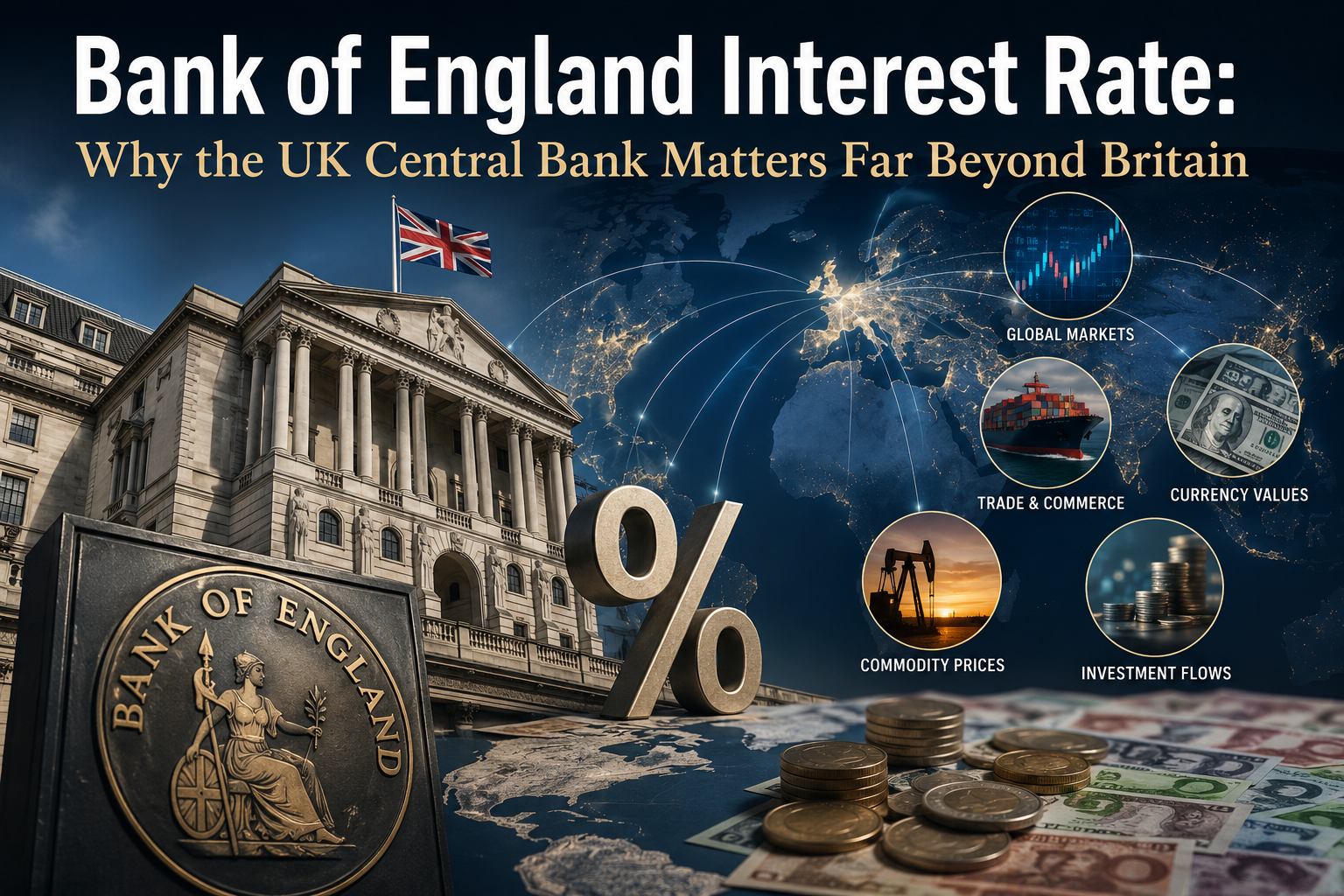
The Bank of England interest rate is one of those numbers that looks simple at first glance. It is usually written as a percentage, announced on a scheduled Thursday, reported in a few headlines, and then quickly folded into market prices. But in reality, that single rate carries a lot of weight.
When I look at the Bank of England’s decision, I do not see just a UK story. I see a signal about inflation, consumer pressure, mortgage costs, currency markets, bond yields, investor confidence, and the global economy. The Bank of England may be the central bank of the United Kingdom, but its decisions echo far beyond London.
At the moment, the Bank of England’s Bank Rate is 3.75%, according to the Bank’s own latest rate page and market data providers. The current environment is especially sensitive because policymakers are trying to balance inflation risks, weak growth, energy prices, wages, and financial market stability.
That balancing act is exactly why the Bank of England interest rate matters so much.
What Is the Bank of England Interest Rate?
The Bank of England interest rate, often called the Bank Rate or UK base rate, is the benchmark rate set by the Bank of England’s Monetary Policy Committee, also known as the MPC. Trading Economics describes the UK benchmark interest rate as the rate set by the MPC, applied through the Bank of England’s open market operations with banks, building societies and other financial counterparties.
In plain English, this is the rate that influences the cost of money across the UK economy.
It affects:
- Mortgage rates
- Savings rates
- Business loans
- Credit cards
- Government bond yields
- The pound sterling
- Investor expectations
- Inflation forecasts
- Consumer confidence
For me, the Bank Rate is one of those numbers that looks small on paper but moves through the economy like a shockwave. A change from 3.75% to 4.00% may sound tiny. But for a household with a large mortgage, a company refinancing debt, or a government issuing bonds, that quarter-point change can matter a lot.
The Bank of England does not set every loan rate directly. Your bank, lender, or credit card provider still decides the exact rate it charges. But the Bank Rate sets the tone. When it goes up, borrowing usually becomes more expensive. When it goes down, borrowing usually becomes cheaper. When it stays unchanged, markets immediately start asking: why did the Bank hold, and what comes next?
Why the Bank of England Is So Important
The Bank of England is one of the world’s most important central banks because the UK remains a major financial hub. London is deeply connected to global banking, foreign exchange, insurance, derivatives, commodities, bond trading, and international capital flows.
That means a Bank of England interest rate decision is not only about British households. It is also about how global investors price risk.
When the BoE changes rates, markets react because investors are constantly comparing returns across countries. If UK rates look attractive relative to US, European, or Japanese rates, money can flow into pound-denominated assets. If the BoE sounds dovish while other central banks sound hawkish, sterling can weaken. If the BoE warns about inflation, gilt yields can rise. If it signals confidence that inflation is cooling, stocks and bonds may rally.
This is why I never treat a Bank of England decision as an isolated event. It sits inside a global central banking map that includes the Federal Reserve, European Central Bank, Swiss National Bank, Bank of Japan, and others.
A decision by the BoE can influence:
- The British pound against the US dollar
- UK government bond yields
- European financial conditions
- Global risk sentiment
- Emerging market flows
- Commodity-linked inflation expectations
- Multinational corporate earnings
The mistake many people make is thinking this only matters to homeowners in Britain. It does matter to them, of course. But the bigger picture is that the Bank of England helps shape the price of capital in one of the world’s key financial systems.
Why Does the Bank of England Change Interest Rates?
The Bank of England’s main job is to keep inflation under control. Its inflation target is 2%, and recent commentary from the Bank has emphasized that inflation has been above target and could remain under pressure because of energy costs and broader price shocks.
When inflation is too high, the Bank may raise or keep interest rates elevated. Higher rates make borrowing more expensive and saving more attractive. That can cool demand, slow spending, reduce credit growth, and eventually ease inflation.
When growth is weak or inflation is falling, the Bank may cut interest rates. Lower rates make borrowing cheaper, which can support spending, investment, housing, and business activity.
But real life is not that clean.
Right now, the BoE is dealing with a difficult mix: inflation pressure from energy and supply shocks, but also signs of a softer labor market and weaker growth. The Guardian reported that markets expected the Bank to leave rates unchanged at 3.75%, while policymakers had to weigh imported inflation from Middle East tensions against the risk of squeezing households and businesses too hard.
That is the central bank dilemma in one sentence: fight inflation too aggressively and you risk hurting the economy; ease too early and inflation can come back.
How the Bank of England Interest Rate Affects Inflation
Interest rates affect inflation mainly through demand.
When rates rise, people and businesses often borrow less. Mortgage payments can increase. Companies may delay investment. Consumers may spend less on discretionary items. Housing activity can slow. Over time, that can reduce pressure on prices.
But not all inflation is demand-driven.
This matters a lot. If inflation comes from a wage boom or excessive consumer spending, higher rates can cool it. But if inflation comes from oil prices, gas prices, shipping disruptions, or war-related energy shocks, interest rates cannot pump more oil, reopen a shipping route, or produce cheaper gas.
That is why the current Bank of England interest rate debate is so complicated. The Bank has noted that war in the Middle East disrupted energy transportation and supply, raising energy prices and pushing up motor fuel costs, with utility bills also expected to rise.
In that situation, the Bank has to ask a second question: will the energy shock become embedded?
If fuel and utility prices rise once, that is painful but potentially temporary. If workers demand higher wages to compensate, businesses raise prices to protect margins, and consumers start expecting inflation to stay high, then the temporary shock becomes a broader inflation cycle.
That is what central bankers fear most: not just one price shock, but a change in inflation psychology.
How Bank of England Rates Affect the Pound
The pound sterling is one of the first places where Bank of England interest rate expectations show up.
If investors believe the BoE will keep rates higher for longer, the pound may strengthen because UK assets can offer better returns. If investors expect rate cuts, the pound may weaken because the relative yield advantage declines.
But currencies are always relative. The pound does not move only because of the BoE. It also moves because of the Federal Reserve, European Central Bank, global risk appetite, trade flows, political risk, energy prices, and investor positioning.
This is why I watch the BoE not only for what it does, but for how it communicates. A central bank can hold rates unchanged and still move the currency sharply if its message is more hawkish or dovish than expected.
For example:
- A hawkish hold means rates stay unchanged, but the Bank warns that hikes are still possible.
- A dovish hold means rates stay unchanged, but the Bank suggests cuts may come later.
- A neutral hold means the Bank keeps its options open and emphasizes data dependence.
Markets care about the decision, but they often care even more about the path.
How Bank of England Interest Rates Affect Bonds and Gilts
UK government bonds are called gilts. They are directly affected by interest rate expectations.
When markets expect higher Bank of England rates, gilt yields often rise. When markets expect lower rates, gilt yields often fall. This matters because gilt yields influence borrowing costs across the UK economy.
Government bond yields affect:
- Mortgage pricing
- Corporate borrowing
- Pension fund valuations
- Government debt costs
- Bank lending conditions
- Investor asset allocation
For me, gilts are one of the clearest windows into market trust. If yields rise because growth is strong, that can be manageable. If yields rise because investors fear inflation, fiscal pressure, or policy mistakes, that is more dangerous.
The Bank of England has to be aware of this because monetary policy is not just about households. It is also about financial stability. A central bank that surprises the market too aggressively can create volatility in bonds, currencies, and equities.
How BoE Decisions Affect the Stock Market
The relationship between Bank of England interest rates and the stock market is not always straightforward.
Higher rates can hurt stocks because they increase borrowing costs and make future profits less valuable in today’s money. Growth companies, real estate firms, utilities, and highly indebted businesses can be especially sensitive.
But banks may benefit from higher rates if they can earn more on lending. Exporters may benefit if rate expectations weaken the pound. Energy companies may move more on oil and gas than on the Bank Rate.
That is why the FTSE 100 and FTSE 250 can react differently.
The FTSE 100 includes many large international companies that earn revenue abroad. A weaker pound can sometimes help them because overseas profits translate into more sterling. The FTSE 250 is more domestically focused, so it can be more exposed to UK consumer demand, borrowing costs, and business confidence.
A Bank of England rate decision can therefore create a split market:
- Banks watch net interest margins.
- Homebuilders watch mortgage affordability.
- Retailers watch consumer spending.
- Utilities watch discount rates and regulation.
- Exporters watch sterling.
- Insurers and pensions watch gilt yields.
This is why I see the BoE as a market-wide catalyst, not just a macro headline.
How the Bank of England Interest Rate Affects Mortgages
For regular households, mortgages are where the Bank of England interest rate becomes personal.
When the Bank Rate rises, mortgage rates usually become more expensive, especially for variable-rate borrowers and people refinancing fixed-rate mortgages. When the Bank Rate falls, mortgage rates may ease, although lenders do not always pass changes through immediately.
The effect depends on the type of mortgage:
Variable-rate mortgages
These can move more directly with the Bank Rate. If rates rise, monthly payments can increase quickly.
Tracker mortgages
These usually follow the Bank Rate plus a set margin. If the Bank Rate changes, the mortgage rate changes automatically.
Fixed-rate mortgages
These are influenced more by market expectations for future interest rates, especially swap rates and gilt yields. A fixed mortgage can become more expensive even before the BoE raises rates if markets expect future hikes.
This is one of the most misunderstood parts of interest rates. People often wait for the Bank of England announcement, but mortgage markets may have already moved weeks earlier based on expectations.
How Bank of England Rates Affect Savings
Higher interest rates are not bad for everyone. Savers can benefit.
When the Bank Rate rises or remains elevated, banks may offer better rates on savings accounts, cash ISAs, fixed-term deposits, and money market products. That can help retirees, conservative investors, and households trying to preserve cash income.
But there is a catch: what matters is the real interest rate.
If your savings account pays 4% but inflation is 5%, your purchasing power is still falling. If inflation is 2.5% and your savings earn 4%, you are gaining in real terms.
That is why inflation matters as much as the interest rate itself. A high Bank Rate does not automatically mean savers are winning. It depends on whether the return beats the rising cost of living.
Why the Bank of England Matters to the Global Economy
The UK is not the largest economy in the world, but it is one of the most financially connected. That makes the Bank of England globally important.
There are several reasons.
First, London is a major global financial center. Decisions that affect sterling, gilts, and UK financial conditions ripple through international portfolios.
Second, the pound is a major currency. It is not the US dollar, but it is widely traded and closely watched.
Third, UK inflation can reflect global pressures. Energy shocks, shipping disruptions, wage dynamics, and supply chain stress are not purely domestic issues.
Fourth, the BoE often faces similar problems to other central banks. When the Bank of England struggles with inflation, growth, and energy prices, investors compare its response to the Federal Reserve and European Central Bank.
This comparison can move capital around the world.
If US rates look more attractive than UK rates, money may flow toward dollar assets. If UK inflation looks stickier than US inflation, markets may expect the BoE to stay tighter. If Europe cuts while the UK holds, sterling may react against the euro.
Global finance is a relative game. The Bank of England’s decision is one piece of that global puzzle.
The Role of the Monetary Policy Committee
The Bank of England’s interest rate decision is made by the Monetary Policy Committee. The MPC votes on whether to raise, hold, or cut Bank Rate.
This vote matters because it shows the balance of opinion inside the central bank. A unanimous decision sends one message. A split vote sends another.
Trading Economics reported that the April 2026 decision kept rates at 3.75%, with an 8–1 vote to hold and one vote for a hike to 4%.
That kind of split is important. Even if the headline says “rates unchanged,” a dissenting vote can tell markets that some policymakers are worried enough about inflation to consider tighter policy.
I always look at three things:
- The rate decision itself.
- The vote split.
- The language in the statement and minutes.
The rate tells us what happened. The vote split tells us how much disagreement exists. The language tells us what may happen next.
Why Energy Prices Matter So Much for the BoE
Energy prices are central to the current Bank of England interest rate debate.
The Guardian reported that UK wholesale gas prices had fallen to their lowest level since the start of the Iran war, while still remaining above pre-war levels. It also noted that Brent crude had dropped from much higher levels after developments around the Strait of Hormuz.
This matters because energy prices hit inflation through several channels:
- Gasoline prices
- Utility bills
- Transportation costs
- Manufacturing input costs
- Food production costs
- Business margins
- Consumer confidence
If energy prices rise sharply, households have less money left after paying essential bills. Businesses face higher costs. Some pass those costs to customers. Workers may ask for higher wages. Inflation expectations can rise.
But if energy prices fall, the pressure can ease. That gives the Bank of England more room to hold rates or eventually cut them.
This is why oil and gas prices are not just commodity stories. They are monetary policy stories.
Why Wages Matter to the Bank of England
The Bank of England also watches wages closely.
Wage growth can be good because it supports households. But if wages rise faster than productivity for too long, businesses may raise prices to cover labor costs. That can keep inflation elevated.
Recent labor market coverage showed mixed signals: unemployment dipped to 4.9%, but job vacancies fell to a five-year low, and private-sector pay pressure remained an important concern.
This is the kind of mixed data that makes central banking difficult. A lower unemployment rate might sound hawkish because it suggests the labor market is resilient. Falling vacancies might sound dovish because it suggests demand for workers is weakening.
The BoE has to interpret the whole picture, not just one number.
For me, wages are the “second-round effects” indicator. Energy prices may start the inflation fire, but wages and pricing behavior can decide whether that fire spreads.
Why the Bank of England Might Hold Rates
A rate hold can mean several things.
It can mean the Bank believes rates are already restrictive enough. It can mean policymakers need more data. It can mean inflation is too high to cut but growth is too weak to hike. It can also mean the central bank wants to avoid shocking markets.
In the current environment, holding at 3.75% makes sense as a cautious middle path. Inflation is still a concern, but the economy also shows signs of strain. The Guardian described the BoE as trying to balance imported inflation against the risk of intensifying the squeeze on firms and consumers.
A hold does not mean nothing is happening. Sometimes holding rates steady is the most important decision a central bank can make.
It says: we are not convinced inflation is beaten, but we are also not convinced the economy can absorb more tightening.
That is a powerful message.
Why the Bank of England Might Raise Rates
The BoE might raise rates if inflation proves more persistent than expected.
Possible reasons for a hike include:
- Inflation rising further above target
- Energy prices staying high
- Wage growth remaining too strong
- Services inflation staying sticky
- Inflation expectations moving higher
- Sterling weakening sharply
- Businesses passing costs through aggressively
A hike would be the Bank’s way of saying inflation risks are too serious to ignore.
But raising rates in a weak economy is dangerous. It can increase mortgage stress, reduce business investment, slow hiring, and weaken consumer spending.
That is why the BoE has to be careful. It is not choosing between good and bad options. It is choosing between different risks.
Why the Bank of England Might Cut Rates
The BoE might cut rates if inflation cools convincingly and the economy weakens.
Possible reasons for a cut include:
- Inflation moving closer to 2%
- Wage growth slowing
- Unemployment rising
- Consumer spending weakening
- Business investment falling
- Energy prices easing
- Financial conditions becoming too tight
A rate cut would support borrowers and may lift confidence. But cutting too early could reignite inflation or weaken the pound.
This is why central banks often wait longer than markets want. Investors may want relief quickly, but central bankers need evidence.
How Investors Read a Bank of England Decision
Markets do not just read the headline. They read the entire message.
A professional investor will ask:
- Was the decision expected?
- What was the vote split?
- Did the statement mention inflation risks?
- Did the Bank sound worried about growth?
- Did it discuss wages?
- Did it mention energy prices?
- Did it signal future hikes or cuts?
- How did sterling react?
- How did gilt yields react?
- What happened to bank stocks, homebuilders, and retailers?
That is why a no-change decision can still create volatility.
If markets expected a dovish hold and got a hawkish hold, yields may rise. If markets expected a hawkish hold and got a dovish hold, the pound may fall and equities may rally.
Central banking is about policy, but it is also about expectations.
The Global Market Chain Reaction
A Bank of England interest rate decision can move through the global economy in stages.
First, sterling reacts.
Then UK gilts react.
Then UK equities react.
Then global investors compare the BoE with the Fed and ECB.
Then capital flows adjust.
Then multinational earnings expectations shift.
Then emerging markets may feel the effect through the dollar, global yields, and risk appetite.
This is why I watch the BoE even from a global perspective. It tells me how one major economy is handling the same pressures many countries face: inflation, energy, debt, wages, and confidence.
The UK can act like a case study for the global economy.
What Makes the Bank of England Different From the Federal Reserve?
The Bank of England and the Federal Reserve both fight inflation and support economic stability, but their economies are different.
The United States has the world’s reserve currency, deeper capital markets, and a larger domestic economy. The UK is smaller, more open, and often more sensitive to imported inflation, currency moves, and energy shocks.
That means the BoE can face a tighter corner.
If the pound weakens, imports can become more expensive. If energy prices rise, households feel it quickly. If mortgage rates stay high, consumer pressure builds. If the Bank cuts too soon, markets may punish sterling. If it stays tight too long, growth can suffer.
The Fed drives the global cycle. The BoE has to respond to global conditions while still protecting domestic price stability.
That makes its job especially delicate.
What the Current Bank of England Interest Rate Tells Us
The current 3.75% Bank Rate tells me the UK is still in a restrictive policy environment, but not necessarily in an active tightening cycle.
The Bank is not rushing to cut because inflation risks remain. But it is also not rushing to hike because growth and labor market conditions are fragile.
That middle ground matters.
It suggests policymakers are waiting for confirmation. They want to know whether inflation pressure is temporary or persistent. They want to see whether energy prices stabilize. They want to understand whether wages cool. They want to avoid overreacting to one data point.
In market terms, this creates uncertainty. And uncertainty creates volatility.
Why This Matters for Businesses
Businesses feel Bank of England decisions through financing costs, consumer demand, currency movements, and planning confidence.
A company with floating-rate debt may see interest expenses rise quickly. A retailer may see consumers pull back if mortgage payments and utility bills rise. An exporter may benefit from a weaker pound. An importer may suffer if sterling falls and imported goods become more expensive.
Higher rates can also affect investment decisions. A business may delay hiring, expansion, or equipment purchases if borrowing costs are high and demand looks uncertain.
This is where monetary policy becomes real. It moves from central bank statements into payroll decisions, pricing strategies, and cash flow planning.
Why This Matters for Households
For households, the Bank of England interest rate affects everyday financial life.
It can influence:
- Monthly mortgage payments
- Rent pressure
- Savings income
- Credit card rates
- Car finance
- Personal loans
- Job security
- Wage growth
- Cost of living
Even people without a mortgage are affected. If businesses face higher financing costs, they may hire less. If landlords face higher mortgage payments, rents may rise. If inflation stays high, real wages can fall.
That is why I think interest rate decisions are one of the most practical economic stories. They may sound technical, but they eventually show up in ordinary budgets.
Why This Matters for the Global Economy
The global economy is connected by money flows.
When the Bank of England changes its interest rate outlook, it changes the relative attractiveness of UK assets. That can influence global portfolios, currency hedging, bond markets, and risk appetite.
The UK is also a major importer and financial services exporter. Changes in UK demand can affect trading partners. Changes in sterling can affect multinational companies. Changes in gilt yields can influence global bond investors.
And because many countries are facing similar inflation-growth tradeoffs, the BoE’s decision becomes part of a broader central bank narrative.
Are central banks done tightening?
Can they cut safely?
Is inflation really under control?
Are energy shocks temporary?
Will wage growth normalize?
The Bank of England does not answer these questions alone, but it contributes to the global answer.
My Take: The BoE Is a Confidence Machine
When I strip away the technical language, I see the Bank of England as a confidence machine.
Its job is not just to set a rate. Its job is to convince households, businesses, and markets that inflation will be controlled without destroying the economy.
That is a hard job.
If people trust the Bank, inflation expectations stay anchored. If investors trust the Bank, the pound and gilt market remain more stable. If businesses trust the Bank, they can plan. If households trust the Bank, they may not panic about future prices.
But confidence is fragile.
A central bank can lose it by cutting too early, hiking too late, sounding confused, or underestimating inflation. That is why every word in a Bank of England statement matters.
Conclusion
The Bank of England interest rate matters because it is much more than a domestic banking number. It affects mortgages, savings, business loans, inflation, the pound, gilts, stocks, and global markets.
At 3.75%, the current Bank Rate reflects a difficult economic moment: inflation is still a threat, but growth and households are under pressure. The BoE has to manage imported energy inflation, wage dynamics, market expectations, and financial stability all at once.
For me, the key point is simple: when the Bank of England speaks, it is not only talking to the UK. It is talking to global investors, currency traders, bond markets, businesses, households, and other central banks.
That is why the Bank of England interest rate deserves close attention. It is one of the clearest signals of where the UK economy stands and where global markets may be heading next.
FAQs
What is the current Bank of England interest rate?
The current Bank of England Bank Rate is 3.75%, according to the Bank of England and market data sources.
Why does the Bank of England raise interest rates?
The Bank of England raises interest rates mainly to control inflation. Higher rates make borrowing more expensive, reduce demand, and can help slow price increases.
How does the Bank of England interest rate affect mortgages?
It influences mortgage rates, especially tracker and variable-rate mortgages. Fixed mortgage rates are also affected by expectations for future Bank Rate changes.
How does the Bank of England interest rate affect the pound?
Higher expected rates can support the pound because they may attract investors to UK assets. Lower expected rates can weaken the pound, although currency moves also depend on global conditions.
Why does the Bank of England matter globally?
The UK is a major financial center, and London is deeply connected to global capital markets. BoE decisions affect sterling, gilts, equities, global portfolios, and investor sentiment.