
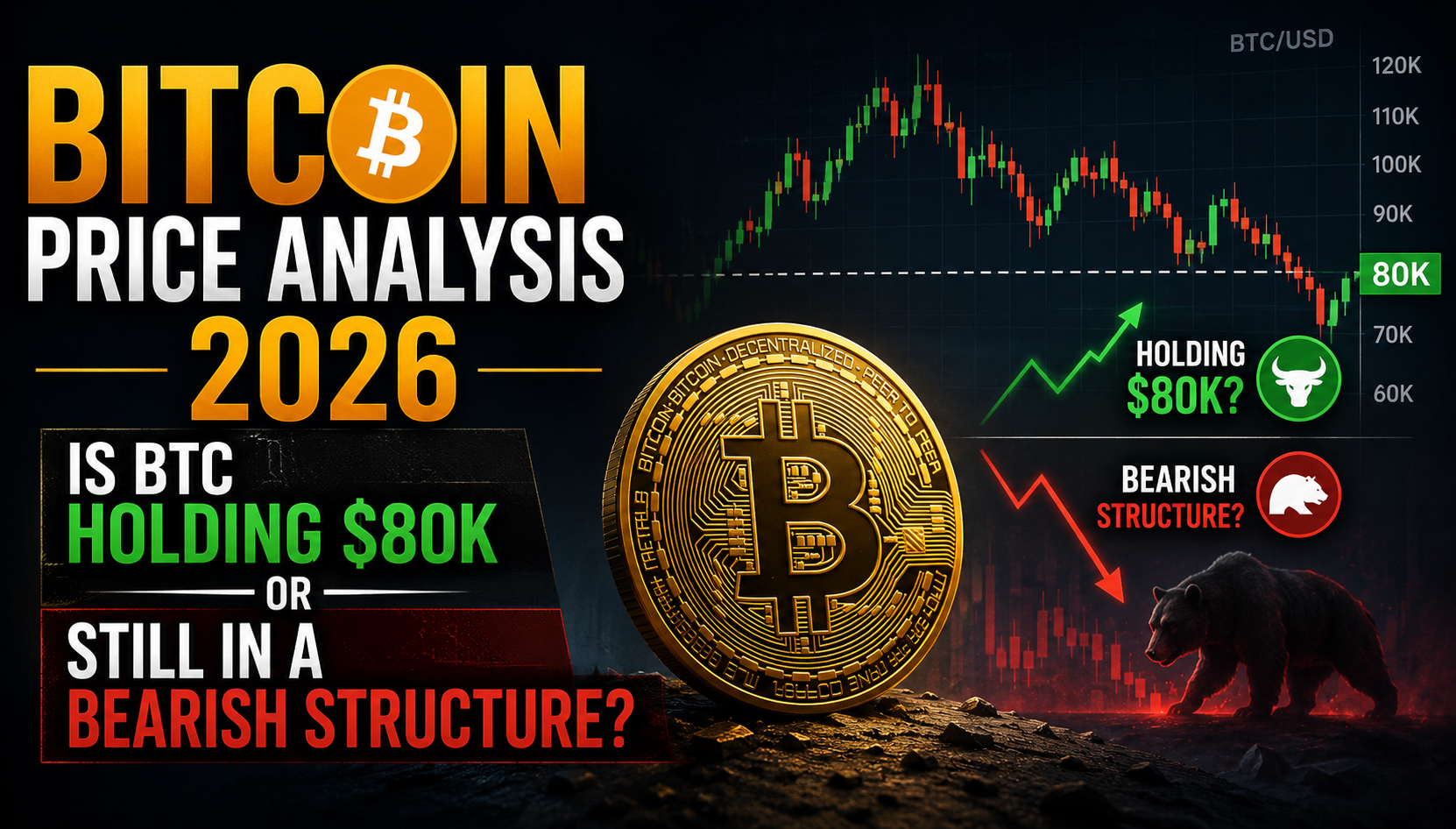
My current view on BTC
Bitcoin is sitting in one of the most important price zones of 2026.
As of May 12, 2026, BTC is trading around $80,262, with an intraday high near $82,084 and an intraday low near $80,190. That tells me one thing right away: Bitcoin is holding the $80K area, but it is not moving away from it with real strength yet.
My position right now is slightly bearish. Not because I think Bitcoin is collapsing tomorrow, but because the current structure still feels fragile. BTC has reclaimed the $80K area, but it has not convincingly turned it into a strong base.
To me, $80K is not a victory yet. It is the battlefield.
Is Bitcoin consolidating around $80K?
Yes, Bitcoin is consolidating around $80K but I would call it a fragile consolidation, not a clean bullish setup.
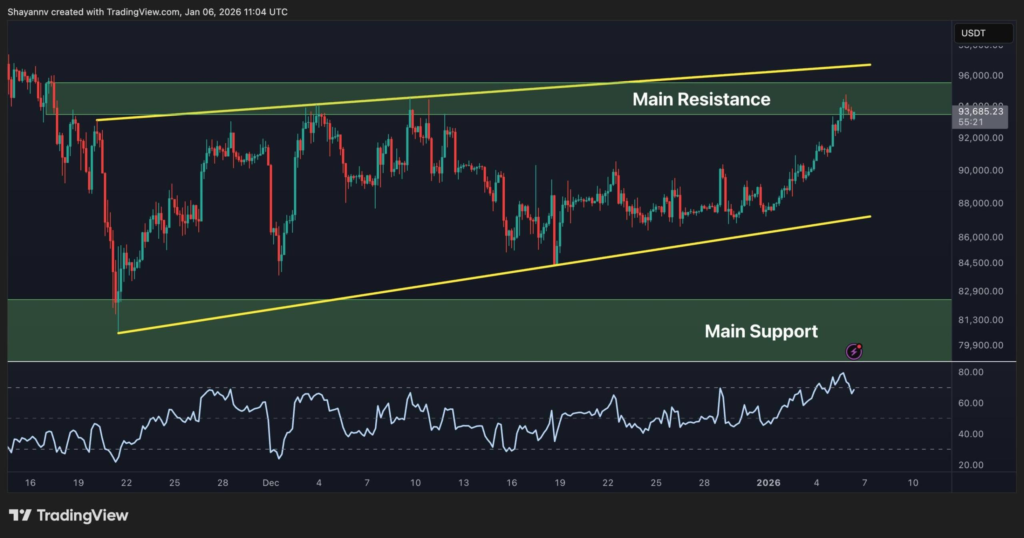
Bitcoin price structure and key macro levels in 2026.
A healthy bullish consolidation usually has three things:
- Price holds above a key level.
- Pullbacks get bought quickly.
- Price starts moving away from support with strong follow-through.
Right now, BTC has the first part, but not enough of the second and third. It is holding near $80K, but it is still struggling around the $80K–$82K zone. Recent market commentary also notes that Bitcoin’s rally has stalled around $80K–$82K as traders wait for U.S. inflation data and clearer macro signals.
That is why I would not treat this as a confirmed bullish breakout yet.
For me, the key levels are:
| BTC price zone | What it means to me |
|---|---|
| Above $90K | Bullish momentum likely returns |
| $85K–$90K | Confirmation zone for bulls |
| $82K–$85K | First major resistance area |
| $79K–$80K | Current make-or-break support |
| $75K–$76K | First downside target if $80K fails |
| $70K–$72K | Major bearish retest zone |
| Below $70K | Bearish structure becomes much stronger |
So, yes, BTC is consolidating. But personally, I do not see this as a comfortable consolidation. I see it as a market trying to decide whether $80K is real support or just a temporary pause before another leg lower.
Is BTC still in a bearish structure?
My answer: BTC is neutral-to-bearish until it proves otherwise.
The bullish side has a valid argument. Bitcoin is still above $80K, institutional demand is still relevant, and ETF flows remain one of the strongest supports for the market. Investing.com recently noted that Bitcoin has been holding above key support while institutional demand and ETF interest continue to support the broader recovery. But from my perspective, the bearish argument is still stronger in the short term.
Why? Because BTC has not shown enough separation from $80K.
If buyers were fully in control, I would expect price to break above $82K, push toward $85K, and then hold that zone as support. Instead, Bitcoin is hovering around the level, which tells me buyers are defending, but sellers are still very active.
That matters because a support level becomes more dangerous the longer price sits on top of it without bouncing strongly.
My current read is simple:
BTC above $80K is stable, but not bullish enough. BTC below $79K would start looking much more bearish.
Why the $80K level matters so much
The $80K level is important for three reasons.
First, it is a major psychological level. Traders react to round numbers, especially in crypto. $80K is not just a price; it is a market narrative.
Second, it is currently acting as a liquidity zone. A lot of traders are likely placing stops, entries, and liquidation levels around this area.
Third, the market is trying to decide whether Bitcoin is still in a larger bullish cycle or entering a deeper correction phase.
This is why I would not be too quick to call $80K a bottom. A bottom usually feels uncomfortable, but it also needs confirmation. Right now, BTC has the discomfort but not enough confirmation.
Macro news that could affect Bitcoin in 2026
Bitcoin is not moving in isolation anymore. In 2026, BTC is deeply connected to macro conditions: inflation, Federal Reserve policy, oil prices, geopolitics, ETF flows, the dollar, and overall risk appetite.
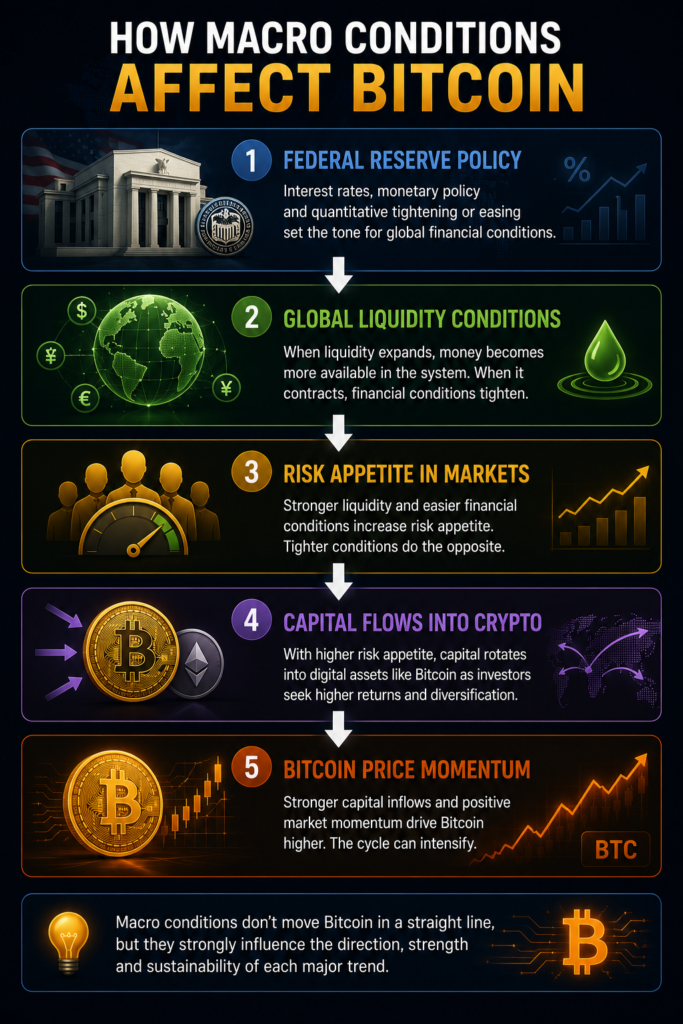
How Macro Conditions Affect Bitcoin
1. Inflation is the biggest short-term risk
The biggest macro issue right now is inflation.
U.S. inflation rose to 3.8% in April 2026, the highest level since 2023, with energy prices playing a major role. Core inflation also remained firm at 2.8%, which makes the Federal Reserve’s job harder.
This matters for Bitcoin because BTC usually performs better when liquidity is improving. If inflation stays hot, the Fed has less room to cut rates. If rate cuts get delayed, liquidity stays tighter. And when liquidity is tight, speculative assets like Bitcoin often struggle.
My take: hot inflation is bearish for BTC unless ETF demand is strong enough to offset it.
2. The Federal Reserve may stay tighter for longer
Bitcoin wants easier financial conditions. It wants lower yields, a weaker dollar, and a market that believes rate cuts are coming.
But the latest inflation data makes that harder.
CoinDesk reported that April CPI rose 0.6% month over month and 3.8% year over year, reducing hopes for near-term Fed rate cuts. That creates a problem for Bitcoin bulls. If the market starts pricing in fewer rate cuts or even the possibility of higher rates later in 2026 BTC could remain under pressure.
For me, this is one of the biggest reasons to stay cautious. Bitcoin can still rally in a tough macro environment, but it needs stronger institutional flows to do it.
3. Oil and geopolitics are indirect Bitcoin risks
Oil prices and geopolitical tension are also important.
The recent inflation spike has been linked in part to energy pressure tied to conflict with Iran and disruptions in global energy markets.
This affects Bitcoin indirectly:
Geopolitical tension → higher oil prices → higher inflation → tighter Fed → weaker risk appetite → pressure on BTC.
That chain is important. Bitcoin does not need to be directly connected to oil to be affected by oil. If energy prices push inflation higher, the Fed becomes more cautious, and risk assets can sell off.
My view: geopolitical stress is short-term bearish for BTC if it keeps inflation elevated.
4. ETF flows are the main bullish counterweight
The strongest bullish argument for Bitcoin is still ETF demand.
Bitcoin ETFs have changed the market structure. In previous cycles, Bitcoin depended heavily on retail speculation and crypto-native liquidity. Now, institutional capital can absorb dips in a way that did not exist before.
That is why I am only slightly bearish, not aggressively bearish.
Recent analysis has pointed to ETF demand as a key reason Bitcoin has been able to hold the $80K zone despite macro pressure.
If ETF inflows remain strong, Bitcoin could keep defending the $75K–$80K area. But if ETF flows weaken or turn negative while inflation and Fed pressure increase, the $80K support could break quickly.
So for me, ETF flows are the key thing to watch after price itself.
My BTC price scenarios for 2026
I would not make one fixed Bitcoin prediction for 2026. That would be too simplistic. Instead, I would frame BTC around three scenarios: bearish, base case, and bullish.
Bearish scenario: BTC falls toward $60K–$72K
This is the scenario that fits my current cautious bias if Bitcoin loses $80K.
A bearish continuation becomes more likely if:
- BTC breaks below $79K–$80K.
- Price fails to reclaim $80K quickly.
- Inflation stays hot.
- The Fed delays rate cuts.
- Treasury yields rise.
- The U.S. dollar strengthens.
- ETF inflows slow or turn into outflows.
- Geopolitical risk keeps oil prices elevated.
If that happens, I would first watch $75K–$76K. If that area fails, the next major zone for me is $70K–$72K.
Below $70K, the structure would become much more bearish, and I would start considering a deeper move toward the low $60Ks. This is not guaranteed, but it is a realistic downside path if $80K fails.
Base scenario: BTC ranges between $75K and $95K
My base case is that Bitcoin stays volatile and range-bound.
In this scenario, BTC does not collapse, but it also does not break out cleanly. ETF demand supports dips, but macro pressure limits upside.
That would create a wide range between roughly $75K and $95K. This kind of market can be frustrating because both bulls and bears get punished. Bulls buy breakouts that fail. Bears short support and get squeezed. Price keeps moving, but direction stays unclear.
Honestly, this is the scenario that feels most realistic to me right now. Bitcoin is strong enough to avoid a major breakdown, but not strong enough yet to prove a clean move toward $100K.
Bullish scenario: BTC breaks toward $100K+
The bullish case is still alive, but I need confirmation before I trust it.
For BTC to turn clearly bullish again, I would want to see:
- A strong daily/weekly close above $85K.
- $85K turning into support.
- ETF inflows staying positive.
- Inflation cooling.
- Fed language becoming more dovish.
- The dollar weakening.
- Risk assets improving broadly.
If those conditions line up, Bitcoin could move toward $100K and potentially higher in 2026.
But from where we are now, I would not front-run that scenario. I would rather wait for confirmation than assume $80K is already a confirmed bottom.
My view: above $85K, I become less bearish. Above $90K, I start respecting the bullish breakout case.
What I am watching next
For my own BTC tracking, I would focus on five things.
1. Does BTC hold $80K?
This is the first and most important question. If BTC holds $80K and starts building higher lows, the bearish case weakens.
2. Can BTC break $85K?
A move above $85K would be the first real sign that buyers are gaining control again.
3. Are ETF flows positive or negative?
ETF demand is one of the biggest structural supports for Bitcoin. If inflows stay strong, downside may be limited. If outflows accelerate, $80K becomes much weaker.
4. What does inflation do next?
Hot inflation is bad for Bitcoin because it reduces the chance of rate cuts. Softer inflation would support the bullish case.
5. How does the Fed respond?
If the Fed stays hawkish, BTC may struggle. If the Fed starts preparing the market for easier policy, Bitcoin could recover quickly.
My final take
My personal view is that Bitcoin is consolidating around $80K, but the structure still leans vulnerable.
I would not call BTC fully bearish yet, because it is still holding support and ETF demand remains a serious bullish force. But I would also not call this a clean bullish setup. Price is too close to support, inflation is too hot, and the Fed backdrop is not friendly enough.
Right now, my bias is:
- Slightly bearish below $85K
- Neutral if BTC keeps holding $80K
- More bearish below $79K
- Strongly cautious below $75K
- Constructively bullish only above $85K–$90K
For me, the key sentence is this:
Bitcoin is alive, but it is not comfortable.
The $80K level may become a strong base, but it has not earned that title yet. Until BTC pushes away from this zone with conviction, I would treat this market carefully.
This is not financial advice. It is my personal market read based on price structure, macro conditions, ETF flows, and the current Bitcoin setup.
FAQs
Is Bitcoin bullish or bearish right now?
I see Bitcoin as neutral-to-bearish while it remains below $85K. Holding $80K is positive, but BTC needs a stronger breakout before I would call the structure bullish.
Is $80K strong support for BTC?
$80K is important support, but I would not call it fully confirmed yet. If BTC keeps holding above $80K and breaks above $85K, the support becomes more credible. If BTC loses $79K, the setup becomes more bearish.
What could push Bitcoin lower in 2026?
Hot inflation, delayed Fed rate cuts, rising oil prices, geopolitical tension, ETF outflows, a stronger dollar, and weaker risk appetite could all pressure Bitcoin lower.
What could push Bitcoin higher in 2026?
Softer inflation, a more dovish Fed, strong ETF inflows, a weaker dollar, institutional accumulation, and a breakout above $85K–$90K could push Bitcoin higher.
What is the most important BTC level right now?
The most important level is $80K. If BTC holds it, the market can stabilize. If BTC loses it, I would watch $75K–$76K and then $70K–$72K.
Could Bitcoin reach $100K in 2026?
Yes, but I would need confirmation first. A move above $85K and then $90K would make the $100K scenario much more realistic. Without that breakout, I think BTC may stay range-bound or vulnerable.